
ISO 9001:2015 Certification in Nepal is a globally recognized Quality Management System (QMS) standard that helps organizations demonstrate their ability to consistently provide products and services that meet customer and regulatory requirements. In Nepal, ISO 9001:2015 certification has gained significant traction among businesses, government agencies, educational institutions, and non-governmental organizations seeking to improve their operational efficiency and market competitiveness.
What is ISO 9001:2015 Certification?
ISO 9001:2015 is the latest version of the ISO 9001 standard, published by the International Organization for Standardization (ISO). It specifies requirements for a Quality Management System (QMS) that organizations must establish, implement, maintain, and continually improve. The “2015” in the name refers to the year the current version was published, replacing the previous ISO 9001:2008 version.
ISO 9001:2015 is built on seven quality management principles:
- Customer focus
- Leadership
- Engagement of people
- Process approach
- Improvement
- Evidence-based decision making
- Relationship management
In Nepal, ISO 9001:2015 certification is applicable to any organization regardless of size, type, or industry sector. It applies to manufacturing companies, service providers, hospitals, schools, IT firms, construction companies, hotels, and even government bodies.
ISO 9001:2015 Certification in Nepal: Legal and Regulatory Framework
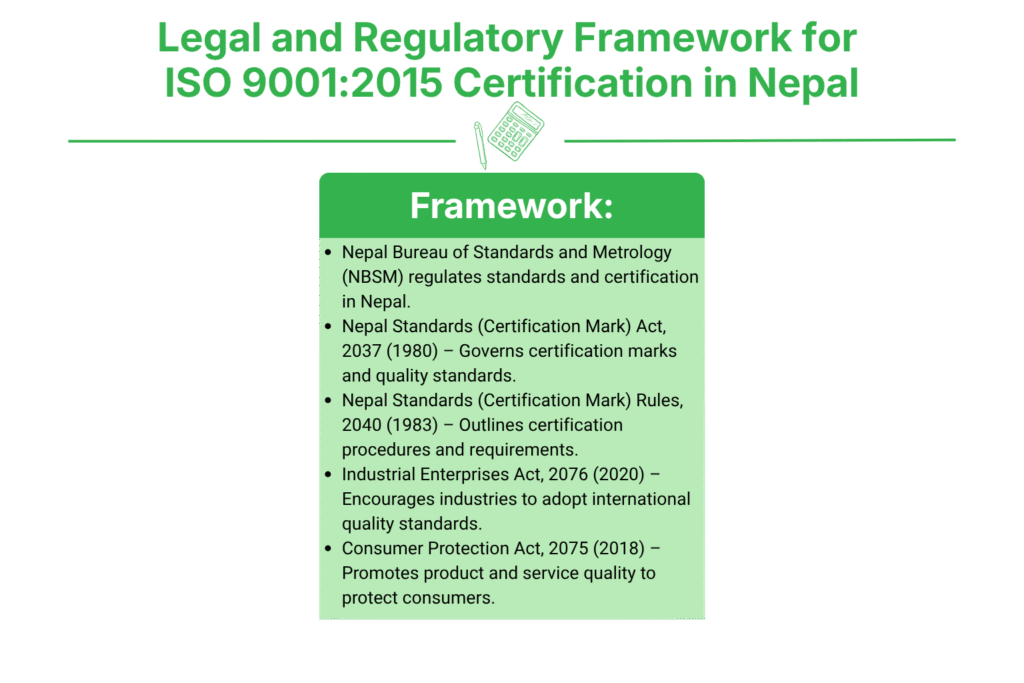
Nepal has its own regulatory infrastructure for quality standards. The primary body responsible for standards and certification in Nepal is the Nepal Bureau of Standards and Metrology (NBSM), which operates under the Ministry of Industry, Commerce and Supplies (MoICS).
The legal basis for standards in Nepal includes:
- Nepal Standards (Certification Mark) Act, 2037 (1980) – This Act governs the use of certification marks and standards in Nepal.
- Nepal Standards (Certification Mark) Rules, 2040 (1983) – These rules define procedures for obtaining certification marks.
- Industrial Enterprises Act, 2076 (2020) – This Act promotes industrial quality and encourages enterprises to adopt international standards.
- Consumer Protection Act, 2075 (2018) – This Act indirectly mandates product and service quality.
While ISO 9001:2015 itself is an international standard, its implementation and certification in Nepal are governed by accreditation bodies. The Nepal Accreditation Board (NAB) under the Government of Nepal is the body responsible for accrediting certification bodies operating in Nepal.
You can visit the official NBSM website at nbsm.gov.np and NAB at nab.gov.np for more information.
Who Issues ISO 9001:2015 Certification in Nepal?
ISO 9001:2015 certification in Nepal is issued by accredited third-party certification bodies (CBs). These certification bodies conduct audits and assessments of an organization’s QMS against the ISO 9001:2015 standard. Some certification bodies operating in Nepal include:
- Bureau Veritas Nepal
- SGS Nepal
- TÜV SÜD (operating through partner firms)
- NCELL Certification and other local bodies accredited by NAB
- International Accreditation Forum (IAF) member bodies with Nepal coverage
It is recommended to choose a certification body that is accredited by the Nepal Accreditation Board (NAB) or a recognized international accreditation body such as UKAS (United Kingdom Accreditation Service), DAkkS (Germany), or JAS-ANZ (Australia/New Zealand) to ensure global recognition of the certificate.
Who Needs ISO 9001:2015 Certification in Nepal?
ISO 9001:2015 certification in Nepal is not legally mandatory for most industries. However, it is practically required in several contexts:
- Government tenders and procurement: Many government bids and public procurement processes under the Public Procurement Act, 2063 (2007) require ISO 9001:2015 certification as a pre-qualification criterion.
- Export-oriented businesses: Companies exporting goods and services to international markets frequently need ISO 9001:2015 to satisfy foreign buyer requirements.
- Multinational partnerships: International companies require local partners to hold ISO 9001:2015 certification.
- Banking and financial institutions: Some financial institutions request ISO-certified suppliers.
- Healthcare and pharmaceutical sectors: These sectors use ISO 9001:2015 as a baseline quality framework.
ISO 9001:2015 Certification Process in Nepal
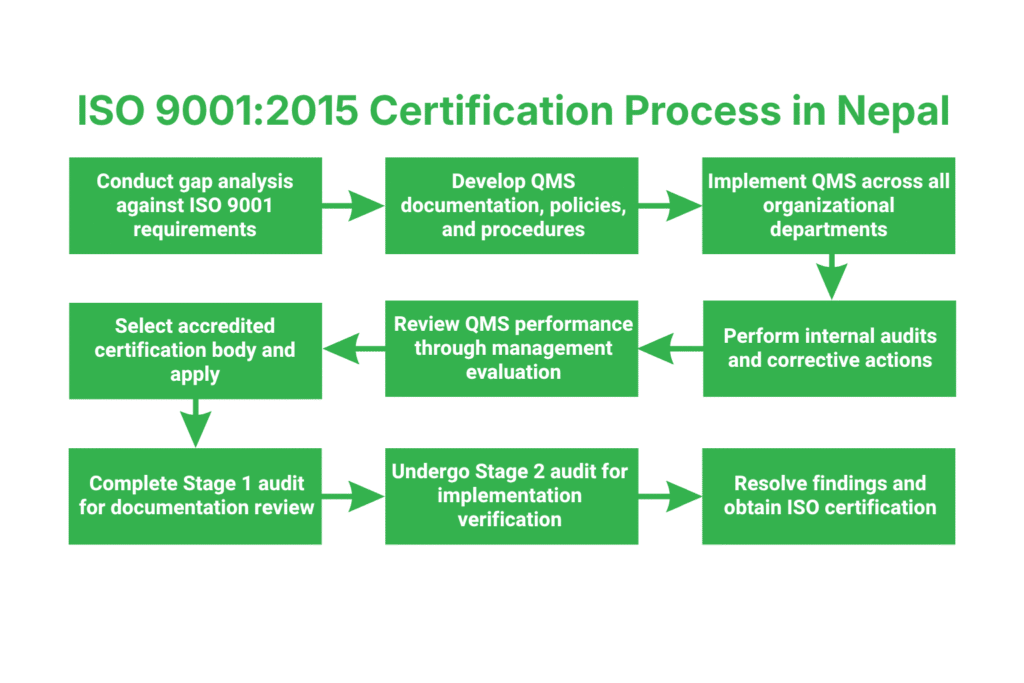
The ISO 9001:2015 certification process in Nepal follows a structured step-by-step approach. Here is the standard procedure:
Step 1: Gap Analysis
- Conduct an initial assessment of the organization’s existing QMS against ISO 9001:2015 requirements.
- Identify gaps between current practices and ISO 9001:2015 standards.
Step 2: QMS Development and Documentation
- Develop a Quality Management System tailored to your organization.
- Prepare mandatory documentation including the Quality Manual, Quality Policy, Quality Objectives, and Standard Operating Procedures (SOPs).
Step 3: QMS Implementation
- Train employees across all departments on the new QMS procedures.
- Implement the documented processes and procedures throughout the organization.
Step 4: Internal Audit
- Conduct internal audits to verify that the QMS is functioning as intended.
- Identify non-conformities and implement corrective actions.
Step 5: Management Review
- Top management reviews the QMS performance data and audit findings.
- Management takes decisions for improvement.
Step 6: Select a Certification Body
- Choose an accredited certification body in Nepal.
- Submit an application with required documents.
Step 7: Stage 1 Audit (Document Review)
- The certification body reviews your documentation and checks readiness for the Stage 2 audit.
Step 8: Stage 2 Audit (Certification Audit)
- The certification body conducts an on-site audit to verify the implementation of the QMS.
Step 9: Corrective Actions
- Address any non-conformities raised during the Stage 2 audit.
Step 10: ISO 9001:2015 Certificate Issuance
- Upon satisfactory correction of non-conformities, the certification body issues the ISO 9001:2015 certificate.
- The certificate is valid for three years with annual surveillance audits.
Documents Required for ISO 9001:2015 Certification in Nepal
The following documents are typically required during the ISO 9001:2015 certification process in Nepal:
- Company registration certificate (under Company Act, 2063 or Private Firm Registration Act, 2014)
- PAN/VAT registration certificate
- Organizational chart
- Quality Manual
- Quality Policy and Quality Objectives documents
- Documented procedures and SOPs
- Records of internal audits
- Management review meeting minutes
- Corrective and Preventive Action (CAPA) records
- Risk and opportunity assessment records
- Employee training records
- Supplier and contractor evaluation records
- Customer feedback and complaint handling records
ISO 9001:2015 Certification Cost in Nepal
The cost of ISO 9001:2015 certification in Nepal varies based on several factors including the size of the organization, the number of employees, the complexity of processes, and the certification body chosen.
| Factor | Estimated Cost (NPR) |
|---|---|
| Consultancy / Gap Analysis | NPR 50,000 – NPR 2,00,000 |
| QMS Documentation Development | NPR 30,000 – NPR 1,50,000 |
| Employee Training | NPR 20,000 – NPR 80,000 |
| Certification Body Audit Fee (Stage 1 + Stage 2) | NPR 1,00,000 – NPR 5,00,000 |
| Annual Surveillance Audit | NPR 50,000 – NPR 2,00,000 |
| Re-certification (every 3 years) | NPR 80,000 – NPR 3,00,000 |
Note: Costs are approximate and vary by certification body and organization size.
Small organizations with fewer than 20 employees may achieve certification at a lower cost, while large manufacturing or service companies may face significantly higher expenses due to the complexity and scope of their operations.
Benefits of ISO 9001:2015 Certification in Nepal
ISO 9001:2015 certification in Nepal provides both internal and external benefits to organizations:
Internal Benefits
- Improved process efficiency and reduced waste
- Clearer roles, responsibilities, and accountability
- Stronger employee engagement through defined procedures
- Better risk identification and management
- Consistent delivery of quality products and services
External Benefits
- Enhanced credibility and reputation in the market
- Eligibility for government tenders under the Public Procurement Act, 2063
- Increased customer confidence and satisfaction
- Access to international markets and foreign partnerships
- Competitive advantage over non-certified competitors
- Meets requirements set by banks and financial institutions for business loans and credit facilities
ISO 9001:2015 vs Other ISO Standards in Nepal
Many organizations in Nepal often confuse ISO 9001:2015 with other ISO standards. Here is a comparison:
| Standard | Focus Area | Common Users in Nepal |
|---|---|---|
| ISO 9001:2015 | Quality Management System | All industries |
| ISO 14001:2015 | Environmental Management System | Manufacturing, construction |
| ISO 45001:2018 | Occupational Health & Safety | Construction, factories |
| ISO 22000:2018 | Food Safety Management | Food processing companies |
| ISO 27001:2022 | Information Security Management | IT companies, banks |
| ISO 50001:2018 | Energy Management | Energy-intensive industries |
ISO 9001:2015 remains the foundation standard. Many organizations in Nepal pursue Integrated Management Systems (IMS) combining ISO 9001:2015, ISO 14001:2015, and ISO 45001:2018 simultaneously to reduce audit costs.
ISO 9001:2015 Certification Validity and Surveillance Audits in Nepal
ISO 9001:2015 certificates issued in Nepal are valid for three years. During this period, the certification body conducts annual surveillance audits (typically in Year 1 and Year 2) to verify that the organization continues to maintain and improve its QMS. In Year 3, a full re-certification audit is conducted.
If an organization fails a surveillance audit or does not maintain its QMS effectively, the certification body has the authority to suspend or withdraw the ISO 9001:2015 certificate.
Challenges of ISO 9001:2015 Certification in Nepal
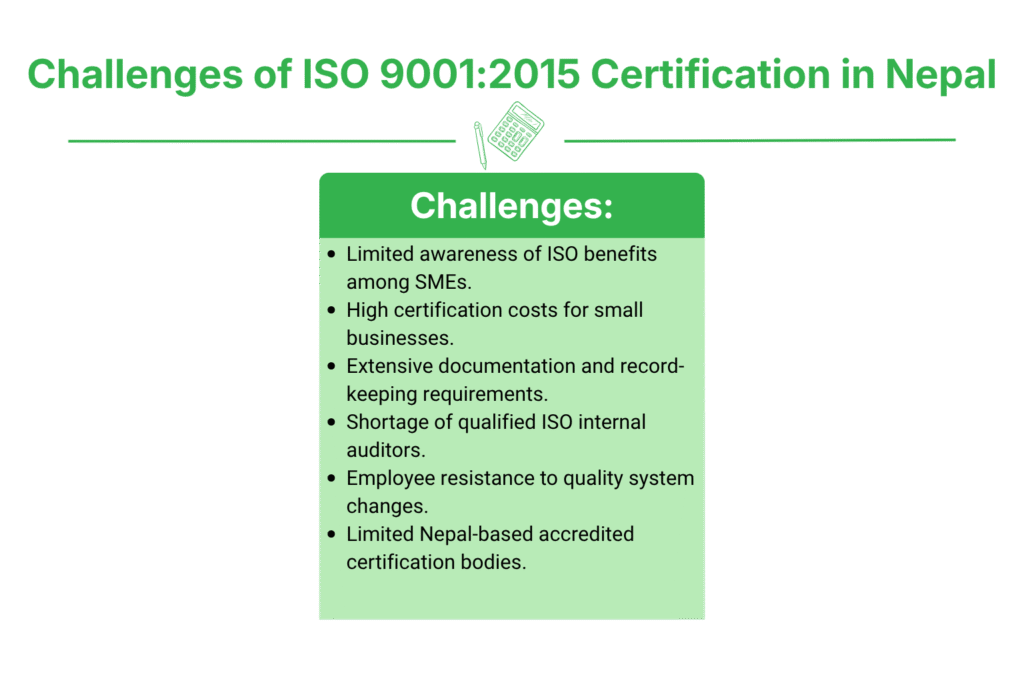
Despite its benefits, several challenges persist for organizations pursuing ISO 9001:2015 certification in Nepal:
- Limited awareness among small and medium enterprises (SMEs) about the benefits of ISO certification
- High cost relative to the financial capacity of micro and small businesses
- Documentation burden especially for organizations without dedicated quality teams
- Shortage of qualified internal auditors trained in ISO 9001:2015 requirements
- Resistance to change among employees unfamiliar with quality management systems
- Lack of accredited certification bodies with full Nepal-based operations
FAQs
1. Is ISO 9001:2015 Certification mandatory in Nepal?
ISO 9001:2015 certification is not legally mandatory in Nepal for most industries. However, it is practically required for government procurement bids, export businesses, and international partnerships under various sector-specific requirements.
2. How long does it take to get ISO 9001:2015 certified in Nepal?
The ISO 9001:2015 certification process in Nepal typically takes 3 to 6 months depending on the organization’s readiness, size, complexity of operations, and speed of implementing required documentation and processes.
3. Which body accredits ISO 9001:2015 certification bodies in Nepal?
The Nepal Accreditation Board (NAB) is the national body responsible for accrediting certification bodies in Nepal. International accreditation bodies like UKAS, DAkkS, and JAS-ANZ also accredit certification bodies operating in Nepal.
4. Can small businesses in Nepal get ISO 9001:2015 certified?
Yes, ISO 9001:2015 certification in Nepal is applicable to businesses of all sizes. Small businesses with limited employees and simpler processes can get certified with proportionally lower costs and documentation requirements.
5. What happens if an organization fails its ISO 9001:2015 surveillance audit in Nepal?
If an organization fails its surveillance audit, the certification body may issue major non-conformities. The organization must submit corrective actions within a defined timeframe, or the certificate may be suspended or withdrawn by the certification body.
6. Does ISO 9001:2015 certification help in getting government contracts in Nepal?
Yes, ISO 9001:2015 certification is frequently listed as a pre-qualification criterion in government procurement processes under Nepal’s Public Procurement Act, 2063 (2007), giving certified businesses a significant advantage in public tenders.
Conclusion
ISO 9001:2015 Certification in Nepal represents a commitment to quality, consistency, and continuous improvement. Whether you are a manufacturing company, a service provider, or a government body, implementing and obtaining ISO 9001:2015 certification enhances operational efficiency and builds customer trust. With the support of the Nepal Bureau of Standards and Metrology (NBSM) and the Nepal Accreditation Board (NAB), the framework for quality certification in Nepal is well-established. Organizations should select accredited certification bodies and follow the structured certification process to ensure globally recognized certification that adds real value to their business.
For further information, visit NBSM Nepal or Nepal Accreditation Board.
- All ISO Certification Standards in Nepal
- ISO 22000:2018 Certification Process in Nepal
- ISO/IEC 27001:2022 Certification Process in Nepal
- ISO 45001:2018 Certification Process in Nepal
- ISO 14001:2015 Certification Process in Nepal
- ISO 9001:2015 Certification in Nepal
- Registration of LLC (Limited Liability Company) in Nepal