
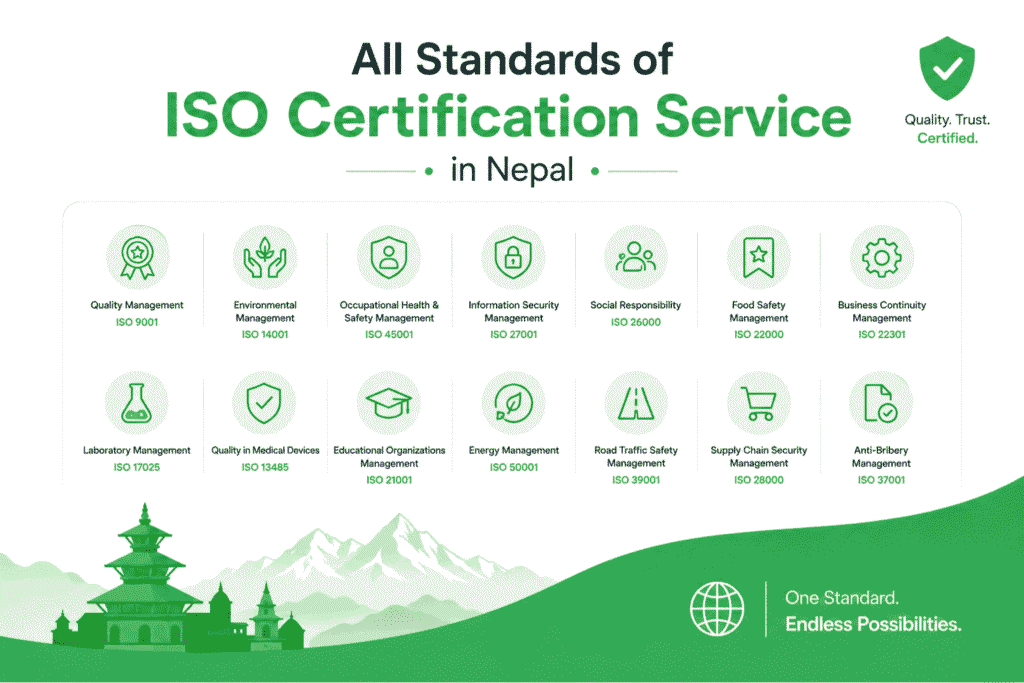
ISO Certification in Nepal has become a fundamental requirement for businesses, organizations, and government bodies that want to demonstrate quality, safety, and operational excellence. ISO Certification Service in Nepal covers a wide range of international standards applicable to various sectors including manufacturing, food, healthcare, information technology, environmental management, and more. Understanding all standards of ISO Certification in Nepal helps organizations choose the right certification that aligns with their business objectives and legal requirements.
What Is ISO Certification and Why Does It Matter in Nepal?
ISO stands for International Organization for Standardization. It is an independent, non-governmental international body that develops and publishes international standards. ISO Certification in Nepal refers to the formal recognition granted to an organization after it demonstrates compliance with a specific ISO standard.
In Nepal, ISO Certification is increasingly demanded by:
- Government procurement processes
- International trade partners
- Financial institutions offering loans and grants
- Large corporations requiring vendor compliance
- Regulatory authorities
The Nepal Bureau of Standards and Metrology (NBSM), established under the Nepal Bureau of Standards and Metrology Act, 2037 (1980), is the primary government body responsible for developing and promoting standards in Nepal. However, ISO Certification in Nepal is issued by both national and internationally accredited third-party certification bodies operating in the country.
What Are the Types of ISO Certification Standards Available in Nepal?
ISO has published over 24,000 international standards. In Nepal, the most commonly applied and recognized ISO Certification Standards fall into the following categories:
1. ISO 9001:2015, Quality Management System (QMS)
ISO 9001 is the most widely recognized and applied ISO Certification Standard in Nepal. It establishes requirements for a Quality Management System (QMS) that helps organizations consistently deliver products and services meeting customer and regulatory requirements.
Applicable to: All types of organizations regardless of size or industry.
Key Principles:
- Customer focus
- Leadership commitment
- Process approach
- Continual improvement
- Evidence-based decision making
- Relationship management
ISO 9001:2015 Certification in Nepal is mandatory for many government tenders and is widely required in construction, manufacturing, consulting, and service industries.
2. ISO 14001:2015, Environmental Management System (EMS)
ISO 14001 Certification in Nepal is designed for organizations that want to manage and reduce their environmental impact. It provides a framework for establishing an Environmental Management System (EMS).
Key Requirements:
- Environmental policy and planning
- Legal compliance with environmental regulations
- Pollution prevention mechanisms
- Waste management systems
- Lifecycle perspective on environmental impact
In Nepal, where environmental laws such as the Environment Protection Act, 2076 (2019) and Environment Protection Rules, 2077 (2020) impose strict environmental obligations, ISO 14001 helps organizations align with legal requirements.
3. ISO 45001:2018, Occupational Health and Safety Management System (OHSMS)
ISO 45001 Certification in Nepal addresses workplace safety and health. It replaced the older OHSAS 18001 standard and sets the framework for managing occupational health and safety risks.
Key Focus Areas:
- Hazard identification and risk assessment
- Worker participation and consultation
- Emergency preparedness
- Incident investigation
- Legal compliance with the Labour Act, 2074 (2017) of Nepal
Organizations in construction, manufacturing, mining, and energy sectors in Nepal particularly benefit from ISO 45001 Certification.
4. ISO 22000:2018, Food Safety Management System (FSMS)
ISO 22000 Certification in Nepal is applicable to all organizations in the food supply chain. It integrates the principles of Hazard Analysis and Critical Control Points (HACCP) with ISO’s management system approach.
Applicable to:
- Food manufacturers and processors
- Food packaging companies
- Catering and hospitality businesses
- Food transportation and storage companies
- Agricultural producers
In Nepal, ISO 22000 is particularly relevant given the Food Act, 2023 BS and the role of the Department of Food Technology and Quality Control (DFTQC) in regulating food safety. Organizations certified under ISO 22000 demonstrate a higher standard of food safety compliance.
5. ISO 27001:2022, Information Security Management System (ISMS)
ISO 27001 Certification in Nepal is designed for organizations that handle sensitive information and want to protect data from breaches, cyberattacks, and unauthorized access. It establishes an Information Security Management System (ISMS).
Key Areas Covered:
- Information security risk assessment
- Access control and cryptography
- Physical and environmental security
- Incident management
- Business continuity planning
With the passage of the Electronic Transactions Act, 2063 (2008) and increasing digitization in Nepal, ISO 27001 Certification is in high demand among IT companies, banks, telecom operators, and government digital service providers.
6. ISO 50001:2018, Energy Management System (EnMS)
ISO 50001 Certification in Nepal helps organizations improve energy performance, reduce energy costs, and minimize environmental impact through an Energy Management System (EnMS).
Benefits:
- Reduction in energy consumption
- Lower operational costs
- Compliance with energy efficiency policies
- Contribution to Nepal’s national energy goals
Given Nepal’s growing focus on hydropower and renewable energy, ISO 50001 is becoming increasingly relevant for energy-intensive industries.
7. ISO 13485:2016, Medical Devices Quality Management System
ISO 13485 Certification in Nepal is specific to organizations involved in the design, production, installation, and servicing of medical devices. It is a specialized form of quality management for the healthcare and medical equipment sector.
Applicable to:
- Medical device manufacturers
- Hospitals and healthcare facilities using specialized equipment
- Medical device importers and distributors in Nepal
8. ISO 17025:2017, Testing and Calibration Laboratories
ISO 17025 Certification in Nepal is relevant to laboratories that perform testing and calibration. It establishes competence requirements for laboratories to produce precise and accurate results.
Key Requirements:
- Laboratory management structure
- Equipment calibration and maintenance
- Method validation
- Quality assurance of testing results
NBSM and other accreditation bodies in Nepal use ISO 17025 as a benchmark for laboratory accreditation.
9. ISO 22301:2019, Business Continuity Management System (BCMS)
ISO 22301 Certification in Nepal provides a framework for organizations to build resilience against disruptions. It is an Business Continuity Management System (BCMS) standard.
Applicable scenarios in Nepal:
- Natural disasters (earthquakes, floods)
- Political disruptions
- Pandemics and health emergencies
- Supply chain failures
Given Nepal’s high vulnerability to natural disasters, ISO 22301 is increasingly adopted by financial institutions, telecommunications companies, and government agencies.
10. ISO/IEC 20000-1:2018, IT Service Management System (ITSMS)
ISO 20000-1 Certification in Nepal is the international standard for IT Service Management. It helps IT service providers deliver managed services to internal or external clients in a quality-assured manner.
Summary of Major ISO Certification Standards in Nepal
| ISO Standard | Full Name | Applicable Sector | Version |
|---|---|---|---|
| ISO 9001 | Quality Management System | All Industries | 2015 |
| ISO 14001 | Environmental Management System | All Industries | 2015 |
| ISO 45001 | Occupational Health & Safety | Manufacturing, Construction | 2018 |
| ISO 22000 | Food Safety Management System | Food & Beverage | 2018 |
| ISO 27001 | Information Security Management | IT, Banking, Telecom | 2022 |
| ISO 50001 | Energy Management System | Energy-Intensive Industries | 2018 |
| ISO 13485 | Medical Devices QMS | Healthcare | 2016 |
| ISO 17025 | Testing & Calibration Labs | Laboratories | 2017 |
| ISO 22301 | Business Continuity Management | All Critical Sectors | 2019 |
| ISO 20000-1 | IT Service Management | IT Services | 2018 |
What Is the ISO Certification Process in Nepal?
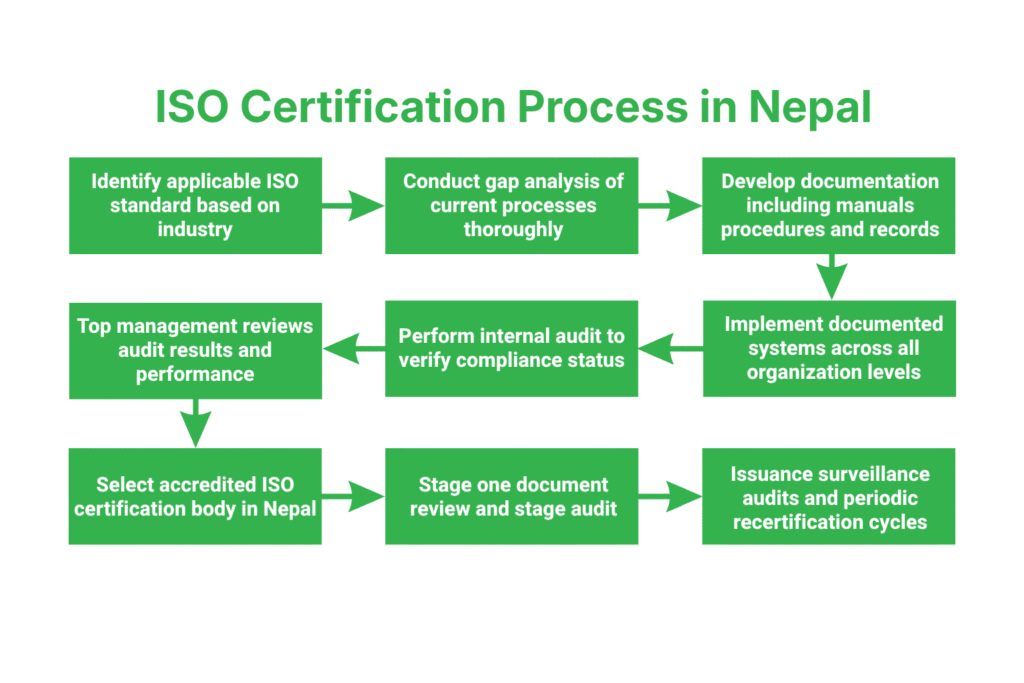
The ISO Certification process in Nepal follows a structured series of steps regardless of which standard is being pursued.
Steps for ISO Certification in Nepal:
- Identify the applicable ISO Standard based on your industry and business needs.
- Gap Analysis — Assess your current processes against ISO standard requirements.
- Documentation — Develop quality manuals, procedures, work instructions, and records.
- Implementation — Apply the documented systems across all organizational levels.
- Internal Audit — Conduct an internal audit to verify compliance.
- Management Review — Top management reviews audit results and system performance.
- Select a Certification Body — Choose an accredited ISO Certification Body operating in Nepal.
- Stage 1 Audit (Document Review) — The certifying body reviews your documentation.
- Stage 2 Audit (Main Audit) — On-site audit of actual implementation.
- Certificate Issuance — Upon successful completion, the ISO Certificate is issued.
- Surveillance Audits — Annual audits to maintain certification validity.
- Recertification — Every 3 years, a full recertification audit is conducted.
What Documents Are Required for ISO Certification in Nepal?
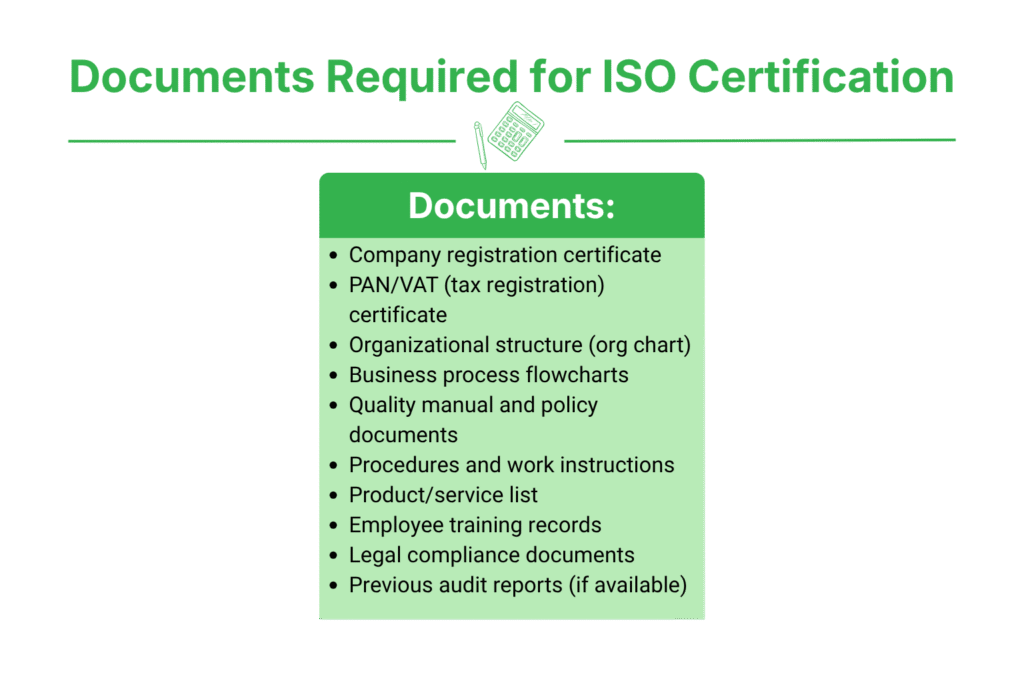
- Company registration certificate
- Tax clearance certificate (PAN/VAT registration)
- Organizational chart
- Business process flowcharts
- Quality manual and policy documents
- Procedure documents and work instructions
- Previous audit reports (if any)
- List of products, services, and processes
- Employee training records
- Legal compliance documentation
Comparison of ISO Certification Bodies Operating in Nepal
| Certification Body | Accreditation | Standards Offered | Remarks |
|---|---|---|---|
| Bureau Veritas Nepal | International | ISO 9001, 14001, 45001, 27001 | Globally recognized |
| SGS Nepal | International | ISO 9001, 22000, 45001, 14001 | Widely used in food sector |
| TÜV SÜD Nepal | International | ISO 9001, 13485, 27001 | Strong in medical and IT |
| Nepal Bureau of Standards and Metrology | National | Nepal Standards (NS) | Government body under Ministry of Industry |
| Intertek Nepal | International | ISO 9001, 22000, 17025 | Active in testing sectors |
What Is the Cost and Validity of ISO Certification in Nepal?
The cost of ISO Certification in Nepal varies based on the certification body, the standard chosen, and the size of the organization. Generally:
- Small organizations: NPR 50,000 to NPR 1,50,000
- Medium organizations: NPR 1,50,000 to NPR 4,00,000
- Large organizations: NPR 4,00,000 and above
Validity: ISO Certificates in Nepal are valid for 3 years with mandatory annual surveillance audits conducted in the 1st and 2nd year.
FAQs
1. Which ISO Certification is most common in Nepal?
ISO 9001:2015 (Quality Management System) is the most commonly obtained ISO Certification in Nepal. It applies to all industries and is frequently required for government tenders and international business partnerships.
2. Is ISO Certification mandatory in Nepal?
ISO Certification is not universally mandatory in Nepal by law. However, it is required for specific government procurement processes, sector-specific regulations, and international trade agreements.
3. Who regulates ISO Certification in Nepal?
The Nepal Bureau of Standards and Metrology (NBSM) under the Ministry of Industry, Commerce, and Supplies oversees national standards. ISO Certification is issued by accredited international and domestic certification bodies, not directly by NBSM.
4. How long does it take to get ISO Certified in Nepal?
The ISO Certification process in Nepal typically takes 3 to 6 months depending on organizational readiness, the complexity of the standard, and the time required for documentation and implementation.
5. Can a small business in Nepal get ISO Certified?
Yes. ISO Certification is available to businesses of all sizes in Nepal. ISO 9001:2015, in particular, is designed to be scalable and applicable to micro, small, and medium enterprises (MSMEs) in Nepal.
6. What is the difference between ISO Certification and Nepal Standards (NS)?
Nepal Standards (NS) are developed and issued by NBSM and are specific to Nepal’s regulatory framework. ISO Standards are international benchmarks. Both can coexist, but ISO Certification provides global recognition while NS marks are more relevant domestically.
Conclusion
ISO Certification Service in Nepal covers a comprehensive range of standards applicable to quality management, environmental compliance, food safety, occupational health, information security, energy management, and more. Organizations in Nepal pursuing ISO Certification gain competitive advantage, legal compliance, and improved operational efficiency. With certification bodies like Bureau Veritas, SGS, TUV SUD, and NBSM operating in Nepal, businesses have multiple options for obtaining internationally recognized ISO Certifications. Understanding the right ISO Standard for your sector and following the structured certification process ensures a successful and sustainable certification outcome.
For official information, visit the Nepal Bureau of Standards and Metrology (NBSM) and the International Organization for Standardization (ISO).
- All ISO Certification Standards in Nepal
- ISO 22000:2018 Certification Process in Nepal
- ISO/IEC 27001:2022 Certification Process in Nepal
- ISO 45001:2018 Certification Process in Nepal
- ISO 14001:2015 Certification Process in Nepal
- ISO 9001:2015 Certification in Nepal
- Registration of LLC (Limited Liability Company) in Nepal