
ISO 45001:2018 Certification process in Nepal is the internationally recognized standard for Occupational Health and Safety Management Systems (OHSMS). Organizations in Nepal across various sectors pursue ISO 45001:2018 certification to demonstrate their commitment to worker safety, legal compliance, and systematic management of workplace hazards. The ISO 45001:2018 certification process in Nepal follows a structured pathway that requires preparation, documentation, auditing, and ongoing surveillance.
What is ISO 45001:2018?
ISO 45001:2018 is an international standard published by the International Organization for Standardization (ISO) in March 2018. It replaced the earlier OHSAS 18001:2007 standard and introduced a more comprehensive, risk-based approach to occupational health and safety management.
The standard uses the High-Level Structure (HLS), also known as Annex SL, which makes it compatible and integrable with other ISO management system standards such as ISO 9001:2015 (Quality Management) and ISO 14001:2015 (Environmental Management).
Core purpose of ISO 45001:2018:
- Prevention of work-related injury and illness
- Provision of safe and healthy workplaces
- Continual improvement of occupational health and safety (OH&S) performance
- Fulfillment of legal and regulatory obligations
Legal and Regulatory Framework for Workplace Safety in Nepal
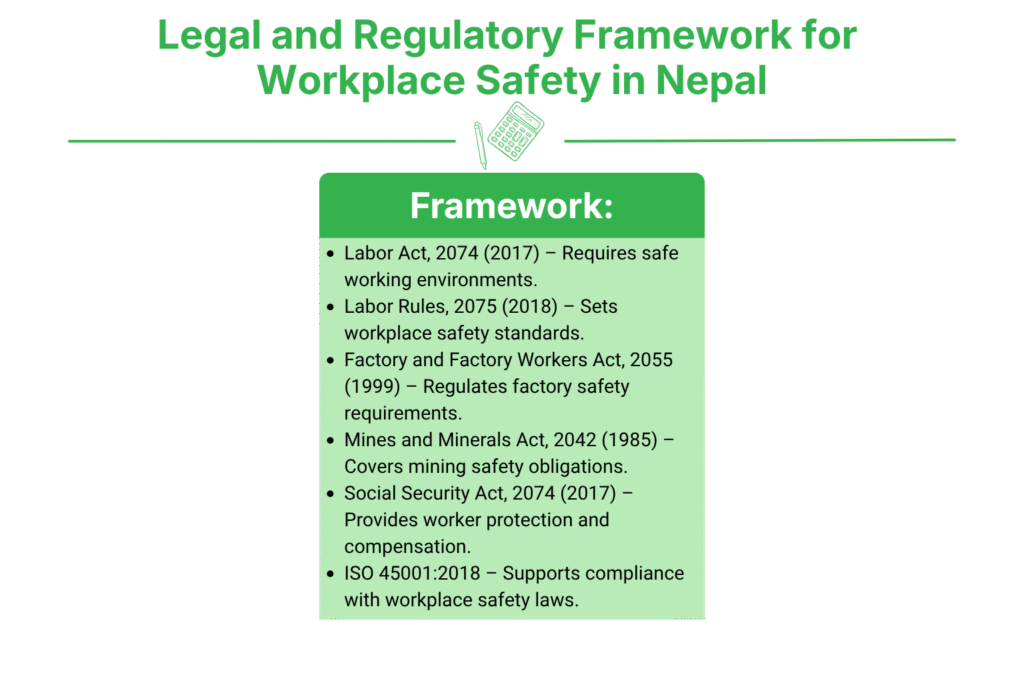
Nepal’s occupational health and safety obligations are governed by several laws and regulations. ISO 45001:2018 certification in Nepal aligns with and supports compliance with these legal instruments.
Key applicable laws in Nepal:
- Labor Act, 2074 (2017): Chapter 8 of the Labor Act, 2074 specifically addresses occupational health and safety obligations for employers. Section 47 mandates employers to provide a safe working environment.
- Labor Rules, 2075 (2018): Rule 56 to Rule 71 provides detailed provisions on workplace safety, health standards, and employer responsibilities.
- Factory and Factory Workers Act, 2055 (1999): Governs safety standards specifically in manufacturing and factory settings.
- Mines and Minerals Act, 2042 (1985): Covers safety requirements in mining operations.
- Social Security Act, 2074 (2017): Covers workers’ compensation and social protection linked to workplace injuries.
ISO 45001:2018 certification helps Nepali organizations meet and exceed these statutory requirements by institutionalizing a formal management system rather than relying on ad hoc safety measures.
Who Issues ISO 45001:2018 Certification in Nepal?
ISO itself does not issue certifications. In Nepal, ISO 45001:2018 certification is issued by accredited third-party certification bodies (CBs). These certification bodies must be accredited by a recognized national or international accreditation body.
Key accreditation and certification bodies relevant to Nepal:
- Nepal Bureau of Standards and Metrology (NBSM): The national standards body under the Ministry of Industry, Commerce and Supplies, Nepal. NBSM develops and promotes standards in Nepal. Website: www.nbsm.gov.np
- International Accreditation Forum (IAF): International body that oversees accreditation globally.
- Nepal Accreditation Board (NAB): Operates under NBSM and is responsible for accrediting conformity assessment bodies in Nepal.
Many organizations in Nepal obtain ISO 45001:2018 certification from internationally accredited certification bodies operating in Nepal or regionally, such as:
- Bureau Veritas
- SGS Nepal
- TÜV Rheinland
- DNV
- Intertek
ISO 45001:2018 Certification Process in Nepal: Step-by-Step
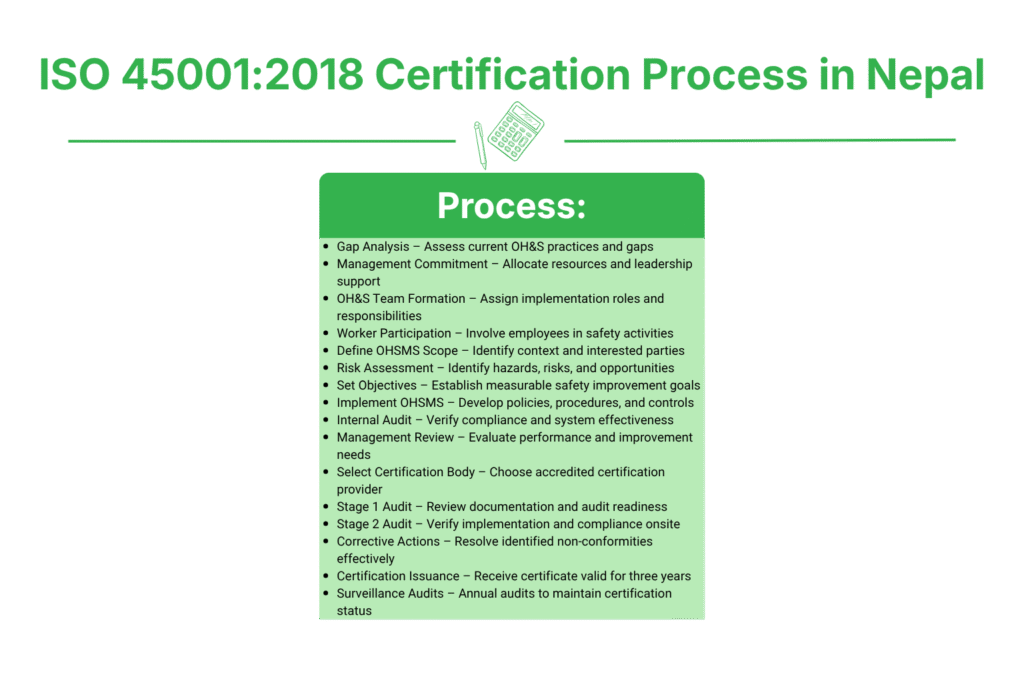
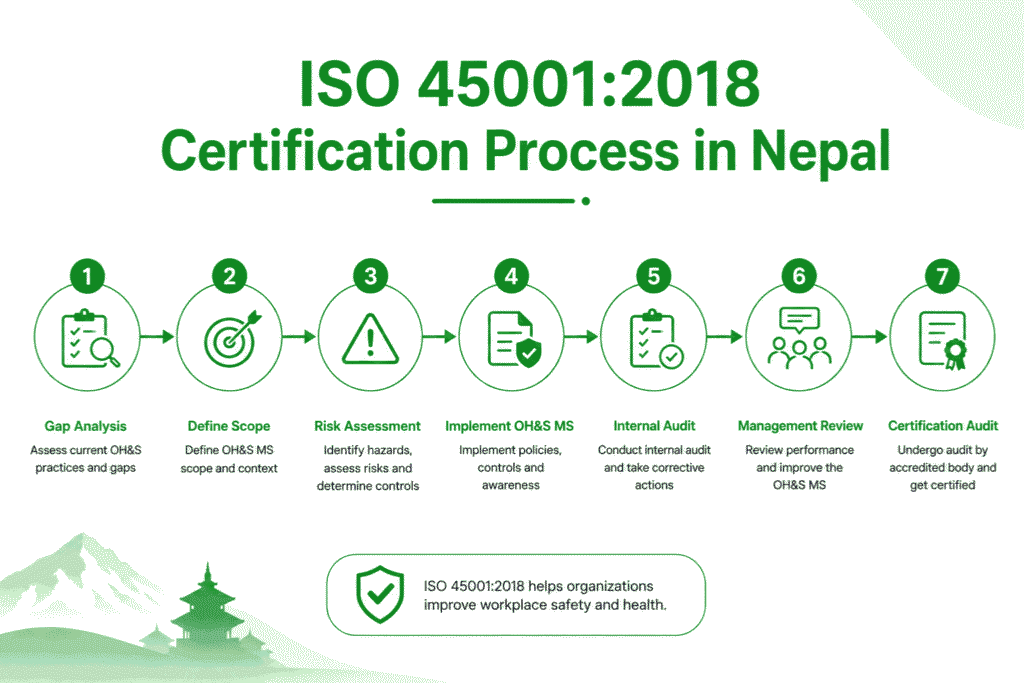
The ISO 45001:2018 certification process in Nepal follows a systematic sequence. Below is the complete step-by-step process.
Step 1: Gap Analysis
The organization conducts or commissions a gap analysis to compare its current OH&S management practices against ISO 45001:2018 requirements. This identifies areas of non-conformance and helps plan the implementation roadmap.
Step 2: Top Management Commitment and Resource Allocation
ISO 45001:2018 requires demonstrated leadership commitment (Clause 5). Top management must formally commit to the OHSMS, assign responsibilities, and allocate adequate human, financial, and technical resources.
Step 3: Formation of OH&S Team
The organization forms a dedicated team responsible for implementing ISO 45001:2018. This team includes an OH&S Manager or representative, department heads, and safety officers.
Step 4: Worker Consultation and Participation
ISO 45001:2018 places strong emphasis on worker participation (Clause 5.4). Unlike OHSAS 18001, the new standard requires that workers at all levels are actively consulted and involved in hazard identification and risk assessment.
Step 5: Context of the Organization (Clause 4)
The organization defines:
- Internal and external issues affecting OH&S outcomes
- Interested parties and their needs
- Scope of the OHSMS
Step 6: Hazard Identification, Risk Assessment, and Opportunity Assessment
This is one of the most critical technical steps. The organization:
- Identifies all workplace hazards (physical, chemical, biological, ergonomic, psychosocial)
- Assesses risks using a risk matrix or similar methodology
- Identifies opportunities to improve OH&S performance
Step 7: Development of OH&S Objectives and Planning
Based on risk assessment results, the organization sets measurable OH&S objectives aligned with its overall organizational strategy. Action plans with timelines and responsibility assignments are documented.
Step 8: Documentation and Implementation
The organization develops and implements all required documented information including:
- OH&S Policy
- Hazard Register and Risk Assessment Reports
- Legal and Other Requirements Register
- Operational Control Procedures
- Emergency Preparedness and Response Plans
- Incident Investigation Procedures
- Internal Audit Procedure
- Management Review Records
Step 9: Internal Audit
Before the external certification audit, the organization conducts internal audits to verify that the OHSMS is implemented effectively and conforms to ISO 45001:2018 requirements.
Step 10: Management Review
Top management conducts a formal management review (Clause 9.3) to evaluate the OHSMS performance, address findings, and identify improvement opportunities.
Step 11: Selection of Certification Body
The organization selects an accredited certification body. In Nepal, organizations typically choose certification bodies accredited by IAF member accreditation bodies to ensure international recognition.
Step 12: Stage 1 Audit (Document Review)
The certification body conducts the Stage 1 audit, which is primarily a documentation review. The auditors assess whether the organization’s documented OHSMS meets ISO 45001:2018 requirements and whether the organization is ready for the Stage 2 audit.
Step 13: Stage 2 Audit (Certification Audit)
The Stage 2 audit is a comprehensive on-site audit. Auditors verify:
- Implementation and effectiveness of the OHSMS
- Actual workplace practices vs. documented procedures
- Worker awareness and participation
- Conformance to all ISO 45001:2018 clauses
Step 14: Addressing Non-Conformities
If non-conformities are identified, the organization submits corrective action plans with evidence. Minor non-conformities are typically addressed before the certificate is issued.
Step 15: Certification Decision and Issuance
Upon satisfactory completion of the Stage 2 audit and resolution of non-conformities, the certification body issues the ISO 45001:2018 Certificate. The certificate is valid for three years.
Step 16: Surveillance Audits
The certification body conducts annual surveillance audits (typically Year 1 and Year 2 after certification) to ensure continued conformance. In Year 3, a recertification audit is conducted.
Documents Required for ISO 45001:2018 Certification in Nepal
- Company registration certificate (Office of the Company Registrar)
- PAN/VAT registration documents
- Organizational chart and list of employees
- Existing OH&S policy and procedures (if any)
- Hazard identification and risk assessment records
- Legal compliance register
- Training records
- Incident and accident records
- Emergency response plans
- Internal audit reports
- Management review minutes
ISO 45001:2018 Certification Cost in Nepal
The cost of ISO 45001:2018 certification in Nepal varies based on several factors.
| Factor | Description | Estimated Cost Range (NPR) |
|---|---|---|
| Consultancy Fees | For gap analysis, documentation, and training support | NPR 80,000 – NPR 3,00,000 |
| Certification Body Fees | Stage 1 + Stage 2 audit fees | NPR 1,50,000 – NPR 5,00,000 |
| Annual Surveillance Audit | Per surveillance visit | NPR 80,000 – NPR 2,00,000 |
| Internal Training | OH&S awareness and internal auditor training | NPR 30,000 – NPR 1,00,000 |
| Total Estimated Cost (First Year) | Certification year total | NPR 3,00,000 – NPR 9,00,000+ |
Costs vary significantly based on organization size, industry sector, number of sites, and chosen certification body.
ISO 45001:2018 Key Clauses and Requirements
| Clause | Title | Key Requirement |
|---|---|---|
| Clause 4 | Context of the Organization | Internal/external issues, interested parties, OHSMS scope |
| Clause 5 | Leadership | Top management commitment, OH&S policy, worker participation |
| Clause 6 | Planning | Hazard identification, risk assessment, legal requirements, objectives |
| Clause 7 | Support | Resources, competence, awareness, communication, documented information |
| Clause 8 | Operation | Operational planning and control, emergency preparedness |
| Clause 9 | Performance Evaluation | Monitoring, internal audit, management review |
| Clause 10 | Improvement | Incident investigation, non-conformity, continual improvement |
Benefits of ISO 45001:2018 Certification for Nepali Organizations
Organizations in Nepal that obtain ISO 45001:2018 certification experience multiple tangible and intangible benefits.
Operational Benefits:
- Systematic reduction of workplace accidents, injuries, and ill-health
- Improved hazard identification and proactive risk control
- Reduced downtime due to workplace incidents
Legal and Compliance Benefits:
- Structured compliance with Nepal’s Labor Act, 2074 and Labor Rules, 2075
- Reduced liability in case of workplace incidents
- Better preparedness for government labor inspections
Business and Commercial Benefits:
- Enhanced credibility with international clients and investors
- Access to government tenders and contracts that require ISO certification
- Improved employer brand and worker morale
Financial Benefits:
- Reduction in insurance premiums
- Reduction in costs associated with workplace accidents, medical compensation, and legal claims
Sectors in Nepal Actively Pursuing ISO 45001:2018 Certification
Several industries in Nepal are increasingly adopting ISO 45001:2018 given their high-risk operating environments:
- Construction sector: Large infrastructure projects, hydropower construction
- Manufacturing: Garment factories, cement plants, food processing units
- Energy sector: Hydropower projects and electricity transmission companies
- Mining and quarrying: Aggregate mining operations
- Healthcare: Hospitals and pharmaceutical manufacturers
- Hospitality and tourism: Large hotel chains
ISO 45001:2018 vs OHSAS 18001:2007: Key Differences
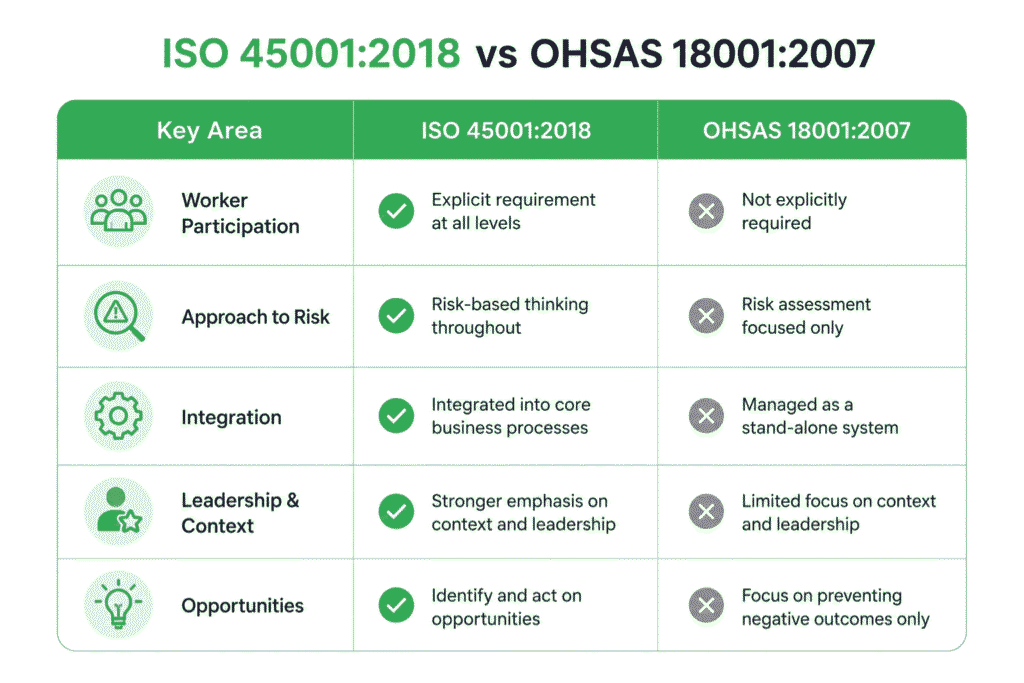
Organizations that previously held OHSAS 18001 certification in Nepal transitioned to ISO 45001:2018 before the transition deadline of March 2021.
Key improvements in ISO 45001:2018 over OHSAS 18001:
- Explicit requirement for worker participation at all levels
- Risk-based thinking applied throughout the standard
- Integration of OHSMS into core business processes
- Stronger emphasis on organizational context and leadership
- Opportunity identification alongside risk assessment
FAQs
1. What is ISO 45001:2018 certification in Nepal?
ISO 45001:2018 certification in Nepal is a formal recognition that an organization’s Occupational Health and Safety Management System meets international standards. It is issued by accredited third-party certification bodies after a systematic audit process.
2. Is ISO 45001:2018 mandatory for companies in Nepal?
ISO 45001:2018 is not legally mandatory in Nepal. However, compliance with occupational health and safety obligations under the Labor Act, 2074 is mandatory. Many government tenders and international contracts require ISO 45001 certification.
3. How long does ISO 45001:2018 certification take in Nepal?
The certification process in Nepal typically takes 3 to 12 months depending on the organization’s size, existing OH&S practices, and readiness. Smaller organizations with good existing practices may achieve certification faster.
4. How long is ISO 45001:2018 certification valid in Nepal?
ISO 45001:2018 certification is valid for three years. Annual surveillance audits are conducted in Year 1 and Year 2, and a full recertification audit is conducted in Year 3.
5. Which body issues ISO 45001:2018 certificates in Nepal?
No single national body issues ISO 45001:2018 certificates in Nepal. Accredited international certification bodies such as Bureau Veritas, SGS, TÜV Rheinland, and DNV operate in Nepal and issue certifications. NBSM (www.nbsm.gov.np) oversees national standards.
6. What is the cost of ISO 45001:2018 certification in Nepal?
The total cost ranges approximately from NPR 3,00,000 to NPR 9,00,000 in the first year, covering consultancy, audit fees, and training. Costs vary based on organization size, number of employees, and the selected certification body.
Conclusion
ISO 45001:2018 certification in Nepal represents a structured and internationally recognized approach to managing occupational health and safety risks in the workplace. The certification process requires significant commitment from top management, active worker participation, thorough hazard identification, and systematic documentation. Nepali organizations that implement ISO 45001:2018 align themselves with the Labor Act, 2074, improve workplace safety outcomes, and enhance their competitiveness in domestic and international markets. For more information on standards and accreditation in Nepal, organizations can refer to the Nepal Bureau of Standards and Metrology at www.nbsm.gov.np and the Department of Labor](http://www.dol.gov.np).Add to Conversation
- All ISO Certification Standards in Nepal
- ISO 22000:2018 Certification Process in Nepal
- ISO/IEC 27001:2022 Certification Process in Nepal
- ISO 45001:2018 Certification Process in Nepal
- ISO 14001:2015 Certification Process in Nepal
- ISO 9001:2015 Certification in Nepal
- Registration of LLC (Limited Liability Company) in Nepal