
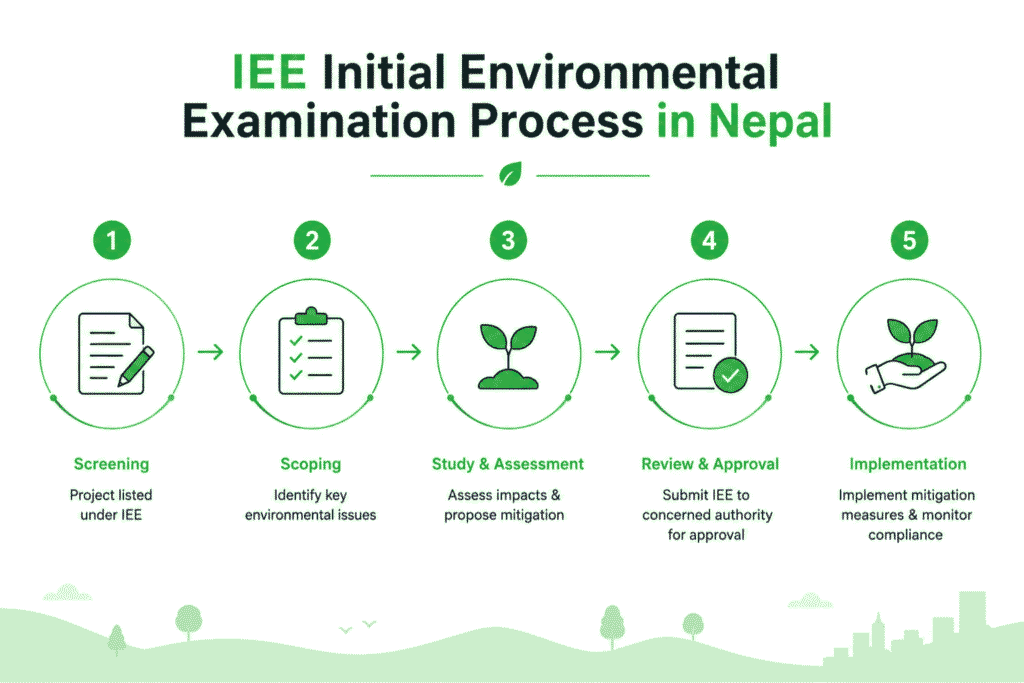
The IEE Initial Environmental Examination process in Nepal is a formal environmental assessment procedure required for development projects that fall below the threshold of a full Environmental Impact Assessment (EIA) but still carry potential environmental risks. The IEE process in Nepal is governed by the Environment Protection Act, 2076 (2019) and the Environment Protection Rules, 2077 (2020). Any project proponent planning to develop infrastructure, industry, or any project listed under Schedule 1 of the Environment Protection Rules must complete the IEE before receiving environmental clearance in Nepal.
What Is IEE Initial Environmental Examination in Nepal?
The Initial Environmental Examination (IEE) is an environmental study conducted to identify, predict, and evaluate the potential environmental impacts of a proposed project. It is less detailed than a full EIA but more structured than a basic environmental screening. The IEE report in Nepal assesses whether a proposed project will cause significant environmental harm and recommends mitigation measures accordingly.
The IEE Nepal process was introduced under the Environment Protection Act, 2053 (1997) and has been revised significantly under the Environment Protection Act, 2076 (2019). The current legal framework mandates that all projects listed under the prescribed thresholds must undergo an IEE before receiving project-specific approvals.
The Ministry of Forests and Environment (MoFE) and the Department of Environment (DoE) Nepal are the primary regulatory bodies overseeing the IEE process. Sector ministries such as the Ministry of Physical Infrastructure and Transport, Ministry of Energy, and others also play a role in approving IEE reports depending on the project type.
Legal Framework for IEE in Nepal
The IEE process in Nepal operates under the following legal instruments:
| Legal Instrument | Year | Key Provision |
|---|---|---|
| Environment Protection Act (EPA) | 2076 (2019) | Mandates IEE/EIA for prescribed projects |
| Environment Protection Rules (EPR) | 2077 (2020) | Defines thresholds, schedules, and procedures |
| National Environmental Impact Assessment Guidelines | 1993 | Provides procedural guidance for IEE/EIA |
| Sector-specific Environmental Guidelines | Various | Road, hydropower, industry-specific requirements |
Under Section 4 of the Environment Protection Act, 2076, no person or institution can implement a project or activity without conducting an IEE or EIA as prescribed. Projects listed under Schedule 1 of the Environment Protection Rules, 2077 require IEE, while those under Schedule 2 require a full EIA.
The Environment Protection Rules, 2077 also specify that project proponents must submit the IEE report to the concerned authority for review and approval before commencing any construction or operational activity.
Which Projects Require IEE in Nepal?
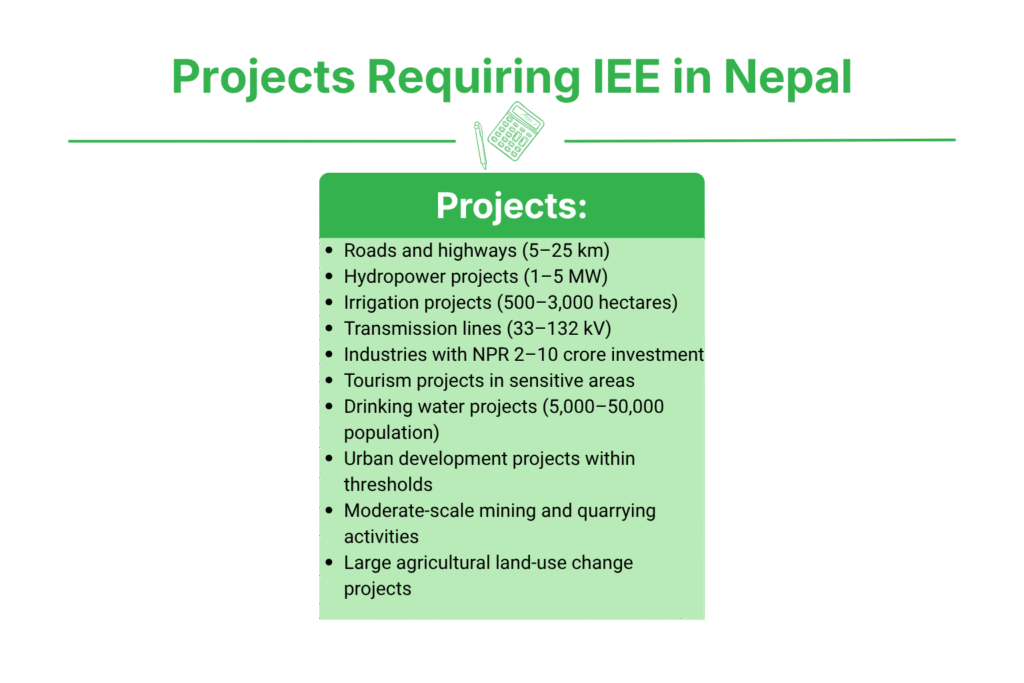
Projects that require IEE in Nepal are those that exceed a basic threshold but do not reach the scale requiring a full EIA. Based on Schedule 1 of the Environment Protection Rules, 2077, the following project categories typically require IEE:
- Roads and highways with a length between 5 km and 25 km in hilly or mountain areas
- Hydropower projects with an installed capacity between 1 MW and 5 MW
- Irrigation projects covering 500 to 3,000 hectares of land
- Transmission lines of 33 kV to 132 kV
- Industrial establishments with a capital investment between NPR 2 crore and NPR 10 crore
- Tourism infrastructure including resorts and trekking routes in sensitive areas
- Drinking water projects serving a population between 5,000 and 50,000
- Urban development projects within prescribed size thresholds
- Mining and quarrying activities of moderate scale
- Agricultural development projects with significant land use change
The Ministry of Forests and Environment Nepal publishes updated thresholds periodically, and project proponents should verify the current schedule before initiating the IEE application process.
IEE Initial Environmental Examination Process: Step-by-Step
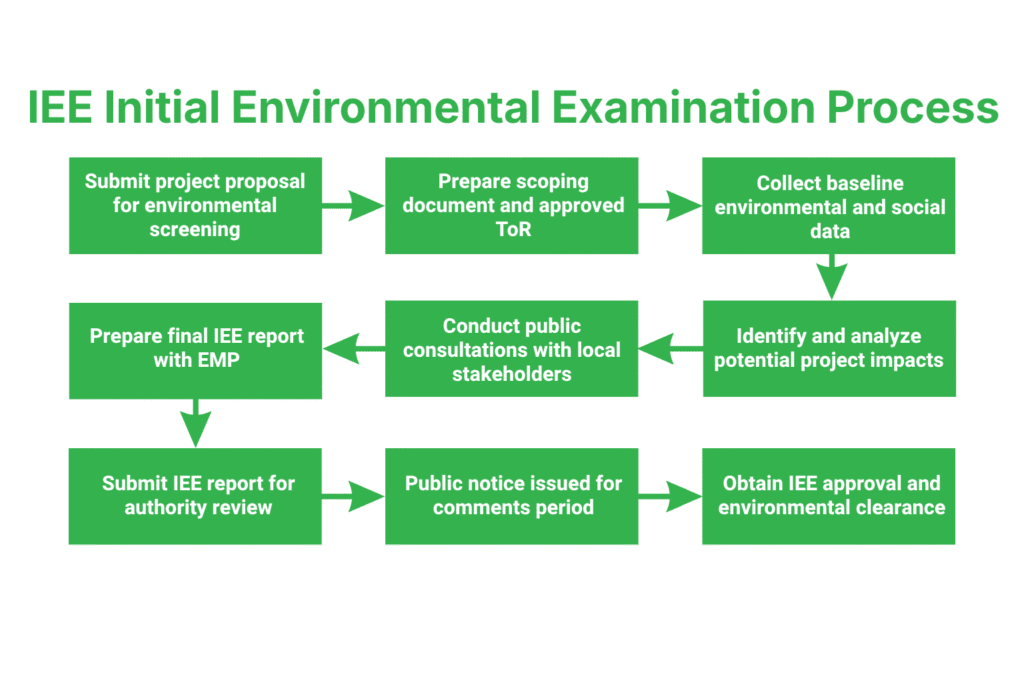
The IEE process in Nepal follows a structured sequence of steps. Below is the standard procedure as per the Environment Protection Rules, 2077:
Step 1: Project Proposal and Screening
- The project proponent identifies the nature and scale of the proposed project.
- The proponent submits a preliminary project description to the concerned authority.
- The authority conducts an environmental screening to determine whether the project requires IEE, EIA, or no formal assessment.
- The concerned body verifies the project against Schedule 1 and Schedule 2 of the Environment Protection Rules, 2077.
Step 2: Scoping
- The proponent or a licensed IEE consultant in Nepal prepares a scoping document that outlines the key environmental issues to be studied.
- The scoping process identifies the geographic area, environmental components, and social factors to be covered in the IEE report.
- The concerned authority approves the Terms of Reference (ToR) for the IEE study.
Step 3: Baseline Data Collection
- The licensed consultant collects environmental baseline data including air quality, water quality, soil conditions, biodiversity, and socio-economic conditions in the project area.
- Fieldwork, laboratory analysis, and community surveys are conducted during this phase.
- An environmental baseline study forms the foundation of the IEE report.
Step 4: Impact Prediction and Analysis
- The IEE team identifies potential environmental impacts during construction and operation phases.
- Both direct and indirect impacts are evaluated, including effects on air, water, land, vegetation, wildlife, and human health.
- The analysis follows the guidelines set under the National Environmental Impact Assessment Guidelines and sector-specific environmental guidelines.
Step 5: Public Consultation
- Public consultation is a mandatory component of the IEE process under the Environment Protection Act, 2076.
- The proponent organizes public hearings and consultation meetings in the project-affected area.
- Local communities, indigenous groups, and other stakeholders provide feedback on potential environmental and social impacts.
- A record of public consultation findings is included in the IEE report.
Step 6: Preparation of IEE Report
- The licensed IEE consultant prepares the final IEE report incorporating all baseline data, impact analysis, mitigation measures, and public consultation outcomes.
- The report includes an Environmental Management Plan (EMP) detailing specific mitigation and monitoring actions.
- The IEE report must be prepared in Nepali or in both Nepali and English as required by the authority.
Step 7: Submission and Review
- The proponent submits the IEE report to the concerned authority (sectoral ministry or Department of Environment).
- The authority reviews the report for completeness, accuracy, and compliance with legal requirements.
- The reviewing body may request additional information or revisions from the proponent.
Step 8: Public Notice and Comment Period
- The concerned authority issues a public notice inviting comments on the IEE report for a specified period.
- Objections and suggestions from the public and civil society organizations are considered during the final review.
Step 9: IEE Approval and Environmental Clearance
- After satisfactory review, the concerned authority grants IEE approval and issues an environmental clearance certificate in Nepal.
- The environmental clearance in Nepal is a prerequisite for obtaining other project-specific permits and licenses.
- The proponent must implement all conditions stipulated in the approval.
Documents Required for IEE Application in Nepal
The proponent must submit the following documents along with the IEE report:
- IEE application form as prescribed by the concerned authority
- Project description document including location maps and design drawings
- Scoping document and approved Terms of Reference
- Environmental baseline study report
- Draft IEE report prepared by a licensed environmental consultant
- Public consultation record including attendance sheets and minutes
- Environmental Management Plan (EMP)
- Land ownership or lease documents for the project area
- Proponent identification documents (company registration, PAN, etc.)
- Appointment letter of the licensed IEE consultant
- Topographic maps and site photographs
Authorities Responsible for IEE Approval in Nepal
| Project Type | Responsible Authority |
|---|---|
| Road and Bridge Projects | Ministry of Physical Infrastructure and Transport |
| Hydropower Projects | Ministry of Energy, Water Resources and Irrigation |
| Industrial Projects | Ministry of Industry, Commerce and Supplies |
| Tourism Projects | Ministry of Culture, Tourism and Civil Aviation |
| Urban Development | Ministry of Urban Development |
| General Projects | Department of Environment (DoE), Ministry of Forests and Environment |
The Department of Environment Nepal and the Ministry of Forests and Environment serve as the apex bodies for environmental oversight. Project proponents can visit these official websites for updated forms, guidelines, and schedules.
Timeline for IEE Approval in Nepal
Under the Environment Protection Rules, 2077, the concerned authority must complete the review of an IEE report within 45 days of receiving a complete application. If the authority requires additional information, the proponent must provide it within the stipulated deadline, and the review clock restarts accordingly.
In practice, the IEE approval timeline in Nepal may range from 2 to 6 months depending on the complexity of the project, quality of the submitted report, public consultation outcomes, and workload of the reviewing authority.
IEE vs EIA: Key Differences
The IEE and EIA are both environmental assessment tools, but they differ in scope and application:
- IEE applies to projects with moderate environmental impacts below the EIA threshold.
- EIA applies to large-scale projects with significant environmental impacts as listed in Schedule 2 of the Environment Protection Rules, 2077.
- The IEE process is less time-consuming and less expensive compared to a full EIA.
- Both require public consultation and submission of an Environmental Management Plan.
- EIA requires more detailed studies including socio-economic impact assessments and alternative analysis.
Environmental Management Plan (EMP) in IEE
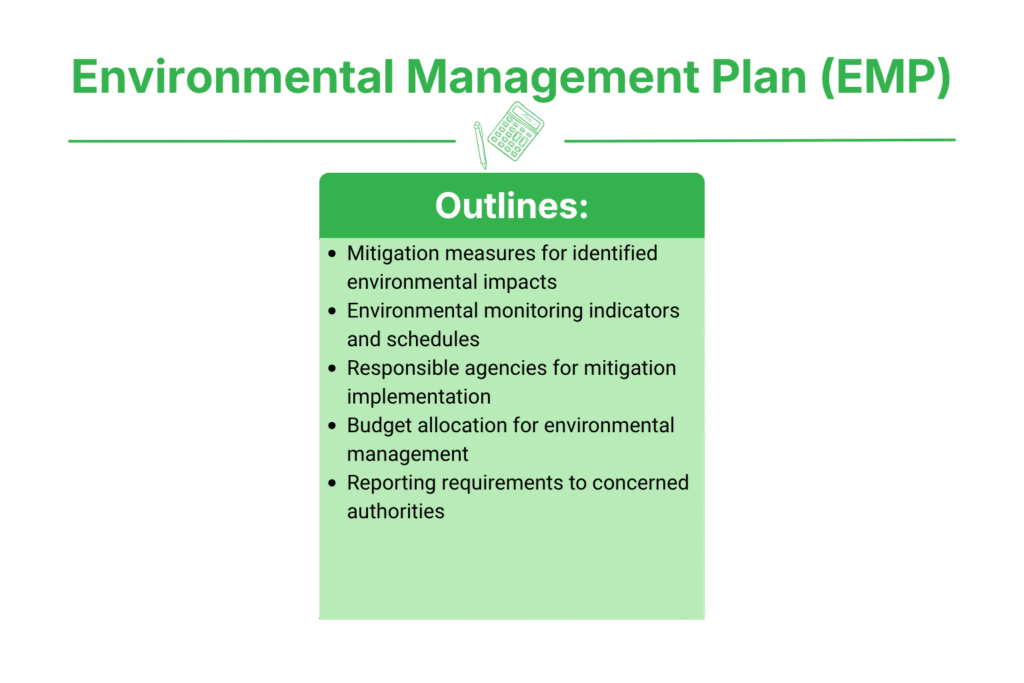
The Environmental Management Plan (EMP) is a mandatory component of the IEE report. It outlines:
- Specific mitigation measures for each identified environmental impact
- Monitoring indicators and frequency of environmental monitoring
- Responsible institutions for implementing mitigation actions
- Budget allocation for environmental management activities
- Reporting requirements to the concerned authority
The proponent must implement the EMP throughout the construction and operation phases. The Department of Environment conducts periodic environmental monitoring to verify compliance with the approved IEE conditions.
FAQs
1. What is IEE Initial Environmental Examination in Nepal?
The IEE Initial Environmental Examination is a formal environmental study required for projects listed under Schedule 1 of the Environment Protection Rules, 2077. It assesses potential environmental impacts and recommends mitigation measures before project implementation begins in Nepal.
2. Which law governs the IEE process in Nepal?
The IEE process in Nepal is governed by the Environment Protection Act, 2076 and the Environment Protection Rules, 2077. These laws define project thresholds, procedures, responsible authorities, and penalties for non-compliance with IEE requirements.
3. Who prepares the IEE report in Nepal?
A licensed environmental consultant registered with the Department of Environment (DoE) Nepal prepares the IEE report. The project proponent hires the consultant and is responsible for submitting the completed IEE report to the concerned authority for approval.
4. How long does IEE approval take in Nepal?
The Environment Protection Rules, 2077 mandate review within 45 days of complete submission. In practice, IEE approval in Nepal takes 2 to 6 months, depending on project complexity, report quality, and public consultation outcomes.
5. Is public consultation mandatory for IEE in Nepal?
Yes. Public consultation is a mandatory requirement under the Environment Protection Act, 2076. The proponent must organize public hearings in the project-affected area and incorporate stakeholder feedback into the final IEE report before submission.
6. What happens if a project starts without IEE approval in Nepal?
Under Section 4 and Section 45 of the Environment Protection Act, 2076, implementing a project without environmental clearance is a punishable offense. Penalties include project suspension, fines, and legal action against the proponent and responsible officials.
Conclusion
The IEE Initial Environmental Examination process in Nepal is a structured and legally mandated procedure designed to protect Nepal’s environment from the adverse effects of development projects. Governed by the Environment Protection Act, 2076 and the Environment Protection Rules, 2077, the IEE process ensures that project proponents assess, disclose, and mitigate potential environmental impacts before commencing any project activity. Project proponents should consult the Department of Environment Nepal and Ministry of Forests and Environment for the most current guidelines, forms, and schedules related to the IEE and environmental clearance process in Nepal.