

Hospital registration in Nepal is a mandatory legal requirement for any individual, organization, or institution that intends to establish and operate a hospital within the territory of Nepal. Hospital registration ensures that healthcare facilities meet the minimum standards set by the Government of Nepal and operate under proper legal authority. Without valid registration, operating a hospital in Nepal is considered illegal under applicable laws and regulations.
What is Hospital Registration in Nepal?
Hospital registration in Nepal refers to the formal process of obtaining legal recognition and a registration certificate from the concerned government authority to establish and operate a hospital. The registration process is regulated primarily by the Health Institution Registration and Regulation Act, 2018 (2075 B.S.) and overseen by the Department of Health Services (DoHS) under the Ministry of Health and Population (MoHP) of Nepal.
Hospital registration in Nepal applies to all types of medical facilities, including general hospitals, specialized hospitals, private hospitals, community hospitals, teaching hospitals, and nursing homes. Every hospital must register before it begins any healthcare operations.
Legal Framework Governing Hospital Registration in Nepal
The legal basis for hospital registration in Nepal is grounded in several Acts and Regulations:
- Health Institution Registration and Regulation Act, 2018 (2075 B.S.): This is the primary law governing the registration and regulation of all health institutions including hospitals in Nepal.
- Public Health Service Act, 2075 B.S. (2018): This Act establishes the framework for public health services and mandates that healthcare institutions comply with defined standards.
- Nepal Medical Council Act, 2020 B.S.: Governs the licensing and conduct of medical professionals working within registered hospitals.
- Hospital and Nursing Home Registration Act (prior legislation): Previously governed hospital registration before the 2018 Act superseded it.
- Province and Local Government Acts: Under federalism, provincial health ministries and local governments also have authority over certain categories of healthcare facilities.
Under Section 3 of the Health Institution Registration and Regulation Act, 2075, no person or organization shall establish or operate a health institution without obtaining registration from the competent authority.
Which Authority Registers Hospitals in Nepal?
The registration authority depends on the type and capacity of the hospital. Nepal follows a tiered regulatory system under its federal structure.
| Hospital Type | Registration Authority |
|---|---|
| National-level and Teaching Hospitals | Department of Health Services (DoHS), MoHP |
| Provincial Hospitals | Provincial Health Directorate |
| District and Community Hospitals | District Health Office |
| Primary Health Care Centers | Local Health Office / Municipality |
| Nursing Homes | District Health Office or Province |
The Department of Health Services (DoHS) is the primary body for hospital registration in Nepal at the federal level. You can visit the official website at www.dohs.gov.np for official guidelines and forms.
The Ministry of Health and Population Nepal official website at www.mohp.gov.np also provides relevant policies and updates on hospital registration requirements.
Types of Hospitals That Require Registration in Nepal
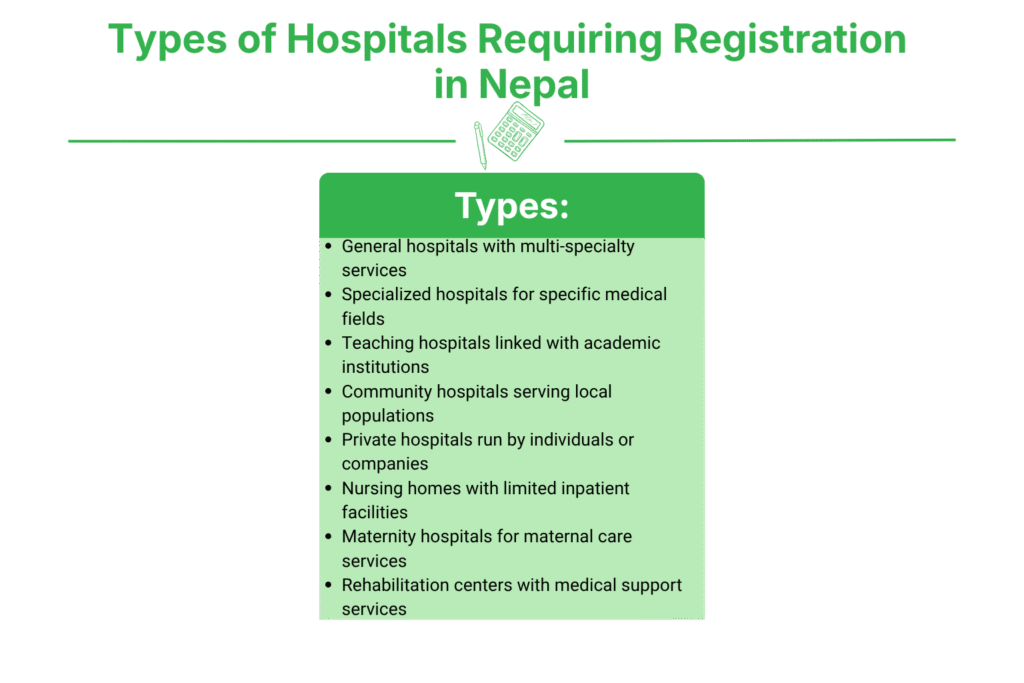
All healthcare institutions that provide inpatient or outpatient services are required to complete the hospital registration process in Nepal. The categories include:
- General Hospitals – Providing multi-specialty inpatient and outpatient services
- Specialized Hospitals – Focused on a specific medical field such as cardiology, orthopedics, or oncology
- Teaching Hospitals – Affiliated with medical or nursing colleges for training purposes
- Community Hospitals – Operated at local or community level
- Private Hospitals – Operated by private individuals or corporations
- Nursing Homes – Small-scale inpatient facilities with limited bed capacity
- Maternity Hospitals – Focused on maternal and child health services
- Rehabilitation Centers with Medical Services – For physical or psychiatric rehabilitation
Each of these institutions must meet the minimum standards as defined by the Health Institution Registration and Regulation Act, 2075 B.S. and applicable regulations.
Minimum Requirements for Hospital Registration in Nepal
Before applying for hospital registration in Nepal, the applicant must meet certain physical, human resource, and technical standards. These standards differ based on the category and bed capacity of the hospital.
Physical Infrastructure Requirements
- Sufficient land area with proper building structure approved by local authorities
- Separate wards for male and female patients
- Operation theater (OT) with standard medical equipment
- Emergency room with 24-hour services
- Pharmacy and laboratory facility
- Adequate sanitation, water supply, and ventilation
- Proper waste management system as per health and environmental standards
Human Resource Requirements
- Minimum number of qualified medical doctors (MBBS or above)
- Registered nurses as per Nepal Nursing Council guidelines
- Paramedical and support staff
- A chief medical officer responsible for clinical operations
Equipment Requirements
- Basic diagnostic equipment including X-ray, ECG, and ultrasound
- ICU setup (for hospitals above a defined bed capacity)
- Ambulance service
- Blood bank or blood storage facility (for larger hospitals)
Documents Required for Hospital Registration in Nepal
The following documents are required when applying for hospital registration in Nepal:
- Duly filled registration application form (available at DoHS or provincial health directorates)
- Company or institution registration certificate (from the Office of the Company Registrar or relevant body)
- Land ownership certificate or lease agreement for the hospital premises
- Building completion certificate from the concerned municipality or rural municipality
- Approved building plan from local government authority
- Environmental Impact Assessment (EIA) or Initial Environmental Examination (IEE) if applicable
- List of medical equipment with details
- List of medical and paramedical staff with their credentials and license copies
- Nepal Medical Council registration copies of all employed doctors
- Nepal Nursing Council registration copies of all employed nurses
- Memorandum of Association (MOA) and Articles of Association (AOA) for corporate hospitals
- Tax clearance certificate and PAN/VAT registration
- Fire safety certificate from relevant authority
- Drinking water quality certificate
- Proposed service charges/fee structure
- Waste management plan
Step-by-Step Process for Hospital Registration in Nepal
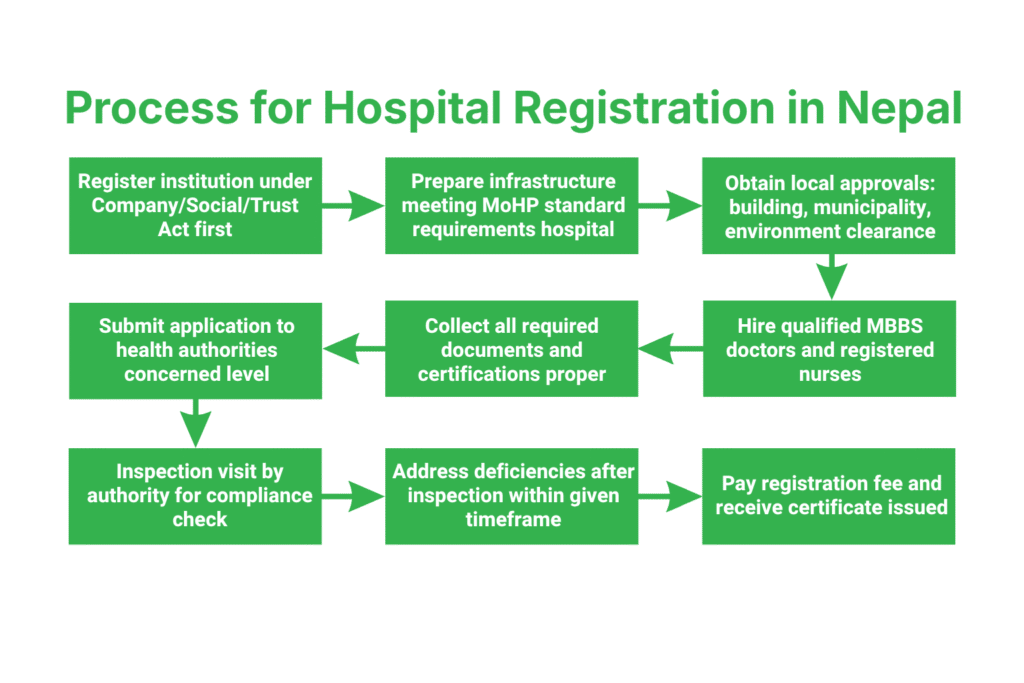
The hospital registration process in Nepal involves multiple steps and may take several weeks to complete depending on the type and scale of the institution.
- Prepare the Institutional Foundation: Register the institution under the relevant act (Company Act, Social Welfare Act, or Trust Act) before applying for hospital registration.
- Prepare the Infrastructure: Construct or lease the hospital building that meets MoHP standards for the specific hospital category.
- Obtain Local Government Approvals: Get the building approval, municipality recommendation, and environment clearance.
- Hire Qualified Staff: Recruit MBBS doctors registered with Nepal Medical Council and nurses registered with Nepal Nursing Council.
- Collect All Required Documents: Compile the full list of documents as required by the concerned registration authority.
- Submit Application: Submit the application along with all documents to the Department of Health Services (federal level) or relevant provincial/district health office.
- Inspection Visit: The registration authority conducts a physical inspection of the hospital premises to verify compliance with minimum standards.
- Address Deficiencies: If the inspection team identifies gaps, the applicant must address them within the given timeframe.
- Fee Payment: Pay the prescribed hospital registration fee as determined by the regulation.
- Issuance of Registration Certificate: After successful inspection and document verification, the authority issues the hospital registration certificate.
Hospital Registration Fee in Nepal
Hospital registration fees in Nepal vary based on the type and bed capacity of the hospital. Fees are determined under the Health Institution Registration and Regulation Act, 2075 and may be updated periodically by the government.
| Hospital Category | Bed Capacity | Approximate Registration Fee (NPR) |
|---|---|---|
| Nursing Home | Up to 15 beds | 5,000 – 10,000 |
| Small Hospital | 16 – 50 beds | 15,000 – 30,000 |
| Medium Hospital | 51 – 100 beds | 30,000 – 50,000 |
| Large / General Hospital | 101 – 200 beds | 50,000 – 75,000 |
| Teaching Hospital | 200+ beds | 75,000 – 1,50,000 |
Note: Fees are subject to revision by the Government of Nepal. Always verify current fees from the Department of Health Services.
Renewal of Hospital Registration in Nepal
Hospital registration in Nepal is not a one-time process. Under the Health Institution Registration and Regulation Act, 2075, all registered hospitals must renew their registration annually. Failure to renew the hospital registration on time can result in fines, penalties, or cancellation of the registration certificate.
Documents required for renewal include:
- Renewal application form
- Copy of previous registration certificate
- Tax clearance certificate
- Updated staff list with valid Nepal Medical Council and Nursing Council registrations
- Inspection compliance report
- Payment receipt of renewal fees
Annual renewal ensures that hospitals continue to meet the minimum standards and that any changes in staff, equipment, or infrastructure are recorded and verified.
Penalties for Operating Without Hospital Registration in Nepal
Operating a hospital without valid registration in Nepal is a criminal offense under the Health Institution Registration and Regulation Act, 2075 B.S. Violations can result in:
- Immediate closure of the hospital by the health authority
- Monetary fines as prescribed under the Act
- Imprisonment for responsible individuals in cases of repeated or serious violations
- Legal proceedings in the concerned court
The Act empowers district health offices, provincial health directorates, and the Department of Health Services to take enforcement action against unregistered healthcare facilities.
Role of Province and Local Government in Hospital Registration in Nepal
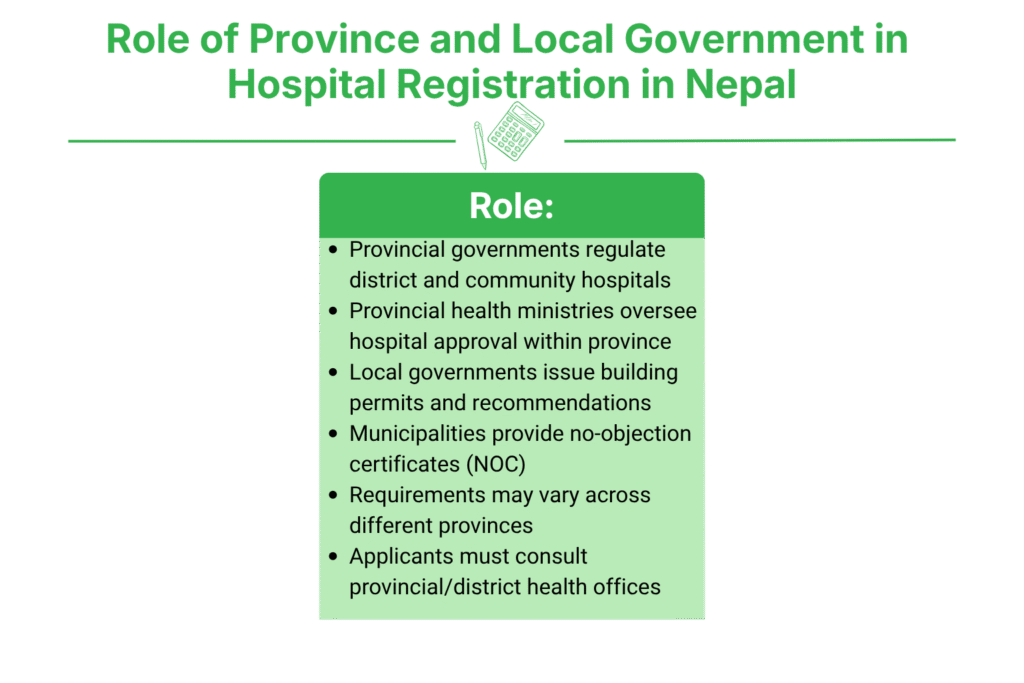
Under Nepal’s federal system, provincial governments and local bodies also play a role in hospital registration. Provincial Health Ministries regulate district-level and community hospitals within their jurisdiction. Local governments (municipalities and rural municipalities) issue preliminary recommendations, building permits, and no-objection certificates that form part of the hospital registration documentation.
This decentralized system means that the registration process may vary slightly across provinces. Applicants should contact the provincial health directorate or district health office for province-specific requirements.
FAQs
1. Who can apply for hospital registration in Nepal?
Any individual, private company, non-governmental organization, community group, or trust registered under applicable Nepali law can apply for hospital registration in Nepal, provided they meet the minimum infrastructure and human resource requirements set by the Health Institution Registration and Regulation Act, 2075.
2. How long does it take to get hospital registration in Nepal?
The hospital registration process in Nepal typically takes 30 to 90 days after submission of the complete application, depending on the type of hospital, completeness of documents, and the inspection schedule of the registration authority.
3. Is it mandatory to renew hospital registration in Nepal every year?
Yes. Hospital registration in Nepal must be renewed annually as required under the Health Institution Registration and Regulation Act, 2075 B.S. Operating with an expired registration certificate carries the same legal consequence as operating without registration.
4. Can a foreign investor register a hospital in Nepal?
Yes. A foreign investor or organization can register a hospital in Nepal subject to compliance with the Foreign Investment and Technology Transfer Act (FITTA), 2075, and obtaining approval from the Department of Industry along with registration from the health authority.
5. What is the difference between a hospital and a nursing home registration in Nepal?
A nursing home registration in Nepal is for smaller facilities with fewer than 15 beds and limited services. Hospital registration applies to larger facilities with broader service capacity. Both are registered under the same Act but at different tiers of authority.
6. Where can I get the hospital registration form in Nepal?
The hospital registration form is available at the Department of Health Services (DoHS), provincial health directorates, or district health offices. Forms are also available online at www.dohs.gov.np.
Conclusion
Hospital registration in Nepal is a legal obligation governed by the Health Institution Registration and Regulation Act, 2075 B.S. and supervised by the Department of Health Services and provincial health authorities. The registration process involves meeting physical, staffing, and equipment standards, submitting required documents, undergoing inspection, and paying the prescribed fees. Annual renewal of hospital registration maintains the hospital’s legal standing. Compliance with these regulations ensures quality healthcare delivery and legal protection for both operators and patients.