

Introduction to Institutional Lawyer in Nepal
An institutional lawyer in Nepal refers to a legally qualified advocate or legal professional who provides legal services, legal counsel, and legal representation on behalf of an institution, organization, government body, corporate entity, or non-governmental organization. Unlike private practitioners who operate independently, an institutional lawyer works within the structural framework of a specific organization and handles all legal matters pertaining to that institution.
In Nepal, the legal profession is governed primarily by the Nepal Bar Council Act, 2050 (1993) and the Advocates Act, 2028 (1972). Both pieces of legislation set the foundation for how lawyers operate, whether as private advocates or as institutional legal professionals. The growing complexity of business operations, government functions, development activities, and corporate governance in Nepal has significantly increased the demand for institutional lawyers across multiple sectors.
Institutional lawyers in Nepal serve in banks, financial institutions, government ministries, public corporations, international organizations, NGOs, INGOs, insurance companies, universities, and large private enterprises. They perform a wide range of functions from contract drafting to litigation management, compliance oversight, and legal advisory services.
What Is the Legal Framework Governing Institutional Lawyers in Nepal?
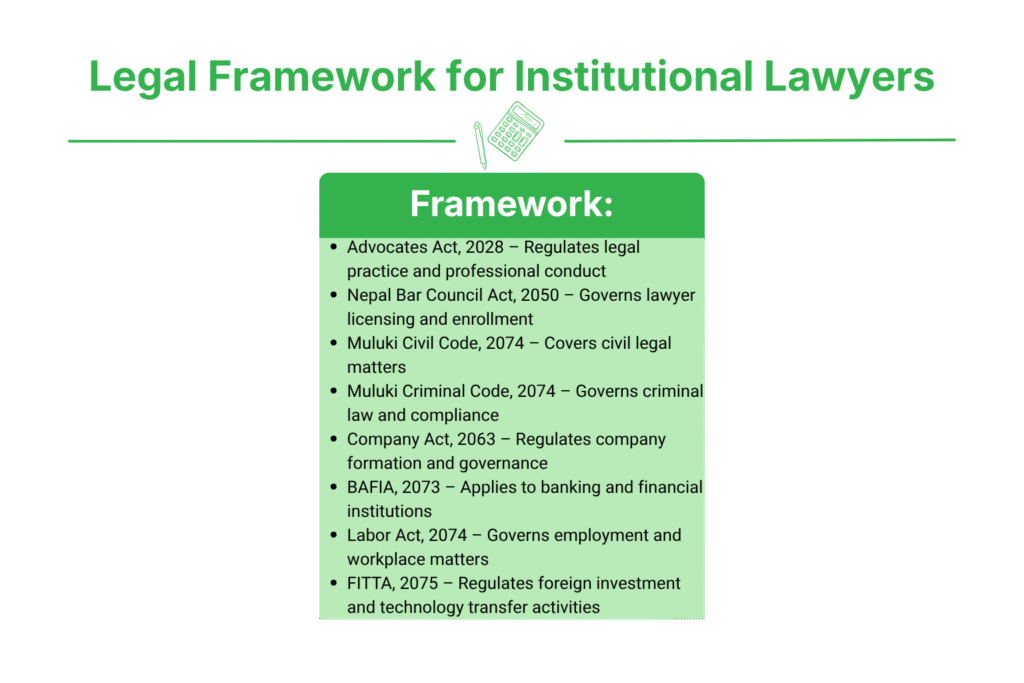
The legal profession in Nepal operates under a clearly defined statutory framework. The following laws and regulations directly affect the practice of an institutional lawyer in Nepal:
- Advocates Act, 2028 (1972): This is the primary legislation governing the conduct, eligibility, enrollment, and disciplinary proceedings of all lawyers in Nepal, including those working in institutional settings.
- Nepal Bar Council Act, 2050 (1993): This Act establishes the Nepal Bar Council, the official regulatory body responsible for licensing advocates in Nepal. All practicing lawyers, including institutional lawyers, must be enrolled with the Nepal Bar Council.
- Muluki Civil Code, 2074 (2017): This comprehensive civil code governs civil matters in Nepal, and institutional lawyers must have thorough knowledge of this code.
- Muluki Criminal Code, 2074 (2017): For institutions involved in criminal proceedings or compliance, understanding this code is essential.
- Company Act, 2063 (2006): Corporate institutional lawyers operating in Nepal must have expertise in this Act, which governs company formation, governance, and dissolution.
- Bank and Financial Institution Act (BAFIA), 2073 (2017): Institutional lawyers working in the banking sector operate under this regulatory framework.
- Labor Act, 2074 (2017): HR-related legal matters within institutions are governed by this Act.
- Foreign Investment and Technology Transfer Act (FITTA), 2075 (2019): Relevant for institutional lawyers working in foreign investment entities operating in Nepal.
The Nepal Bar Council (www.nepalbarcouncil.org.np) is the official body that oversees the licensing and ethical standards of all advocates in Nepal. Institutional lawyers must maintain their bar license and adhere to professional standards set by the Council.
Types of Institutional Lawyers in Nepal
Nepal has several distinct categories of institutional lawyers, each serving different types of organizations and carrying out different legal functions.
1. Government Institutional Lawyer (Legal Officer)
Government ministries and departments employ legal officers who function as institutional lawyers. The Attorney General’s Office of Nepal is the apex legal authority for the Government of Nepal. Legal officers appointed to various government bodies advise on policy matters, draft legislation, represent the government in courts, and handle compliance.
2. Corporate Institutional Lawyer (In-House Counsel)
Large corporations, banks, financial institutions, and insurance companies in Nepal hire in-house legal counsel. These lawyers manage corporate governance, mergers and acquisitions, contract negotiations, regulatory compliance, and litigation oversight. Banks operating under the Nepal Rastra Bank (NRB) regulatory framework commonly employ institutional legal teams.
3. International Organization Institutional Lawyer
Organizations such as the United Nations, World Bank, ADB, and other international bodies operating in Nepal employ institutional lawyers who handle diplomatic, contractual, labor, and compliance matters within the Nepali legal context.
4. NGO/INGO Institutional Lawyer
Non-governmental organizations registered under the Social Welfare Act, 2049 (1992) and affiliated with the Social Welfare Council (SWC) often employ institutional lawyers to manage compliance with government regulations, funding agreements, and labor law.
5. Academic and University Institutional Lawyer
Higher education institutions such as Tribhuvan University, Kathmandu University, and Pokhara University maintain institutional legal advisors to handle service conditions, land disputes, contractual obligations, and governance matters.
Roles and Responsibilities of an Institutional Lawyer in Nepal
An institutional lawyer in Nepal carries out a broad range of legal functions within the employing organization. These responsibilities include:
- Legal Advisory: Providing internal legal opinions on operational decisions, policy changes, and compliance requirements.
- Contract Drafting and Review: Drafting, reviewing, and negotiating contracts including service agreements, procurement contracts, employment agreements, and partnership deeds.
- Litigation Management: Coordinating with external advocates when the institution is a party to court proceedings before the District Courts, High Courts, or the Supreme Court of Nepal.
- Regulatory Compliance: Ensuring the institution complies with applicable Nepali laws and regulations issued by regulatory bodies such as Nepal Rastra Bank, Securities Board of Nepal (SEBON), Insurance Board of Nepal (Beema Samiti), and others.
- Corporate Governance: Assisting in board meetings, preparing board resolutions, and ensuring adherence to corporate governance norms under the Company Act, 2063.
- Intellectual Property: Managing trademark registrations, copyright matters, and patent filings with the Department of Industry or Intellectual Property Office of Nepal.
- Employment Law Compliance: Advising on matters related to the Labor Act, 2074, social security contributions under the Social Security Fund, and employee relations.
- Property and Land Matters: Handling land acquisition, property registration, and tenancy matters under the Land Act, 2021 (1964) and related legislation.
- Due Diligence: Conducting legal due diligence for investments, mergers, joint ventures, and acquisitions.
How to Become an Institutional Lawyer in Nepal
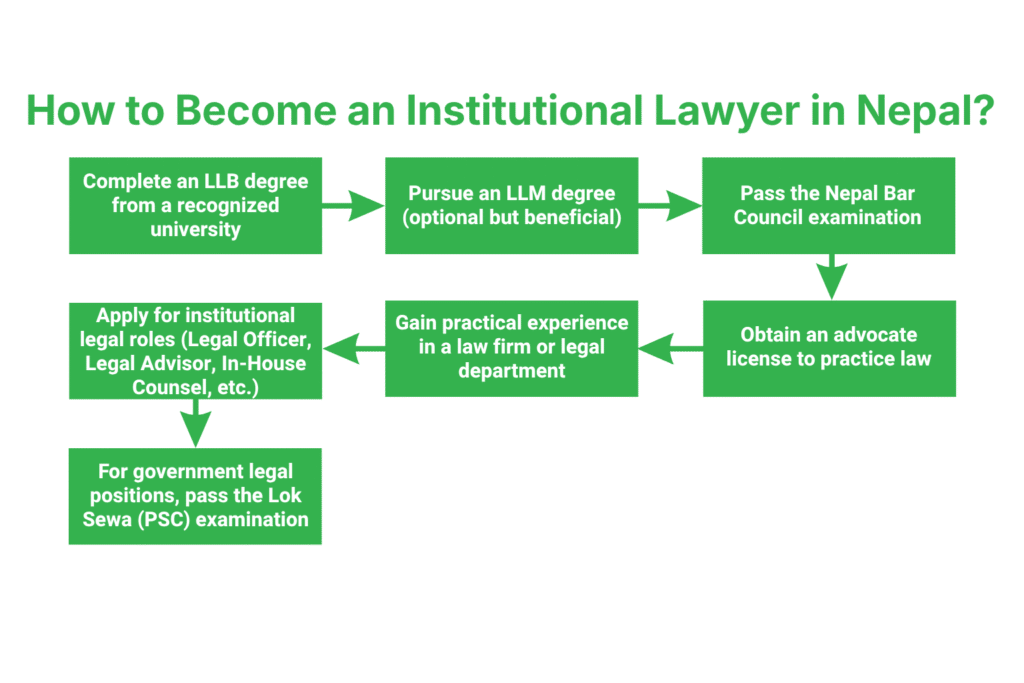
Becoming an institutional lawyer in Nepal requires completing specific educational and professional steps. The process is as follows:
- Complete a Bachelor of Laws (LLB) Degree: Candidates must obtain an LLB degree from a recognized institution. Nepal Law Campus, affiliated with Tribhuvan University, is the most prominent law school in Nepal. Other universities such as Kathmandu School of Law (KSL) also offer LLB programs.
- Complete LLM (Optional but Preferred): A Master of Laws degree enhances specialization in areas such as corporate law, international law, or human rights law.
- Enroll with the Nepal Bar Council: After completing the LLB, candidates must enroll as an advocate with the Nepal Bar Council by passing the bar examination and fulfilling eligibility requirements under the Advocates Act, 2028.
- Obtain a License: The Nepal Bar Council issues an advocate license which authorizes the individual to practice law in Nepal.
- Gain Legal Work Experience: Work as an associate or junior advocate in a law firm or legal department to gain practical experience.
- Apply for Institutional Legal Positions: Apply through open competition or institutional recruitment processes for positions such as Legal Officer, Legal Advisor, In-House Counsel, or Company Secretary.
- Government Legal Positions: For government legal officer positions, candidates must appear in the Public Service Commission (PSC) examination conducted by Lok Sewa Aayog (www.psc.gov.np).
Documents Required to Practice as an Institutional Lawyer in Nepal
- Citizenship Certificate (Nepali Citizenship)
- LLB Degree Certificate from a recognized university
- Bar Council Enrollment Certificate from Nepal Bar Council
- Advocate License Card
- Academic transcripts
- Character Certificate from the respective institution
- Experience Certificate (if required by the employer)
- Passport-sized photographs
- PAN (Permanent Account Number) registration
- No Objection Certificate from previous employer (if applicable)
Institutional Lawyer vs. Private Advocate in Nepal
| Feature | Institutional Lawyer | Private Advocate |
|---|---|---|
| Employer | Institution/Organization | Self-employed or Law Firm |
| Client | Single institution (employer) | Multiple clients |
| Income Source | Fixed salary/retainer | Client fees and retainers |
| Work Scope | Specific to institution’s legal needs | Broad range of cases |
| Court Appearance | Limited; often coordinates with external counsel | Regular court appearances |
| Regulatory Body | Nepal Bar Council | Nepal Bar Council |
| Registration Required | Yes, Advocate License | Yes, Advocate License |
| Governing Law | Advocates Act, 2028 | Advocates Act, 2028 |
Key Sectors Employing Institutional Lawyers in Nepal
| Sector | Regulatory Authority | Key Legal Area |
|---|---|---|
| Banking & Finance | Nepal Rastra Bank (NRB) | BAFIA, 2073; NRB Directives |
| Insurance | Nepal Insurance Authority | Insurance Act, 2049 |
| Capital Markets | Securities Board of Nepal (SEBON) | Securities Act, 2063 |
| Government Bodies | Ministry of Law, Justice and Parliamentary Affairs | Constitutional Law, Administrative Law |
| NGO/INGO | Social Welfare Council | Social Welfare Act, 2049 |
| Corporate/Company | Office of Company Registrar | Companies Act, 2063 |
| International Organizations | Ministry of Foreign Affairs | International Law, Treaties |
| Telecom/Technology | Nepal Telecommunications Authority | Telecom Act, 2053 |
Salary and Career Growth of Institutional Lawyers in Nepal
The salary structure for institutional lawyers in Nepal varies significantly based on the sector, organization size, and experience level. Government legal officers receive compensation as per the Civil Service Act, 2049 (1993) salary scales set by the Government of Nepal. In the private banking sector, institutional lawyers can earn competitive packages ranging from NPR 50,000 to NPR 200,000 or more per month depending on seniority. International organizations such as UNDP Nepal, World Bank Nepal, and ADB offer significantly higher remuneration packages.
Career progression typically moves from Legal Officer to Senior Legal Officer, Legal Manager, Head of Legal, General Counsel, and finally to Chief Legal Officer (CLO) or Legal Director in larger organizations.
Challenges Faced by Institutional Lawyers in Nepal
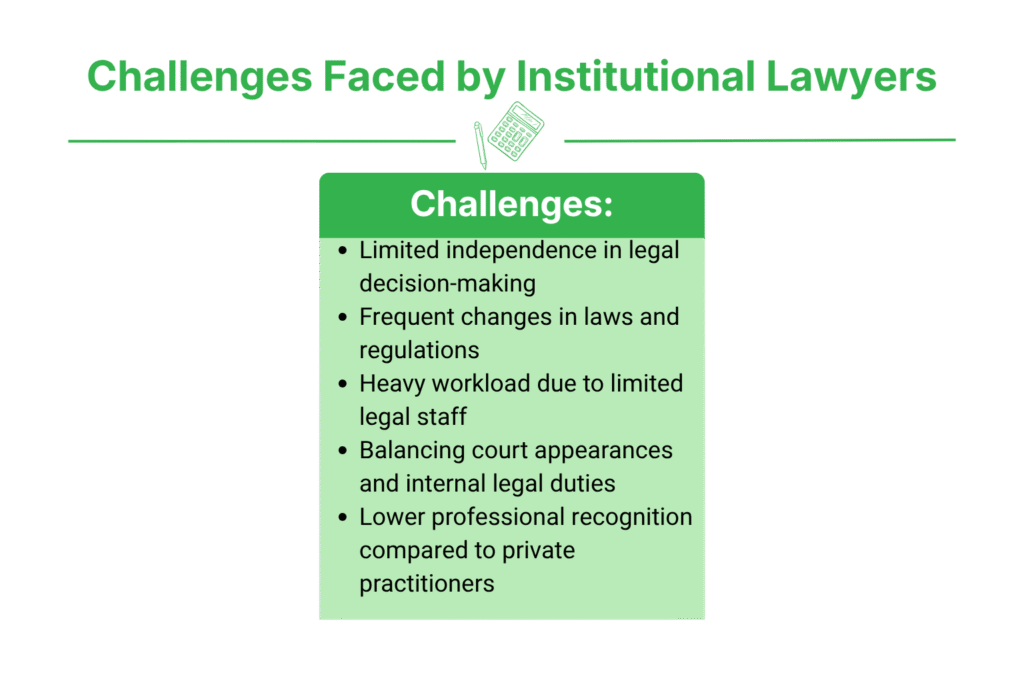
Institutional lawyers in Nepal face several professional and systemic challenges:
- Limited Independence: Institutional lawyers may face pressure from management to provide legal opinions that favor business decisions over strict legal compliance.
- Rapidly Changing Legislation: Nepal has undergone significant legislative transformation, including the enactment of the Constitution of Nepal, 2072 (2015), requiring continuous legal updating.
- Capacity Constraints: Smaller institutions may employ a single legal professional to manage all legal functions, creating workload challenges.
- Dual Role Conflict: Some institutional lawyers are also required to appear in courts while simultaneously managing internal legal affairs.
- Recognition and Professional Status: Institutional lawyers sometimes receive less professional recognition compared to senior advocates in private practice.
FAQs
1. What is the difference between an institutional lawyer and a private advocate in Nepal?
An institutional lawyer works exclusively for one organization on a salary basis, while a private advocate represents multiple clients independently. Both must hold a valid Nepal Bar Council license under the Advocates Act, 2028.
2. Is a Nepal Bar Council license mandatory for an institutional lawyer in Nepal?
Yes. Under the Advocates Act, 2028, any person practicing law in Nepal, including institutional lawyers providing legal advisory services, must be enrolled with the Nepal Bar Council and hold a valid advocate license.
3. Can a foreign lawyer work as an institutional lawyer in Nepal?
Foreign lawyers cannot directly practice law or appear before Nepali courts. However, they may work in advisory roles within international organizations operating in Nepal, subject to applicable immigration and labor laws including the Labor Act, 2074.
4. Which government body regulates the legal profession of institutional lawyers in Nepal?
The Nepal Bar Council, established under the Nepal Bar Council Act, 2050 (1993), regulates the legal profession in Nepal. The Ministry of Law, Justice and Parliamentary Affairs also oversees legislative and legal policy matters.
5. What educational qualification is required to become an institutional lawyer in Nepal?
A minimum of an LLB degree from a recognized university is required. An LLM degree is preferred for senior positions. Candidates must also pass the Nepal Bar Council examination to obtain an advocate license.
6. What laws should an institutional lawyer in Nepal specialize in?
Institutional lawyers should have knowledge of the Company Act, 2063, Labor Act, 2074, Muluki Civil Code, 2074, Contract Act, 2056, Tax Laws, sector-specific regulations, and the Constitution of Nepal, 2072, depending on the employing institution’s industry.
Conclusion
An institutional lawyer in Nepal plays a central role in maintaining the legal health of organizations across public, private, and international sectors. Governed by the Advocates Act, 2028, Nepal Bar Council Act, 2050, and a wide array of sector-specific legislation, these legal professionals ensure that institutions operate within the bounds of Nepali law. The profession requires formal legal education, bar licensing, and continuous professional development. As Nepal’s regulatory environment grows more complex, the role of institutional lawyers in corporate governance, compliance, and legal risk management becomes increasingly significant for the sustainable operation of any institution in Nepal.