


Nepal has emerged as a growing destination for technology businesses in South Asia. With a young, English-speaking workforce, improving digital infrastructure, and government initiatives to attract foreign direct investment (FDI), Nepal offers real opportunities for foreign entrepreneurs who want to establish tech companies. However, the process of tech business registration for foreigners in Nepal involves specific legal requirements, government approvals, and compliance obligations that every foreign investor must understand before proceeding.
What Is the Legal Framework Governing Foreign Tech Business Registration in Nepal?
The primary law governing foreign investment and business registration in Nepal is the Foreign Investment and Technology Transfer Act (FITTA), 2019 (2076 B.S.). This Act replaced the earlier FITTA of 1992 and introduced significant reforms to attract foreign investors. Alongside FITTA, the Companies Act, 2006 (2063 B.S.) governs the general registration of companies in Nepal.
Other relevant laws include:
- Industrial Enterprises Act, 2020 (2076 B.S.) – governs industrial and enterprise operations
- Special Economic Zone Act, 2016 (2073 B.S.) – applicable to businesses operating in SEZ areas
- Income Tax Act, 2002 (2058 B.S.) – governs corporate taxation
- Foreign Exchange Regulation Act, 2019 (2076 B.S.) – governs repatriation of profits
- Electronic Transactions Act, 2008 (2063 B.S.) – governs digital and IT-related business operations
The Department of Industry (DoI) under the Ministry of Industry, Commerce and Supplies handles registration for most foreign-invested tech companies. Larger investments above NPR 6 billion (approximately USD 45 million) are handled by the Investment Board Nepal (IBN).
What Types of Business Structures Can Foreigners Register for Tech Business in Nepal?
Foreign nationals can register a tech business in Nepal under the following structures:
1. Private Limited Company (Pvt. Ltd.)
This is the most common structure for foreign investors in Nepal. A private limited company allows foreign equity participation as per FITTA provisions. It requires a minimum of one shareholder and one director.
2. Public Limited Company
This structure suits larger tech ventures. It requires a minimum of seven shareholders and can raise public capital.
3. Branch Office
A foreign company can establish a branch office in Nepal. However, a branch office cannot independently hold assets in Nepal and requires prior approval from the Department of Industry.
4. Liaison/Representative Office
A liaison office is used for market research, promotion, and representation. It cannot engage in direct commercial activities or generate revenue in Nepal.
5. Joint Venture Company
A joint venture between a foreign investor and a Nepali partner is allowed. This is often the preferred route when foreign investors want local expertise and established market presence.
What Are the Foreign Ownership Limits for Tech Businesses in Nepal?
Under FITTA 2019, the Government of Nepal has defined sectors where foreign investment is permitted, restricted, or prohibited. The technology sector falls under the permitted category with conditions.
| Business Type | Minimum Foreign Investment | Maximum Foreign Ownership |
|---|---|---|
| IT and Software Companies | NPR 20 million (approx. USD 150,000) | Up to 100% |
| Tech Manufacturing | NPR 50 million | Up to 100% |
| E-commerce Platforms (Foreign) | NPR 50 million | Up to 51% |
| Telecom Services | As per Telecom Act | Up to 80% |
| Joint Venture (General Tech) | NPR 20 million | Up to 100% |
Note: These figures are subject to change per government notifications. Refer to Department of Industry Nepal for updated thresholds.
Foreign nationals cannot invest in sectors like cottage industries, personal service businesses (such as beauty parlors, tailoring), and businesses reserved solely for Nepali citizens. However, information technology, software development, BPO/KPO services, digital platforms, and tech consulting are open to foreign investment.
What Is the Step-by-Step Process for Tech Business Registration in Nepal for Foreigners?

The registration process for a foreign-invested tech company in Nepal follows a structured procedure. The One Stop Service Center (OSSC), established under FITTA 2019, is designed to provide all government approvals under one roof.
Step 1: Name Reservation
- Submit an application to the Office of the Company Registrar (OCR) for name approval.
- The name must not duplicate existing registered companies.
- Online name reservation is available at ocr.gov.np.
Step 2: Foreign Investment Approval
- Submit a foreign investment approval application to the Department of Industry or the Investment Board Nepal, depending on the investment size.
- Attach the business plan, proof of fund source, and identity documents.
Step 3: Company Registration at OCR
- File the Memorandum of Association (MoA) and Articles of Association (AoA) with the Office of the Company Registrar.
- Pay the applicable registration fees based on authorized capital.
Step 4: PAN/VAT Registration
- Register for a Permanent Account Number (PAN) at the Inland Revenue Department (IRD).
- If annual turnover is expected to exceed NPR 5 million, VAT registration is mandatory.
- Online PAN registration is available at ird.gov.np.
Step 5: Industry/Business Registration
- Register the tech enterprise with the Department of Industry under the Industrial Enterprises Act, 2020.
Step 6: Labor and Social Security Compliance
- Register employees with the Social Security Fund (SSF) under the SSF Nepal portal.
- Comply with the Labour Act, 2017 (2074 B.S.).
Step 7: Intellectual Property Registration (Optional but Recommended)
- Register trademarks, software copyrights, and patents with the Department of Industry under the Patent, Design and Trademark Act, 2022 (2079 B.S.).
What Documents Are Required for Tech Business Registration by Foreigners?
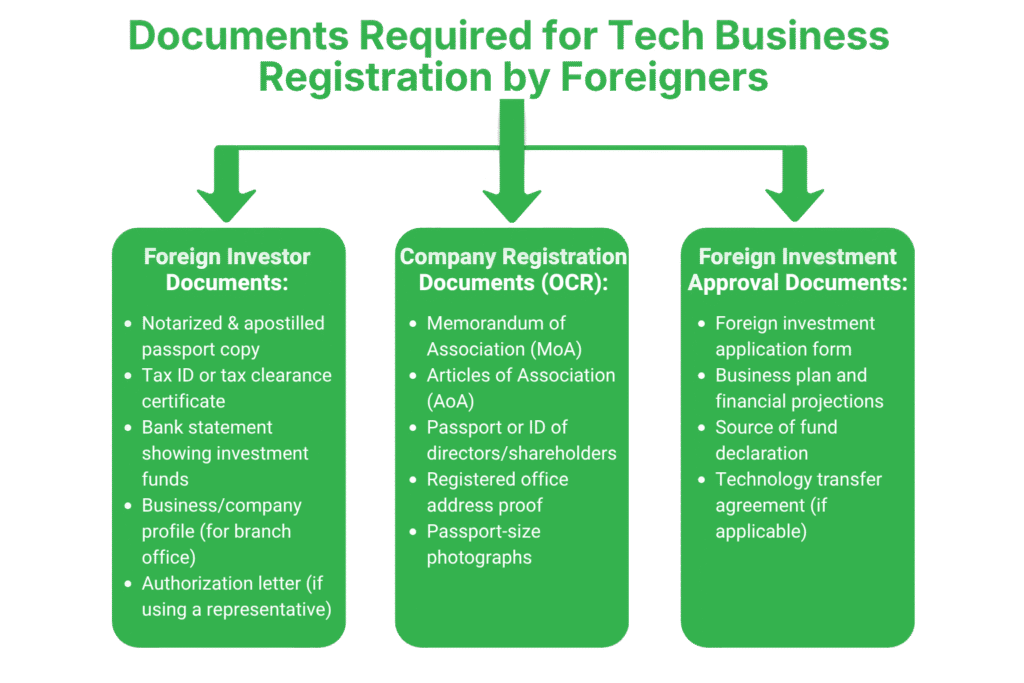
The following documents are required for foreign investors registering a tech company in Nepal:
For the Foreign Individual/Entity:
- Valid passport copy (notarized and apostilled)
- Tax identification or tax clearance certificate from the home country
- Bank statement showing fund availability (minimum investment amount)
- Business profile or company profile (if registering a branch)
- Authorization letter (if applying through a representative)
For Company Registration at OCR:
- Memorandum of Association (MoA)
- Articles of Association (AoA)
- Citizenship or passport of directors
- Registered office address proof (lease agreement or ownership document)
- Passport-size photographs of directors/shareholders
For Foreign Investment Approval (DoI):
- Duly filled foreign investment approval form
- Proposed business plan and financial projections
- Technology transfer agreement (if applicable)
- Source of fund declaration
What Are the Minimum Investment Requirements for Foreign Tech Companies in Nepal?
Under FITTA 2019 and its regulations, foreign investors must meet a minimum investment threshold. For the information technology and technology services sector, the minimum foreign investment is NPR 20 million (approximately USD 150,000).
This amount must be brought into Nepal through banking channels recognized by Nepal Rastra Bank (NRB). Cash transactions or informal remittances are not accepted as valid foreign investment. The Foreign Exchange Regulation Act, 2019 governs how foreign capital enters and exits Nepal.
For technology transfer agreements, a separate registration is required with the Department of Industry. Foreign companies that provide software, patents, or technical know-how to Nepali entities must register the agreement under FITTA.
What Are the Tax Obligations for Foreign-Invested Tech Companies in Nepal?
| Tax Type | Rate | Applicability |
|---|---|---|
| Corporate Income Tax | 25% | Standard rate for most companies |
| IT/Technology Companies (SEZ) | 0% for 10 years, then 50% concession | For SEZ-based tech companies |
| Dividend Tax (Repatriation) | 5% | On profits sent abroad |
| VAT | 13% | On goods and services above NPR 5 million threshold |
| TDS (Withholding Tax) | 15% on royalties | On technology transfer payments |
Tax incentives for tech businesses include:
- IT and software companies registered in Software Technology Parks or SEZs receive significant income tax exemptions.
- Companies that export IT services receive a 50% tax exemption on export earnings under the Income Tax Act.
- Young technology startups may qualify for startup incentives under the Industrial Enterprises Act, 2020.
Can a Foreigner Be a Director or CEO of a Tech Company in Nepal?
Yes. A foreign national can serve as a director or chief executive officer (CEO) of a registered tech company in Nepal. However, they must obtain a Business Visa and a Work Permit issued by the Department of Immigration and the Department of Labour, respectively.
A foreign director must have a valid visa that corresponds to their role. Tourist visas do not authorize business operations. The relevant visa categories include:
- Business Visa – for meetings, negotiations, and non-remunerative activities
- Non-Tourist Visa – for employment and active business management
- Work Permit – mandatory for any foreigner receiving salary from a Nepali company
The Department of Immigration Nepal provides updated guidelines on visa requirements for foreign business persons.
What Is the Role of One Stop Service Center (OSSC) in Business Registration?
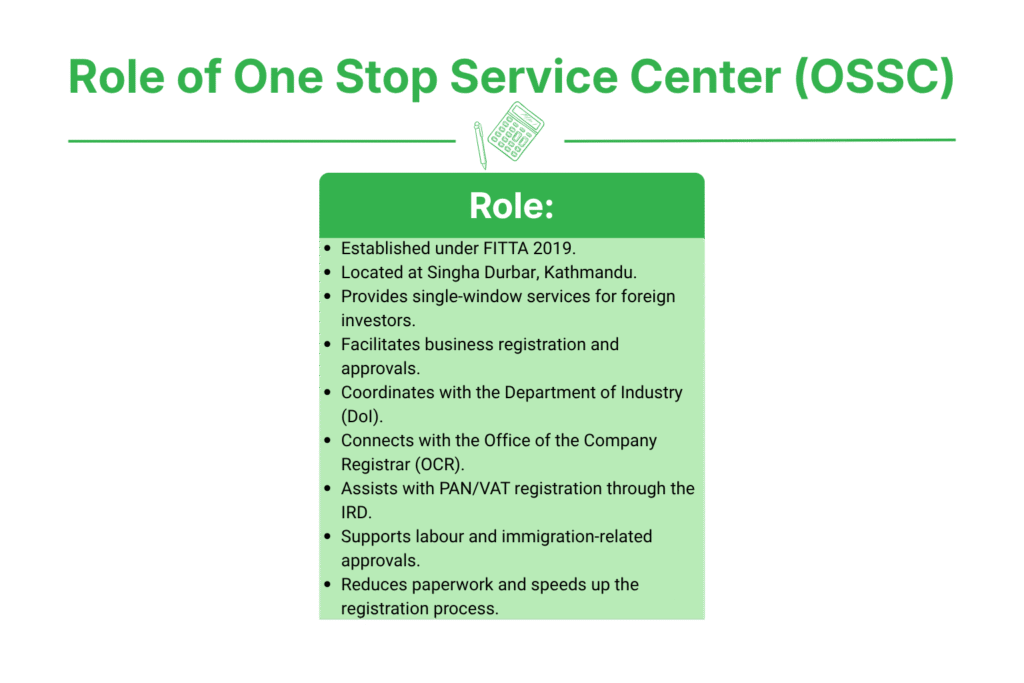
The One Stop Service Center (OSSC) was established under FITTA 2019 at Singha Durbar, Kathmandu. It brings together representatives from:
- Department of Industry
- Office of the Company Registrar
- Inland Revenue Department
- Department of Labour
- Department of Immigration
The OSSC reduces the time and complexity of registration by allowing foreign investors to complete most approvals in a single location. The government’s target processing time through OSSC is 15-30 working days for complete and compliant applications. However, actual processing times vary depending on document completeness and investment category.
FAQs
1. Can a foreign national register a 100% foreign-owned tech company in Nepal?
Yes. Under FITTA 2019, foreign nationals can register a 100% foreign-owned company in the IT and software sector in Nepal, provided the minimum investment of NPR 20 million is met.
2. What is the minimum capital required for a foreign tech company in Nepal?
The minimum foreign investment for technology companies is NPR 20 million (approximately USD 150,000), which must be transferred through formal banking channels as per Nepal Rastra Bank regulations.
3. How long does it take to register a tech company in Nepal as a foreigner?
The registration process typically takes 15 to 45 working days through the One Stop Service Center, depending on the completeness of documents and the investment size involved.
4. Is it mandatory to have a Nepali partner in a tech company?
No. FITTA 2019 allows 100% foreign ownership in IT and technology sectors. A Nepali partner is not legally required, though joint ventures are a common and often practical choice for market entry.
5. Can a foreign tech company repatriate profits from Nepal?
Yes. Under the Foreign Exchange Regulation Act, 2019 and FITTA 2019, foreign investors can repatriate dividends and profits after paying applicable taxes, including a 5% dividend withholding tax.
6. Does Nepal offer tax incentives for IT companies?
Yes. IT companies operating in Software Technology Parks or SEZs receive income tax holidays and significant concessions under the Income Tax Act, 2002 and Industrial Enterprises Act, 2020.
Conclusion
Tech business registration for foreigners in Nepal follows a defined legal process under FITTA 2019, the Companies Act 2006, and the Industrial Enterprises Act 2020. Foreign investors in the technology sector can own up to 100% of their company, benefit from tax incentives, and access Nepal’s growing IT talent pool. The One Stop Service Center simplifies registration, while government portals like doind.gov.np, ocr.gov.np, and ird.gov.np provide updated procedural information. Compliance with minimum investment thresholds, visa requirements, and tax obligations remains essential for lawful operation.