
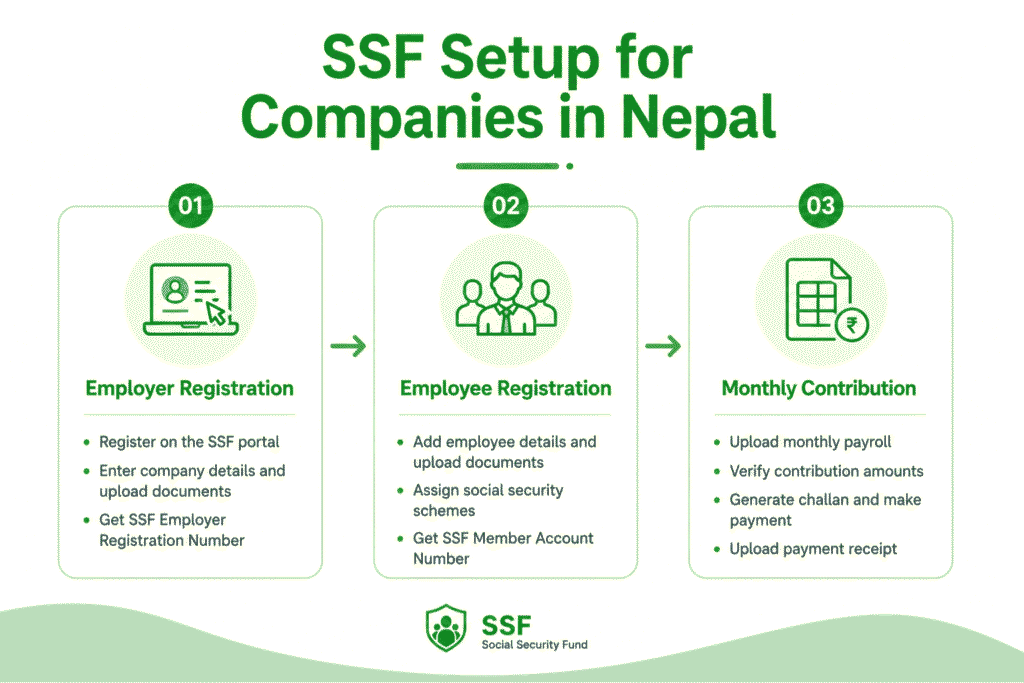
The Social Security Fund (SSF) setup for companies in Nepal is a mandatory legal requirement under the Contribution Based Social Security Act, 2074 (2017). Every company operating in Nepal that employs workers must register with the Social Security Fund, enroll its employees, and make regular monthly contributions.
This article explains everything about SSF setup, registration process, contribution rates, documents required, and compliance obligations for employers in Nepal.
What Is the Social Security Fund (SSF) in Nepal?
The Social Security Fund Nepal is a government-managed fund established under the Contribution Based Social Security Act, 2074 (2017) and governed by the Social Security Fund Regulations, 2075 (2018). The SSF operates under the Ministry of Labour, Employment and Social Security of Nepal.
The fund provides social protection to workers in Nepal through five major schemes:
- Medical Treatment, Health and Maternity Protection Scheme
- Accident and Disability Protection Scheme
- Dependent Family Protection Scheme
- Old Age Protection Scheme
- Unemployment Protection Scheme (Unemployment Allowance Scheme)
The SSF is administered by the Social Security Fund Board, and all transactions, registrations, and contributions are managed through the official portal at https://ssf.gov.np.
Which Companies Must Register with SSF in Nepal?
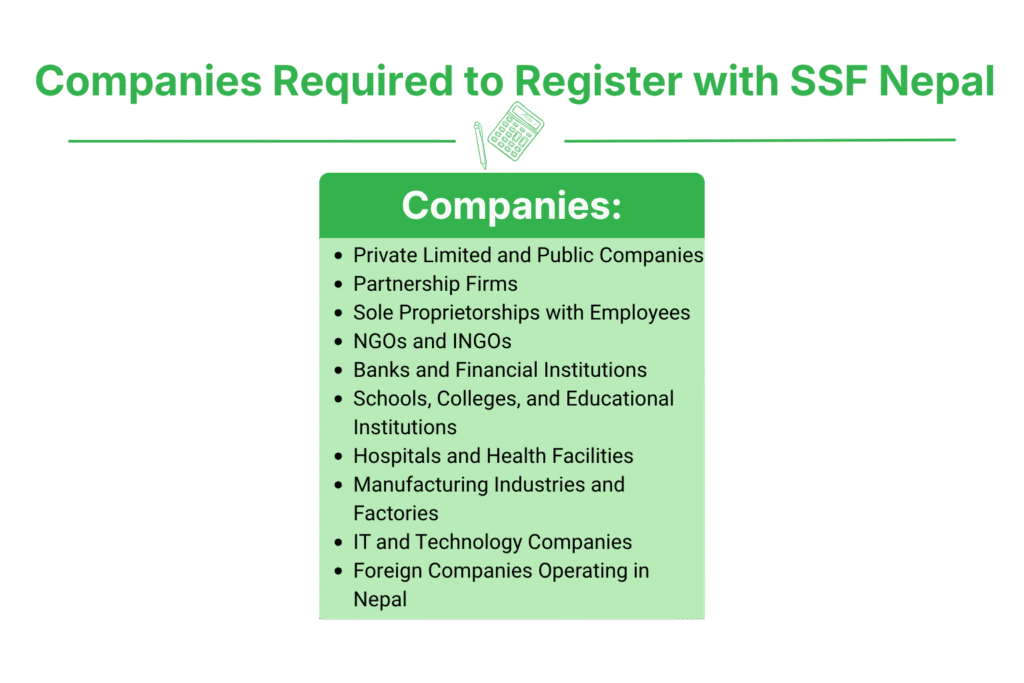
Under Section 5 of the Contribution Based Social Security Act, 2074, every enterprise or establishment that employs one or more workers is legally required to register with the Social Security Fund. This includes:
- Private companies registered under the Companies Act, 2063
- Partnership firms under the Partnership Act, 2020
- Sole proprietorships with employees
- NGOs and INGOs operating with paid staff
- Banks and financial institutions
- Schools, colleges, and educational institutions
- Hospitals and health facilities
- Manufacturing industries and factories
- IT companies and technology firms
- Foreign companies operating in Nepal
The law applies regardless of the size of the company. Even a company with a single employee must complete SSF registration and enrollment.
What Are the SSF Contribution Rates in Nepal?
The SSF contribution rate in Nepal is divided between the employer and the employee. The total monthly contribution is calculated as a percentage of the employee’s basic salary.
| Contributor | Contribution Rate | Purpose |
|---|---|---|
| Employer | 20% of Basic Salary | Social security schemes |
| Employee | 11% of Basic Salary | Social security schemes |
| Total Contribution | 31% of Basic Salary | SSF Fund |
Breakdown of Employer’s 20% Contribution:
| Scheme | Percentage |
|---|---|
| Medical Treatment, Health and Maternity | 1% |
| Accident and Disability Protection | 1.4% |
| Dependent Family Protection | 0.27% |
| Old Age Protection | 13.33% |
| Gratuity (Upadhana) | 8.33% (if applicable) |
The employee contributes 11% of their basic salary, which goes primarily toward the Old Age Protection Scheme and other social security benefits. These rates are prescribed under Schedule 1 of the Social Security Fund Regulations, 2075.
What Are the Documents Required for SSF Company Registration?
To complete SSF registration for a company in Nepal, the employer must submit the following documents through the SSF online portal at https://ssf.gov.np or through the respective District Social Security Office.
Documents Required for SSF Employer Registration:
- Company registration certificate (issued by the Office of Company Registrar)
- PAN/VAT registration certificate (issued by the Inland Revenue Department)
- Tax clearance certificate
- Memorandum of Association (MOA) and Articles of Association (AOA)
- Citizenship certificate of the company’s authorized representative
- Recent photograph of the authorized representative
- Bank account details of the company
- Labour audit report (if applicable)
- Office location map or address verification document
- List of employees with their details
Documents Required for SSF Employee Enrollment:
- Citizenship certificate copy of the employee
- Recent passport-sized photograph
- Employee appointment letter or employment contract
- Employee’s bank account number
- Date of birth certificate (if required)
What Is the Step-by-Step Process for SSF Setup for Companies in Nepal?
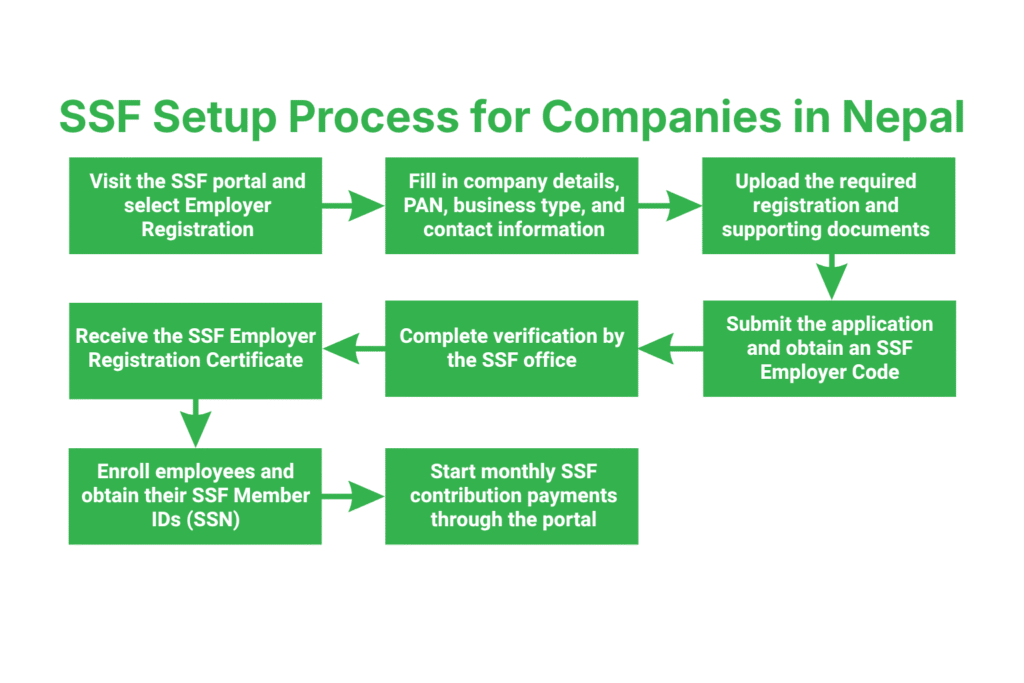
The SSF setup process involves two major stages: Employer Registration and Employee Enrollment. Both steps must be completed through the SSF online portal.
Step 1: Visit the Official SSF Portal
Go to https://ssf.gov.np and click on the “Employer Registration” option from the portal dashboard.
Step 2: Fill the Employer Registration Form
Provide all required company details including:
- Company name and registration number
- PAN number
- Type of industry/business
- Number of employees
- Company address and contact details
- Authorized person’s details
Step 3: Upload Required Documents
Upload all scanned copies of the required documents as listed above. Ensure all documents are clear and legible.
Step 4: Submit the Application
After filling all details and uploading documents, submit the application online. The system generates an Employer ID (SSF Employer Code).
Step 5: Verification by SSF Office
The SSF office verifies the submitted application and documents. In case of any discrepancy, the company receives a notice for correction.
Step 6: Obtain SSF Employer Registration Certificate
Upon successful verification, the employer receives the SSF Registration Certificate with a unique Employer ID.
Step 7: Enroll Employees on SSF Portal
After employer registration, the company must enroll each employee on the SSF portal by submitting their personal details and employment information. Each employee receives a unique SSF Member ID (Social Security Number – SSN).
Step 8: Begin Monthly Contribution Payments
After enrollment, the company must remit monthly SSF contributions by the 15th of each Nepali month (Shrawan to Ashadh). Payments are made through the SSF portal integrated with banking services.
What Are the Penalties for Non-Compliance with SSF in Nepal?
The Contribution Based Social Security Act, 2074 prescribes strict penalties for companies that fail to comply with SSF registration and contribution requirements.
Under Section 46 and Section 47 of the Act:
- A company that fails to register with SSF within the prescribed time faces a fine of up to NPR 25,000 and an additional NPR 500 per day for each day of continued non-registration.
- A company that fails to enroll employees faces penalties per un-enrolled employee.
- Delayed contribution payments attract an additional 10% annual interest on the unpaid amount.
- Companies that misrepresent employee salaries or under-report contributions face both financial penalties and potential criminal liability.
- The Labour Office under the Department of Labour can conduct inspections and audits of SSF compliance.
Employers must also submit a Labour Audit Report (Shram Parikshan) annually as required under the Labour Act, 2074, which also covers SSF compliance verification.
What Are the Benefits of SSF for Employees in Nepal?
Employees enrolled in the Social Security Fund Nepal receive multiple benefits across the five protection schemes:
Medical and Health Benefits:
- Outpatient treatment expenses up to NPR 75,000 per year per family
- Inpatient treatment coverage up to NPR 700,000 per family
- Maternity benefits including delivery expenses
Accident and Disability Benefits:
- Lump sum payment in case of permanent disability
- Monthly allowance in case of partial permanent disability
- Medical expenses for accident treatment
Dependent Family Protection:
- Death benefit paid to nominee/family of deceased worker
- Funeral expenses coverage
Old Age Protection:
- Monthly pension after reaching 60 years of age
- Lump sum amount if the worker does not qualify for monthly pension
- Minimum pension guarantee under SSF regulations
Unemployment Benefits:
- Monthly unemployment allowance for workers who lose their job involuntarily
- Coverage for up to a specific period as defined under SSF regulations
How Can Companies Check SSF Compliance Status in Nepal?
Companies can verify their SSF compliance status by:
- Logging into the employer account at https://ssf.gov.np
- Checking contribution payment history
- Verifying employee enrollment records
- Downloading contribution receipts and certificates
- Accessing the SSF mobile application available for Android and iOS
The Social Security Fund Board also allows employees to check their contribution history and account balance through the SSF member portal using their SSF Social Security Number (SSN).
What Is the Role of the Labour Audit in SSF Compliance?
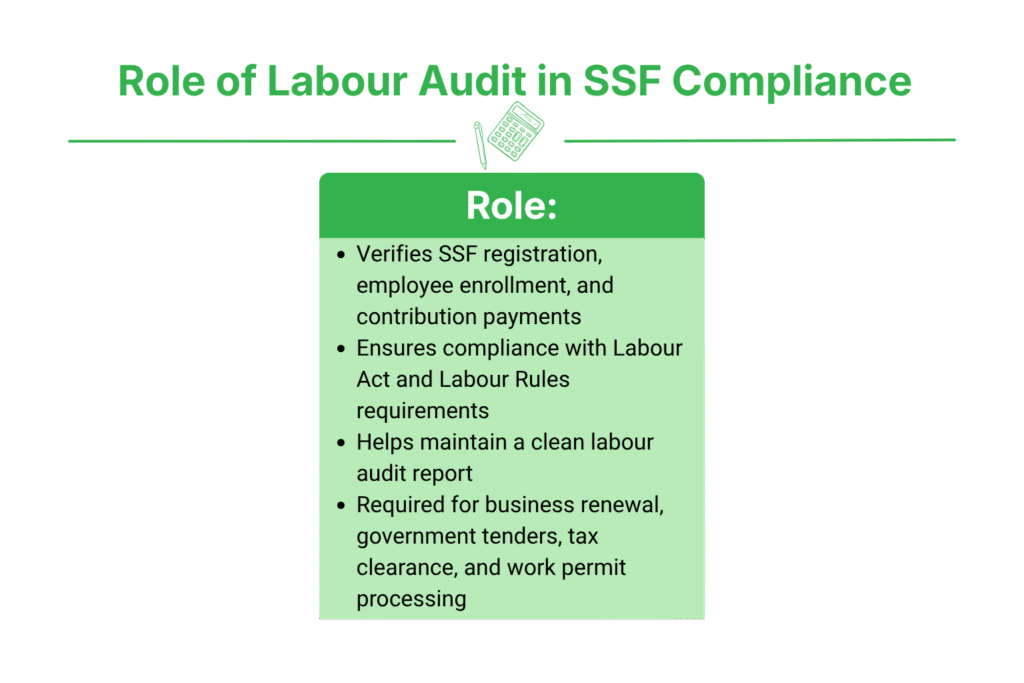
Under the Labour Act, 2074 (2017) and Labour Rules, 2075, companies in Nepal are required to conduct a Labour Audit (Shram Parikshan) annually. The labour audit includes verification of SSF registration, employee enrollment, and monthly contribution payments. A company that has completed SSF setup and maintains regular contributions will receive a clean labour audit report.
The labour audit report is also required for:
- Renewing business registrations
- Applying for government contracts and tenders
- Obtaining tax clearance certificates
- Immigration and work permit processing
FAQs
1. Is SSF registration mandatory for all companies in Nepal?
Yes, SSF registration is mandatory for all companies and enterprises with at least one employee under Section 5 of the Contribution Based Social Security Act, 2074. There are no exemptions based on company size or sector.
2. What is the deadline for SSF registration after a company is established?
A newly established company must register with the SSF within 30 days of commencing business operations or hiring its first employee, as prescribed under the Contribution Based Social Security Act, 2074.
3. Can a company register employees with SSF if they are on a probationary period?
Yes, employees on probationary periods must also be enrolled in SSF. The Labour Act, 2074 and SSF regulations require contribution for all employed workers from the date of employment, including during the probation period.
4. What happens to SSF contributions if an employee resigns or leaves the company?
When an employee leaves, the employer must update the SSF portal and stop contributions. The employee’s accumulated fund remains in their SSF account and can be claimed as per applicable scheme rules and eligibility conditions.
5. Can foreign nationals working in Nepal be enrolled in SSF?
Yes, foreign nationals holding valid work permits issued by the Department of Labour in Nepal are required to be enrolled in SSF and covered under SSF contribution requirements as per the law.
6. Where can companies get help for SSF registration in Nepal?
Companies can get assistance from the official SSF office, District Social Security Offices, or visit https://ssf.gov.np. Labour law consultants and certified auditors in Nepal also assist with SSF setup and compliance.
Conclusion
SSF setup for companies in Nepal is a legal obligation under the Contribution Based Social Security Act, 2074, and no employer can ignore this requirement. The registration process, employee enrollment, and monthly contribution remittance must all be completed through the SSF online portal at https://ssf.gov.np. The total contribution rate stands at 31% of the basic salary (20% employer + 11% employee), covering five social security schemes. Companies that complete proper SSF registration protect their employees, avoid legal penalties, and maintain good standing with regulatory authorities including the Department of Labour, Ministry of Labour, Employment and Social Security Nepal, and the Inland Revenue Department.
For official SSF registration and compliance, visit: https://ssf.gov.np | Department of Labour Nepal: https://dol.gov.np | Ministry of Labour, Employment and Social Security: https://moless.gov.np