
The Social Security Fund (SSF) of Nepal, also known as सामाजिक सुरक्षा कोष, is a government-established institution that provides social security benefits to workers and employees across Nepal. SSF registration in Nepal is a legal obligation for employers and employees operating under the formal employment sector. This guide covers every aspect of the SSF registration process, contribution rates, required documents, benefits, and applicable laws.
What is the Social Security Fund (SSF) in Nepal?
The Social Security Fund Nepal is a contributory social security scheme established under the Contribution Based Social Security Act, 2074 (2017). The Government of Nepal enacted this law to provide financial protection to workers against risks such as illness, accident, maternity, old age, and death.
The SSF operates under the Ministry of Labour, Employment and Social Security and is governed by a Board of Directors. The fund collects contributions from both employers and employees and distributes benefits through various social security schemes.
The SSF portal is accessible at the official website: https://ssf.gov.np
Who Must Register Under SSF in Nepal?
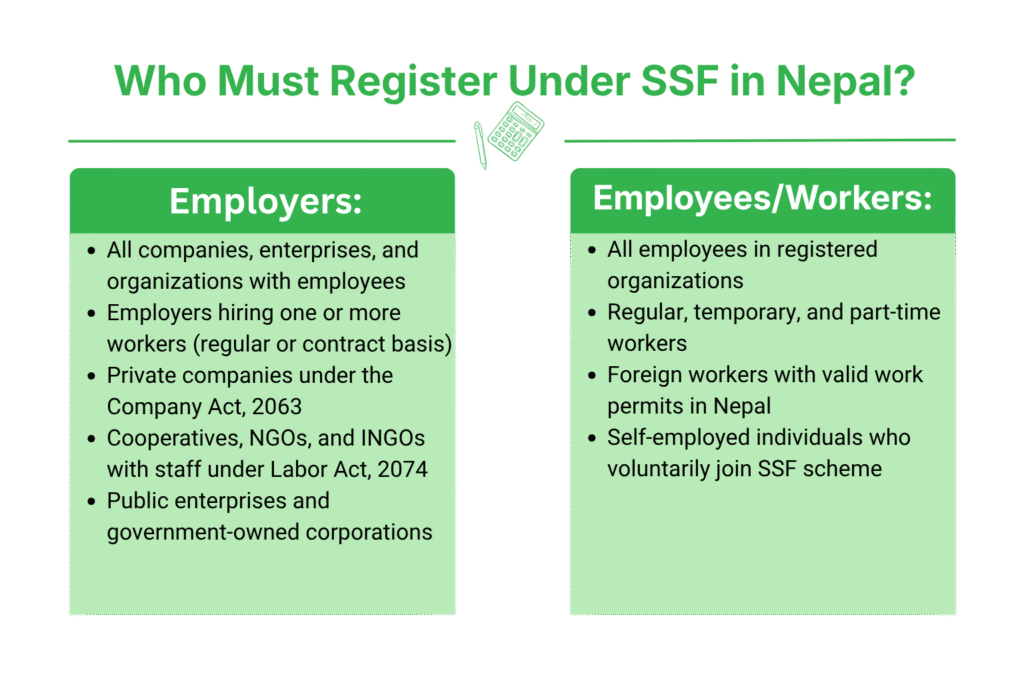
Under Section 4 of the Contribution Based Social Security Act, 2074, the following persons are required to register with the Social Security Fund:
Employers required to register:
- All enterprises, companies, or organizations operating with employees under a formal employment contract
- Employers employing one or more workers on a regular or contract basis
- Private sector companies registered under the Company Act, 2063
- Cooperatives, NGOs, and INGOs employing staff under the Labor Act, 2074
- Public enterprises and government-owned corporations
Employees/Workers required to register:
- All employees working in registered organizations
- Workers employed on a regular, temporary, or part-time basis
- Foreign workers working in Nepal under valid work permits
- Self-employed individuals who voluntarily opt into the scheme
According to Section 6 of the Contribution Based Social Security Act, 2074, it is mandatory for every employer to register all their employees within three months of the commencement of employment.
Legal Framework Governing SSF Registration
The Social Security Fund registration process in Nepal is governed by several key laws and regulations:
| Legal Instrument | Year | Purpose |
|---|---|---|
| Contribution Based Social Security Act, 2074 | 2074 (2017) | Primary law establishing SSF |
| Social Security Fund Regulations, 2075 | 2075 (2018) | Operational and procedural rules |
| Labor Act, 2074 | 2074 (2017) | Employment standards and worker rights |
| Company Act, 2063 | 2063 (2006) | Registration of employing entities |
| Social Security Fund Bye-laws, 2076 | 2076 (2019) | Internal governance of SSF |
The Contribution Based Social Security Act, 2074 is the primary legislation. Any employer who fails to register employees within the prescribed period faces penalties under Section 65 of the Act, which includes fines and legal action.
SSF Contribution Rates in Nepal
One of the most asked questions regarding SSF Nepal is the contribution rate. The contribution is shared between the employer and employee as prescribed under Schedule 1 of the Social Security Fund Regulations, 2075.
| Contributor | Contribution Rate | Basis |
|---|---|---|
| Employee | 11% | Of basic salary |
| Employer | 20% | Of basic salary |
| Total Contribution | 31% | Of basic salary |
Breakdown of Employer’s 20% Contribution:
- Medical Treatment, Health and Maternity Protection Scheme: 1%
- Accident and Disability Protection Scheme: 1.4%
- Dependent Family Protection Scheme: 0.27%
- Old Age Protection Scheme: 17.33% (transferred to Provident Fund)
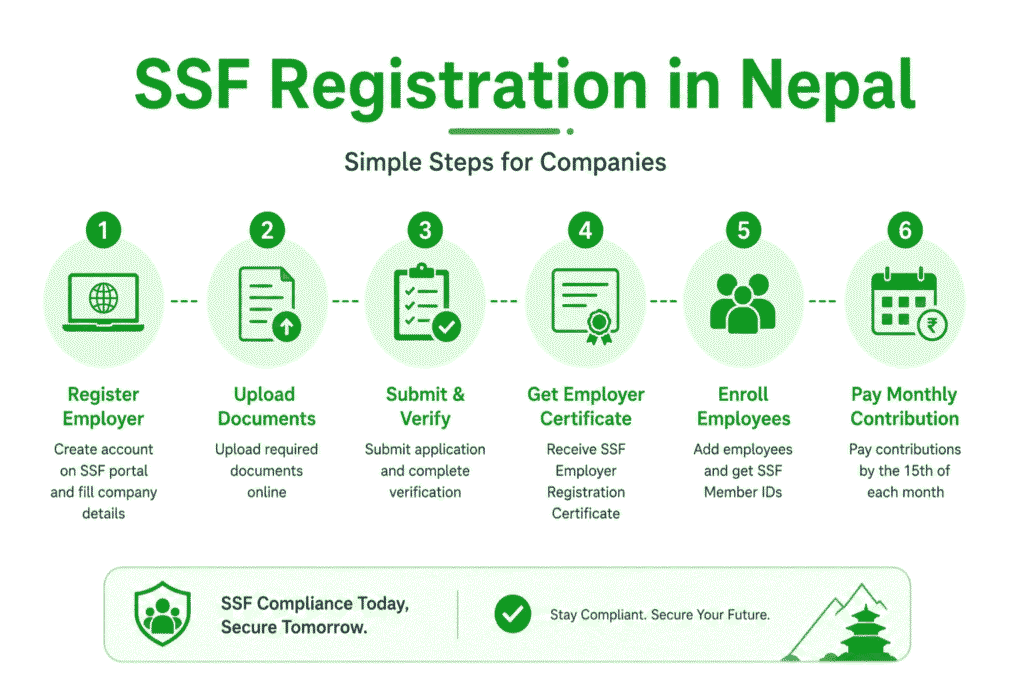
The employee contributes 11% directly into the Old Age Protection Scheme (Provident Fund component). Contributions must be deposited by the 15th of each Nepali month for the previous month’s salary.
How to Register as an Employer on the SSF Portal
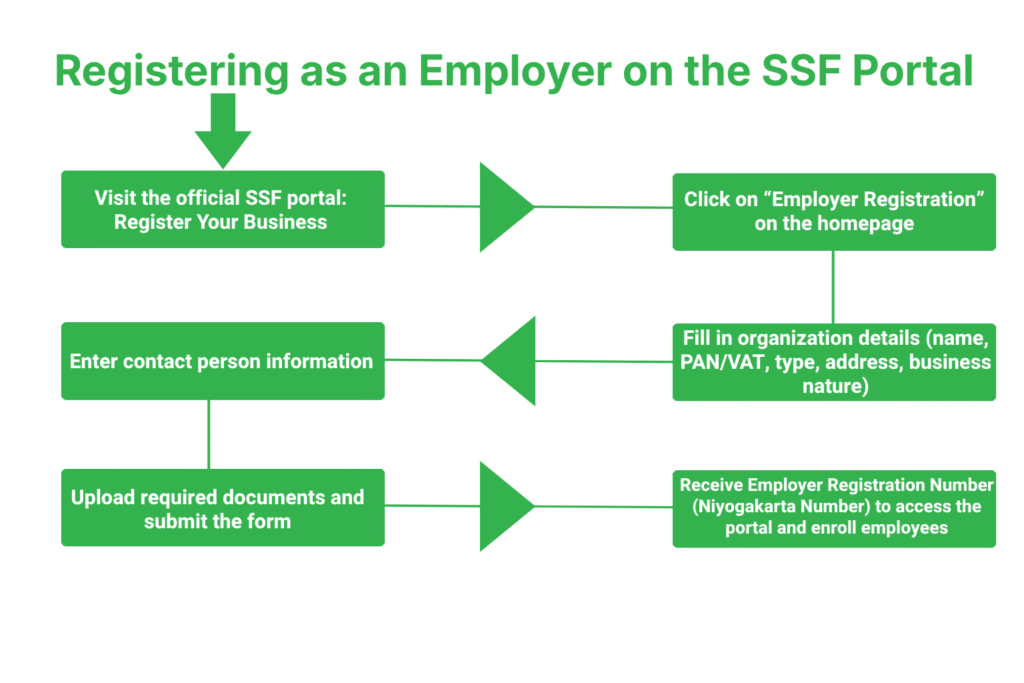
The SSF employer registration process is primarily conducted online through the official SSF portal. Below is the step-by-step process:
Step 1: Visit the official SSF portal at https://ssf.gov.np
Step 2: Click on “Employer Registration” on the homepage
Step 3: Fill in the employer registration form with the following details:
- Organization/company name
- PAN/VAT registration number
- Type of organization (private, NGO, cooperative, etc.)
- Registered office address and district
- Nature of business/industry
- Contact person details
Step 4: Upload all required documents (listed below)
Step 5: Submit the form and receive an Employer Registration Number (also called Niyogakarta Number)
Step 6: Use the employer registration number to log into the SSF portal and proceed with employee enrollment
Required Documents for Employer Registration:
- Company registration certificate (issued by Office of Company Registrar or CDO)
- PAN/VAT registration certificate from Inland Revenue Department
- Tax clearance certificate (most recent)
- Memorandum and Articles of Association (for companies)
- Organizational chart with employee count
- Bank account details of the organization
- Authorized signatory’s citizenship certificate copy
- Labor audit report (if applicable)
How to Register as an Employee on SSF Portal
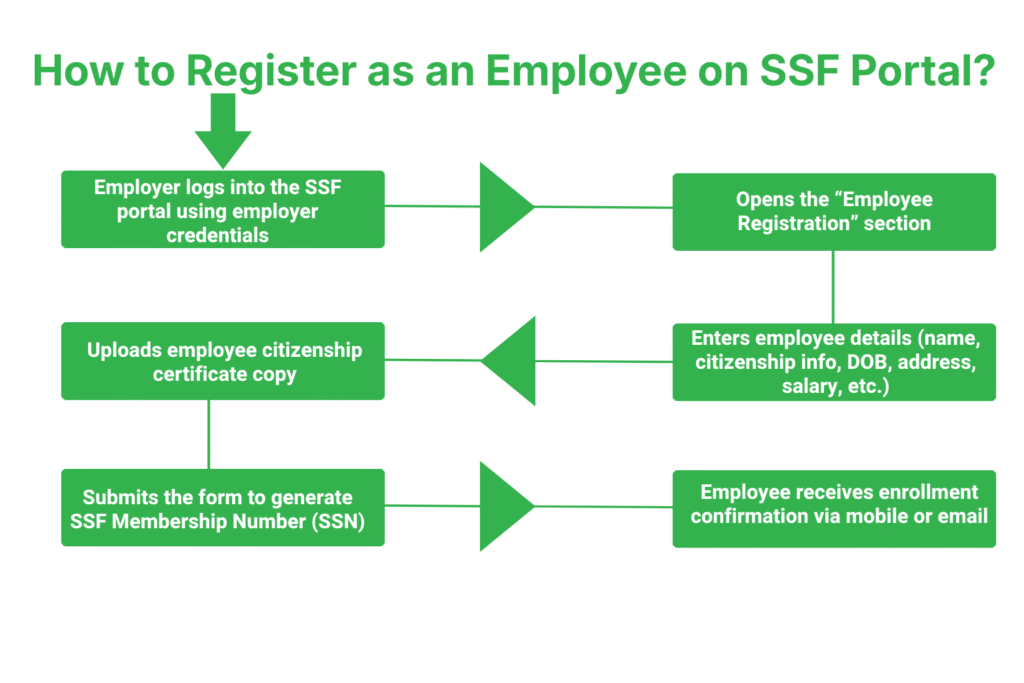
After employer registration, the employer enrolls employees individually through the SSF system. However, employees can also initiate self-registration through the portal.
Step 1: Employer logs into the SSF portal with employer credentials
Step 2: Navigate to “Employee Registration” section
Step 3: Enter individual employee details including:
- Full name as per citizenship certificate
- Citizenship certificate number and issue date
- Date of birth
- Gender
- Permanent and temporary address
- Bank account details
- Salary details (basic, allowances, etc.)
- Designation and department
Step 4: Upload the employee’s citizenship certificate copy
Step 5: Submit the form to generate an SSF Membership Number (also called Social Security Number – SSN)
Step 6: The employee receives a confirmation of their SSF enrollment via their registered mobile number or email
Required Documents for Employee Registration:
- Nepali citizenship certificate (original for verification)
- Passport-size photograph
- Bank account passbook copy (for salary credit)
- Academic certificates (optional in some cases)
- Employment contract copy
- Mobile number linked to personal bank account
SSF Benefits and Social Security Schemes
The primary purpose of SSF registration in Nepal is to access the social protection benefits offered under the fund. The Social Security Fund Regulations, 2075 define four main schemes:
1. Medical Treatment, Health and Maternity Protection Scheme:
- Covers inpatient treatment costs up to NPR 1,00,000 per year
- Maternity benefit for female contributors
- Covers the contributor, spouse, and dependent children
2. Accident and Disability Protection Scheme:
- Compensation for workplace accidents causing disability
- Full compensation for permanent disability
- Partial compensation for partial disability based on assessed percentage
3. Dependent Family Protection Scheme:
- Death benefit paid to the family of a deceased contributor
- Compensation equivalent to 60 times the monthly basic salary in case of death due to accident
- Provides financial support to dependent family members
4. Old Age Protection Scheme (Retirement Benefit):
- Provident fund accumulation throughout the service period
- Gratuity equivalent benefits upon retirement at age 60
- Monthly pension for contributors who have contributed for at least 15 years
- Contributors with less than 15 years receive a lump sum payment
Penalties for Non-Registration Under SSF
Employers who fail to comply with the mandatory SSF registration and contribution requirements face legal consequences under Section 65 and 66 of the Contribution Based Social Security Act, 2074:
- Fine of NPR 10,000 to NPR 50,000 for not registering employees within the prescribed period
- Interest at 10% per annum on unpaid contributions
- Additional penalty of 50% on the outstanding contribution amount
- Criminal proceedings in serious cases of non-compliance
- The Department of Labour conducts random inspections and audits to ensure compliance
The Labour Audit provision under the Labor Act, 2074 also requires employers to maintain records of SSF contributions, making it easier for authorities to identify defaulting employers.
SSF Registration for Foreign Workers in Nepal
Foreign nationals employed legally in Nepal under a valid Work Permit issued by the Department of Labour are also subject to SSF registration obligations under Section 5 of the Contribution Based Social Security Act, 2074. Employers hiring foreign workers must register those workers with SSF and deduct contributions from their salary at the same rate as Nepali employees.
Foreign workers receive the same benefits as Nepali contributors during their period of employment in Nepal. Upon termination of employment or departure from Nepal, foreign workers are entitled to receive their accumulated contribution amount from the Old Age Protection Scheme.
SSF Online Portal Features and Services
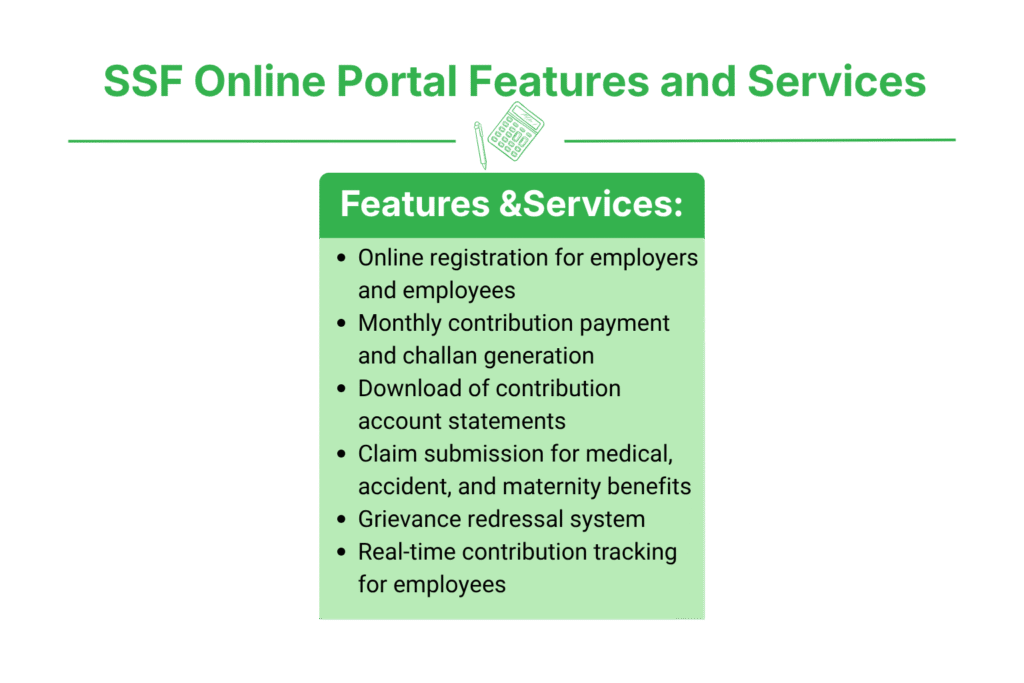
The SSF online portal (ssf.gov.np) provides a range of digital services to both employers and employees:
- Online employer and employee registration
- Monthly contribution payment and challan generation
- Contribution account statement download
- Claim submission for medical, accident, and maternity benefits
- Grievance redressal mechanism
- Real-time contribution tracking for employees
Employees can check their SSF balance and contribution history by logging into the portal using their SSF Membership Number and registered mobile number.
FAQs
1. What is SSF Registration in Nepal?
SSF Registration is the mandatory enrollment of employers and employees under the Social Security Fund as required by the Contribution Based Social Security Act, 2074. It provides workers with social security benefits including medical, accident, maternity, and retirement protection.
2. What is the total SSF contribution rate in Nepal?
The total SSF contribution rate is 31% of the basic salary 20% paid by the employer and 11% deducted from the employee’s salary. Contributions must be deposited by the 15th of each Nepali month.
3. Is SSF registration mandatory for all employers in Nepal?
Yes. Under Section 4 and 6 of the Contribution Based Social Security Act, 2074, all employers employing one or more workers under a formal employment contract must register with SSF and enroll all employees within three months of employment commencement.
4. How does an employee check their SSF balance in Nepal?
Employees can check their SSF balance and contribution history by logging into the official SSF portal at ssf.gov.np using their SSF Membership Number and registered mobile number to access the personal account dashboard.
5. What are the penalties for not registering with SSF in Nepal?
Employers who fail to register employees face fines ranging from NPR 10,000 to NPR 50,000, plus 10% annual interest on unpaid contributions and an additional 50% penalty on outstanding amounts under Section 65 of the Contribution Based Social Security Act, 2074.
6. Can self-employed individuals register with SSF in Nepal?
Yes. Self-employed individuals can voluntarily register with SSF under the provisions of the Contribution Based Social Security Act, 2074. They must contribute both the employer and employee portions, totaling 31% of their declared income, to access social security benefits.
Conclusion
SSF registration in Nepal is a legal requirement that protects both employers and employees under the formal employment structure. The Contribution Based Social Security Act, 2074 and Social Security Fund Regulations, 2075 form the legal foundation for this system. Employers must complete the registration process through the SSF portal at ssf.gov.np and deposit monthly contributions on time to avoid penalties. Employees, in turn, gain access to medical, accident, maternity, and retirement benefits. Timely compliance ensures legal protection for all parties involved in the employment relationship.