
The Social Security Fund (SSF) monthly filing in Nepal is a legal obligation that every registered employer must fulfill on a regular basis. Under the Social Security Act, 2074 (2017) and the Labour Act, 2074 (2017), employers operating in Nepal are required to register their employees with the SSF and deposit contributions monthly. Failure to comply with SSF monthly filing requirements leads to penalties, legal action, and loss of employee benefits. This article explains the entire process of SSF monthly filing in Nepal, including contribution rates, deadlines, procedures, penalties, and frequently asked questions.
What Is the Social Security Fund (SSF) in Nepal?
The Social Security Fund Nepal is a government-established fund that provides social security protection to formal sector workers. It was established under the Social Security Act, 2074 and is operated by the Social Security Fund Management Board under the Ministry of Labour, Employment and Social Security.
The SSF provides five major schemes to enrolled workers:
- Medical Treatment, Health and Maternity Protection Scheme
- Accident and Disability Protection Scheme
- Dependent Family Protection Scheme
- Old Age Protection Scheme
- Foreign Employment Injury Protection Scheme
Employers and employees both contribute a fixed percentage of the employee’s basic salary to the fund every month through the SSF online portal at ssf.gov.np.
What Are the SSF Contribution Rates in Nepal?
The SSF contribution rate in Nepal is divided between the employer and the employee. The rates are prescribed under the Social Security (Contribution-Based Social Security) Fund Regulations, 2075 (2018).
| Contribution Party | Contribution Rate | Basis |
|---|---|---|
| Employee Contribution | 11% | Basic Salary |
| Employer Contribution | 20% | Basic Salary |
| Total Contribution | 31% | Basic Salary |
The employer contributes 20% of the employee’s basic salary, and the employee contributes 11% of their basic salary. This total of 31% goes into the SSF monthly contribution fund.
The breakdown of the employer’s 20% contribution into specific schemes is as follows:
| Scheme | Employer’s Share |
|---|---|
| Medical Treatment, Health and Maternity Protection | 1% |
| Accident and Disability Protection | 1.4% |
| Dependent Family Protection | 0.27% |
| Old Age Protection Scheme | 3.33% (employer) + 11% (employee) |
| Provident Fund Equivalent | Remaining percentage |
It is important to note that the basic salary is used as the base for SSF contribution calculation, not the gross salary. This distinction matters greatly when calculating the actual monthly deposit.
Who Must File SSF Monthly Contributions in Nepal?
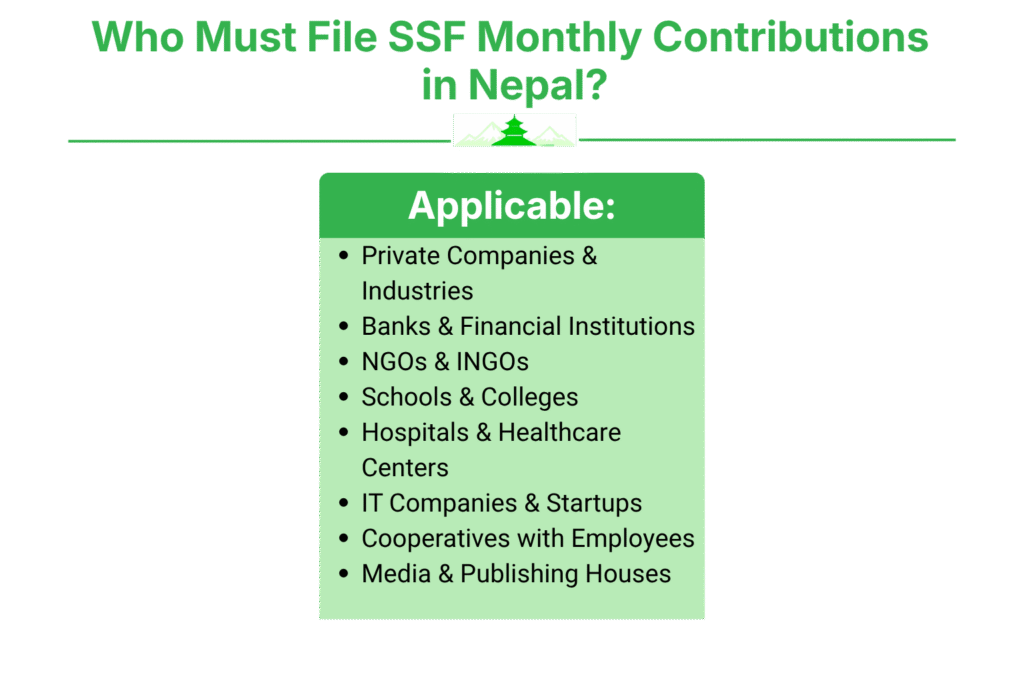
Under Section 5 of the Social Security Act, 2074, every employer who operates a business or enterprise and employs workers in Nepal must register with the SSF and make monthly contributions. The obligation applies to:
- Private sector companies and industries
- Financial institutions and banks
- Non-governmental organizations (NGOs) and INGOs employing Nepali staff
- Educational institutions
- Hospitals and healthcare entities
- IT companies and startups
- Cooperatives with paid employees
- Media houses and publishing companies
Employers with even one paid employee fall under the mandatory SSF registration and monthly filing requirement. There is no minimum employee threshold for SSF applicability in the private sector.
How to Register for SSF in Nepal?
Before making monthly contributions, both employers and employees must complete SSF registration. The registration process is conducted through the SSF online portal.
Employer Registration Process
- Step 1: Visit ssf.gov.np and click on Employer Registration
- Step 2: Enter PAN/VAT number, company name, and basic details
- Step 3: Upload required documents including company registration certificate, PAN certificate, and tax clearance
- Step 4: Submit the application and receive an Employer ID
- Step 5: Log in using the Employer ID for monthly filing
Employee Registration Process
- Step 1: Employer logs into the SSF portal
- Step 2: Clicks on Employee Registration under their employer account
- Step 3: Enters employee details including citizenship number, name, date of birth, and designation
- Step 4: Employee receives an SSF Social Security Number (SSN)
- Step 5: Employee can independently log into the SSF portal to track their account
What Is the Process of SSF Monthly Filing in Nepal?
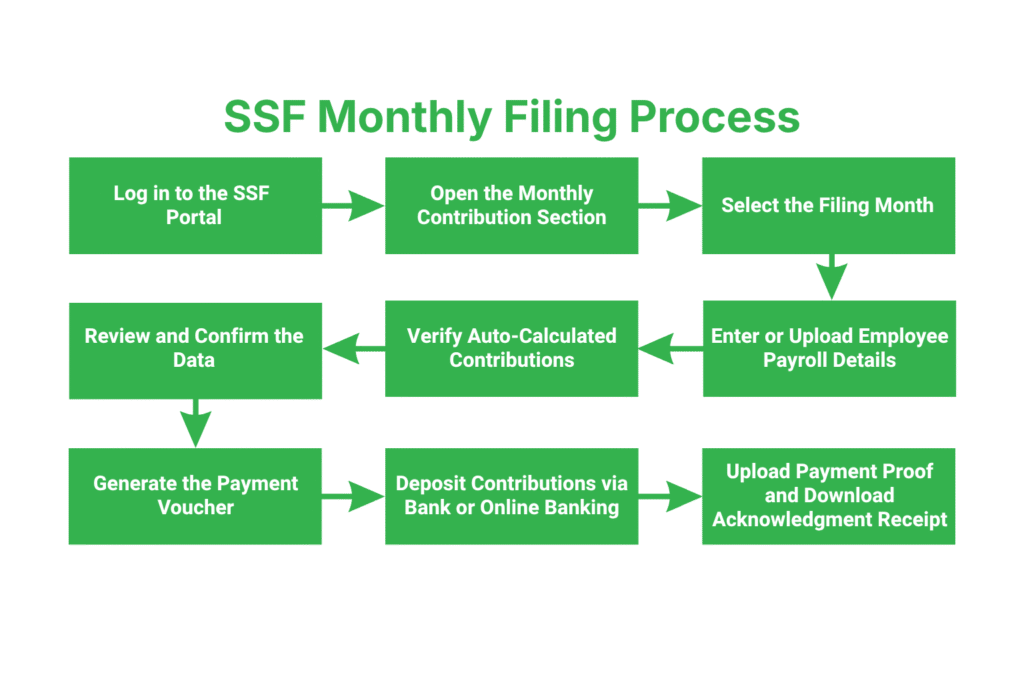
The SSF monthly filing process in Nepal involves submitting employee payroll data and depositing the corresponding contributions through the SSF portal. The entire process is digital and is done online.
Step-by-Step Process for SSF Monthly Filing
- Step 1: Log in to the SSF portal at ssf.gov.np using your Employer ID and password
- Step 2: Go to the Monthly Contribution section in the employer dashboard
- Step 3: Select the relevant fiscal month for which the contribution is being filed
- Step 4: Enter or upload the payroll details for all enrolled employees (name, basic salary, working days)
- Step 5: The system automatically calculates the 11% employee contribution and 20% employer contribution
- Step 6: Review the calculated contribution amount for accuracy
- Step 7: Generate the payment voucher from the portal
- Step 8: Deposit the total contribution amount at designated commercial banks or through online banking
- Step 9: Upload the payment receipt back on the SSF portal to complete the monthly filing
- Step 10: Download the acknowledgment receipt for your records
The SSF portal supports bulk upload of employee payroll data through a downloadable Excel template, which is particularly useful for companies with large workforces.
What Is the SSF Monthly Filing Deadline in Nepal?
The SSF monthly filing deadline is one of the most strictly monitored compliance requirements. Under the SSF regulations, employers must deposit monthly contributions within the last day of the following month after the salary payment month.
For example:
- Salary paid for Shrawan (July-August) → SSF contribution must be deposited by the last day of Bhadra (August-September)
- Salary paid for Poush (December-January) → SSF contribution must be deposited by the last day of Magh (January-February)
Employers must complete both the online filing and bank deposit before this deadline to avoid penalties.
What Are the Penalties for Late SSF Filing in Nepal?
The Social Security Act, 2074 and its regulations prescribe clear penalties for employers who fail to file or deposit SSF contributions on time.
- Late Contribution Penalty: An additional 10% per annum on the unpaid contribution amount is charged as interest for delayed deposits
- Non-Registration Penalty: Employers who fail to register with the SSF can face fines up to NPR 25,000 under Section 68 of the Social Security Act, 2074
- Non-Contribution Penalty: Employers who are registered but fail to deposit monthly contributions face fines and possible legal proceedings
- Employee Benefit Denial: Employees whose employers have not filed SSF contributions may face denial of medical, accident, or maternity benefits
- Tax Non-Compliance: Since SSF contributions are tax-deductible, non-compliance can also trigger issues during tax audit and assessment by the Inland Revenue Department
Repeated non-compliance may result in the employer being blacklisted from government contracts and tenders.
What Documents Are Required for SSF Monthly Filing?
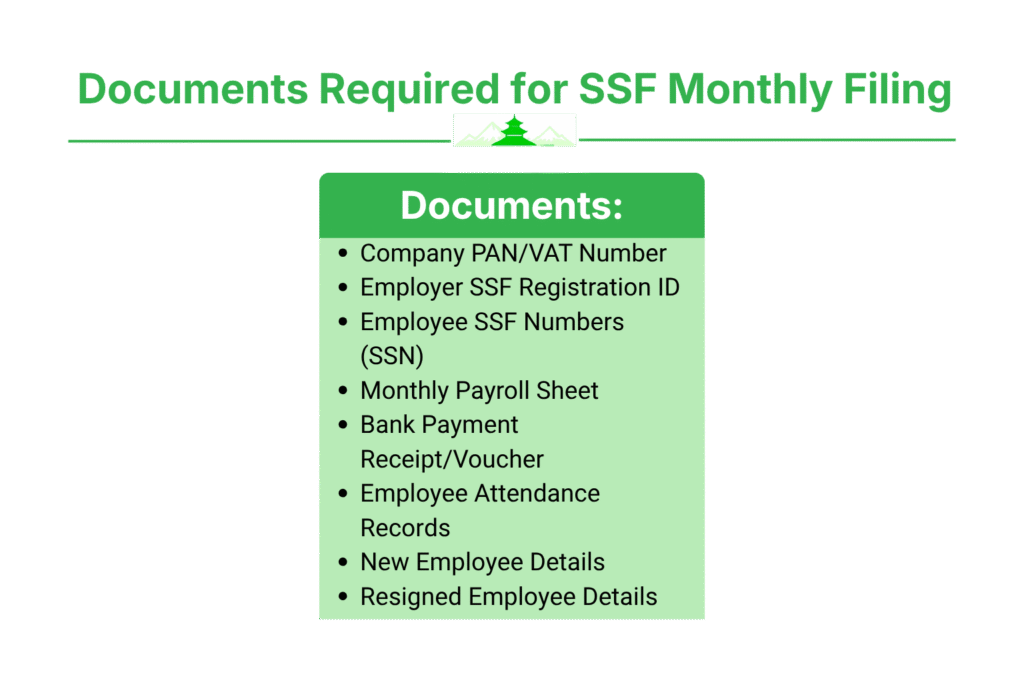
For the monthly SSF contribution filing, employers must maintain and submit the following documents and data:
- Company PAN/VAT registration number
- Employer SSF registration ID
- Employee SSF Social Security Numbers (SSN)
- Monthly payroll sheet showing basic salary, working days, and deductions
- Bank payment receipt/voucher confirming the SSF deposit
- Employee attendance records (for part-time or contractual workers)
- Details of newly joined or resigned employees for that month
For new employee additions during the filing month, the employer must complete employee registration on the SSF portal before including them in the monthly payroll submission.
How Does SSF Monthly Filing Benefit Employees?
Regular and timely SSF monthly contribution directly benefits employees in the following ways:
- Medical Benefits: Employees can claim medical treatment costs at empaneled hospitals under the medical scheme
- Maternity Benefits: Female employees can claim maternity-related medical costs and cash benefits
- Accident Benefits: In case of workplace injury, employees receive compensation based on their accumulated SSF contribution
- Pension/Old Age Benefits: After a minimum contribution period, employees become eligible for monthly pension upon retirement
- Dependent Benefits: In case of employee death, the dependent family receives death compensation from the fund
The minimum contribution period to access most benefits is actively maintained in the SSF portal, and employees can check their contribution history and balance anytime by logging into ssf.gov.np.
What Is the Relationship Between SSF and Provident Fund (PF) in Nepal?
Many employers ask whether SSF replaces the Employees Provident Fund (EPF) in Nepal. Under the current framework:
- Employers who enroll employees in SSF are exempted from separately contributing to the Employees Provident Fund Office (EPFO)
- The old age protection component of the SSF effectively replaces the traditional provident fund
- Employees who were previously enrolled in EPFO can transfer their PF balance to SSF
- The Labour Act, 2074 under Section 53 provides that employers contributing to an SSF-recognized scheme are compliant with provident fund obligations
Employers should confirm the exact transition status with the Social Security Fund office or consult a legal expert to ensure compliance with both the Labour Act and SSF regulations.
SSF Monthly Filing for Part-Time and Contractual Workers
SSF contribution obligations for part-time or contractual workers follow a prorated approach:
- Contributions are calculated based on actual basic wages earned during the month
- Working days must be accurately reported in the monthly filing form
- If a worker works for less than a full month, the contribution is proportionally adjusted
- Contractual workers hired through manpower agencies may have different arrangements, but the employing organization remains responsible for SSF compliance
FAQs
1. What is the SSF monthly filing deadline in Nepal?
The SSF monthly contribution must be filed and deposited by the last day of the month following the salary month. For example, Shrawan salary contributions must be deposited by the end of Bhadra.
2. What is the total SSF contribution rate for employees and employers?
The total SSF contribution rate is 31% of the employee’s basic salary, split as 20% from the employer and 11% from the employee, as prescribed under the Social Security Regulations, 2075.
3. Can employees check their SSF contribution history online?
Yes, employees can log into the official SSF portal at ssf.gov.np using their SSF Social Security Number (SSN) to view their contribution history, balance, and benefit eligibility.
4. What happens if an employer misses the SSF monthly filing deadline?
Late filing attracts a 10% per annum penalty interest on the outstanding contribution amount, plus possible fines under Section 68 of the Social Security Act, 2074, for non-compliance.
5. Is SSF mandatory for all private sector employers in Nepal?
Yes, under the Social Security Act, 2074 and Labour Act, 2074, all private sector employers with at least one paid employee must register with SSF and file monthly contributions without exception.
6. Does SSF contribution replace the Provident Fund contribution in Nepal?
Yes, employers enrolled in the SSF are exempted from separate EPF contributions. The SSF old age protection component fulfills the provident fund obligation under Section 53 of the Labour Act, 2074.
Conclusion
SSF monthly filing in Nepal is a mandatory compliance requirement for every formal sector employer under the Social Security Act, 2074. The process involves registering employees, computing contributions at 31% of basic salary, filing online through the SSF portal, and depositing funds within the prescribed deadline. Employers who fail to comply face financial penalties, legal consequences, and denial of employee benefits. Regular and accurate monthly SSF filing not only protects employees but also ensures that employers remain legally compliant with Nepal’s labor and social security laws. For updates and official guidelines, employers should regularly visit ssf.gov.np and the Ministry of Labour, Employment and Social Security.