


Registering a hire purchase company in Nepal is a formal legal process governed by specific laws, regulatory bodies, and compliance requirements. A hire purchase company in Nepal operates by providing goods to customers under an agreement where the buyer pays in installments and receives ownership only after the final payment. This business model is common in vehicle financing, equipment leasing, and consumer goods financing across Nepal. If you plan to start a hire purchase business in Nepal, understanding the legal framework, registration process, required documents, and regulatory oversight is essential.
What Is a Hire Purchase Company in Nepal?
A hire purchase company in Nepal is a financial institution or non-banking financial entity that provides goods or assets to customers on a deferred payment basis. Under a hire purchase agreement, the hirer (customer) takes possession of the goods and makes periodic installment payments. The ownership of the goods transfers to the hirer only after all installment payments are completed.
In Nepal, hire purchase companies operate under the regulation of Nepal Rastra Bank (NRB) and are classified under Finance Companies or Non-Banking Financial Institutions (NBFIs). The business of hire purchase in Nepal falls under the scope of the Finance Company Act, 2042 (1985) and the broader Bank and Financial Institutions Act (BAFIA), 2073 (2017).
Legal Framework for Hire Purchase Companies in Nepal
The legal framework for registering and operating a hire purchase company in Nepal is based on the following laws:
| Law / Regulation | Year | Governing Body |
|---|---|---|
| Bank and Financial Institutions Act (BAFIA) | 2073 (2017) | Nepal Rastra Bank |
| Finance Company Act | 2042 (1985) | Nepal Rastra Bank |
| Hire Purchase Act | 2974 (1974) | Government of Nepal |
| Companies Act, 2063 | 2063 (2006) | Office of Company Registrar |
| Income Tax Act, 2058 | 2058 (2002) | Inland Revenue Department |
| Foreign Investment and Technology Transfer Act, 2075 | 2075 (2019) | Department of Industry |
The Hire Purchase Act, 2974 (1974) specifically governs hire purchase transactions in Nepal. It defines a hire purchase agreement, sets obligations of the owner and the hirer, and establishes rights and remedies in case of default. Section 2 of the Hire Purchase Act defines a hire purchase agreement as a contract where goods are hired under a system that allows the hirer to purchase them through installments.
Under BAFIA 2073, financial institutions offering hire purchase services must obtain a license from Nepal Rastra Bank (NRB). NRB classifies financial institutions into four categories:
- Class A: Commercial Banks
- Class B: Development Banks
- Class C: Finance Companies
- Class D: Micro Finance Development Banks
A hire purchase company in Nepal typically registers as a Class C Finance Company under NRB regulations.
Who Can Register a Hire Purchase Company in Nepal?
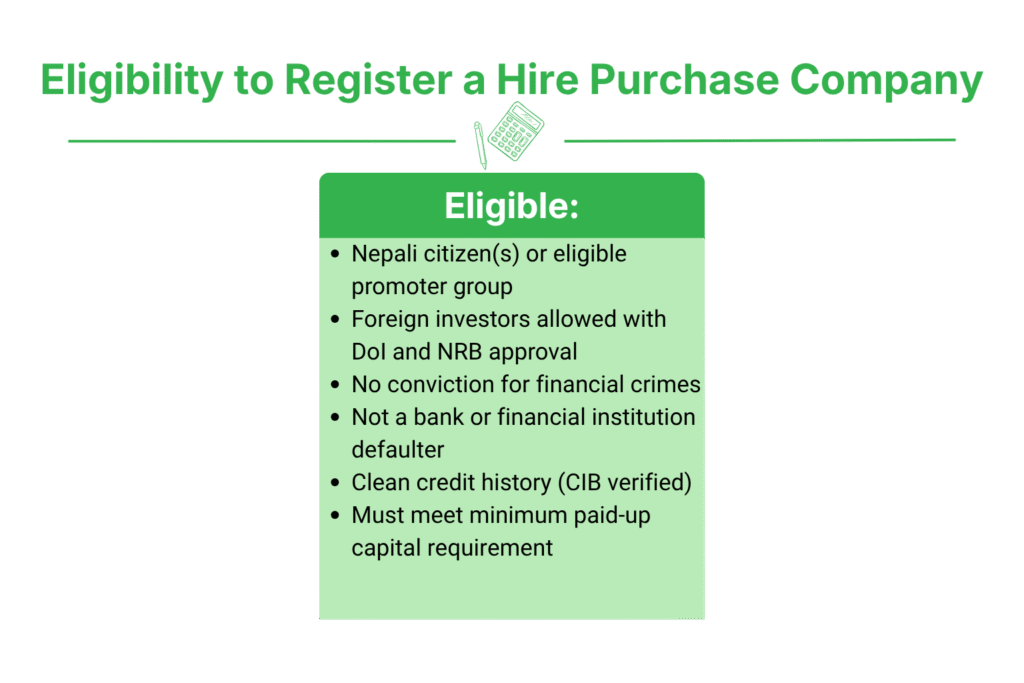
Any Nepali citizen or a group of promoters who meet the eligibility criteria set by Nepal Rastra Bank can apply to register a hire purchase company. Foreign investors can also participate in hire purchase financing under the Foreign Investment and Technology Transfer Act (FITTA), 2075 with prior approval from the Department of Industry and NRB.
Eligibility Criteria for Promoters:
- Must be a Nepali citizen (for domestic entities)
- Must not have been convicted of any financial crime
- Must not be a defaulter of any bank or financial institution
- Must have a clean credit history verified by Credit Information Bureau (CIB)
- Must meet the minimum paid-up capital requirement
Minimum Capital Requirement for Hire Purchase Company in Nepal
Nepal Rastra Bank sets the minimum paid-up capital requirement for finance companies offering hire purchase services. As per NRB Directives, the minimum paid-up capital for a Class C Finance Company in Nepal is as follows:
| Category | Location | Minimum Paid-Up Capital |
|---|---|---|
| Class C Finance Company | Kathmandu Valley | NPR 80 Crore |
| Class C Finance Company | Outside Kathmandu Valley | NPR 40 Crore |
These capital requirements are subject to revision by Nepal Rastra Bank through its periodic directives. Always check the latest NRB guidelines at www.nrb.org.np for updated capital requirements.
Steps to Register a Hire Purchase Company in Nepal
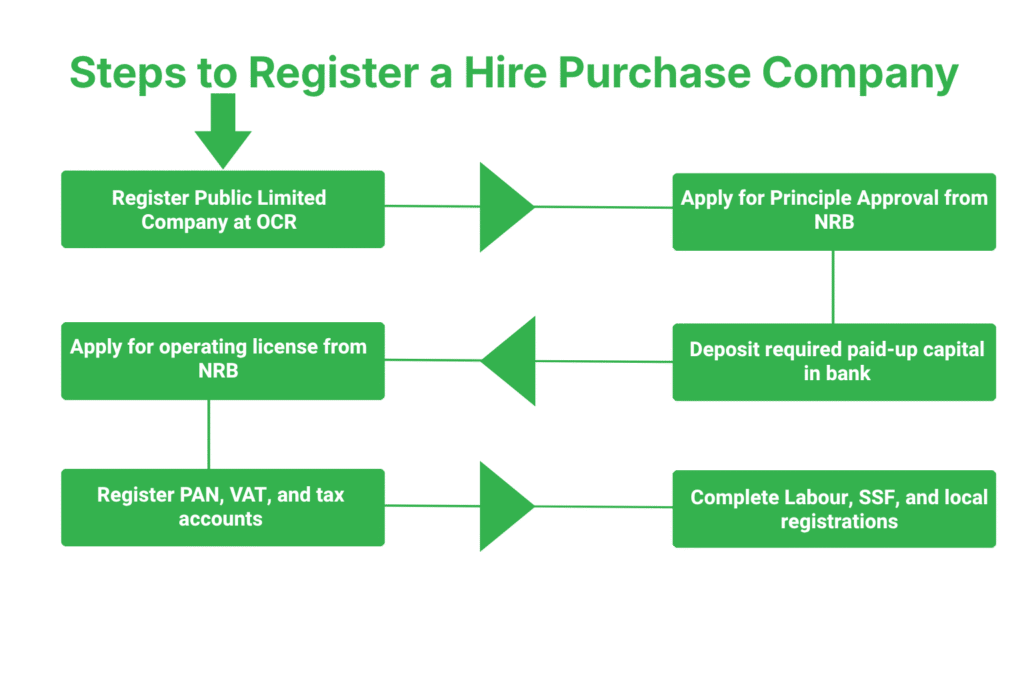
Registering a hire purchase company in Nepal involves multiple stages. The process starts from the Office of Company Registrar and proceeds to Nepal Rastra Bank for a financial institution license.
Step 1: Incorporate the Company at the Office of Company Registrar (OCR)
The first step is to register a company under the Company Act, 2063 (2006). The company must be incorporated as a Public Limited Company to qualify for a finance company license from NRB.
Documents Required for Company Registration:
- Memorandum of Association (MoA)
- Articles of Association (AoA)
- Citizenship certificates of all promoters/directors
- Passport-size photographs of all promoters
- Office address proof (rental agreement or ownership certificate)
- Promoters’ agreement
- Application form (available at OCR)
- Tax clearance certificates of all promoters
- Bank voucher of registration fees
The company registration is done through the Office of Company Registrar (OCR), accessible at www.ocr.gov.np.
Step 2: Apply for a Principle Approval Letter from NRB
After completing company registration at OCR, the promoters must apply to Nepal Rastra Bank for a Principle Approval (Sweekriti) to operate as a finance company.
Documents Required for NRB Principle Approval:
- Application letter addressed to the Governor of NRB
- Company registration certificate from OCR
- MoA and AoA
- Feasibility study or business plan of the company
- Details of all promoters including net worth statements
- Source of funds declaration
- CIB (Credit Information Bureau) report of all promoters
- Tax clearance certificates
- PAN registration certificates
- Bank statements of all promoters for the last 12 months
- Promoters’ agreement (notarized)
- Proposed organizational chart
- Details of proposed capital structure
NRB evaluates the application based on promoters’ credibility, financial capacity, business viability, and compliance with the BAFIA 2073 requirements.
Step 3: Deposit the Required Paid-Up Capital
After receiving the Principle Approval from NRB, the promoters must deposit the minimum paid-up capital in a designated bank account as directed by NRB. The capital must be deposited within the timeframe specified in the Principle Approval letter.
Step 4: Apply for Operating License from NRB
Once the paid-up capital is deposited, the company submits an application to NRB for an Operating License. NRB conducts a final inspection and review before issuing the license.
Documents Required for Operating License:
- Application for operating license
- Evidence of paid-up capital deposit
- Office establishment documents
- IT system and software readiness report
- Staff appointment details
- Security system details
- Final company registration documents
Step 5: Register with Tax Authorities
After receiving the NRB operating license, the company must register with the Inland Revenue Department (IRD) for:
- Permanent Account Number (PAN)
- Value Added Tax (VAT) registration (if applicable)
- Tax registration under Income Tax Act, 2058
Tax registration is done through the IRD portal at www.ird.gov.np.
Step 6: Obtain Other Necessary Registrations
- Register with the Department of Labour under Labour Act, 2074
- Obtain a business operating permit from the local municipality or metropolitan office
- Register with the Social Security Fund (SSF) for employee benefits
Regulatory Compliance for Hire Purchase Companies in Nepal
After registration, hire purchase companies in Nepal must comply with ongoing regulatory requirements set by Nepal Rastra Bank. These include:
- Maintaining the Capital Adequacy Ratio (CAR) as directed by NRB
- Submitting periodic financial reports to NRB
- Following NRB Unified Directives on loan classification, provisioning, and interest rates
- Complying with the Anti-Money Laundering (AML) Act, 2064 and Know Your Customer (KYC) norms
- Maintaining proper books of accounts as per Nepal Financial Reporting Standards (NFRS)
- Conducting annual audits through a NRB-approved auditor
- Filing tax returns with IRD annually
Hire purchase agreements executed by a hire purchase company must comply with the Hire Purchase Act, 2974. Key provisions include clear disclosure of installment amounts, the interest rate applied, the total cost of the asset, and the rights of both parties in case of default.
Hire Purchase Agreement Requirements Under Nepal Law
Under the Hire Purchase Act, 2974 (1974), a valid hire purchase agreement in Nepal must contain:
- Description of goods under hire purchase
- Total hire purchase price
- Cash price of the goods
- Number and amount of installments
- Date when each installment is due
- Rights of the owner to repossess goods in case of default
- Rights of the hirer to terminate the agreement
Any hire purchase agreement that does not meet these requirements is considered void under the Act.
Challenges in Registering a Hire Purchase Company in Nepal
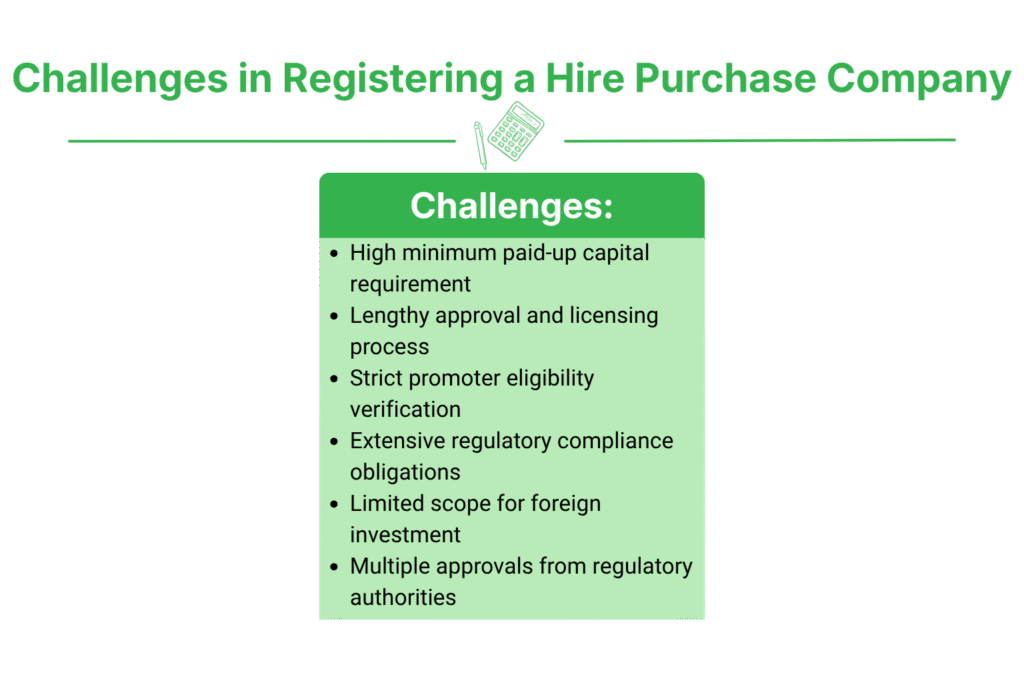
Several practical challenges arise when registering a hire purchase company in Nepal:
- High capital requirement: The minimum paid-up capital of NPR 80 Crore is a significant barrier for smaller promoters.
- Lengthy approval process: The NRB approval process involves multiple stages and can take 12 to 18 months in total.
- Strict promoter eligibility: NRB conducts thorough background checks on all promoters.
- Compliance burden: Post-registration compliance requirements are extensive and require dedicated compliance teams.
- Limited foreign investment scope: Foreign investors in hire purchase or finance companies face restrictions under NRB regulations.
FAQs
1. What law governs hire purchase companies in Nepal?
Hire purchase companies in Nepal are primarily governed by the Hire Purchase Act, 2974 (1974), the Bank and Financial Institutions Act (BAFIA), 2073 (2017), and Nepal Rastra Bank (NRB) directives applicable to Class C Finance Companies.
2. What is the minimum capital required to register a hire purchase company in Nepal?
As per NRB directives, the minimum paid-up capital for a Class C Finance Company in the Kathmandu Valley is NPR 80 Crore and NPR 40 Crore outside the Kathmandu Valley. These figures are subject to revision by NRB.
3. Can foreigners register a hire purchase company in Nepal?
Yes, foreign investors can participate in a hire purchase company in Nepal under FITTA 2075, but they need prior approval from the Department of Industry and NRB. Foreign investment in finance companies has specific percentage restrictions under NRB guidelines.
4. How long does it take to register a hire purchase company in Nepal?
The complete registration process, including company registration at OCR and obtaining an NRB operating license, typically takes 12 to 18 months, depending on the completeness of documents and NRB’s processing timeline.
5. What type of company structure is required for a hire purchase company in Nepal?
A hire purchase company in Nepal must be incorporated as a Public Limited Company under the Company Act, 2063 (2006) to be eligible for a finance company license from Nepal Rastra Bank.
6. Where do I register a hire purchase company in Nepal?
The registration starts at the Office of Company Registrar (OCR) at www.ocr.gov.np for company incorporation, followed by a license application to Nepal Rastra Bank at www.nrb.org.np for financial institution approval.
Conclusion
Registering a hire purchase company in Nepal requires compliance with multiple laws including the Hire Purchase Act 2974, BAFIA 2073, and NRB directives. The process involves company registration at OCR, obtaining NRB’s principle approval, depositing the required paid-up capital, and securing an operating license. Promoters must meet strict eligibility criteria and capital requirements. Ongoing regulatory compliance with NRB, IRD, and other authorities is mandatory after registration. Any person or group planning to establish a hire purchase company in Nepal should consult a qualified legal or financial advisor familiar with Nepal’s banking and financial institution laws to ensure a smooth and fully compliant registration process.