

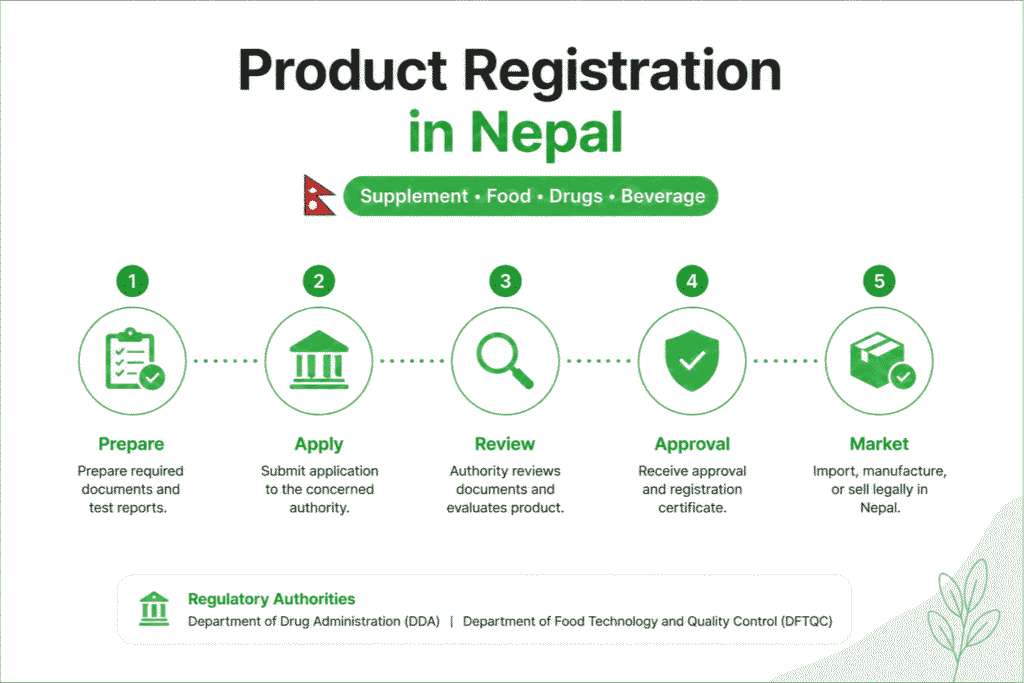
Product Registration in Nepal (Supplement, Food, Drugs, Beverage) is a mandatory legal process that any manufacturer, importer, or distributor must complete before selling food products, dietary supplements, drugs, or beverages in the Nepali market. The Government of Nepal, through its designated regulatory authorities, enforces strict product registration requirements to ensure public health safety, quality control, and legal compliance. Whether you are a local producer or a foreign company seeking to import products into Nepal, understanding the product registration process in Nepal is essential to operate lawfully.
What Is Product Registration in Nepal?
Product registration in Nepal refers to the formal process of obtaining government approval from competent authorities before a product is manufactured, imported, distributed, or sold in Nepal. This process verifies that the product meets the required safety, quality, and labeling standards established under Nepali law.
The Food Act, 2023 BS (1966 AD) and its amendments, the Drug Act, 2035 BS (1978 AD), and the Consumer Protection Act, 2075 BS (2018 AD) together form the primary legal framework for product registration in Nepal.
Product registration in Nepal applies to:
- Food products (processed foods, packaged foods, spices, dairy products)
- Dietary and health supplements (vitamins, minerals, herbal supplements)
- Pharmaceutical drugs and medicines (allopathic, ayurvedic, herbal drugs)
- Beverages (soft drinks, juices, energy drinks, alcoholic beverages, mineral water)
- Cosmetics with health claims
Regulatory Authorities for Product Registration in Nepal
Nepal has two primary regulatory bodies responsible for product registration depending on the product category.
1. Department of Food Technology and Quality Control (DFTQC)
The Department of Food Technology and Quality Control (DFTQC), under the Ministry of Agriculture and Livestock Development, is the main authority for food product registration, beverage registration, and dietary supplement registration in Nepal.
Official Website: https://www.dftqc.gov.np
DFTQC regulates:
- Packaged and processed food registration
- Beverage product registration
- Health supplement registration
- Food additive and food color approvals
- Import permits for food and supplements
2. Department of Drug Administration (DDA)
The Department of Drug Administration (DDA), under the Ministry of Health and Population, is responsible for drug registration, pharmaceutical product registration, and ayurvedic medicine registration in Nepal.
Official Website: https://www.dda.gov.np
DDA regulates:
- Allopathic drug registration
- Ayurvedic and herbal medicine registration
- Homeopathic product registration
- Medical device registration
- Import and export license for pharmaceuticals
Legal Framework for Product Registration in Nepal
| Law / Regulation | Year | Coverage |
|---|---|---|
| Food Act (Khadhya Ain) | 2023 B.S. (1966 A.D.) | Food safety, quality standards, food licensing |
| Food Regulation (Khadhya Niyamawali) | 2027 B.S. (1970 A.D.) | Detailed food standards and registration rules |
| Drug Act (Aushadhi Ain) | 2035 B.S. (1978 A.D.) | Drug registration, manufacturing, import/export |
| Drug Regulation (Aushadhi Niyamawali) | 2038 B.S. (1981 A.D.) | Drug registration procedures |
| Consumer Protection Act, 2075 | 2075 B.S. (2018 A.D.) | Consumer rights, product labeling, liability |
| Nepal Standards Act, 2037 | 2037 B.S. (1980 A.D.) | Nepal Standards (NS) quality certification |
Product Registration Process in Nepal: Step-by-Step
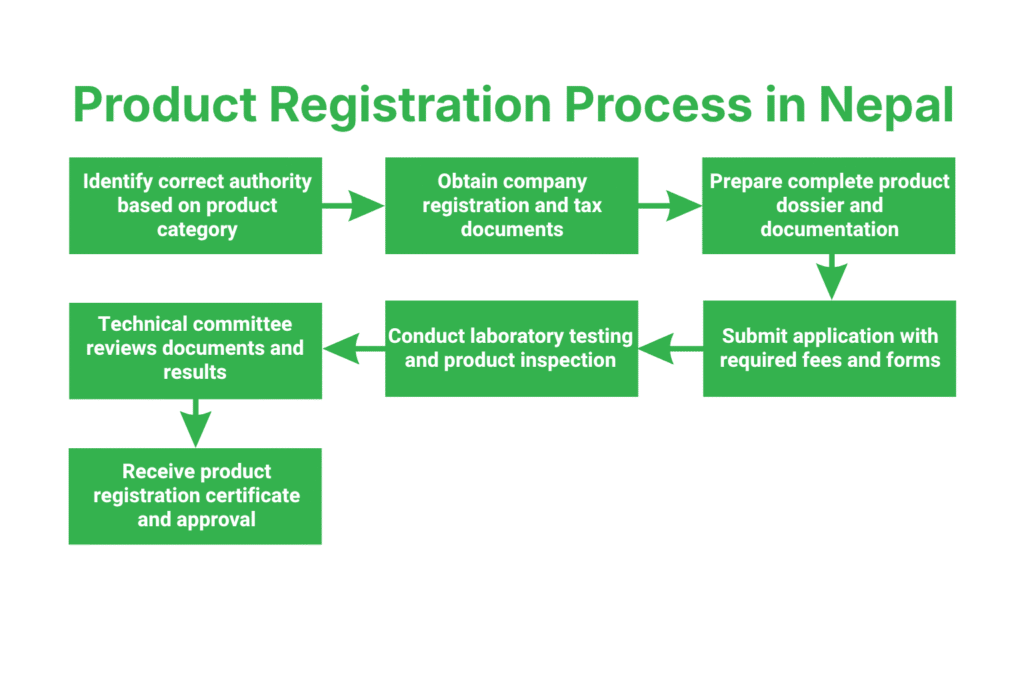
Step 1: Identify the Correct Regulatory Authority
Before applying for product registration in Nepal, identify whether your product falls under DFTQC (food, beverage, supplement) or DDA (drug, pharmaceutical, ayurvedic medicine). Some products like herbal health supplements may require consultation with both authorities.
Step 2: Obtain Company Registration and Tax Documents
The applicant must have:
- Company registration certificate from the Office of Company Registrar (OCR)
- PAN/VAT registration certificate from the Inland Revenue Department
- Industry registration from the Department of Cottage and Small Industries or relevant authority
- Trademark registration (if applicable) from the Department of Industry
Step 3: Prepare Product Dossier and Technical Documentation
All product registration applications in Nepal require a complete technical dossier that includes:
- Full product composition and ingredient list
- Manufacturing process description
- Certificate of Analysis (CoA) from accredited laboratory
- Certificate of Free Sale (CFS) from the country of origin (for imported products)
- Shelf-life and stability study data
- Product label in Nepali and English
- Packaging specifications
- Good Manufacturing Practice (GMP) certificate
Step 4: Submit Application to DFTQC or DDA
Submit the completed application along with all required documents and applicable fees to the respective authority. DFTQC applications are submitted to their central office in Babarmahal, Kathmandu.
Step 5: Laboratory Testing and Inspection
DFTQC and DDA both conduct mandatory laboratory testing of product samples. The applicant must submit product samples for analysis at government-approved laboratories including the National Food Laboratory (NFL) under DFTQC or the Drug Administration Laboratory under DDA.
Step 6: Technical Committee Review
The respective authority’s technical committee reviews the complete dossier, laboratory test results, and product label claims. The committee assesses compliance with Nepali standards and international standards.
Step 7: Receive Registration Certificate
Upon successful review and approval, the authority issues a Product Registration Certificate with a unique registration number. The registration number must appear on all product labels sold in Nepal.
Documents Required for Product Registration in Nepal
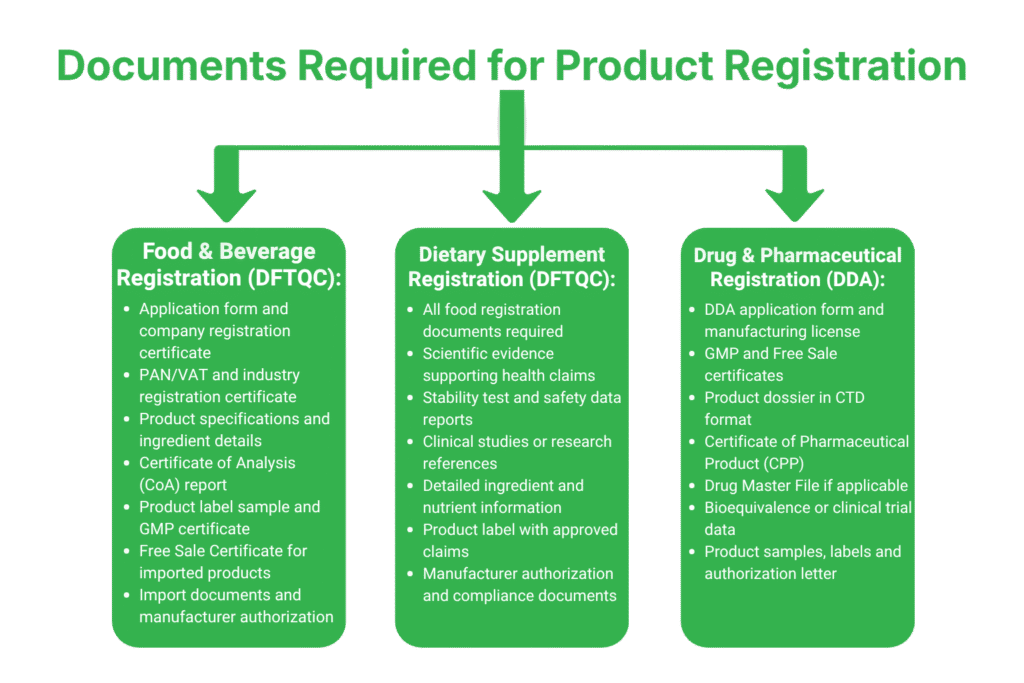
For Food and Beverage Registration (DFTQC)
- Completed application form (available at DFTQC or official website)
- Company registration certificate (certified copy)
- PAN/VAT certificate
- Industry registration certificate
- Product specification sheet
- Full ingredient list with quantities
- Certificate of Analysis (CoA) from accredited laboratory
- Product label sample (meeting Nepal labeling requirements)
- GMP certificate (for manufactured products)
- Certificate of Free Sale (for imported food products)
- Import declaration or invoice (for imported products)
- Trademark certificate (if applicable)
- Authorization letter from foreign manufacturer (for importers)
For Dietary Supplement Registration (DFTQC)
- All documents listed under food registration
- Scientific evidence supporting health or nutrient claims
- Toxicological safety data (if required)
- Stability test report
- Clinical data or published research references (for specific claims)
For Drug and Pharmaceutical Registration (DDA)
- Completed DDA application form
- Manufacturing license from country of origin
- Good Manufacturing Practice (GMP) certificate
- Product dossier (CTD format preferred)
- Certificate of Pharmaceutical Product (CPP) from country of origin
- Certificate of Free Sale
- Drug Master File (DMF) if applicable
- Bioequivalence or clinical trial data (for new chemical entities)
- Product label and package insert
- Sample product for laboratory testing
- Authorization letter from foreign manufacturer
Product Registration Fees in Nepal
| Product Category | Authority | Approximate Fee (NPR) |
|---|---|---|
| Domestic Food Product Registration | Department of Food Technology and Quality Control (DFTQC) | NPR 2,000 – 10,000 |
| Imported Food Product Registration | Department of Food Technology and Quality Control (DFTQC) | NPR 5,000 – 15,000 |
| Beverage Registration | Department of Food Technology and Quality Control (DFTQC) | NPR 5,000 – 20,000 |
| Health Supplement Registration | Department of Food Technology and Quality Control (DFTQC) | NPR 10,000 – 25,000 |
| Allopathic Drug Registration (Generic) | Department of Drug Administration (DDA) | NPR 10,000 – 50,000 |
| Ayurvedic/Herbal Drug Registration | Department of Drug Administration (DDA) | NPR 5,000 – 30,000 |
| Drug Registration Renewal | Department of Drug Administration (DDA) | NPR 5,000 – 20,000 |
Note: Fees are subject to revision by the Government of Nepal. Applicants should confirm current fees directly with DFTQC or DDA at the time of application.
Product Registration Validity and Renewal in Nepal
Product registrations in Nepal are not permanent. All registrations require periodic renewal.
- Food product registration under DFTQC is generally valid for 3 to 5 years and must be renewed before expiry.
- Drug registration under DDA is generally valid for 5 years and requires renewal with updated documentation.
- Health supplement registration is typically valid for 3 years.
Failure to renew product registration before expiry can result in product seizure, fines, and legal action under the Food Act and Drug Act.
Labeling Requirements for Registered Products in Nepal
The Food Regulation, 2027 BS and DDA guidelines mandate that all registered products bear specific label information. Non-compliance with labeling requirements results in rejection of registration or market withdrawal.
Mandatory label information includes:
- Product name and brand name
- Net weight or volume
- Full ingredient list in descending order
- Nutritional information per serving
- Manufacturing date and expiry date
- Batch number / lot number
- Country of origin
- Manufacturer name and address
- Importer name and address (for imported products)
- Instructions for use and storage conditions
- Registration number issued by DFTQC or DDA
- Nepali language text (required for domestic market)
Product Registration for Imported Products in Nepal
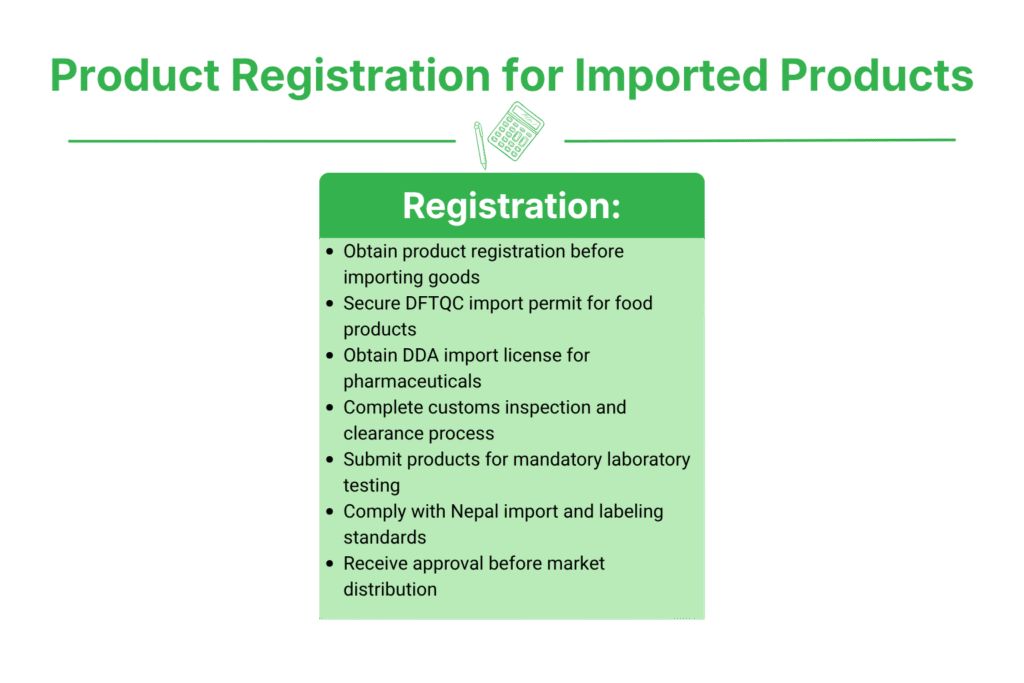
Companies importing food, supplements, drugs, or beverages into Nepal must obtain product registration from the relevant authority before importing. Additionally, imported products require:
- Import Permit from DFTQC (for food and supplements)
- Import License from DDA (for drugs and pharmaceuticals)
- Border inspection and clearance at Customs
- Laboratory testing at the port of entry or designated government laboratory
The Customs Act, 2064 BS and Nepal Import Policy also govern the importation of regulated products alongside product registration requirements.
Penalties for Selling Unregistered Products in Nepal
Selling, distributing, or importing unregistered food products, supplements, drugs, or beverages in Nepal carries serious legal consequences under Nepali law.
Under the Food Act, 2023 BS (as amended), penalties include:
- Fine of NPR 1,000 to NPR 100,000 depending on the nature of violation
- Seizure and destruction of unregistered products
- Cancellation of business license
Under the Drug Act, 2035 BS, penalties include:
- Imprisonment of up to 5 years and/or heavy fines for manufacturing or selling unregistered drugs
- Permanent cancellation of manufacturing or import license
FAQs
1. Which authority handles food product registration in Nepal?
The Department of Food Technology and Quality Control (DFTQC) under the Ministry of Agriculture and Livestock Development handles food product registration, beverage registration, and dietary supplement registration in Nepal.
2. How long does product registration take in Nepal?
Product registration in Nepal typically takes 3 to 6 months for food and beverages and 6 to 12 months for drugs and pharmaceuticals, depending on document completeness and laboratory testing timelines.
3. Do foreign companies need a local agent for product registration in Nepal?
Yes. Foreign manufacturers must appoint a registered local agent or importer in Nepal who holds company registration, PAN/VAT, and applicable licenses to file and manage the product registration application on their behalf.
4. Can an imported supplement be sold in Nepal without registration?
No. All imported dietary supplements must obtain DFTQC product registration and an import permit before they can legally enter the Nepali market. Selling unregistered supplements is a violation of the Food Act.
5. Is GMP certification required for product registration in Nepal?
Yes. Good Manufacturing Practice (GMP) certification from the country of manufacture is a mandatory document for drug registration under DDA. DFTQC also requires GMP evidence for food and supplement manufacturers.
6. How do I renew a product registration certificate in Nepal?
Submit a renewal application to DFTQC or DDA at least 60 to 90 days before expiry, along with updated documents, renewal fee payment, and a fresh Certificate of Analysis. Late renewal applications may attract additional penalty fees.
Conclusion
Product registration in Nepal is a structured legal requirement that protects consumers and ensures that all food products, dietary supplements, drugs, and beverages meet established safety and quality standards. Companies must engage with DFTQC for food, supplement, and beverage registration and with DDA for all drug and pharmaceutical registrations. The process involves document preparation, laboratory testing, label compliance, and technical committee review. Compliance with the Food Act, Drug Act, and Consumer Protection Act is mandatory for all businesses operating in the Nepali market. Early preparation of documents and working with experienced local agents significantly reduces delays in obtaining product registration in Nepal.