

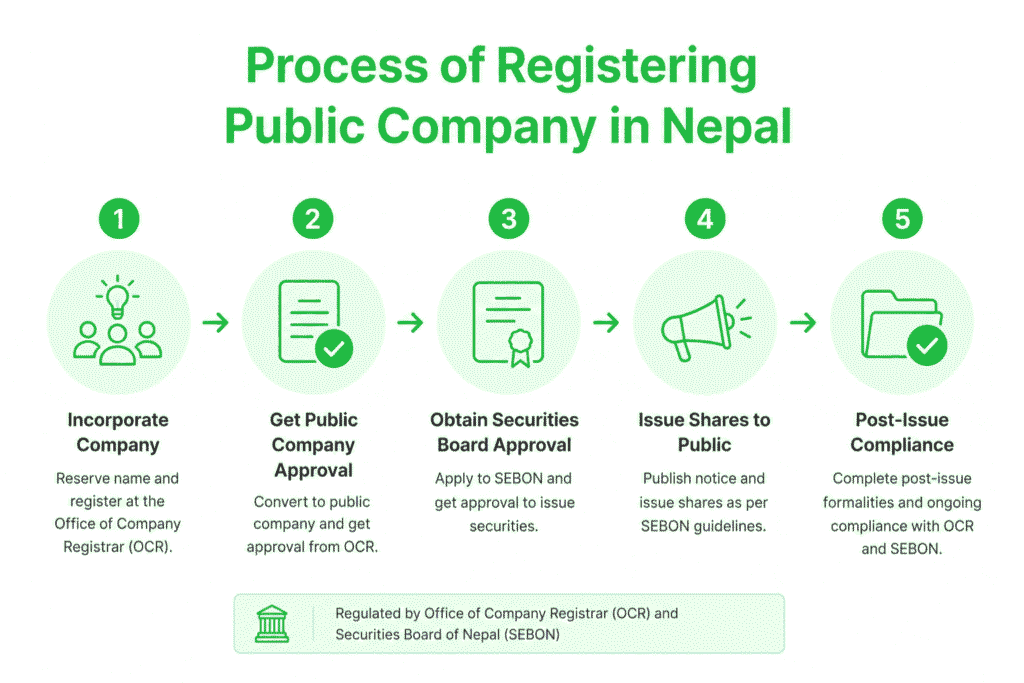
The process of registering a public company in Nepal is governed by the Companies Act, 2063 (2006) and regulated by the Office of the Company Registrar (OCR). A public company in Nepal is a company that can offer its shares to the general public and must comply with strict disclosure and governance requirements. Understanding the full process of public company registration in Nepal is essential for entrepreneurs, investors, and legal professionals who want to establish a publicly traded or publicly held corporate entity in the country.
What is a Public Company in Nepal?
A public limited company in Nepal is a type of company that has the authority to issue shares to the public and can be listed on the Nepal Stock Exchange (NEPSE). Under Section 2(k) of the Companies Act, 2063, a public company must have a minimum of seven shareholders and three directors. The company’s name must end with the words “Limited” (लिमिटेड).
Unlike a private company, a public company in Nepal:
- Can invite the public to subscribe to its shares and debentures
- Must publish a prospectus before issuing shares
- Is subject to oversight by the Securities Board of Nepal (SEBON)
- Must comply with more rigorous financial reporting and audit requirements
Legal Framework for Public Company Registration in Nepal
The registration and operation of a public company in Nepal is governed by several key laws:
| Law / Regulation | Purpose |
|---|---|
| Companies Act, 2063 (2006) | Primary law for company incorporation and governance |
| Securities Act, 2063 (2007) | Governs issuance of securities to the public |
| Securities Registration and Issuance Regulations, 2073 | Regulates public share issuance |
| Income Tax Act, 2058 | Taxation of companies |
| Industrial Enterprises Act, 2076 | Applicable for industrial public companies |
| Nepal Rastra Bank Act, 2058 | Applicable for banking and financial institutions |
Minimum Requirements for Registering a Public Company in Nepal
Before initiating the public company registration process in Nepal, the following minimum requirements must be fulfilled:
- Minimum Shareholders: 7 (seven)
- Minimum Directors: 3 (three)
- Minimum Paid-Up Capital: NPR 1,00,00,000 (One Crore) as per general provisions; sectoral minimums may be higher
- Company Name: Must end with “Limited”
- Registered Office Address: A fixed address in Nepal is mandatory
- Memorandum of Association (MoA): Must be prepared and signed
- Articles of Association (AoA): Must be prepared and signed
Step-by-Step Process of Registering a Public Company in Nepal
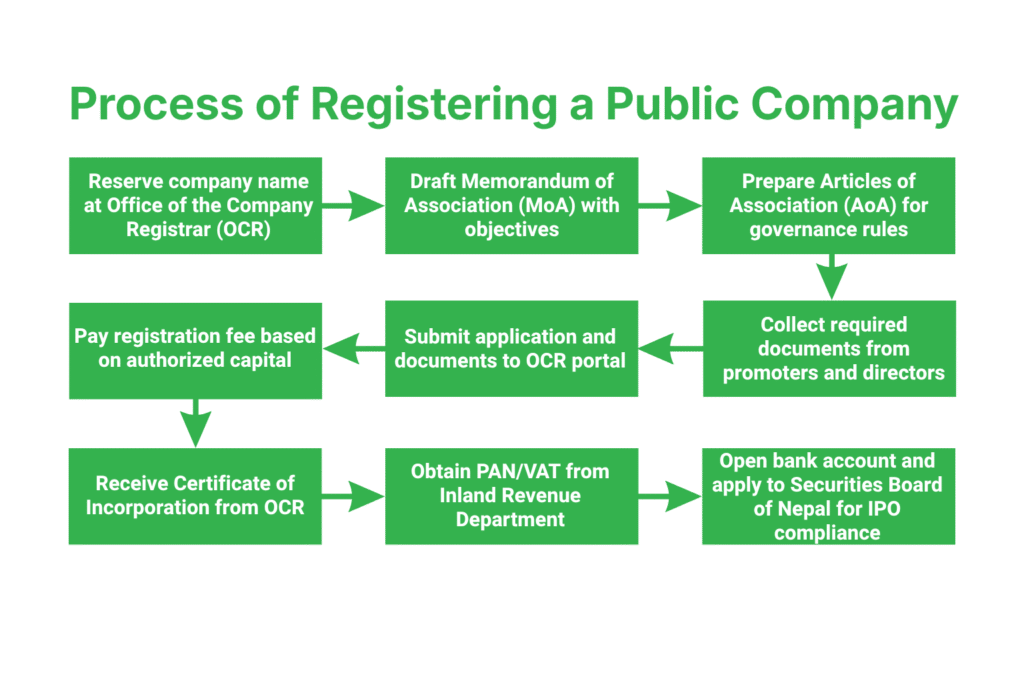
Step 1: Name Reservation
The first step in registering a public company in Nepal is reserving the company name with the Office of the Company Registrar (OCR).
- Visit the OCR Online Portal or visit the OCR office in Kathmandu
- Submit an application for name reservation
- Pay the name reservation fee
- The OCR checks for name similarity and compliance with naming rules under Section 10 of the Companies Act, 2063
- Upon approval, the name is reserved for 35 days
The proposed name must not be identical or similar to an already registered company. It should not contain words that are prohibited under the Companies Act.
Step 2: Drafting Memorandum of Association (MoA)
The Memorandum of Association is the founding charter of the company. Under Section 11 of the Companies Act, 2063, the MoA must contain:
- The name of the company
- The address of the registered office
- The objectives and business activities of the company
- The total authorized share capital and its division into shares
- The liability of the members (limited by shares)
- The names and details of the promoters/shareholders
All promoters must sign the MoA. The MoA must be notarized or executed as per the required legal format.
Step 3: Drafting Articles of Association (AoA)
The Articles of Association govern the internal management of the company. Under Section 18 of the Companies Act, 2063, the AoA of a public company must include:
- Rules for share transfer and issuance
- Rules for conducting Board of Directors meetings
- Rules for conducting Annual General Meetings (AGM)
- Dividend declaration procedures
- Rules for appointment and removal of directors
- Financial reporting obligations
The AoA must be consistent with the MoA and the Companies Act, 2063.
Step 4: Preparation of Required Documents
The following documents are required for the public company registration in Nepal:
- Memorandum of Association (MoA) – signed by all promoters
- Articles of Association (AoA) – signed by all promoters
- Application Form – prescribed form under the Companies Act
- Citizenship certificates of all promoters/directors (Nepali citizens) or passport copies (foreign nationals)
- Passport-sized photographs of all promoters and directors
- PAN/VAT registration documents (if applicable)
- Proof of registered office address – ownership deed or rental agreement
- Tax clearance certificates of promoters (if required)
- Director’s consent letter – each director must provide written consent
- Declaration by promoters confirming compliance with the Companies Act
Step 5: Submission of Application to OCR
After preparing all documents, submit the application to the Office of the Company Registrar (OCR) at Tripureshwor, Kathmandu, or through the OCR Online Portal.
- Submit all required documents along with the prescribed application form
- Pay the registration fee based on the authorized share capital
- OCR verifies the documents and conducts due diligence
- If there are any deficiencies, OCR issues a notice for correction
Step 6: Payment of Registration Fee
The registration fee for public company registration in Nepal is calculated based on the authorized share capital. The fee structure is prescribed under the Company Registration Fee Schedule issued by OCR.
| Authorized Share Capital (NPR) | Registration Fee (Approx.) |
|---|---|
| Up to 1,00,000 | NPR 1,000 |
| 1,00,001 to 5,00,000 | NPR 4,500 |
| 5,00,001 to 25,00,000 | NPR 9,500 |
| 25,00,001 to 1,00,00,000 | NPR 18,000 |
| Above 1,00,00,000 | NPR 18,000 + additional charges per lakh |
The fee must be paid through the prescribed payment channels, including online banking or counter payment at OCR.
Step 7: Issuance of Certificate of Incorporation
Upon satisfactory verification of all documents and payment of fees, the Office of the Company Registrar issues the Certificate of Incorporation under Section 17 of the Companies Act, 2063.
The Certificate of Incorporation confirms:
- The company is legally incorporated as a public limited company
- The company has a separate legal identity from its shareholders
- The company can enter into contracts, own property, and sue or be sued
Step 8: PAN/VAT Registration
After receiving the Certificate of Incorporation, the company must register for a Permanent Account Number (PAN) with the Inland Revenue Department (IRD). Companies with annual turnover above the prescribed threshold must also register for VAT.
- Visit IRD Nepal for PAN registration
- Submit the Certificate of Incorporation, MoA, AoA, and promoter documents
- PAN is issued within a few working days
Step 9: Opening a Bank Account
The company must open a corporate bank account in Nepal in the company’s name. The bank requires:
- Certificate of Incorporation
- MoA and AoA
- PAN certificate
- Board resolution for opening the account
- KYC documents of authorized signatories
Step 10: Compliance with SEBON for Public Share Issuance
If the public company intends to issue shares to the general public, it must comply with the Securities Act, 2063 and register with the Securities Board of Nepal (SEBON).
- File an application with SEBON for securities registration
- Prepare and publish a Prospectus as per SEBON regulations
- Obtain approval from SEBON before issuing shares to the public
- After successful IPO, the company may apply for listing on Nepal Stock Exchange (NEPSE)
Visit SEBON Nepal for more information.
Post-Registration Compliance for Public Companies in Nepal
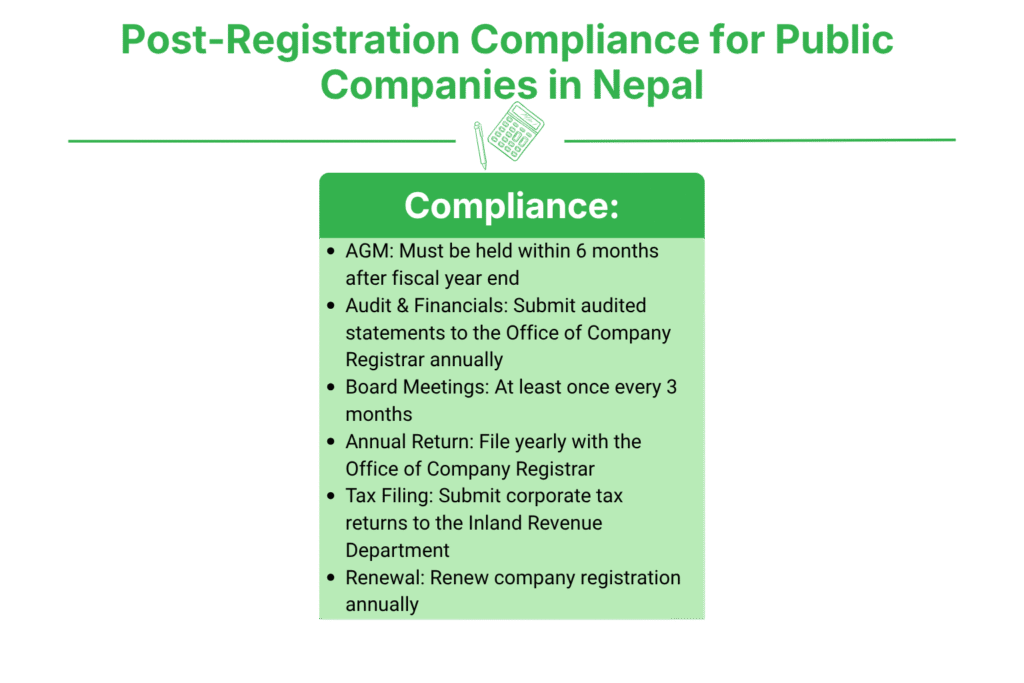
After completing the public company registration process in Nepal, the company must fulfill ongoing compliance requirements:
- Annual General Meeting (AGM): Must be held within 6 months of the end of the fiscal year
- Annual Report and Audit: Audited financial statements must be submitted to OCR annually
- Board of Directors Meetings: Must be held at least once every three months
- Annual Return Filing: Must be filed with OCR every year
- Tax Filing: Corporate income tax returns must be filed with the IRD
- Renewal of Registration: Company registration must be renewed annually
Key Differences Between Public and Private Company in Nepal
| Feature | Public Company | Private Company |
|---|---|---|
| Minimum Shareholders | 7 | 1 |
| Minimum Directors | 3 | 1 |
| Share Transfer | Freely transferable | Restricted |
| Public Share Issuance | Allowed | Not allowed |
| Listing on NEPSE | Possible | Not allowed |
| Name Suffix | “Limited” | “Private Limited” |
| Regulatory Oversight | Office of Company Registrar + Securities Board of Nepal | Office of Company Registrar |
FAQs
1. How long does it take to register a public company in Nepal?
The public company registration process in Nepal typically takes 7 to 15 working days after submission of complete documents to the OCR, provided all documents are in order and there are no deficiencies.
2. What is the minimum capital required to register a public company in Nepal?
The minimum paid-up capital for a general public company is NPR 1 Crore (1,00,00,000). For sector-specific companies like banks, insurance, or hydropower, higher capital requirements apply as per their respective regulatory authorities.
3. Can a foreign national be a promoter of a public company in Nepal?
Yes, foreign nationals can be promoters of a public company in Nepal, subject to the Foreign Investment and Technology Transfer Act (FITTA), 2075 and approval from the Department of Industry or relevant authority.
4. Is it mandatory for a public company to be listed on NEPSE?
No, NEPSE listing is not mandatory for all public companies. However, if a public company issues shares to the general public through an IPO, it is generally required to apply for NEPSE listing as per the Securities Act, 2063 and SEBON regulations.
5. What is the role of SEBON in public company registration in Nepal?
SEBON (Securities Board of Nepal) regulates the issuance of securities to the public. If a public company wants to raise funds through public share issuance, it must register its securities with SEBON and comply with the Securities Act, 2063 and related regulations.
6. What happens if a public company fails to file its annual return with OCR?
Under the Companies Act, 2063, failure to file the annual return attracts penalties and fines. Repeated non-compliance can result in the de-registration or blacklisting of the company by the OCR.
Conclusion
The process of registering a public company in Nepal involves multiple legal, regulatory, and administrative steps governed by the Companies Act, 2063, Securities Act, 2063, and regulations of the Office of the Company Registrar and SEBON. From name reservation to issuance of the Certificate of Incorporation and post-registration compliance, each step requires careful attention to legal requirements and documentation. Promoters and investors who plan to establish a public limited company in Nepal should consult qualified legal professionals and visit the OCR Nepal and SEBON Nepal official websites for updated guidelines and procedures.