

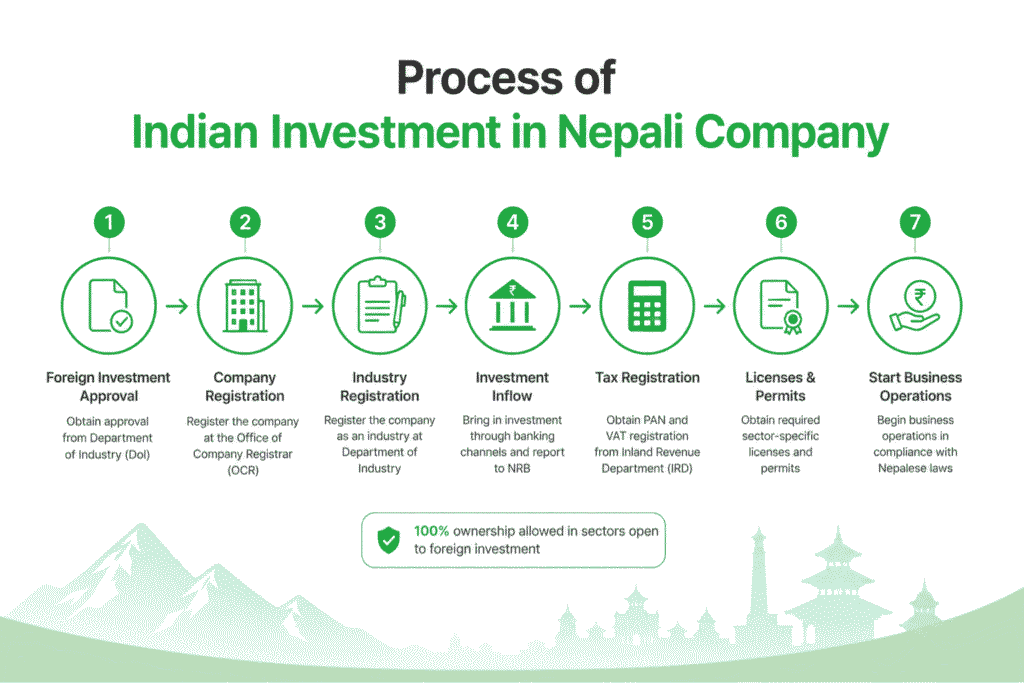
Process of Indian Investment in Nepali Company Indian investment in Nepal holds a significant place in the country’s foreign direct investment (FDI) landscape. India remains one of the largest sources of foreign investment in Nepal. The geographic proximity, cultural similarities, open border policy, and bilateral trade agreements make Nepal an attractive destination for Indian investors. However, Indian nationals and Indian companies must follow a defined legal process to invest in Nepal. This article explains every step of the process in detail.
What is the Legal Framework Governing Foreign Investment in Nepal?
The primary law that governs foreign investment in Nepal is the Foreign Investment and Technology Transfer Act, 2019 (FITTA 2019). This Act replaced the earlier FITTA of 1992 and brought a more structured and investor-friendly approach to foreign direct investment (FDI) in Nepal.
Other relevant laws include:
- Companies Act, 2006 – Governs company registration in Nepal
- Industrial Enterprises Act, 2020 – Regulates industries and enterprises
- Nepal Rastra Bank Act, 2002 – Oversees foreign exchange regulations
- Foreign Exchange (Regulation) Act, 1962 – Controls currency transactions
- Income Tax Act, 2002 – Covers tax obligations
- Special Economic Zone Act, 2016 – Applicable for SEZ-based investments
Under FITTA 2019, foreign investment includes equity investment, reinvestment of earnings, and investment made through technology transfer. Indian investors, whether individuals or corporate entities, fall under the definition of “foreign investors” under this Act.
Can Indian Nationals and Indian Companies Invest in Nepal?
Yes. Indian nationals, Indian registered companies, Non-Resident Indians (NRIs), and Indian joint ventures can invest in Nepal. Under FITTA 2019, a “foreign investor” means any foreign national, foreign company, or foreign institutional body making an investment in Nepal.
Indian investment in Nepal is also guided by the Treaty of Peace and Friendship, 1950 between India and Nepal, which gives Indian citizens equal rights to engage in economic activities in Nepal as Nepali citizens. However, for formal foreign direct investment purposes, Indian investors must still follow the FITTA 2019 process and obtain approval from concerned government bodies.
Which Sectors Allow Indian Investment in Nepal?
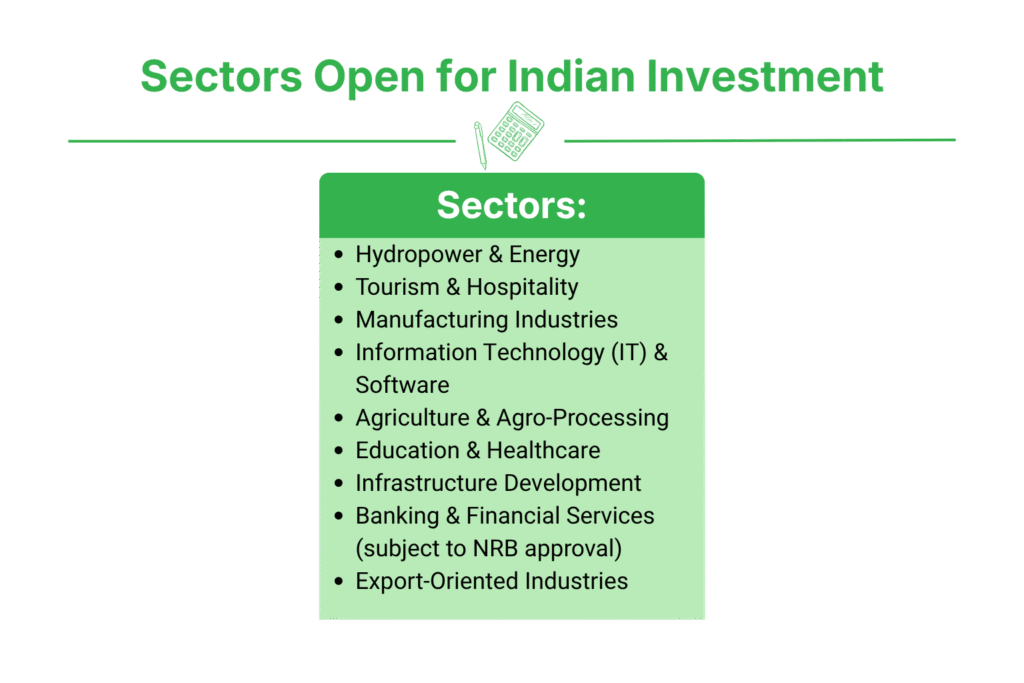
Nepal allows foreign investment including Indian investment in most sectors. However, certain sectors are restricted or prohibited.
Sectors Open for Indian Investment
- Hydropower and energy
- Tourism and hospitality
- Manufacturing industries
- Information technology and software
- Agriculture and agro-processing
- Education and health
- Infrastructure development
- Banking and financial services (subject to NRB regulations)
- Export-oriented industries
Sectors Restricted or Prohibited for Foreign Investment
Under Schedule 1 and Schedule 2 of FITTA 2019, some industries are either restricted or completely closed for foreign investment.
| Category | Examples |
|---|---|
| Prohibited Sectors | Cottage industries, personal service businesses (hair cutting, tailoring), weapons manufacturing without government permission, poultry farming (small scale), remittance businesses |
| Restricted Sectors | Retail trading (up to certain limits), media and broadcasting (joint venture required), domestic air transport, travel agencies |
Indian investors must review these schedules carefully before proceeding with investment plans.
What is the Minimum Investment Threshold for Indian Investors in Nepal?
As per FITTA 2019, the minimum foreign investment threshold is NPR 50 million (approximately INR 31 million) for most sectors. However, for specific sectors like tourism and agro-industries, relaxed thresholds may apply.
For investments below this threshold, Indian citizens residing in Nepal under the Treaty of Peace and Friendship, 1950 may still conduct business but without the formal FDI route.
What is the Step-by-Step Process of Indian Investment in a Nepali Company?
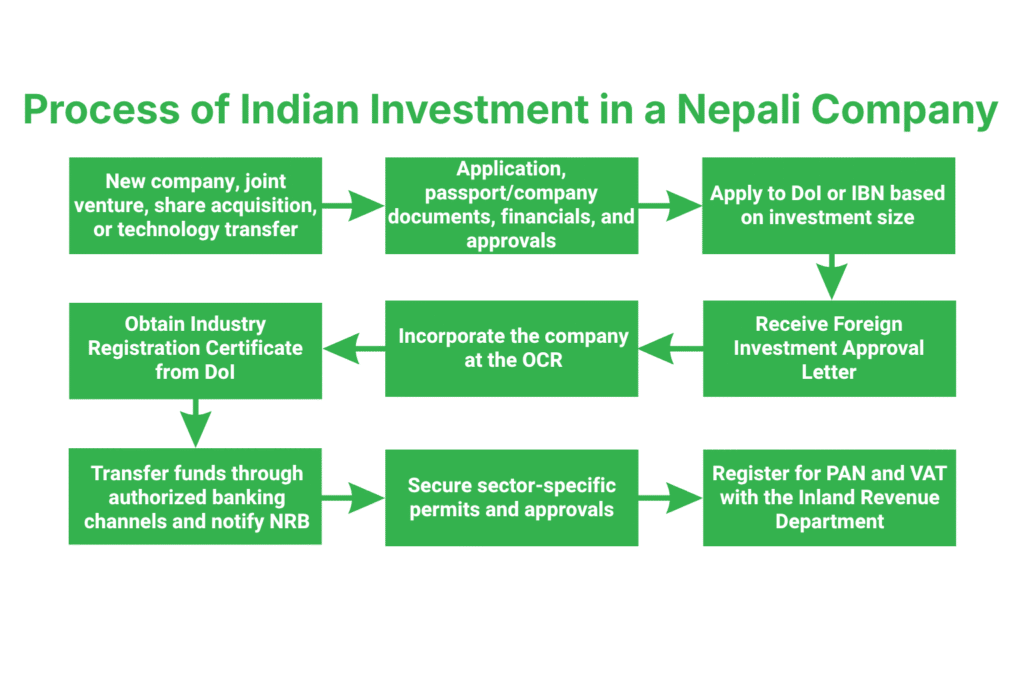
The process of Indian investment in Nepal involves multiple government agencies. The main bodies are:
- Department of Industry (DoI) – for investments up to NPR 6 billion
- Investment Board Nepal (IBN) – for investments above NPR 6 billion or in priority sectors
- Nepal Rastra Bank (NRB) – for foreign exchange and remittance approvals
- Office of the Company Registrar (OCR) – for company registration
Step 1: Choose the Investment Route
Indian investors can invest through:
- Establishing a new company (wholly owned or joint venture)
- Acquiring shares in an existing Nepali company
- Technology Transfer Agreement with a Nepali company
Step 2: Prepare Required Documents
The following documents are required for foreign investment approval:
- Application form as prescribed by DoI or IBN
- Project proposal or business plan
- Passport copy of Indian investor (for individuals)
- Certificate of Incorporation (for Indian companies)
- Board resolution authorizing investment (for companies)
- Audited financial statements of the investing company (last 3 years)
- Bank solvency certificate from a recognized Indian bank
- Tax clearance certificate from India
- Memorandum and Articles of Association of the investing company
- Power of Attorney if represented by an agent
- No Objection Certificate (NOC) from relevant sector ministry, if required
Step 3: Submit Application to Department of Industry or Investment Board Nepal
- Submit the completed application with all supporting documents to DoI (for investments up to NPR 6 billion)
- Submit to Investment Board Nepal (for investments above NPR 6 billion)
- Pay the prescribed application fee
The DoI processes applications under the One Stop Service Center (OSSC) system, which is meant to streamline approval processes.
You can access the DoI portal at: https://www.doind.gov.np Investment Board Nepal portal: https://www.ibn.gov.np
Step 4: Receive Foreign Investment Approval
After review, DoI or IBN issues a Foreign Investment Approval Letter. This approval grants the Indian investor legal permission to invest in Nepal. The approval letter specifies:
- Approved investment amount
- Sector of investment
- Type of investment (equity, technology transfer, etc.)
Step 5: Register the Company at the Office of the Company Registrar
After receiving the foreign investment approval, the investor must register the company under the Companies Act, 2006 at the Office of the Company Registrar (OCR).
- Submit the Memorandum of Association and Articles of Association
- Pay registration fees based on authorized capital
- Obtain the Certificate of Incorporation
OCR portal: https://www.ocr.gov.np
Step 6: Register Industry at Department of Industry
After company registration, the company must register the industry or enterprise at the Department of Industry under the Industrial Enterprises Act, 2020. This gives the company an Industry Registration Certificate.
Step 7: Open a Bank Account and Bring Capital through Banking Channel
The Indian investor must bring the investment capital through official banking channels. Nepal Rastra Bank mandates that:
- All foreign investment must be brought in through a licensed bank or financial institution in Nepal
- The amount must correspond to the approved investment
- NRB must be informed of the foreign exchange inflow
This is governed by Nepal Rastra Bank’s Foreign Investment Guidelines.
NRB portal: https://www.nrb.org.np
Step 8: Obtain Sector-Specific Licenses and Permits
Depending on the nature of the business, Indian investors may also need:
- Environmental Impact Assessment (EIA) clearance for large projects
- License from Nepal Electricity Authority (NEA) for hydropower
- Hotel and tourism license from Ministry of Culture, Tourism and Civil Aviation
- Pharmaceutical license from Department of Drug Administration
- School/hospital operating license from respective ministries
Step 9: Tax Registration at Inland Revenue Department
Every company in Nepal must obtain a Permanent Account Number (PAN) and register for Value Added Tax (VAT) if applicable.
- PAN registration is mandatory for all companies
- VAT registration is required if annual turnover exceeds NPR 5 million
IRD portal: https://www.ird.gov.np
What Are the Tax Incentives for Indian Investors in Nepal?
Nepal offers several tax incentives under the Income Tax Act, 2002 and the Industrial Enterprises Act, 2020.
| Incentive | Details |
|---|---|
| Tax Holiday | Up to 10 years for export-oriented industries and 5 years for manufacturing industries |
| Reduced Tax Rate | Special industries get 20% tax rate instead of standard 25% |
| Customs Duty Exemption | On import of machinery and equipment for manufacturing |
| Double Taxation Avoidance | India–Nepal DTAA signed in 1987 prevents double taxation |
| Repatriation of Profits | Indian investors can repatriate profit, dividend, and capital after paying applicable taxes |
The India-Nepal Double Taxation Avoidance Agreement (DTAA) signed in 1987 is an important consideration for Indian investors. It ensures that income is not taxed twice in both India and Nepal.
How Can Indian Investors Repatriate Profits from Nepal?
Under FITTA 2019, Indian investors have the legal right to repatriate:
- Profit and dividends earned
- Capital gain after tax payment
- Amounts received from sale of shares
- Royalties and technical fees from technology transfer
The repatriation must be done through authorized banking channels with approval from Nepal Rastra Bank. Investors must present tax clearance documents before repatriation is permitted.
What is the Role of the One Stop Service Centre (OSSC)?
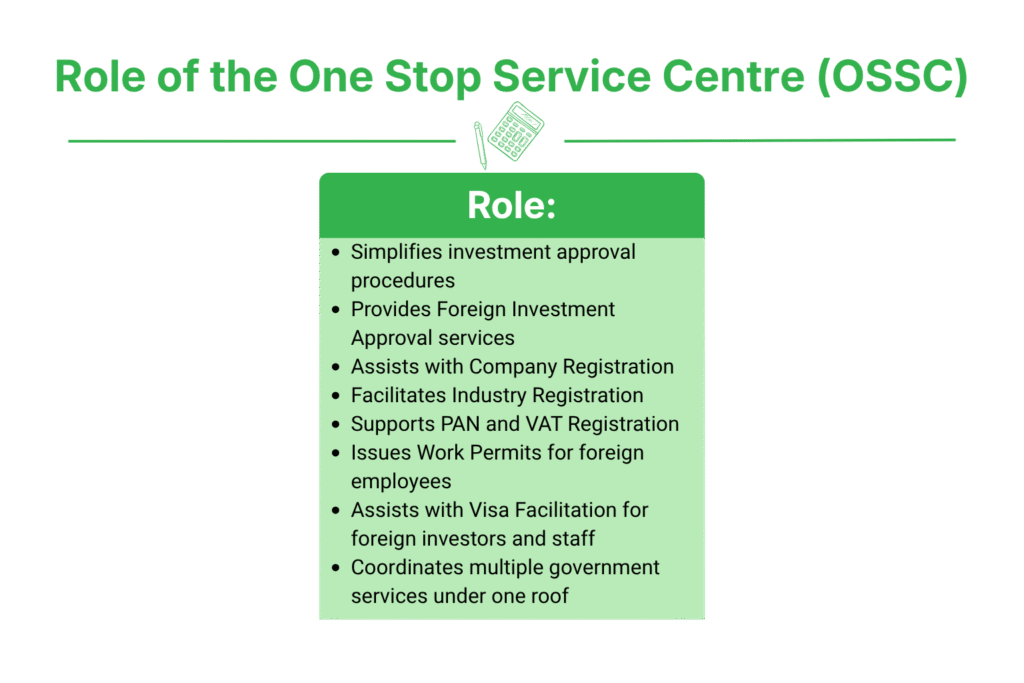
The One Stop Service Centre (OSSC) operates under the Department of Industry and is a key facility for foreign investors. It brings together representatives from multiple government agencies under one roof to process investment-related approvals efficiently.
Services available at OSSC:
- Foreign investment approval
- Company registration
- Industry registration
- PAN/VAT registration
- Work permit issuance for foreign employees
- Visa facilitation
FAQs
1. Can an Indian individual directly invest in a Nepali company without forming a joint venture?
Yes, an Indian individual can establish a wholly owned subsidiary or invest solo in Nepal subject to FITTA 2019 approval and minimum investment threshold of NPR 50 million.
2. Is there any restriction on land ownership for Indian investors in Nepal?
Yes. Foreign investors, including Indians, cannot own land directly in Nepal. However, they can lease land for business purposes for up to 50 years, extendable by another 40 years.
3. What is the processing time for foreign investment approval in Nepal?
The Department of Industry is required to process applications within 15 working days under FITTA 2019. Delays may occur if documents are incomplete.
4. Can Indian investors bring Indian employees to work in Nepal?
Yes, Indian investors can bring Indian nationals to work in Nepal. Work permits are issued by the Department of Labour through the OSSC for a limited number of foreign employees.
5. Is profit repatriation guaranteed under Nepal law?
Yes, FITTA 2019 guarantees the right to repatriate profits, dividends, and capital after payment of applicable taxes. Nepal Rastra Bank oversees all repatriation transactions.
6. Does the India-Nepal Treaty of 1950 give Indian investors any special advantage?
Yes, the Treaty of Peace and Friendship, 1950 gives Indian citizens equal economic rights in Nepal. For small-scale businesses, Indians can operate without formal FDI approval. However, large investments must still follow FITTA 2019 procedures.
Conclusion
Indian investment in Nepal follows a well-defined legal process under FITTA 2019, the Companies Act 2006, the Industrial Enterprises Act 2020, and NRB regulations. Indian investors must obtain foreign investment approval from the Department of Industry or Investment Board Nepal, register their company, bring capital through banking channels, and comply with sector-specific requirements. Nepal offers strong tax incentives, profit repatriation rights, and a favorable bilateral framework under the India-Nepal Treaty and DTAA that makes it a viable investment destination for Indian businesses and individuals.Add to Conversation