


Foreign companies operating in Nepal must understand the concept of Permanent Establishment Branch in Nepal before conducting any business activity. A permanent establishment branch in Nepal creates a taxable presence for foreign entities. The Income Tax Act, 2058 (2002) and the Company Act, 2063 (2006) govern how permanent establishments function and how they are taxed in Nepal.
This article explains everything about the permanent establishment branch in Nepal, from registration to tax liability.
What Is a Permanent Establishment Branch in Nepal?
A Permanent Establishment (PE) refers to a fixed place of business through which a foreign company carries out its business activities wholly or partly in Nepal. The concept of permanent establishment in Nepal is defined under Section 2(dda) of the Income Tax Act, 2058.
A foreign company has a permanent establishment in Nepal if it:
- Maintains a fixed place of business in Nepal such as an office, branch, factory, workshop, or mine
- Has a dependent agent in Nepal who has the authority to conclude contracts on behalf of the foreign company
- Performs services in Nepal for more than 90 days within any 12-month period
- Operates a construction, assembly, or installation project in Nepal for more than 90 days
The permanent establishment branch is the most common form of PE in Nepal. It is essentially a branch office of a foreign company registered in Nepal under the Company Act, 2063.
Legal Framework Governing Permanent Establishment Branch in Nepal
Several laws regulate the establishment and operation of a permanent establishment branch in Nepal:
| Law | Relevance |
|---|---|
| Income Tax Act, 2058 (2002) | Defines PE, tax liability, withholding tax, and income calculation |
| Companies Act, 2063 | Governs branch office registration of foreign companies |
| Foreign Investment and Technology Transfer Act, 2075 (FITTA 2019) | Governs foreign investment and repatriation |
| Industrial Enterprises Act, 2076 (2020) | Applicable if the PE is engaged in industrial activities |
| Nepal Rastra Bank Act, 2058 | Regulates foreign currency transactions and remittances |
| Value Added Tax Act, 2052 | VAT registration and compliance for PE branches |
The Department of Industry (DOI) and the Office of the Company Registrar (OCR) are the primary government bodies for registering a permanent establishment branch in Nepal. You can access the OCR portal at https://ocr.gov.np and the Department of Industry at https://www.doi.gov.np.
How to Register a Permanent Establishment Branch in Nepal?
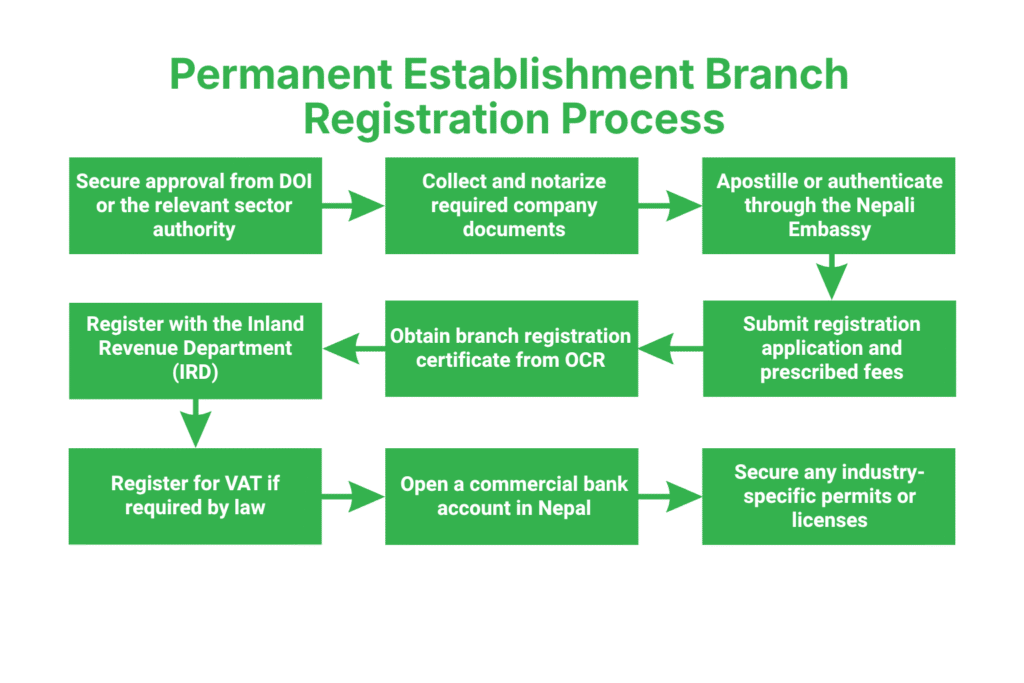
The registration of a permanent establishment branch in Nepal is a structured process. The foreign company must register its branch office at the Office of the Company Registrar (OCR) under the provisions of Section 155 of the Company Act, 2063.
Step-by-Step Registration Process
- Obtain approval from the Department of Industry (DOI) or relevant sector ministry depending on the nature of business
- Prepare and notarize all required documents from the country of incorporation
- Get documents apostilled or authenticated by the Nepali Embassy in the home country
- Submit the application to the Office of the Company Registrar along with prescribed fees
- Obtain the Certificate of Registration of the branch office from OCR
- Register with the Inland Revenue Department (IRD) at https://ird.gov.np for Permanent Account Number (PAN)
- Register for VAT if the annual turnover exceeds the threshold or if engaged in import/export
- Open a bank account in a commercial bank in Nepal for business transactions
- Obtain industry-specific licenses if required (e.g., banking, insurance, telecom)
Documents Required for Permanent Establishment Branch Registration in Nepal
The Office of the Company Registrar requires the following documents for registering a foreign company’s branch as a permanent establishment in Nepal:
- Certificate of Incorporation of the foreign parent company (notarized and apostilled)
- Memorandum and Articles of Association of the parent company (notarized and apostilled)
- Board Resolution authorizing the establishment of a branch in Nepal
- Power of Attorney authorizing a representative or agent in Nepal
- Latest audited financial statements of the parent company
- Passport copy of the authorized representative in Nepal
- Details of the proposed business activities in Nepal
- Proof of registered office address in Nepal (rental agreement or ownership document)
- Application form as prescribed by OCR
- No Objection Certificate (NOC) from the relevant ministry (if applicable)
All foreign documents must be translated into Nepali and duly authenticated.
Tax Treatment of Permanent Establishment Branch in Nepal
The Income Tax Act, 2058 treats a permanent establishment branch as a separate taxable entity in Nepal. The tax treatment differs from that of a fully incorporated subsidiary company.
Income Tax Rate for PE Branch in Nepal
| Entity Type | Corporate Tax Rate | Additional Branch Profit Tax |
|---|---|---|
| PE Branch of Foreign Company | 25% (standard rate) | 5% on repatriated profits |
| PE in Special Industry | 20% | 5% on repatriated profits |
| PE in Banking / Financial Sector | 30% | 5% on repatriated profits |
| Locally Incorporated Subsidiary | 25% | No additional tax |
Under Section 73 of the Income Tax Act, 2058, a permanent establishment is required to pay a 5% branch profit tax on the after-tax profit that is repatriated to the foreign head office. This is in addition to the standard corporate income tax.
Taxable Income of PE Branch
The taxable income of a permanent establishment branch in Nepal is calculated based on:
- Income attributable to the permanent establishment
- Income from assets used by the PE
- Income from sales of goods or services by the PE
- Income from management fees, royalties, or interest paid by the PE to the head office (which may not be deducted)
Under Section 67 of the Income Tax Act, 2058, transactions between the PE and its head office are treated as transactions between separate and independent enterprises. The arm’s length principle applies to all related-party transactions.
Withholding Tax Obligations of PE Branch in Nepal
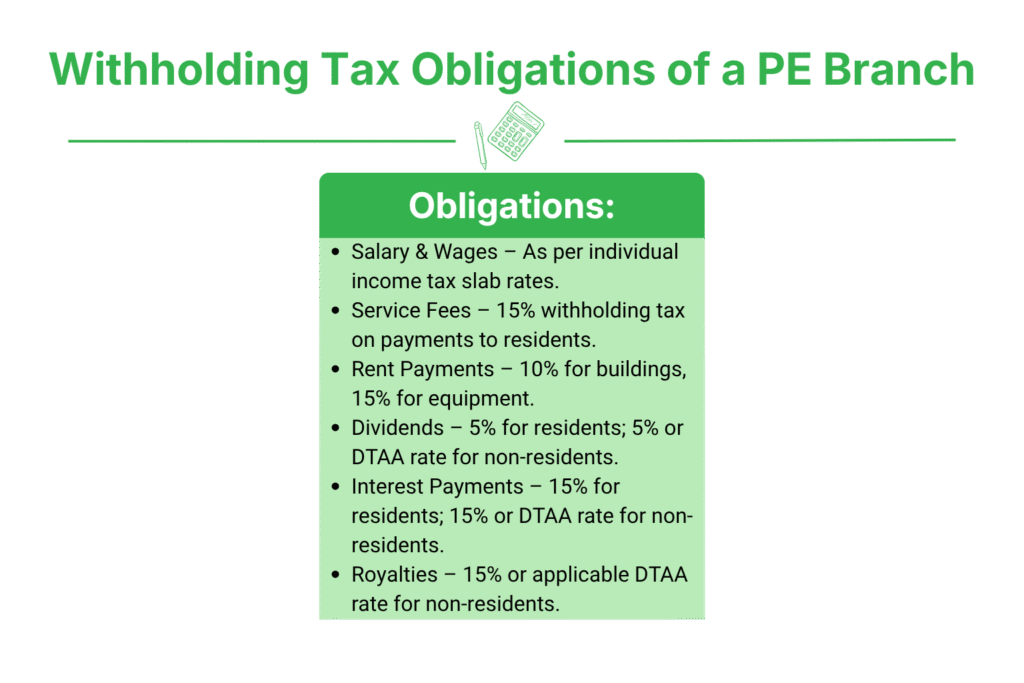
A permanent establishment branch in Nepal has withholding tax obligations under the Income Tax Act, 2058. The PE must withhold tax on certain payments made to residents and non-residents.
Key withholding tax rates applicable to a PE branch in Nepal:
- Salary and wages: As per the individual income tax slab rates
- Service fees paid to resident persons: 15%
- Rent payments: 10% for buildings, 15% for equipment
- Dividends: 5% for resident individuals, 5% or as per DTAA for non-residents
- Interest payments: 15% for residents, 15% or as per DTAA for non-residents
- Royalties to non-residents: 15% or as per the applicable Double Taxation Avoidance Agreement (DTAA)
Nepal has signed Double Taxation Avoidance Agreements (DTAA) with several countries including India, China, Norway, Austria, Mauritius, South Korea, Sri Lanka, and Thailand. These treaties may reduce the applicable withholding tax rate.
VAT Registration and Compliance for PE Branch in Nepal
A permanent establishment branch in Nepal must register for Value Added Tax (VAT) under the Value Added Tax Act, 2052 (1995) if:
- Annual turnover exceeds NPR 50 lakhs (5 million)
- The PE is engaged in the import or export of goods
- The PE provides taxable services that cross the registration threshold
The standard VAT rate in Nepal is 13%. The PE must file monthly VAT returns and maintain proper books of accounts as prescribed by the Inland Revenue Department (IRD).
Accounting and Audit Requirements for PE Branch in Nepal
A permanent establishment branch in Nepal must maintain accounts in accordance with Nepal Financial Reporting Standards (NFRS) or applicable accounting standards recognized by the Institute of Chartered Accountants of Nepal (ICAN).
Key compliance requirements:
- Maintain books of accounts in Nepal for the activities attributable to the PE
- Annual audit of financial statements by a licensed auditor registered with ICAN
- File annual tax return with the Inland Revenue Department within 3 months of the end of the fiscal year (Nepali fiscal year ends on Ashad end / mid-July)
- Submit annual report to the Office of the Company Registrar
- Renew the branch registration annually at OCR
Foreign Currency and Repatriation Rules for PE Branch in Nepal
A permanent establishment branch in Nepal must comply with Nepal Rastra Bank (NRB) regulations on foreign currency transactions. The Foreign Exchange Regulation Act, 2019 (2062 BS) governs the repatriation of profits.
A PE branch can repatriate its after-tax profits to the foreign head office after:
- Paying the 5% branch profit tax on the repatriated amount as per Section 73 of the Income Tax Act
- Obtaining tax clearance certificate from the Inland Revenue Department
- Complying with NRB directives on foreign currency remittances
The repatriation must be done through banking channels and with prior approval from NRB if the amount exceeds the prescribed limit.
Differences Between PE Branch and Subsidiary Company in Nepal
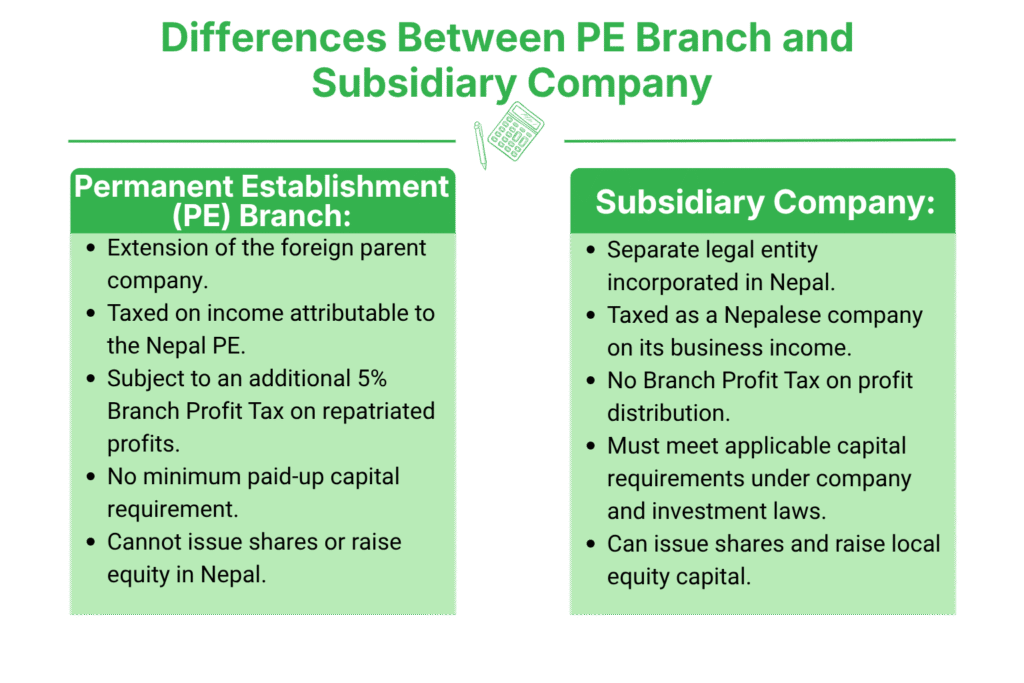
Many foreign investors confuse a permanent establishment branch with a subsidiary company. The following are the key differences:
- A PE branch is an extension of the foreign parent company, while a subsidiary is a separate legal entity incorporated in Nepal
- A PE branch is taxed on income attributable to the PE, while a subsidiary is taxed on its worldwide income from Nepal operations
- A PE branch pays an additional 5% branch profit tax on repatriated profits, while a subsidiary does not
- A subsidiary must have a minimum paid-up capital as required under the Company Act and FITTA, while a PE branch has no such capital requirement
- A PE branch cannot issue shares in Nepal, while a subsidiary can raise equity capital locally
FAQs
1. What is the definition of a Permanent Establishment in Nepal?
Under Section 2(dda) of the Income Tax Act, 2058, a permanent establishment in Nepal is a fixed place through which a foreign enterprise conducts business, including a branch, office, factory, or agent with authority to conclude contracts in Nepal.
2. What is the corporate tax rate for a PE branch in Nepal?
A permanent establishment branch in Nepal pays 25% corporate income tax on attributable profits plus an additional 5% branch profit tax on repatriated after-tax profits under Section 73 of the Income Tax Act, 2058.
3. How long does it take to register a PE branch in Nepal?
The registration process at the Office of the Company Registrar typically takes 15 to 30 working days after submission of all complete documents, subject to the nature of business and sector-specific approvals from relevant ministries.
4. Does a PE branch in Nepal need to register for VAT?
Yes, a PE branch in Nepal must register for VAT under the Value Added Tax Act, 2052 if its annual turnover exceeds NPR 5 million or if it is engaged in import/export activities, regardless of turnover.
5. Can a PE branch in Nepal repatriate profits to the head office?
Yes, a PE branch can repatriate after-tax profits to the foreign head office after paying the 5% branch profit tax, obtaining a tax clearance certificate from IRD, and complying with Nepal Rastra Bank foreign currency remittance regulations.
6. What is the difference between a PE branch and a liaison office in Nepal?
A PE branch conducts active business operations and is fully taxable in Nepal. A liaison office can only perform promotional or information-gathering activities, cannot earn income in Nepal, and is not subject to income tax under the Income Tax Act, 2058.
Conclusion
A permanent establishment branch in Nepal is subject to detailed legal, tax, and compliance obligations under the Income Tax Act, 2058, Company Act, 2063, and FITTA, 2075. Foreign companies must register their PE branch with the Office of the Company Registrar, obtain PAN from the Inland Revenue Department, and comply with VAT, withholding tax, and NRB regulations. The 5% branch profit tax on repatriation is a key cost consideration for foreign companies. Proper understanding of the permanent establishment rules in Nepal helps foreign companies structure their operations efficiently and remain fully compliant with Nepali law.