


Nepal has steadily opened its doors to foreign investors and entrepreneurs over the past decade. The government of Nepal has introduced multiple legal reforms to attract foreign direct investment (FDI), including in the service and consulting sector. If you are a foreign national looking to open a consulting business in Nepal, understanding the legal framework, registration process, minimum investment requirements, and compliance obligations is essential before you begin.
This article covers everything a foreign entrepreneur needs to know about Opening a Consulting Business for Foreigners in Nepal under current Nepali law.
What Is the Legal Framework for Foreign Business in Nepal?
The primary law governing foreign investment in Nepal is the Foreign Investment and Technology Transfer Act (FITTA), 2019. This Act replaced the earlier FITTA of 1992 and brought significant reforms to how foreign investment is regulated in Nepal.
Other relevant laws include:
- Company Act, 2006 – Governs company registration and corporate governance
- Industrial Enterprises Act, 2020 – Regulates industries and business enterprises
- Income Tax Act, 2002 – Covers taxation of businesses and individuals
- Foreign Exchange Regulation Act, 1962 – Controls foreign currency transactions
- Labor Act, 2017 – Governs employment of both Nepali and foreign nationals
- Special Economic Zone Act, 2016 – Provides incentives for businesses in SEZs
Under FITTA 2019, foreign nationals can invest in Nepal either through 100% foreign ownership or through joint ventures with Nepali partners. However, certain sectors remain restricted or require a minimum Nepali ownership stake.
For consulting businesses specifically, the Negative List under FITTA 2019 and the Schedule 1 of the Industrial Enterprises Act 2020 define which sectors are open, restricted, or closed to foreign investment.
Can Foreigners Open a Consulting Business in Nepal?
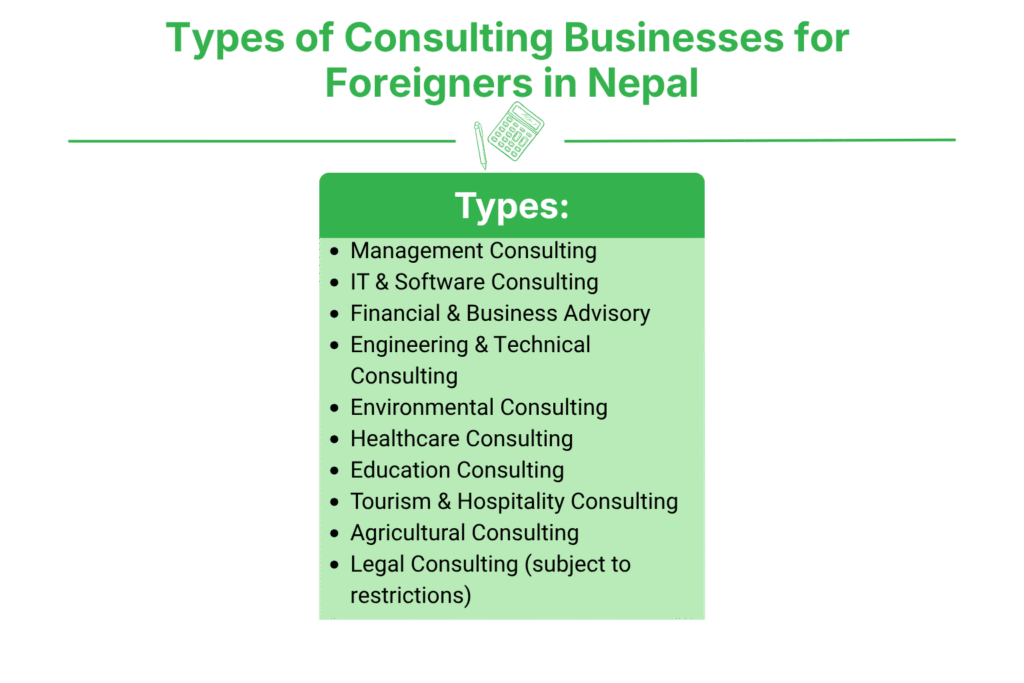
Yes, foreigners can open a consulting business in Nepal. However, the type of consulting, ownership structure, and minimum investment requirements depend on the nature of services offered.
Types of consulting businesses that foreigners can operate in Nepal:
- Management consulting
- IT consulting and software consulting
- Financial advisory and business consulting
- Engineering and technical consulting
- Environmental consulting
- Legal consulting (with restrictions)
- Healthcare consulting
- Education consulting
- Tourism and hospitality consulting
- Agricultural consulting
It is important to note that legal practice is restricted under the Nepal Bar Council Act and requires admission to the Nepal Bar. Foreign lawyers can operate in an advisory capacity but cannot practice as advocates before Nepali courts.
What Is the Minimum Investment Requirement for Foreign Consulting Businesses?
Under FITTA 2019, foreign investors must meet a minimum investment threshold to register a business in Nepal.
| Type of Investment | Minimum Foreign Investment Required |
|---|---|
| Foreign investment in services sector | NPR 2 Crore (approx. USD 150,000) |
| Joint venture with Nepali partner | NPR 50 Lakh (approx. USD 37,500) |
| Technology transfer agreement | No minimum capital requirement |
| IT/Software sector | NPR 50 Lakh (subject to revision) |
The Department of Industry (DOI) or the Investment Board Nepal (IBN) approves foreign investment depending on the size and nature of the investment. Projects above NPR 6 Arba (approx. USD 45 million) go to the Investment Board Nepal, while smaller investments are handled by the Department of Industry.
What Type of Company Structure Can Foreigners Use in Nepal?
Under the Company Act, 2006, a foreign national can register a business in Nepal through the following structures:
1. Private Limited Company (Pvt. Ltd.)
This is the most common structure for foreign consulting firms. It requires a minimum of one director and one shareholder. A foreign-owned private limited company can be 100% foreign-owned if the business falls outside the negative list.
2. Public Limited Company
Suitable for larger consulting businesses that may want to raise public capital. Requires a minimum of seven shareholders.
3. Branch Office
A foreign company can open a branch office in Nepal. The branch office is not a separate legal entity but an extension of the parent company. It requires approval from the Department of Industry under FITTA 2019.
4. Liaison Office / Representative Office
This type of office is for promotional and information purposes only. It cannot engage in commercial activities or earn revenue in Nepal.
5. Joint Venture Company
A foreign investor can form a joint venture with a Nepali individual or company. This is often preferred when entering sectors where 100% foreign ownership is not permitted.
For most consulting businesses, the Private Limited Company structure registered under the Company Act, 2006 and approved under FITTA 2019 is the most practical option.
What Is the Step-by-Step Process to Register a Consulting Business in Nepal?
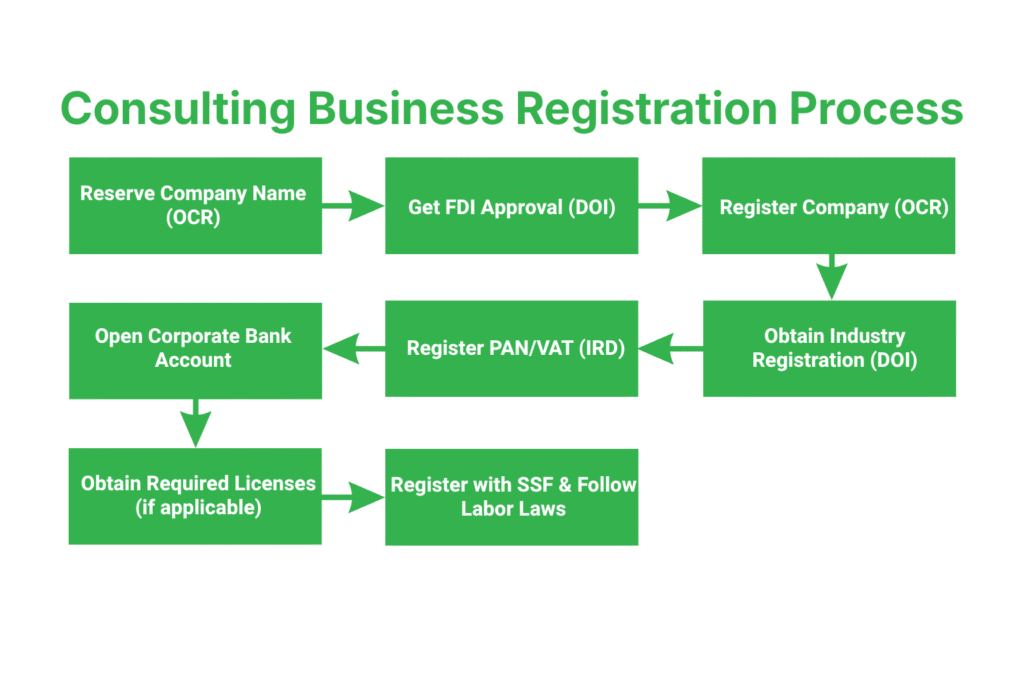
The government of Nepal has established a One Stop Service Center (OSSC) at the Department of Industry to streamline the registration process for foreign investors.
Step 1: Reserve Company Name
Submit a name reservation application to the Office of the Company Registrar (OCR). The name must not conflict with existing registered companies.
Step 2: Obtain Foreign Investment Approval
Submit an application to the Department of Industry (DOI) for foreign investment approval under FITTA 2019. This includes submitting your business plan, proposed equity structure, and investment details.
Step 3: Register the Company at OCR
After receiving FDI approval, register the company with the Office of the Company Registrar under the Company Act, 2006. This involves submitting the Memorandum of Association (MoA) and Articles of Association (AoA).
Step 4: Obtain Industry Registration Certificate
Register the business with the Department of Industry to receive an Industry Registration Certificate, which formalizes the business as an industrial or service enterprise.
Step 5: Obtain PAN/VAT Registration
Register with the Inland Revenue Department (IRD) for a Permanent Account Number (PAN) and Value Added Tax (VAT) registration if annual turnover exceeds NPR 50 Lakh.
Step 6: Open a Bank Account
Open a corporate bank account in a Nepali bank. For foreign-owned companies, the initial investment must be brought through official banking channels in foreign currency as per the Foreign Exchange Regulation Act, 1962.
Step 7: Obtain Business Operating License (Optional)
Depending on the nature of consulting (e.g., financial, healthcare, education), sector-specific licenses may be required from relevant regulatory bodies.
Step 8: Register for Social Security and Labor Compliance
Register with the Social Security Fund (SSF) and comply with the Labor Act, 2017 for employee benefits and payroll management.
What Documents Are Required to Register a Foreign Consulting Business?
- Notarized and apostilled copy of passport of foreign director(s)
- Proposed company name reservation certificate from OCR
- Memorandum of Association (MoA) and Articles of Association (AoA)
- Business plan with investment details and projected financials
- Proof of investment capital (bank statement or fund transfer proof)
- Board resolution (if the investor is a foreign company)
- Registered address proof in Nepal (rental agreement or property ownership)
- No Objection Certificate from the relevant municipality
- Photographs and signature of directors
- Power of Attorney (if applying through a representative)
- Technology Transfer Agreement (if applicable)
What Are the Tax Obligations for Foreign Consulting Businesses in Nepal?
Foreign consulting businesses in Nepal are subject to the same tax obligations as domestic businesses under the Income Tax Act, 2002.
| Tax Type | Rate / Applicability |
|---|---|
| Corporate Income Tax | 25% on net taxable income |
| Value Added Tax (VAT) | 13% on taxable turnover above NPR 50 Lakh |
| Withholding Tax on dividends | 5% for resident, 15% for non-resident |
| Withholding Tax on service fees | 15% for non-resident service providers |
| Advance Tax | Paid quarterly based on estimated income |
| Social Security Contribution | 20% of basic salary (employer: 20%, employee: 11%) |
Nepal has signed Double Taxation Avoidance Agreements (DTAA) with several countries including India, China, South Korea, Norway, Mauritius, Austria, and others. Foreign investors from these countries may benefit from reduced withholding tax rates on dividends and royalties.
You can verify current DTAAs and tax treaties on the Inland Revenue Department website: https://ird.gov.np
Can a Foreigner Get a Business Visa for Running a Consulting Firm in Nepal?
Yes. Nepal’s Immigration Act, 1992 and Immigration Regulations, 1994 allow foreign nationals to obtain a Business Visa for conducting business activities. Foreign investors who have obtained FDI approval under FITTA 2019 can apply for a Non-Tourist Visa or a Business Visa at the Department of Immigration.
Foreign directors or key personnel working in the consulting firm can also apply for a Work Permit from the Department of Labor and Employment under the Foreign Employment Act, 2007.
Key conditions:
- A work permit is required for any foreign national working in Nepal
- At least 90% of employees must be Nepali nationals under general rules
- Foreign nationals holding senior or technical positions may receive exemptions
For more information on business visas and work permits, visit: https://nepalimmigration.gov.np
What Are the Common Challenges in Opening a Consulting Business in Nepal?
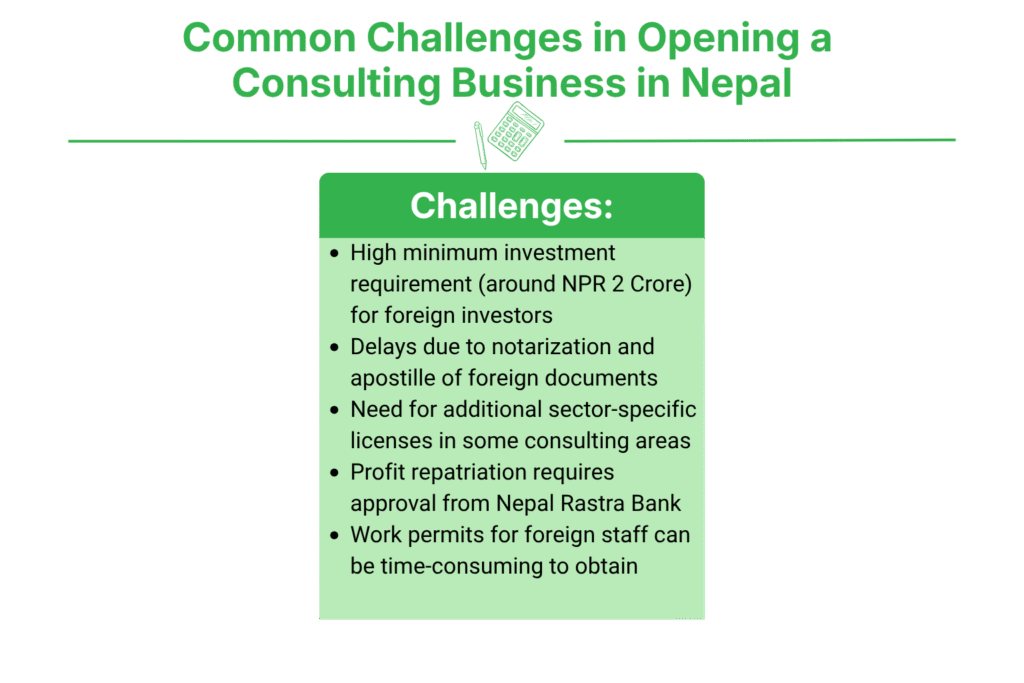
Foreign investors often face certain procedural and structural challenges when setting up consulting firms in Nepal:
- The minimum investment threshold of NPR 2 Crore can be high for small consulting firms
- Document notarization and apostille requirements create delays for foreign applicants
- Some consulting sectors require sector-specific licenses from different government bodies
- Repatriation of profits requires prior approval from Nepal Rastra Bank under the Foreign Exchange Regulation Act
- Hiring foreign staff requires work permits which can take several weeks to process
The government has introduced the One Stop Service Center at the Department of Industry and the Investment Board Nepal portal to reduce these barriers. You can access investment-related information at: https://ibn.gov.np and https://doind.gov.np
FAQs
1. Can a foreign national own 100% of a consulting business in Nepal?
Yes, under FITTA 2019, a foreign national can own 100% of a consulting business in Nepal, provided the business does not fall under the negative list or restricted sectors. Most management, IT, and business consulting services allow full foreign ownership.
2. What is the minimum investment required for a foreign consulting firm in Nepal?
Under FITTA 2019, the minimum foreign investment for a service-sector business is NPR 2 Crore. For joint ventures with Nepali partners, the threshold may be NPR 50 Lakh depending on the sector.
3. How long does it take to register a foreign consulting company in Nepal?
The registration process through the One Stop Service Center at the Department of Industry typically takes 15 to 30 working days, depending on document completeness and approvals required.
4. Do foreigners need a Nepali partner to open a consulting firm?
Not necessarily. Many consulting sectors allow 100% foreign ownership. However, a Nepali partner may be required in restricted sectors or when the investment falls below the FDI minimum threshold.
5. Are there any tax exemptions for foreign consulting businesses in Nepal?
Special Economic Zone (SEZ) businesses enjoy income tax exemptions for the first five years. For businesses outside SEZs, standard corporate tax rates apply. DTAA benefits may reduce withholding taxes for investors from treaty countries.
6. Can a foreign consulting business repatriate profits from Nepal?
Yes. Under FITTA 2019 and the Foreign Exchange Regulation Act, 1962, foreign investors can repatriate profits, dividends, and capital gains after paying applicable taxes and obtaining approval from Nepal Rastra Bank.
Conclusion
Opening a consulting business in Nepal as a foreign national is a legally permissible and structured process governed primarily by FITTA 2019, the Company Act 2006, and the Industrial Enterprises Act 2020. Foreign investors must meet minimum capital requirements, register with the Office of the Company Registrar, obtain FDI approval from the Department of Industry, and comply with tax and labor laws. The Nepali government continues to simplify the investment environment through the One Stop Service Center and digital registration portals. Understanding these requirements fully before initiating the registration process will save both time and resources.