
Foreign companies that want to establish a physical presence in Nepal must go through the Office of the Company Registrar OCR to get branch office approval. This process involves legal compliance, document submission, and regulatory clearance under Nepalese law. This article covers every aspect of OCR branch office approval in Nepal in a straightforward manner.
What Is OCR Branch Office Approval in Nepal?
What does OCR stand for, and what role does it play in branch office registration?
OCR stands for the Office of the Company Registrar, which operates under the Ministry of Industry, Commerce and Supplies of Nepal. The OCR serves as the primary regulatory body responsible for registering companies, branch offices, liaison offices, and project offices of foreign companies in Nepal.
When a foreign company decides to operate in Nepal, it must register its branch office with the OCR under the Companies Act, 2063 (2006). Section 153 of the Companies Act, 2063 specifically mandates that any foreign company intending to establish a place of business in Nepal must register itself with the OCR before commencing operations.
The OCR branch office approval in Nepal gives foreign companies the legal right to conduct business activities within the country, maintain accounts, enter into contracts, hire employees, and operate under Nepalese jurisdiction.
🔗 Official OCR Website: www.ocr.gov.np
What Laws Govern Branch Office Approval in Nepal?
Which laws apply to OCR branch office registration in Nepal?
Several key laws regulate the branch office approval process in Nepal:
| Legislation | Relevance |
|---|---|
| Companies Act, 2063 (2006) | Sections 153–158 govern foreign company registration and branch offices |
| Foreign Investment and Technology Transfer Act, 2075 (FITTA, 2019) | Regulates foreign investment approval prior to branch registration |
| Industrial Enterprises Act, 2076 (2020) | Governs industrial operations for foreign entities |
| Income Tax Act, 2058 (2002) | Tax obligations of branch offices in Nepal |
| Foreign Exchange (Regulation) Act, 1962 | Controls foreign currency transactions and remittances |
Under Section 153 of the Companies Act, 2063, a foreign company must register with OCR within 30 days of establishing a place of business in Nepal. Non-compliance attracts penalties under Section 157 of the same Act.
Additionally, before registering with OCR, most foreign companies must obtain prior approval from the Department of Industry (DOI) or the Investment Board Nepal (IBN) under the Foreign Investment and Technology Transfer Act, 2019, depending on the nature and scale of investment.
🔗 Department of Industry: www.doind.gov.np 🔗 Investment Board Nepal: www.ibn.gov.np
Who Needs OCR Branch Office Approval in Nepal?
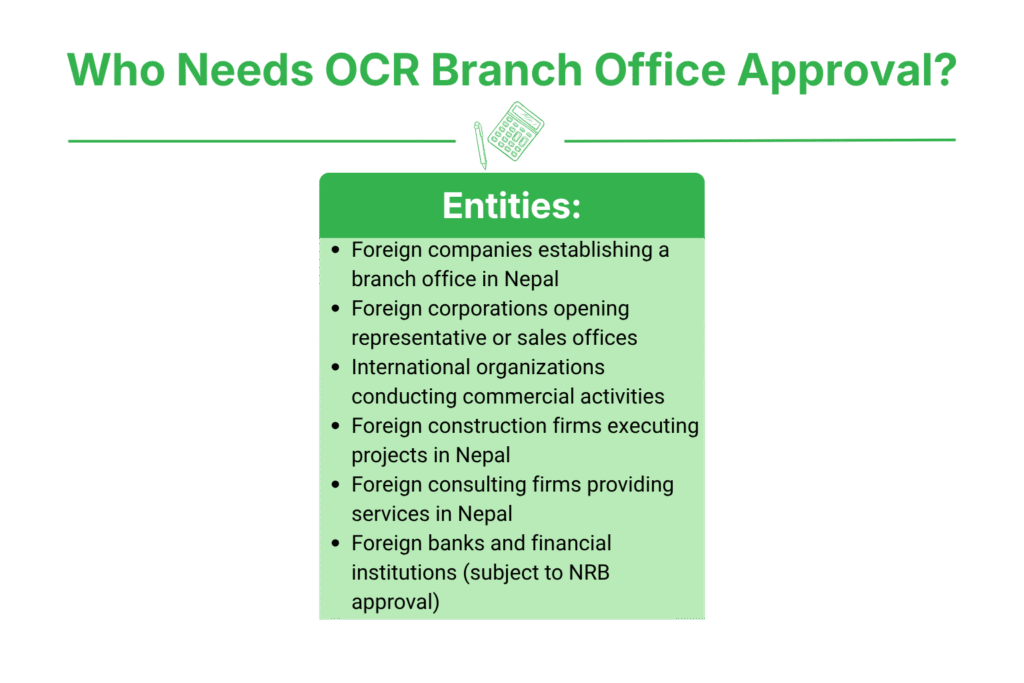
Which types of foreign entities require OCR branch office approval?
The following foreign entities require OCR branch office approval in Nepal:
- Foreign companies establishing a branch to conduct business operations in Nepal
- Foreign corporations opening representative or sales offices
- International organizations with commercial operations in Nepal
- Foreign construction or consulting firms executing projects in Nepal
- Foreign banks and financial institutions (subject to additional NRB regulations)
A branch office differs from a liaison office and a project office. A branch office conducts full commercial activities, while a liaison office only performs promotional and communication activities without direct business transactions.
What Documents Are Required for OCR Branch Office Approval?
What documents must a foreign company submit to OCR for branch office registration in Nepal?
The following documents are required for OCR branch office approval in Nepal:
- Duly filled application form as prescribed by OCR
- Certificate of Incorporation of the parent foreign company
- Memorandum of Association (MOA) and Articles of Association (AOA) of the parent company
- Board Resolution authorizing the establishment of a branch office in Nepal
- Power of Attorney (POA) in favor of the authorized representative in Nepal
- Audited financial statements of the parent company (last 3 years)
- Details and passport copy of the authorized representative in Nepal
- Details of the proposed branch office address in Nepal
- Foreign Investment Approval Letter from the Department of Industry or IBN (if applicable)
- Certified copy of the parent company’s latest annual return
- Declaration stating the nature of business activities to be conducted in Nepal
- No Objection Certificate (NOC) from the concerned sector ministry (if required)
All foreign documents must be notarized and apostilled or authenticated by the Nepalese Embassy in the country of the parent company’s origin. Documents not in English or Nepali must be officially translated.
What Is the Step-by-Step Process for OCR Branch Office Approval in Nepal?
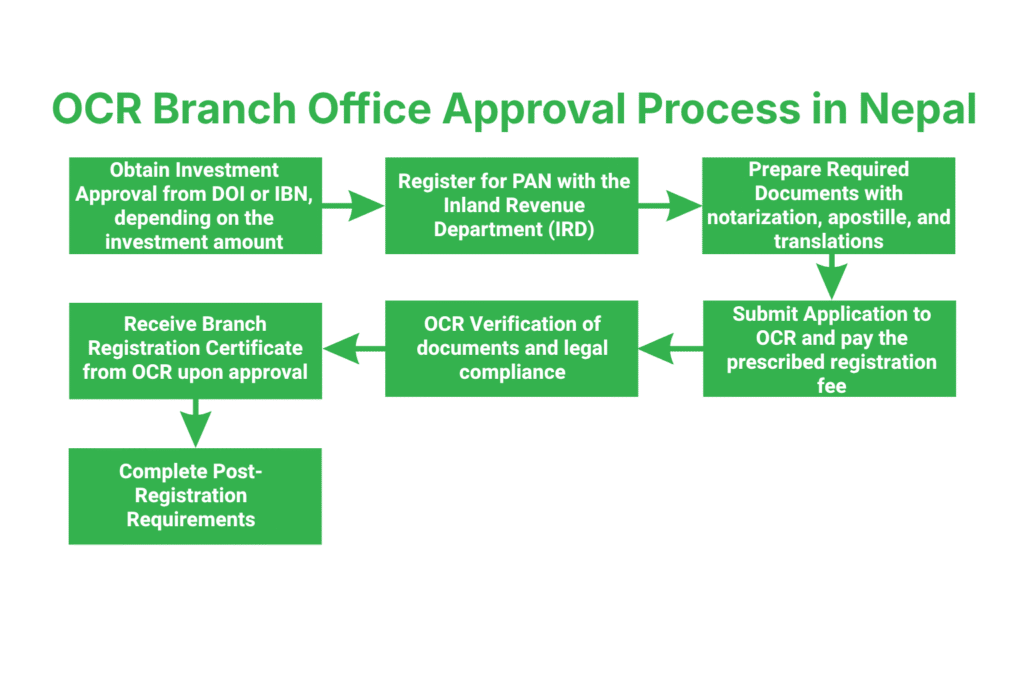
How does a foreign company complete the OCR branch office registration process in Nepal?
The process involves multiple stages across different government offices:
Step 1: Obtain Foreign Investment Approval
- Apply to the Department of Industry (DOI) for projects with investment below NPR 6 billion.
- Apply to the Investment Board Nepal (IBN) for projects with investment exceeding NPR 6 billion.
- Submit the business plan, investment details, and parent company documents.
Step 2: Obtain Tax Registration (PAN)
- Register with the Inland Revenue Department (IRD) for a Permanent Account Number (PAN).
- Submit the DOI/IBN approval letter along with required documents.
Step 3: Prepare OCR Application Package
- Compile all required documents listed above.
- Ensure notarization, apostille, and official translation are complete.
Step 4: Submit Application to OCR
- Submit the completed application package to OCR at Tripureshwor, Kathmandu.
- Pay the prescribed registration fee.
Step 5: OCR Review and Verification
- OCR reviews all documents for completeness and legal compliance.
- OCR may request additional documents or clarification.
Step 6: Receive Registration Certificate
- Upon approval, OCR issues the Branch Office Registration Certificate.
- The branch office can now legally commence business operations in Nepal.
Step 7: Post-Registration Compliance
- Register with the local municipality for business operating license.
- Complete Social Security Fund (SSF) and labor registrations.
- Open a corporate bank account in Nepal.
What Are the Fees for OCR Branch Office Registration in Nepal?
How much does OCR branch office registration cost in Nepal?
The registration fee for branch offices at OCR depends on the authorized capital of the parent company. The OCR charges fees as per the Company Registration Fee Schedule under the Companies Act, 2063.
| Authorized Capital of Parent Company (NPR) | Approximate Registration Fee (NPR) |
|---|---|
| Up to 1 Crore | 9,000 |
| 1 Crore to 5 Crore | 18,000 |
| 5 Crore to 20 Crore | 25,000 |
| 20 Crore to 1 Arba | 45,000 |
| Above 1 Arba | 85,000 |
Additional charges may apply for document authentication, translation services, legal advisory fees, and Department of Industry processing fees. The total cost including professional and government fees typically ranges between NPR 50,000 to NPR 2,00,000 depending on complexity.
How Long Does OCR Branch Office Approval Take in Nepal?
What is the processing time for OCR branch office approval in Nepal?
The processing time depends on the completeness of documents and the workload at OCR. Under normal circumstances:
- Department of Industry Approval: 7–15 working days
- OCR Registration Processing: 7–15 working days
- Total Average Processing Time: 3–6 weeks from the date of complete document submission
If OCR raises queries or requests additional documents, the timeline may extend. Companies that engage professional legal or consulting services generally complete the process faster due to proper document preparation.
What Are the Annual Compliance Requirements After OCR Branch Office Approval?
What ongoing compliance must a registered branch office maintain in Nepal?
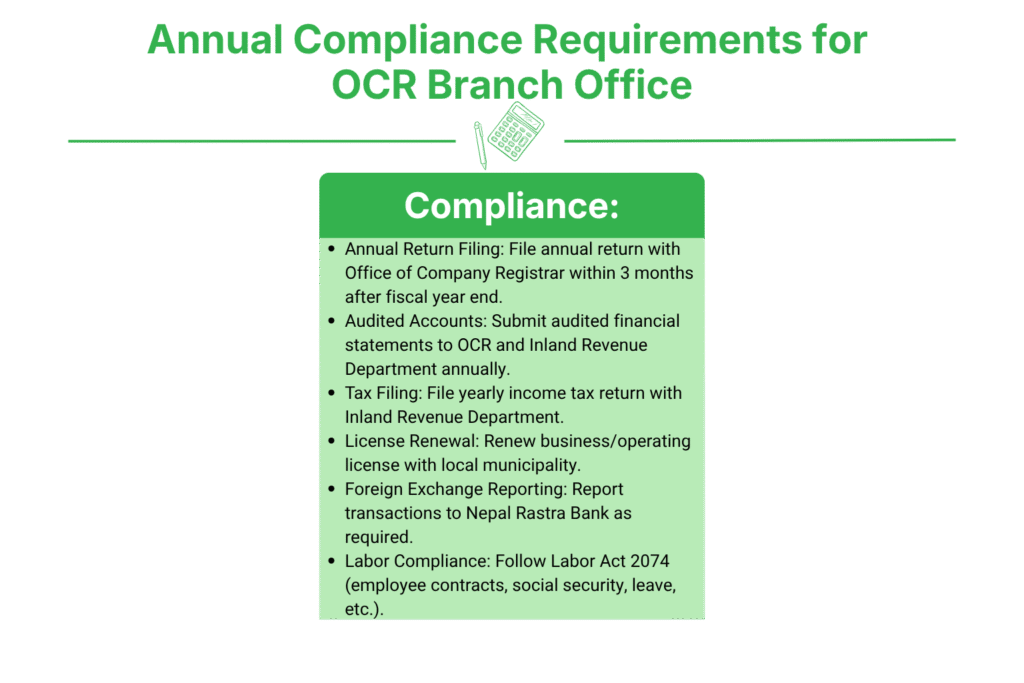
After receiving OCR branch office approval, the foreign company must fulfill several annual compliance obligations:
- Annual Return Filing: Submit annual returns to OCR every year within 3 months of the end of the fiscal year (Ashad end = mid-July).
- Audited Accounts Submission: Submit audited financial statements of the branch office to OCR and IRD annually.
- Tax Filing: File annual income tax returns with the Inland Revenue Department under the Income Tax Act, 2058.
- Renewal of Business License: Renew the operating license with the local municipality.
- Foreign Exchange Compliance: Report foreign currency transactions to Nepal Rastra Bank (NRB) as required.
- Labor Law Compliance: Maintain compliance with the Labor Act, 2074 (2017) regarding employee contracts, social security, and leave policies.
Failure to file annual returns attracts a penalty of NPR 10,000 per month under Section 81 of the Companies Act, 2063. Continued non-compliance can result in de-registration of the branch office.
🔗 Inland Revenue Department: www.ird.gov.np 🔗 Nepal Rastra Bank: www.nrb.org.np
Can a Branch Office Be Converted to a Subsidiary Company in Nepal?
Is it possible to convert an OCR-registered branch office into a subsidiary company in Nepal?
Yes, a branch office can be converted into a fully incorporated subsidiary company in Nepal. A subsidiary operates as a separate legal entity under the Companies Act, 2063, whereas a branch office is an extension of the foreign parent company.
The conversion process requires:
- Incorporating a new private or public limited company with OCR
- Obtaining fresh foreign investment approval from DOI or IBN under FITTA, 2019
- Transferring assets and liabilities from the branch to the new subsidiary
- Closing the branch office registration with OCR after completing all pending compliance
Many foreign companies prefer to operate as a branch office initially and later convert to a subsidiary company once their business operations stabilize in Nepal.
FAQs
1. What is the difference between a branch office and a liaison office in Nepal?
A branch office conducts full commercial business activities in Nepal, while a liaison office only performs communication and promotional work. Liaison offices cannot earn revenue or enter commercial contracts in Nepal under Nepalese company law.
2. Does a branch office in Nepal need a separate PAN registration?
Yes, every branch office in Nepal must obtain a separate Permanent Account Number (PAN) from the Inland Revenue Department, even if the parent company has a PAN in its home country.
3. Can 100% foreign-owned branch offices operate in Nepal?
Yes, 100% foreign ownership is allowed in branch offices as the branch is legally the same entity as the foreign parent company. The FITTA, 2019 and the Foreign Investment Negative List define restricted sectors.
4. What happens if a foreign company fails to register its branch with OCR within 30 days?
Under Section 157 of the Companies Act, 2063, the foreign company and its authorized representative face financial penalties. OCR can impose fines and restrict the company from legal business operations in Nepal.
5. Is notarization and apostille of foreign documents mandatory for OCR branch registration?
Yes, all documents issued outside Nepal must be notarized and apostilled by the competent authority in the issuing country, or alternatively, authenticated by the Nepalese Embassy in that country.
6. Can a branch office repatriate profits to its parent company from Nepal?
Yes, a branch office can repatriate profits after paying applicable taxes in Nepal. Repatriation must comply with the Foreign Exchange Regulation Act, 2019 and requires prior approval from Nepal Rastra Bank (NRB) in most cases.
Conclusion
OCR branch office approval in Nepal follows a defined legal process under the Companies Act, 2063, FITTA, 2019, and related regulations. Foreign companies must secure prior investment approval from the Department of Industry or Investment Board Nepal, prepare all required and authenticated documents, and submit a complete application to OCR. After registration, the branch office must maintain annual compliance with OCR, IRD, and other regulators. Engaging a qualified legal professional in Nepal significantly reduces errors and delays in the entire process.