
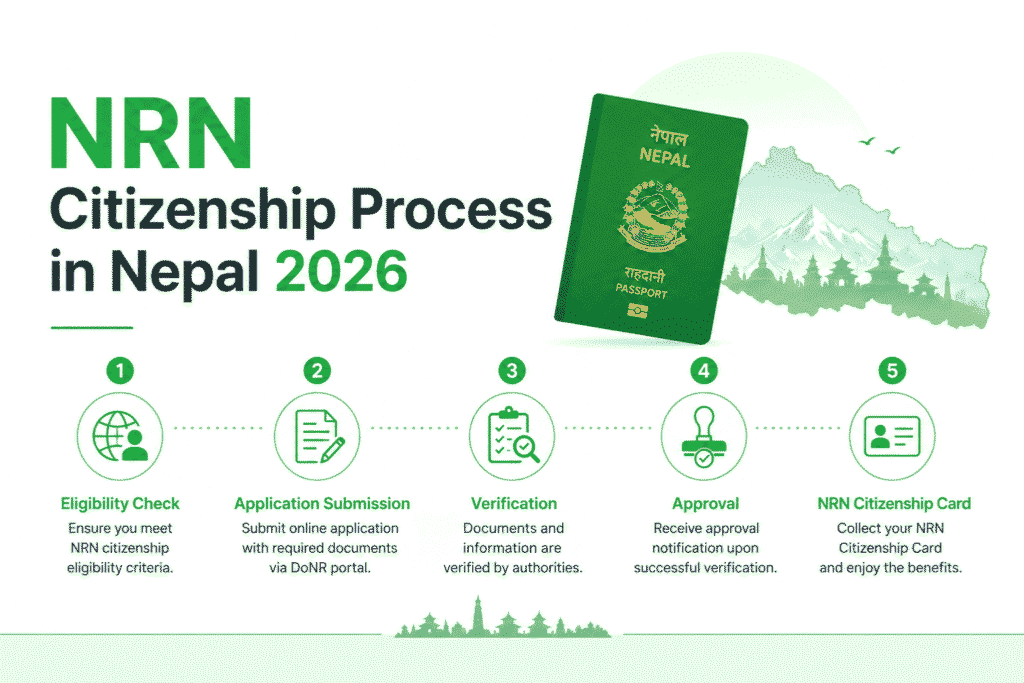
The NRN Citizenship Process in Nepal 2026 has become one of the most searched immigration topics among Nepali diaspora communities worldwide. The Non-Resident Nepali (NRN) citizenship framework allows persons of Nepali origin living abroad to maintain a formal legal identity connected to Nepal. Whether you are a Nepali who has obtained foreign citizenship or a person of Nepali origin born abroad, understanding the NRN citizenship process in Nepal is essential for accessing the rights and benefits that come with NRN status.
What is NRN Citizenship in Nepal?
NRN citizenship, more accurately referred to as the Non-Resident Nepali Identity Card or NRN Certificate, is a legal status granted by the Government of Nepal to eligible persons of Nepali origin or former Nepali citizens who currently hold foreign citizenship. It is important to clarify that Nepal does not formally recognize dual citizenship in the traditional sense. The NRN identity card is a special status not a second citizenship that grants specific economic, social, and cultural rights within Nepal.
The Non-Resident Nepali Act, 2008 (2064 B.S.) and the Non-Resident Nepali Rules, 2010 (2066 B.S.) form the primary legal basis for NRN status in Nepal. The Act defines a Non-Resident Nepali as a person who has acquired citizenship of a foreign country and is of Nepali origin, or a person who has obtained a foreign permanent residency card or work permit.
Legal Framework Governing NRN Citizenship Process in Nepal
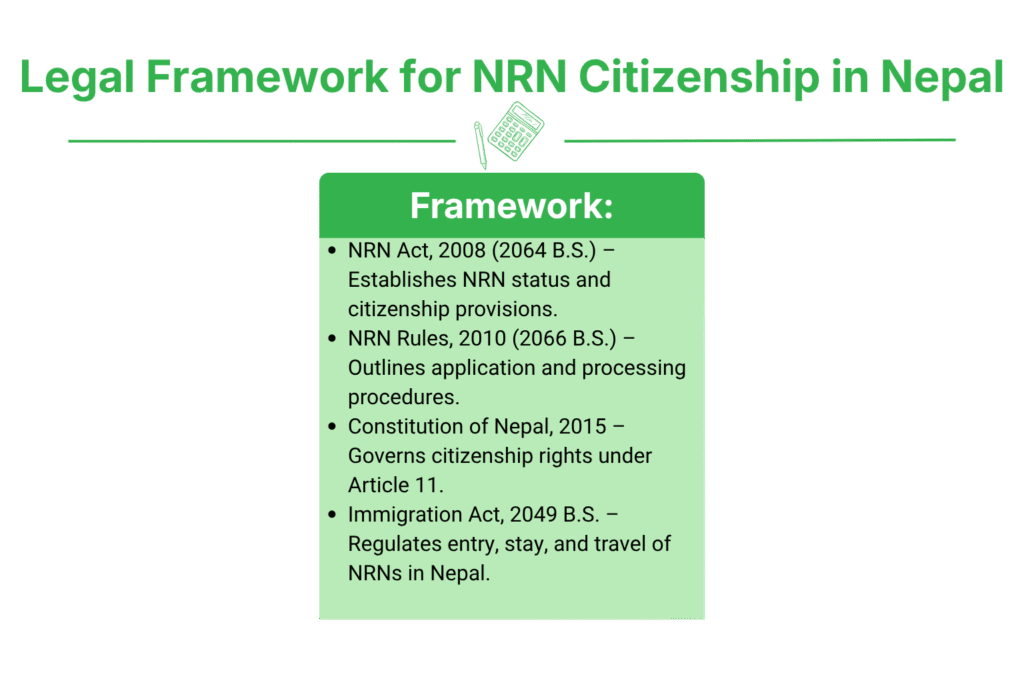
The NRN citizenship process in Nepal is governed by the following laws and regulations:
- Non-Resident Nepali Act, 2008 (2064 B.S.) — The foundational legislation establishing NRN status, rights, and the application process.
- Non-Resident Nepali Rules, 2010 (2066 B.S.) — The procedural rules detailing how applications are filed and processed.
- Constitution of Nepal, 2015 (2072 B.S.) — Article 11 governs citizenship provisions; Nepal does not grant full dual citizenship but allows NRN status as a special category.
- Immigration Act, 2049 B.S. — Governs the entry, stay, and departure of foreigners including NRNs visiting Nepal.
The Non-Resident Nepali Association (NRNA) coordinates with the Government of Nepal and plays a role in advocating for NRN rights globally. You can visit the official Government of Nepal’s Department of Immigration at www.immigration.gov.np for official updates.
Who is Eligible for NRN Citizenship in Nepal 2026?
Under Section 2 of the Non-Resident Nepali Act, 2008, a person qualifies for NRN status if they meet any of the following criteria:
- A person who was a citizen of Nepal but has acquired the citizenship of a foreign country.
- A person who is of Nepali origin and holds citizenship of a foreign country.
- A person who holds a permanent residency card or long-term work permit of a foreign country and is of Nepali origin.
- The spouse of any eligible NRN applicant, provided the spouse is not a citizen of an enemy country.
- Descendants up to the second generation of persons of Nepali origin living abroad.
The Act specifically excludes persons who hold citizenship of a country that Nepal has not established diplomatic relations with, or a country that Nepal considers an adversary state.
NRN Citizenship Process in Nepal 2026
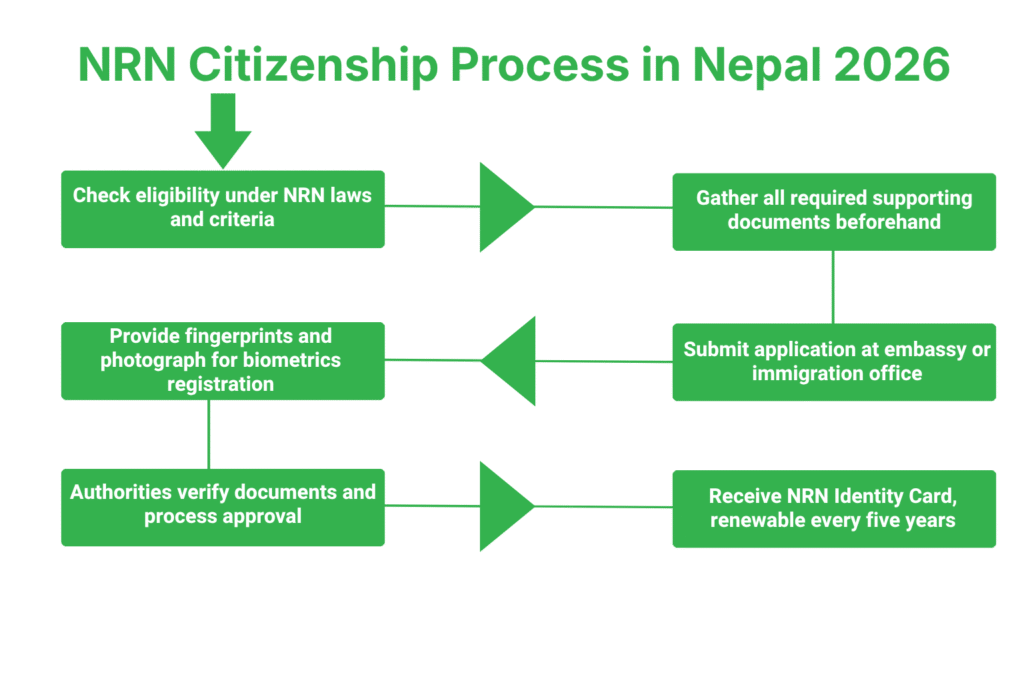
The NRN citizenship application process in Nepal follows a structured procedure. Applicants can apply either at the Department of Immigration in Kathmandu or through the Nepali Embassy or Consulate in their country of residence.
Step 1: Determine Eligibility
Check whether you meet the eligibility criteria under the Non-Resident Nepali Act, 2008. Verify your Nepali origin documents and your current foreign citizenship or residency status.
Step 2: Collect Required Documents
Gather all mandatory documents before submitting your application. Missing documents will delay the NRN citizenship process significantly.
Step 3: Submit Application
Submit the completed application form along with supporting documents to:
- Department of Immigration, Maitighar, Kathmandu, or
- Nepali Embassy or Consulate in your country of residence.
Step 4: Biometric Registration
Provide biometric data including fingerprints and a recent photograph at the designated office. This is a mandatory part of the NRN identity card issuance process.
Step 5: Verification and Processing
The Department of Immigration verifies the submitted documents and forwards them for approval to the Ministry of Home Affairs or designated authority.
Step 6: Receive NRN Identity Card
Once approved, the NRN Identity Card is issued. The card is valid for five years and can be renewed thereafter.
Documents Required for NRN Citizenship Application in Nepal
The following documents are required for the NRN citizenship process in Nepal in 2026:
- Proof of Nepali Origin:
- Former Nepali citizenship certificate (if you were a Nepali citizen)
- Grandfather’s or father’s Nepali citizenship certificate
- Birth certificate issued by a Nepali government authority
- Nepali passport (expired or valid)
- Foreign Citizenship Documents:
- Valid foreign passport
- Foreign citizenship certificate or naturalization certificate
- Permanent residency card (if applicable)
- Identity and Residential Proof:
- Two recent passport-sized photographs (white background)
- Proof of foreign address (utility bill, bank statement, etc.)
- Family Documents:
- Marriage certificate (if applying as a spouse of an NRN)
- Birth certificate of children (if applicable)
- Application Form:
- Completed NRN application form (available at the Department of Immigration or the respective Nepali Embassy)
- Application Fee Receipt:
- Proof of payment of the prescribed fee
NRN Citizenship Application Fee and Validity in Nepal 2026
| Category | Application Fee (USD) | Validity |
|---|---|---|
| NRN Identity Card (New Application) | USD 100 | 5 Years |
| NRN Identity Card (Renewal) | USD 50 | 5 Years |
| Spouse of NRN (New Application) | USD 100 | 5 Years |
| Minor Children of NRN | USD 50 | Until age 18 |
The fees are subject to change based on government notifications. Always verify the latest fee structure at www.immigration.gov.np or the official Nepali Embassy website in your country.
Rights and Privileges Granted Under NRN Citizenship in Nepal
The Non-Resident Nepali Act, 2008 grants NRN cardholders a set of specific rights. These rights are economic, social, and cultural in nature, but NRNs do not receive political rights such as voting or holding public office.
Economic Rights
- NRNs can invest in Nepal under the Foreign Investment and Technology Transfer Act, 2019 (2075 B.S.).
- NRNs can purchase land and property in Nepal for residential and business purposes as per prevailing laws.
- NRNs can open foreign currency accounts in Nepali banks.
- NRNs can engage in business activities in Nepal.
Social and Cultural Rights
- NRNs can obtain a visa-free entry or special visa facility when visiting Nepal.
- NRNs enjoy access to educational and social services in Nepal.
- NRNs can participate in Non-Resident Nepali Association (NRNA) activities.
Travel and Entry Rights
- NRN cardholders receive a multiple-entry visa to Nepal valid for a longer period.
- NRNs can stay in Nepal for up to 150 days in a single visit without frequent visa extensions.
NRN Citizenship vs. Nepal Dual Citizenship
This is a common area of confusion. The table below clarifies the difference:
| Feature | NRN Identity Card | Nepal Dual Citizenship |
|---|---|---|
| Legal Status | Special Non-Resident Status | Not Available in Nepal |
| Voting Rights | No | N/A |
| Property Rights | Limited (as per NRN Act) | Full |
| Business Rights | Yes (with conditions) | Full |
| Validity | 5 Years (Renewable) | Permanent |
| Governed By | NRN Act, 2008 | Constitution of Nepal, 2015 |
| Political Rights | No | Full |
Nepal’s Constitution, 2015 under Article 11(7) allows a person of Nepali origin who has acquired foreign citizenship to obtain citizenship of Nepal by descent upon renouncing foreign citizenship. The NRN card is a separate mechanism for those who wish to retain their foreign citizenship while maintaining ties to Nepal.
Role of Non-Resident Nepali Association (NRNA) in NRN Citizenship Process
The Non-Resident Nepali Association (NRNA) is a global organization registered under the Non-Resident Nepali Act, 2008. The NRNA facilitates NRN cardholders in accessing government services, advocates for policy reforms, and organizes community support for NRNs worldwide. The NRNA has chapters in over 80 countries. You can find chapter-specific assistance through the NRNA’s official website.
The NRNA works closely with the Ministry of Foreign Affairs of Nepal and the Department of Immigration to streamline the NRN citizenship application process.
Common Reasons for NRN Citizenship Application Rejection in Nepal
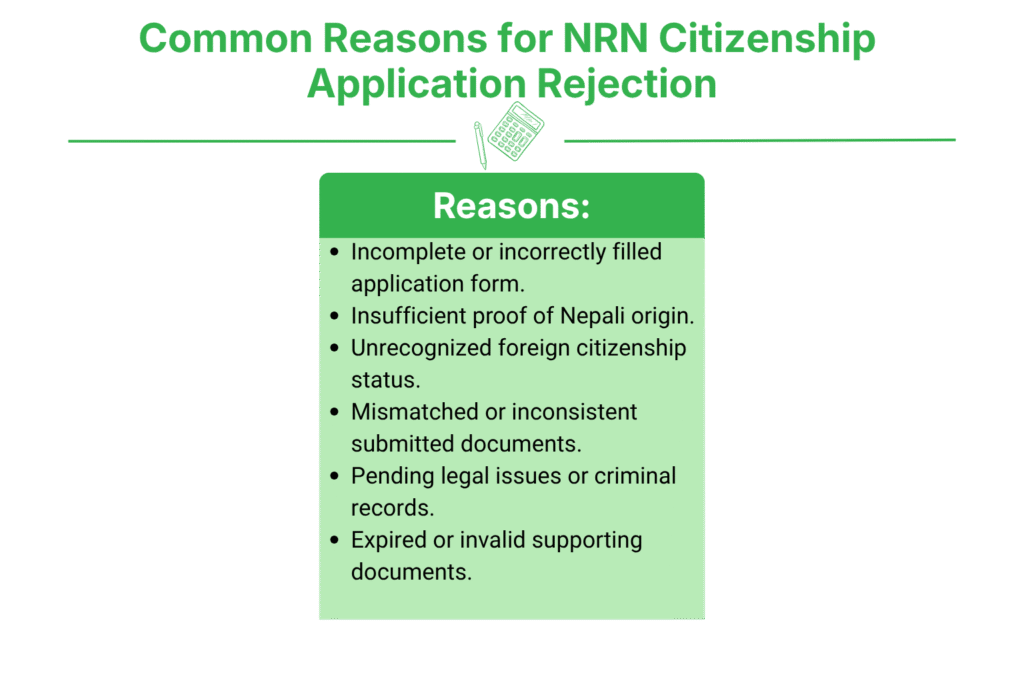
Applicants face rejection in the NRN citizenship process in Nepal for the following reasons:
- Incomplete or incorrectly filled application form.
- Failure to provide adequate proof of Nepali origin.
- Foreign citizenship from a country not recognized by Nepal.
- Inconsistencies between documents submitted.
- Outstanding legal issues or criminal records in Nepal.
- Expired supporting documents.
NRN Citizenship Renewal Process in Nepal 2026
The NRN identity card is valid for five years. The renewal process is similar to the initial application:
- Submit a renewal application form at the Department of Immigration or Nepali Embassy.
- Submit the original expired NRN card.
- Provide updated foreign citizenship documents and passport.
- Pay the renewal fee of USD 50.
- Provide updated biometric data if required.
- Receive renewed NRN card valid for another five years.
FAQs
1. Can an NRN cardholder vote in Nepal’s elections?
No. Under the Non-Resident Nepali Act, 2008, NRN cardholders do not receive political rights. Voting in national or local elections in Nepal is not permitted for NRN cardholders.
2. How long does the NRN citizenship process take in Nepal?
The NRN citizenship application process typically takes 30 to 60 working days from the date of complete document submission. Processing times may vary based on the workload at the Department of Immigration or the Nepali Embassy.
3. Can I apply for NRN citizenship from outside Nepal?
Yes. You can apply for NRN citizenship status through the Nepali Embassy or Consulate in your country of residence. The embassy forwards the application to the Department of Immigration in Kathmandu for processing.
4. Does the NRN card allow me to buy land in Nepal?
Yes. Under the NRN Act, 2008, NRN cardholders can purchase land in Nepal for residential and business purposes. However, restrictions may apply under other land-related laws of Nepal. Verification with a legal expert is advisable.
5. What happens to my NRN card if I renounce my foreign citizenship?
If you renounce your foreign citizenship, your NRN status becomes void. You may then apply for Nepali citizenship by descent under Article 11(7) of the Constitution of Nepal, 2015, subject to meeting all eligibility conditions.
6. Is there a specific age requirement to apply for NRN citizenship in Nepal?
No fixed minimum age applies for NRN status. Minor children of NRN cardholders can also receive NRN cards at a reduced fee until they reach the age of 18, after which they must apply independently.
Conclusion
The NRN citizenship process in Nepal 2026 remains a structured legal procedure governed primarily by the Non-Resident Nepali Act, 2008 and the Non-Resident Nepali Rules, 2010. The NRN identity card provides persons of Nepali origin and former Nepali citizens with economic, social, and cultural access to Nepal without granting political rights. Applicants must prepare complete documentation, pay prescribed fees, and submit applications either at the Department of Immigration, Kathmandu, or through a Nepali Embassy or Consulate abroad. For official and updated information, always refer to www.immigration.gov.np and the Ministry of Foreign Affairs of Nepal at www.mofa.gov.np.