
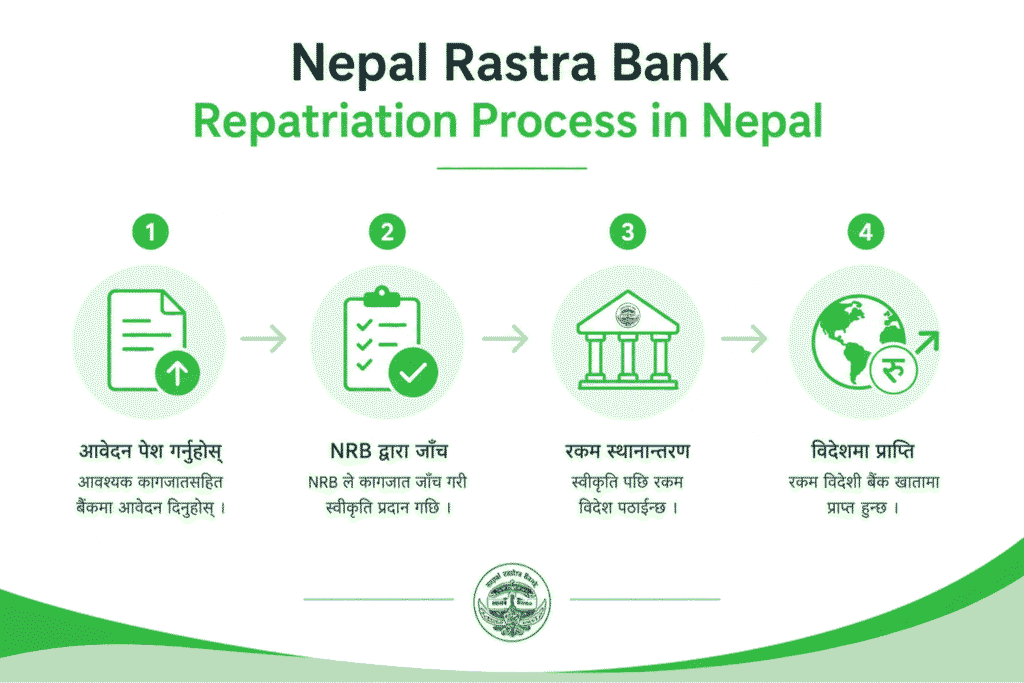
Repatriation of funds is one of the most critical aspects of foreign investment and foreign employment in Nepal. The Nepal Rastra Bank (NRB) serves as the central regulatory authority that oversees, approves, and monitors all foreign exchange repatriation transactions in Nepal. Whether you are a foreign investor repatriating profits, a returning migrant worker sending savings home, or a foreign national transferring funds abroad, understanding the NRB repatriation process is essential.
This article covers everything you need to know about the Nepal Rastra Bank repatriation process in Nepal, applicable laws, required documents, step-by-step procedures, and common questions.
What Is Repatriation in the Context of Nepal?
Repatriation refers to the process of transferring money or assets from Nepal to a foreign country, or in certain contexts, bringing foreign currency earnings back into Nepal. The term covers:
- Foreign investors sending dividends, profits, or capital back to their home countries.
- Foreign nationals employed in Nepal transferring their salaries abroad.
- Non-Resident Nepalis (NRNs) and foreign nationals repatriating their investments.
- Returning Nepali workers converting and repatriating foreign income.
Nepal Rastra Bank, established under the Nepal Rastra Bank Act, 2002, regulates all foreign exchange transactions, including repatriation, under the Foreign Exchange (Regulation) Act, 1962 (2019 B.S.) and its subsequent amendments.
Legal Framework Governing Repatriation in Nepal
The Nepal Rastra Bank repatriation process operates under a clearly defined legal framework. The following laws and regulations govern all repatriation activities:
| Law / Regulation | Year | Governing Authority |
|---|---|---|
| Foreign Exchange (Regulation) Act, 1962 | 1962 (2019 B.S.) | Nepal Rastra Bank |
| Nepal Rastra Bank Act, 2002 | 2002 | Nepal Rastra Bank |
| Foreign Investment and Technology Transfer Act, 2075 | 2019 | Department of Industry / Investment Board Nepal |
| Industrial Enterprises Act, 2076 | 2020 | Ministry of Industry |
| Income Tax Act, 2058 | 2002 | Inland Revenue Department |
Under Section 10 of the Foreign Exchange (Regulation) Act, 1962, no person shall repatriate any foreign exchange without prior approval from Nepal Rastra Bank or a bank authorized by NRB. Violation of this provision invites penalties under the same Act.
The Foreign Investment and Technology Transfer Act (FITTA), 2019 further guarantees the right of foreign investors to repatriate dividends, profits, proceeds from the sale of shares, and principal amounts after fulfilling the required legal formalities.
Who Can Repatriate Funds Through Nepal Rastra Bank?
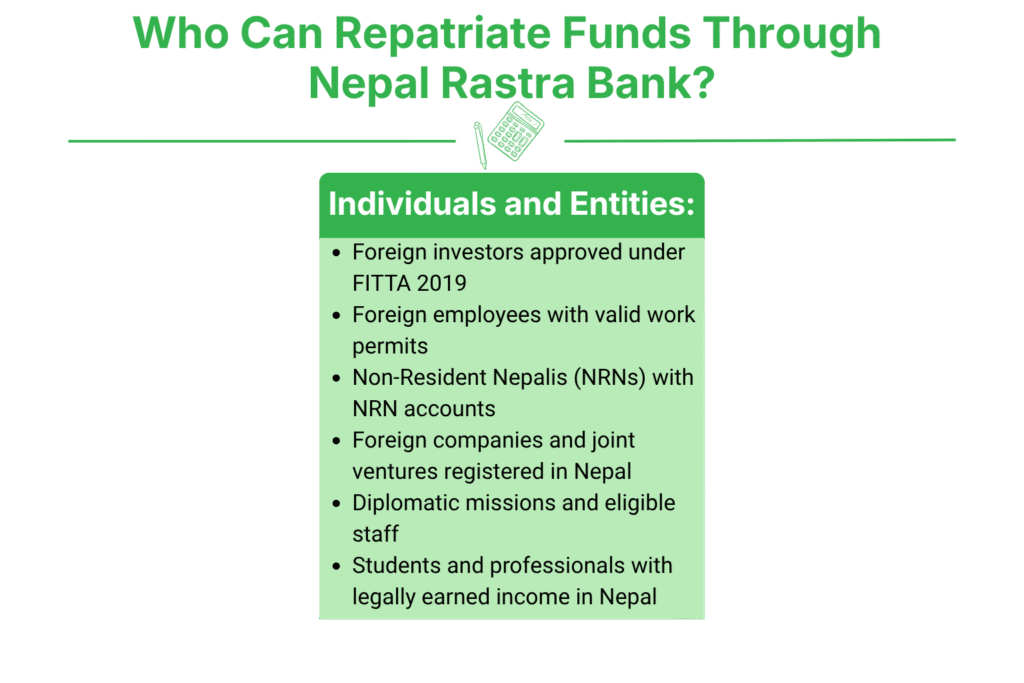
The following categories of individuals and entities are eligible to repatriate funds through the NRB-approved process:
- Foreign investors who have registered their investment under FITTA 2019 and received approval from the Department of Industry or Investment Board Nepal.
- Foreign nationals employed in Nepal who hold a valid work permit and employment contract.
- Non-Resident Nepalis (NRNs) who have opened Non-Resident Nepali (NRN) accounts.
- Foreign companies or joint ventures registered in Nepal.
- Diplomatic missions and their employees subject to bilateral agreements.
- Students or professionals who have received income from legitimate sources in Nepal.
Types of Repatriation Under NRB Rules
Nepal Rastra Bank categorizes repatriation into several types based on the source of funds:
1. Profit and Dividend Repatriation
Foreign investors registered under FITTA 2019 can repatriate profits and dividends after:
- Filing annual tax returns with the Inland Revenue Department.
- Clearing all outstanding taxes.
- Obtaining a tax clearance certificate.
- Submitting audited financial statements.
2. Capital Repatriation
Foreign investors can repatriate the principal investment amount upon liquidation, sale of shares, or closure of business, provided all legal dues are cleared.
3. Salary and Service Income Repatriation
Foreign nationals employed in Nepal can repatriate up to a specified percentage of their net salary after paying applicable income tax. NRB periodically revises these limits through its Unified Directives (Ekata Nirdeshan).
4. Loan Repayment Repatriation
Repayment of foreign loans, interest payments, and service charges are permitted through NRB-authorized A-class commercial banks with appropriate documentation.
5. Technology Transfer Fee and Royalty Repatriation
Payments for technology transfer agreements registered under FITTA 2019 may be repatriated upon NRB approval.
Step-by-Step NRB Repatriation Process in Nepal
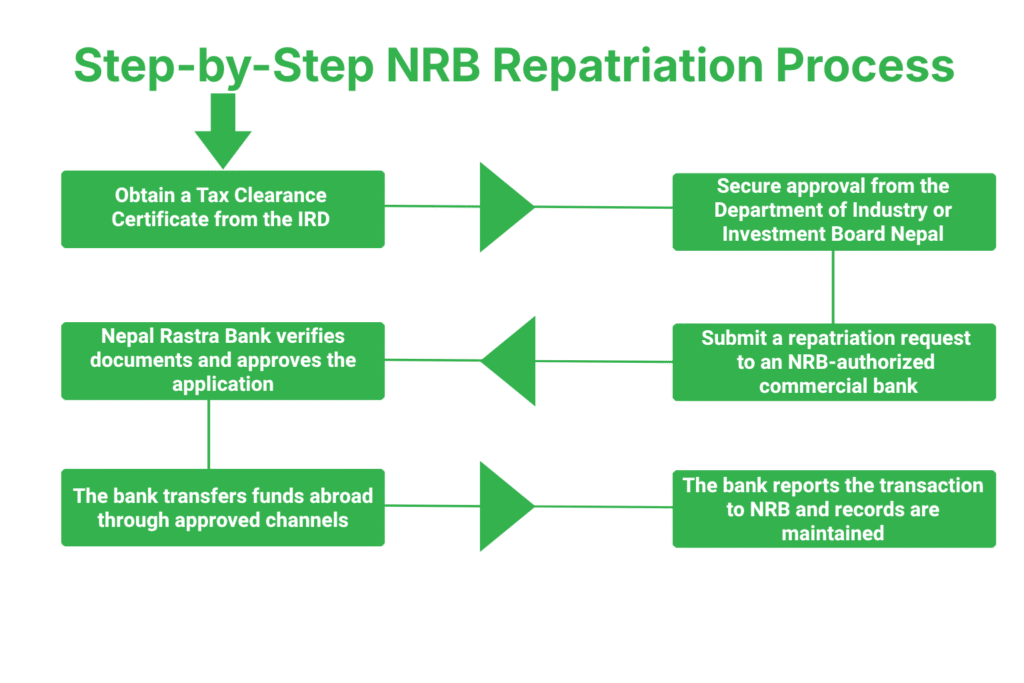
The Nepal Rastra Bank repatriation process follows a structured procedure. Below is the step-by-step guide for foreign investment repatriation in Nepal:
Step 1: Obtain Tax Clearance Certificate
- Apply to the Inland Revenue Department (IRD) at www.ird.gov.np.
- Submit audited accounts, income tax returns, and VAT returns (if applicable).
- Obtain the tax clearance certificate confirming all tax obligations are cleared.
Step 2: Obtain Approval from the Department of Industry (for FITTA investments)
- Submit an application to the Department of Industry at www.doind.gov.np or Investment Board Nepal at www.ibn.gov.np.
- Provide proof of registered investment, audited profit/loss statements, and dividend distribution resolutions.
Step 3: Apply to the Authorized Bank
- Approach a NRB-authorized ‘A’ Class Commercial Bank in Nepal.
- Submit the repatriation application along with all supporting documents.
- The bank forwards the application to Nepal Rastra Bank’s Foreign Exchange Management Department (FEMD).
Step 4: NRB Review and Approval
- Nepal Rastra Bank reviews the application through the Foreign Exchange Management Department.
- NRB verifies tax compliance, investment registration, and source of funds.
- NRB issues a foreign exchange repatriation approval letter.
Step 5: Fund Transfer
- The authorized bank executes the international fund transfer via SWIFT or other approved payment channels.
- The transaction is recorded in the bank’s foreign exchange ledger as per NRB directives.
Step 6: Post-Repatriation Reporting
- The authorized bank reports the transaction to NRB as per the NRB Unified Directives.
- The investor retains copies of all documents for future compliance and audit purposes.
Documents Required for NRB Repatriation
The documents required vary based on the type of repatriation. The general list is as follows:
For Foreign Investors (Profit/Dividend Repatriation):
- Valid passport copy of the investor or authorized representative
- Company registration certificate
- Industrial/business registration certificate
- FITTA registration and approval letter from Department of Industry or Investment Board Nepal
- Audited financial statements (minimum last two fiscal years)
- Tax clearance certificate from the Inland Revenue Department
- Dividend distribution resolution passed by the company’s Board of Directors or General Meeting
- Share register showing foreign investor’s ownership
- Bank account details of the receiving foreign account
For Foreign Employees (Salary Repatriation):
- Valid passport copy
- Valid work permit issued by the Department of Labour and Occupational Safety
- Employment contract duly approved by concerned authority
- Salary slip and bank statements
- Income tax payment receipt or clearance
- Application letter to the authorized bank
For Capital Repatriation:
- All documents listed for profit repatriation
- Share transfer deed or liquidation order (as applicable)
- Capital gains tax clearance certificate
- NRB prior approval letter (if required above threshold amounts)
NRB Repatriation Limits and Restrictions
Nepal Rastra Bank sets specific foreign exchange repatriation limits to maintain the country’s foreign exchange reserves and balance of payments.
CategoryRepatriation LimitRemarksSalary Repatriation for Foreign EmployeesUp to 50-75% of net salary (NRB revised periodically)Remaining amount must be used in NepalProfit/Dividend RepatriationNo fixed ceiling, subject to full tax complianceRequires audited financials and tax clearanceCapital RepatriationFull invested capital after liquidationFITTA registration requiredTechnology Transfer FeesAs per approved agreement amountFITTA registration requiredLoan RepaymentAs per loan agreement sanctioned by NRBPrior NRB approval required for foreign loans
Note: NRB may revise these limits through its periodic directives. Always verify current limits at www.nrb.org.np.
Foreign nationals and investors should note that round-tripping of funds (i.e., investing funds that originally came from Nepal) is strictly prohibited under the Foreign Exchange (Regulation) Act and FITTA 2019. NRB actively monitors such transactions.
Role of Nepal Rastra Bank’s Foreign Exchange Management Department (FEMD)
The Foreign Exchange Management Department (FEMD) of Nepal Rastra Bank is the primary department responsible for:
- Processing and approving foreign exchange repatriation requests.
- Issuing foreign exchange repatriation approval letters.
- Monitoring foreign exchange inflows and outflows.
- Supervising authorized dealers (commercial banks) engaged in foreign exchange transactions.
- Investigating violations of the Foreign Exchange (Regulation) Act, 1962.
Foreign investors and individuals can visit NRB’s official website at www.nrb.org.np or contact the FEMD directly for specific queries related to repatriation approvals.
Common Challenges in the NRB Repatriation Process
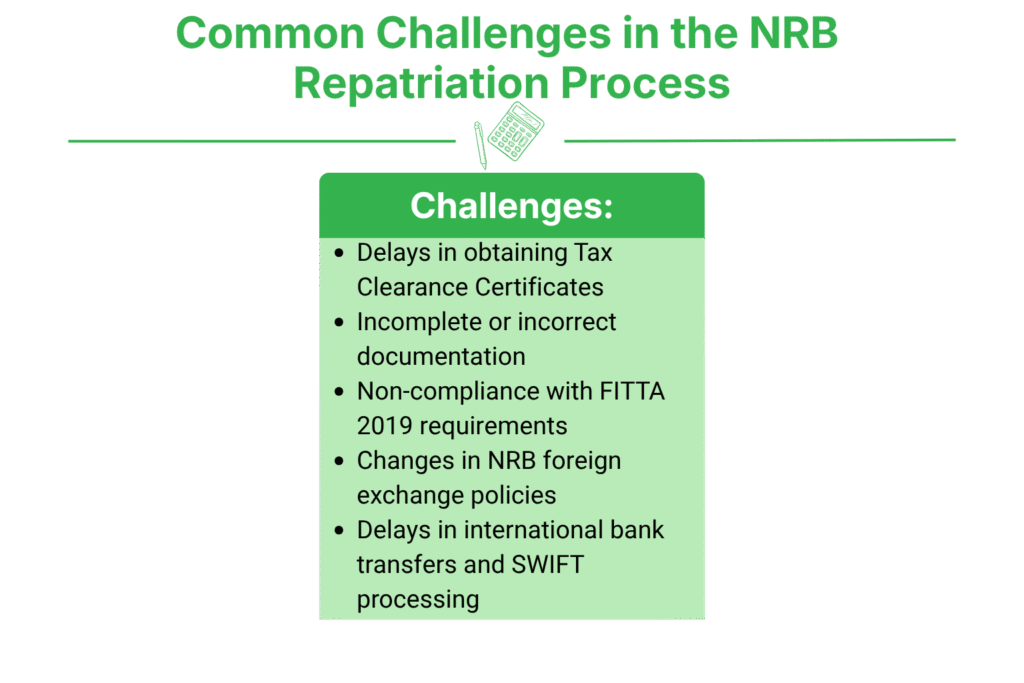
Several practical challenges arise during the NRB repatriation process in Nepal:
- Delay in tax clearance: The Inland Revenue Department sometimes takes weeks to issue tax clearance certificates, particularly if there are pending assessments.
- Documentation gaps: Incomplete or inconsistent documents are the most common reason for rejection or delay.
- FITTA non-compliance: Investments not registered under FITTA 2019 face severe complications in repatriating profits or capital.
- Forex reserve policy changes: NRB periodically tightens or relaxes repatriation rules based on Nepal’s foreign exchange reserve position.
- Banking correspondence delays: SWIFT transfers and correspondent banking issues occasionally cause technical delays.
Penalties for Unauthorized Repatriation
Under the Foreign Exchange (Regulation) Act, 1962, unauthorized repatriation or violation of NRB repatriation rules invites the following penalties:
- Confiscation of the amount involved in the unauthorized transaction.
- Fines up to three times the value of the amount repatriated without authorization.
- Criminal prosecution in serious cases.
- Blacklisting from future investment registration under FITTA.
NRB has the authority to investigate, seize, and prosecute both individuals and institutions involved in unauthorized foreign exchange repatriation in Nepal.
Frequently Asked Questions (FAQs)
Q1. What is the main law governing repatriation in Nepal?
The Foreign Exchange (Regulation) Act, 1962 is the primary law governing all foreign exchange repatriation in Nepal. The Foreign Investment and Technology Transfer Act (FITTA), 2019 additionally governs repatriation rights for registered foreign investors.
Q2. Do foreign investors need NRB approval for every repatriation?
Yes. All repatriation transactions require either direct NRB approval or approval through an NRB-authorized commercial bank, depending on the amount and category. Applications are processed through the Foreign Exchange Management Department (FEMD).
Q3. Can a foreign employee repatriate their full salary from Nepal?
No. Foreign employees can repatriate only a portion of their net salary, typically 50–75%, after deducting applicable income taxes. The exact percentage is governed by NRB Unified Directives, which NRB revises periodically.
Q4. Is tax clearance mandatory before repatriating profits from Nepal?
Yes. A tax clearance certificate from the Inland Revenue Department is mandatory before any profit or dividend repatriation. No NRB-authorized bank will process a repatriation request without this certificate.
Q5. How long does the NRB repatriation process take?
The process typically takes 2 to 6 weeks, depending on document completeness, tax clearance processing time, and NRB’s review schedule. Delays are common when documents are incomplete or when FITTA registration is not in order.
Q6. Where can I submit a repatriation application in Nepal?
Repatriation applications are submitted to any NRB-authorized ‘A’ Class commercial bank in Nepal. The bank then forwards the application to Nepal Rastra Bank’s Foreign Exchange Management Department. For reference, visit www.nrb.org.np.
Conclusion
The Nepal Rastra Bank repatriation process is a well-structured but documentation-intensive procedure governed by the Foreign Exchange (Regulation) Act, 1962, FITTA 2019, and NRB Unified Directives. Foreign investors, foreign employees, and Non-Resident Nepalis must follow the process strictly, clear all tax obligations through the Inland Revenue Department, and work through NRB-authorized commercial banks. Non-compliance or unauthorized repatriation carries significant legal and financial penalties. Regularly checking updates on www.nrb.org.np ensures you follow the latest NRB repatriation guidelines and directives.