

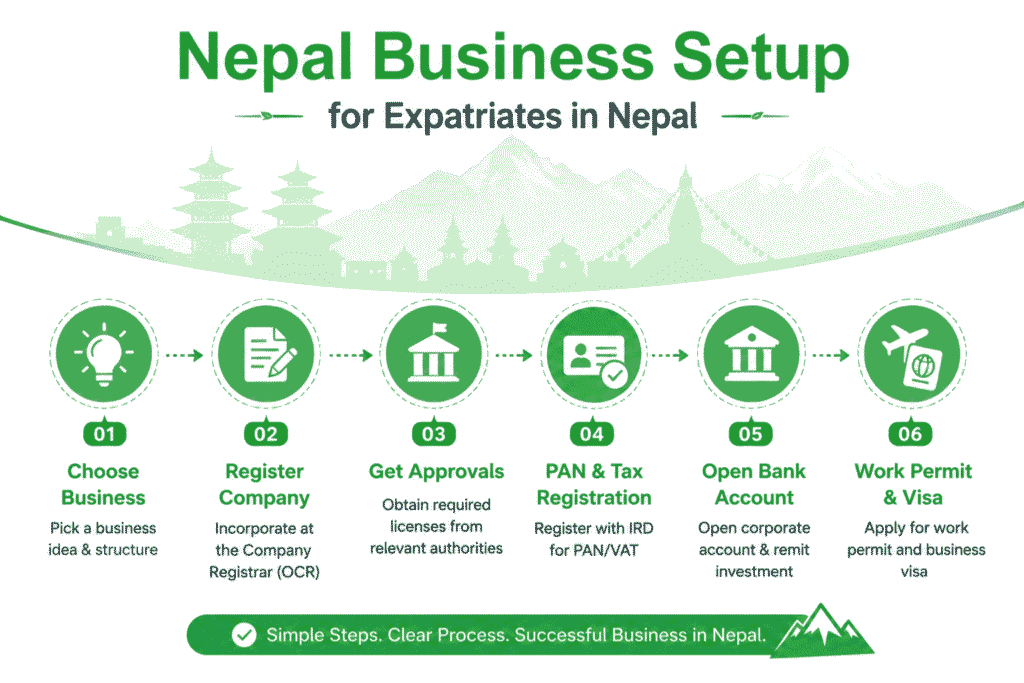
Nepal Business Setup for Expatriates in Nepal as an expatriate involves a structured legal process governed by specific laws and regulations. Nepal has opened its doors to foreign investment across many sectors, and the government has established clear frameworks to guide expatriates through the business registration and operation process. This article covers everything an expatriate needs to know about starting and running a business in Nepal.
What Laws Govern Business Setup for Expatriates in Nepal?
Nepal has a defined legal framework that governs foreign business investment and company registration. The primary laws applicable to expatriates who want to set up a business in Nepal are:
- Foreign Investment and Technology Transfer Act (FITTA), 2019 – This is the principal law regulating foreign investment in Nepal. It defines who qualifies as a foreign investor, what sectors are open for investment, and what protections are available.
- Companies Act, 2006 (2063 BS) – This law governs the registration and operation of all companies in Nepal, including those with foreign shareholding.
- Industrial Enterprises Act, 2020 (2076 BS) – This act categorizes industries and defines provisions for industries operating in Nepal.
- Income Tax Act, 2002 (2058 BS) – This act governs all tax-related obligations of businesses operating in Nepal.
- Special Economic Zone (SEZ) Act, 2016 – This act provides special incentives for businesses operating within SEZs in Nepal.
The Investment Board Nepal (IBN) and the Department of Industry (DOI) are the two primary government bodies managing foreign investment approvals.
Who Qualifies as a Foreign Investor in Nepal?
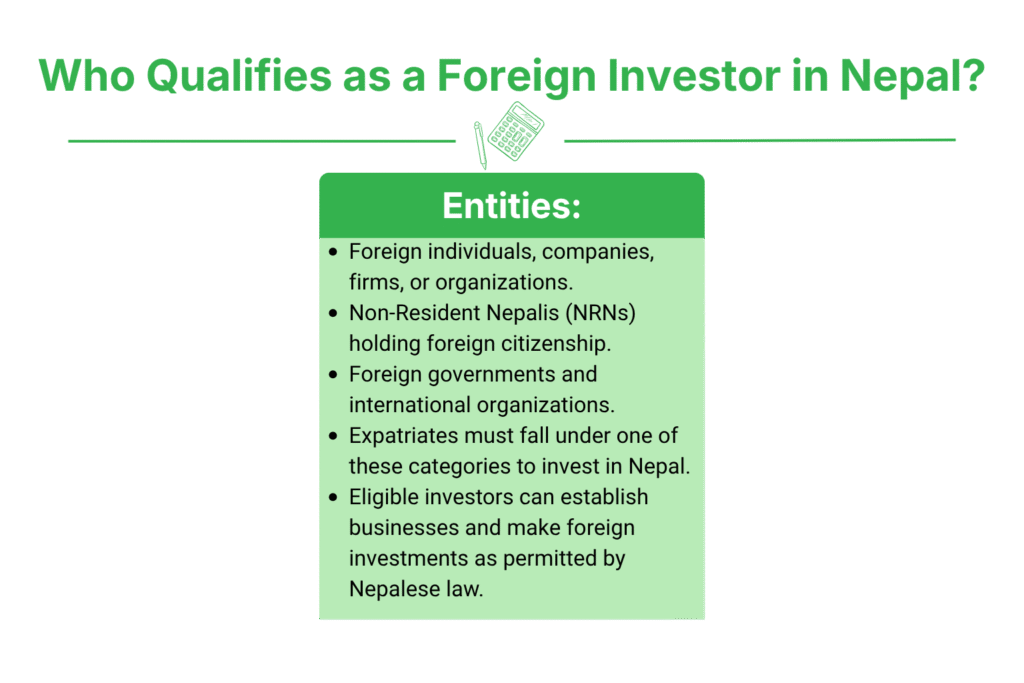
Under Section 2(c) of FITTA, 2019, a foreign investor is defined as:
- A foreign individual, firm, company, or organization
- A non-resident Nepali (NRN) holding foreign citizenship
- A foreign government or international organization investing in Nepal
An expatriate wishing to set up a business in Nepal must fall under one of these categories. Foreign investors can invest in Nepal through equity investment, technology transfer, or loan investment.
What Types of Business Entities Can Expatriates Register in Nepal?
Expatriates in Nepal can set up different types of business entities depending on the nature and scale of their investment.
| Business Entity Type | Ownership | Governing Law |
|---|---|---|
| Private Limited Company | Up to 100% foreign ownership (sector-specific) | Companies Act, 2063 |
| Public Limited Company | Partial or full foreign equity | Companies Act, 2063 |
| Branch Office | Foreign parent company | Companies Act, 2063 |
| Liaison / Representative Office | Foreign parent company | Companies Act, 2063 |
| Joint Venture Company | Foreign + Nepali partner | Foreign Investment and Technology Transfer Act, 2075 |
The most common form of business setup for expatriates in Nepal is a Private Limited Company because of its simpler registration requirements and operational flexibility.
What Is the Minimum Foreign Investment Requirement in Nepal?
Under FITTA, 2019, Section 3, foreign investors must meet a minimum investment threshold to be eligible for foreign investment approval in Nepal.
- Minimum investment for goods-producing industries: NPR 20 million (approximately USD 150,000)
- Minimum investment for service industries: NPR 15 million (approximately USD 112,000)
- Minimum investment for tourism industries: NPR 20 million
However, these thresholds are subject to revision by the Government of Nepal. Investments made by Non-Resident Nepalis (NRNs) may be subject to different thresholds as per NRN Act, 2008.
Which Sectors Are Open and Restricted for Foreign Investment in Nepal?
Nepal has a Negative List of sectors where foreign investment is restricted or prohibited. The government publishes this list through the DOI and periodically revises it.
Sectors Open for Foreign Investment:
- Manufacturing industries
- Tourism and hospitality
- Information technology and software
- Education (certain levels)
- Healthcare and pharmaceuticals
- Energy and hydropower
- Agriculture and agro-processing
- Infrastructure development
Restricted/Prohibited Sectors for Foreign Investors:
- Cottage and small-scale industries (reserved for Nepali nationals)
- Retail trade (below a specified threshold)
- Personal service businesses (tailoring, driving instruction, etc.)
- Arms and ammunition manufacturing
- Explosives production
- Real estate business (buying and selling land directly)
- Poultry farming, fisheries, and bee-keeping (below specified scale)
- Mass communication and media
Expatriates must verify the current negative list from the Department of Industry before proceeding with registration.
What Is the Step-by-Step Process to Register a Business in Nepal as an Expatriate?
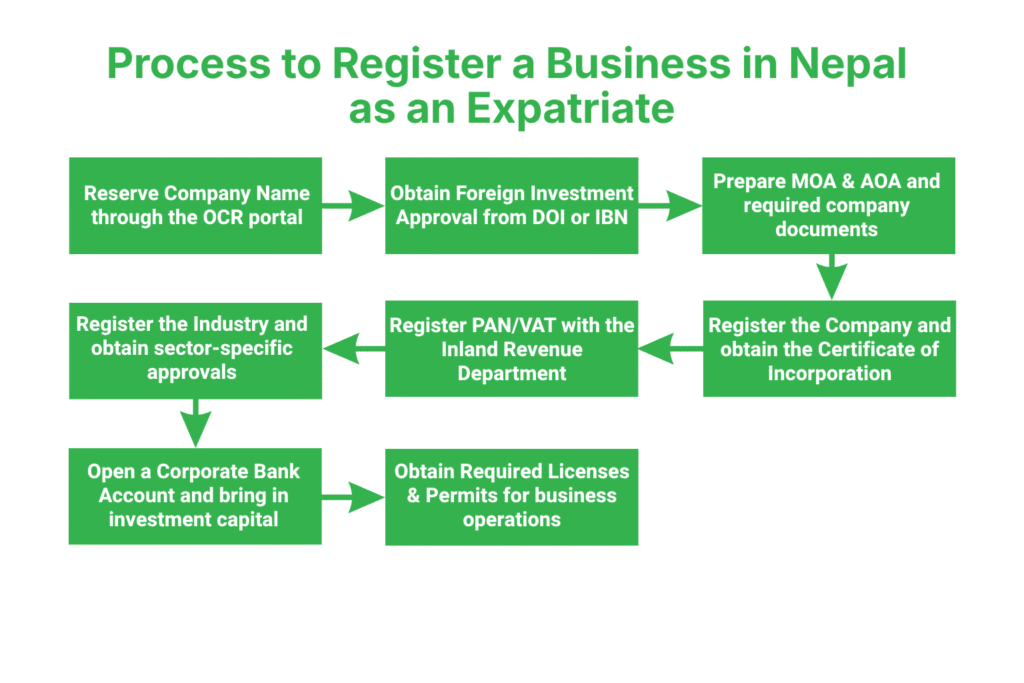
The business registration process for expatriates in Nepal involves multiple steps and agencies.
Step 1: Name Reservation
- Visit the Office of the Company Registrar (OCR) portal
- Reserve a company name online through the OCR’s name reservation system
- Ensure the name does not conflict with existing registered company names
Step 2: Obtain Foreign Investment Approval
- Submit an application to the Department of Industry (DOI) for investments below NPR 6 billion
- Submit to the Investment Board Nepal (IBN) for investments above NPR 6 billion
- Provide a business plan, source of funds, and nature of business
Step 3: Prepare the Memorandum and Articles of Association
- Draft the Memorandum of Association (MOA) specifying the company’s objectives
- Prepare the Articles of Association (AOA) outlining governance rules
- Documents must be notarized and translated into Nepali if in a foreign language
Step 4: Company Registration at OCR
- Submit all registration documents to the OCR
- Pay the applicable registration fee based on authorized capital
- The OCR issues a Certificate of Incorporation upon verification
Step 5: Obtain PAN/VAT Registration
- Register with the Inland Revenue Department (IRD) for a Permanent Account Number (PAN)
- Register for VAT if annual turnover exceeds NPR 5 million for goods or NPR 2 million for services
Step 6: Industry Registration
- Register the industry with the Department of Industry for manufacturing or service-based businesses
- Obtain sector-specific licenses from relevant ministries
Step 7: Open a Corporate Bank Account
- Open a bank account in Nepal in the company’s name
- Bring in the foreign investment capital through proper banking channels (SWIFT transfer)
Step 8: Obtain Necessary Licenses and Permits
- Apply for sector-specific operating licenses (e.g., tourism license from NTB, medical license from Ministry of Health)
What Documents Does an Expatriate Need to Register a Business in Nepal?
The following documents are required for business registration by expatriates in Nepal:
- Valid passport copy of all foreign shareholders and directors
- Passport-size photographs of shareholders and directors
- Proof of residential address (utility bill or bank statement)
- Source of funds documentation (bank statements, financial statements)
- Company registration certificate of the parent company (for branch/liaison offices)
- Board resolution authorizing Nepal business establishment (for corporate investors)
- Notarized and apostilled documents from the home country
- Translated versions in Nepali language (certified translation required)
- Proposed business plan outlining operations in Nepal
- MOA and AOA (Memorandum and Articles of Association)
What Are the Tax Obligations for Foreign-Owned Businesses in Nepal?
Foreign-owned businesses registered in Nepal are subject to the same tax obligations as domestic companies under the Income Tax Act, 2002.
| Tax Type | Rate | Authority |
|---|---|---|
| Corporate Income Tax | 25% (standard) | Inland Revenue Department |
| Corporate Tax (Special Industries) | 20% (reduced rate for certain sectors) | Inland Revenue Department |
| VAT | 13% | Inland Revenue Department |
| Dividend Tax (Repatriation) | 5% withheld at source | Inland Revenue Department |
| Custom Duties | Variable by product | Department of Customs |
Under FITTA, 2019, Section 8, foreign investors have the right to repatriate profits, dividends, and capital after fulfilling all tax obligations. Repatriation must be done through authorized banking channels and with approval from Nepal Rastra Bank (NRB).
Can Expatriates Get a Work Visa While Running a Business in Nepal?
Yes. Expatriates who invest in Nepal and run a business can obtain a Business Visa or Non-Tourist Visa from the Department of Immigration Nepal.
Foreign nationals employed in their own companies or as executives require a Work Permit issued by the Department of Labour, Employment and Occupational Safety. Nepal’s Labour Act, 2017 (2074 BS) restricts certain jobs for foreign nationals to protect local employment. Foreign ownership of a company does not automatically grant the right to work a separate work permit is required.
The visa and work permit must be renewed annually and are tied to the operational status of the business.
What Are the Key Benefits of Setting Up a Business in Nepal as an Expatriate?
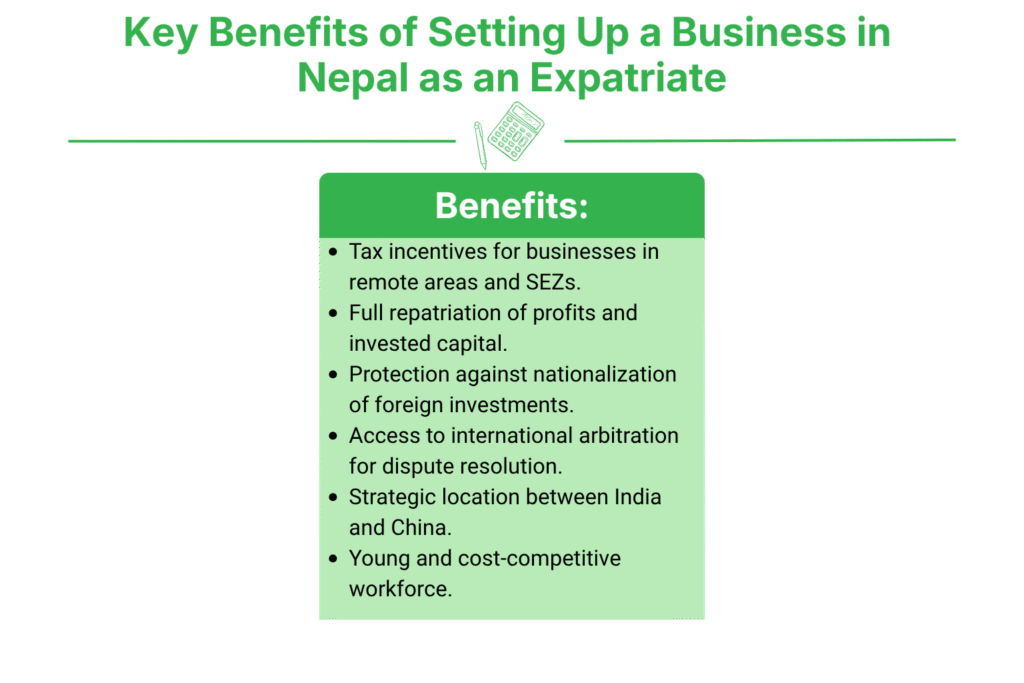
Nepal offers several incentives to attract foreign direct investment (FDI):
- Tax holidays for industries established in remote areas or Special Economic Zones under the Industrial Enterprises Act, 2020
- Full repatriation rights for profits and capital under FITTA, 2019
- Protection against nationalization the government guarantees foreign investments will not be nationalized
- Dispute resolution through international arbitration, as Nepal is a signatory to the New York Convention
- Strategic geographic location between India and China with trade access to both markets
- Young labor force with competitive wage rates
FAQs
1. Can a foreigner own 100% of a company in Nepal?
Yes, under FITTA, 2019, foreign investors can own up to 100% equity in sectors not listed in the negative list. However, some sectors require mandatory local partnership or joint venture structure with Nepali shareholders.
2. What is the minimum investment required for a foreigner to start a business in Nepal?
The minimum foreign investment requirement is NPR 20 million for goods-producing and tourism industries and NPR 15 million for service industries as per FITTA, 2019, Section 3.
3. How long does it take to register a company in Nepal as an expatriate?
The company registration process typically takes 4 to 8 weeks, depending on document preparation, DOI approval timelines, and OCR processing. Having all notarized documents ready shortens the process significantly.
4. Do expatriates need a Nepali partner to start a business in Nepal?
Not necessarily. Many sectors allow 100% foreign ownership. However, sectors like retail trade and cottage industries require Nepali partnership. Check the current negative list at DOI Nepal.
5. Can expatriates repatriate profits from Nepal?
Yes. Under FITTA, 2019, Section 8, expatriates and foreign investors can repatriate profits, dividends, and capital through authorized banking channels after paying applicable taxes including 5% dividend tax.
6. Is Nepal a good country for foreign business investment?
Nepal offers a growing market, strategic location, young workforce, and legal protections under FITTA, 2019. The government is actively promoting FDI through the Investment Board Nepal, making it a viable option for expatriate investors.
Conclusion
Setting up a business in Nepal as an expatriate is a straightforward process when you follow the legal requirements under FITTA, 2019, the Companies Act, 2006, and the Industrial Enterprises Act, 2020. The key steps include obtaining foreign investment approval from DOI or IBN, registering with OCR, obtaining PAN/VAT, and securing sector-specific licenses. Expatriates must also verify sector eligibility, meet minimum investment requirements, and fulfill tax obligations under Nepal’s Income Tax Act, 2002. For the most updated information, always consult the Office of the Company Registrar, Department of Industry, and Investment Board Nepal.