
Loan agreement drafting service in Nepal is a professional legal service that helps individuals, businesses, financial institutions, and private lenders prepare legally binding loan documents. A properly drafted loan agreement protects both the lender and the borrower and ensures that all terms, conditions, repayment schedules, interest rates, and collateral arrangements are clearly documented under Nepalese law.
Whether you are lending money to a friend, a business partner, or a corporate entity, or if you are borrowing funds for personal or commercial purposes, a written loan agreement is the foundation of a secure financial transaction in Nepal.
What Is a Loan Agreement in Nepal?
A loan agreement in Nepal is a written legal contract between a lender (creditor) and a borrower (debtor) that defines the terms of a financial loan. It outlines the principal amount, interest rate, repayment terms, collateral or security, penalties for default, and the rights and obligations of both parties.
In Nepal, loan agreements are governed by several laws including:
- The Contract Act, 2056 (2000) – governs the formation and enforceability of contracts in Nepal
- The Civil Code, 2074 (2017) – provides provisions for obligations, debt recovery, and civil liabilities
- The Bank and Financial Institutions Act (BAFIA), 2073 (2017) – regulates lending by licensed banks and financial institutions
- The Private Firm Registration Act and related commercial laws for business loans
- The Debt Recovery Tribunal Act, 2058 (2002) – governs the recovery of institutional debts
A loan agreement that is drafted in compliance with these laws is legally valid and enforceable in Nepal’s courts.
Why You Need a Loan Agreement Drafting Service in Nepal?
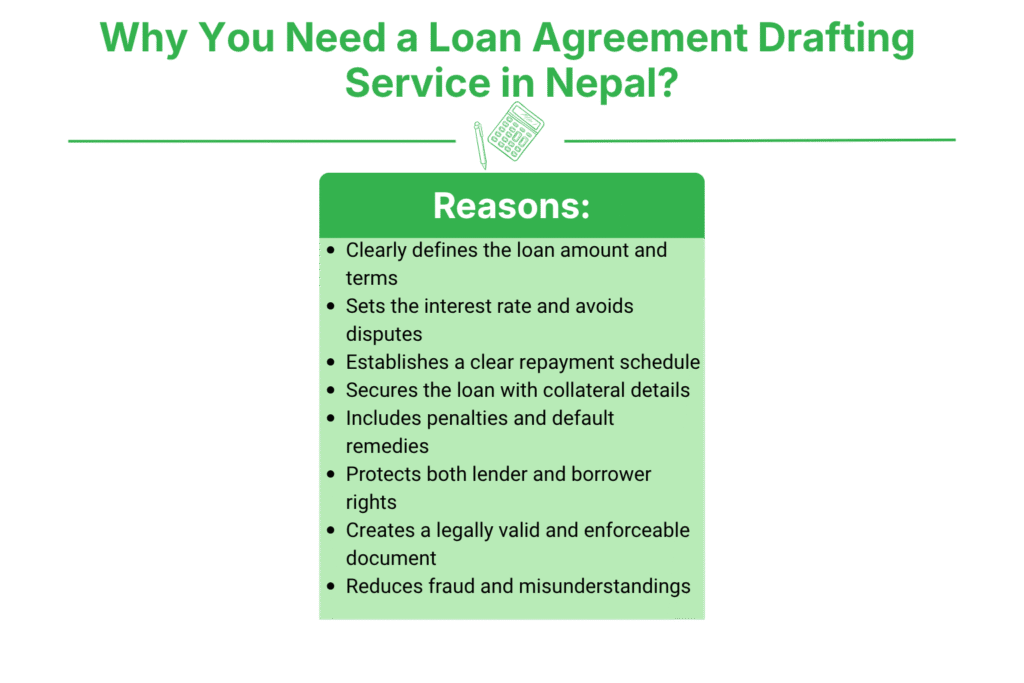
Many people in Nepal conduct informal lending without proper documentation. This leads to disputes, financial losses, and lengthy legal proceedings. A professional loan agreement drafting service in Nepal ensures that the document meets all legal requirements and stands valid in court.
Here are specific reasons why a professionally drafted loan agreement matters:
- It clearly defines the principal amount and prevents later disputes about the borrowed sum
- It specifies the interest rate, whether flat or diminishing, and prevents usurious claims
- It describes the repayment schedule so both parties know their obligations
- It includes collateral details to secure the lender’s interest
- It specifies penalties and legal remedies if the borrower defaults
- It protects the borrower from arbitrary demands by the lender
- It is admissible as evidence in Nepal’s courts and debt recovery tribunals
- It reduces the risk of fraud and misrepresentation
Types of Loan Agreements Drafted in Nepal
A loan agreement drafting lawyer in Nepal or a legal firm can draft several types of loan agreements depending on the nature and purpose of the loan.
1. Personal Loan Agreement
This is between two individuals. It can be for emergency funds, education, medical expenses, or personal needs. It must include repayment terms, interest, and signatures of both parties.
2. Business Loan Agreement
This is used when a lender provides funds to a business entity such as a private limited company, partnership firm, or sole proprietorship. It often includes business assets as collateral.
3. Mortgage Loan Agreement
In a mortgage loan agreement in Nepal, the borrower pledges real estate property as security. This document must be registered at the land revenue office under the Land Revenue Act.
4. Vehicle Loan Agreement
Used when a financial institution or private lender provides funds to purchase a vehicle. The vehicle is pledged as collateral.
5. Promissory Note (Tamasuk)
A simpler form of debt instrument used in Nepal, especially in private lending. It is governed by the Civil Code, 2074 and must be signed before witnesses or a notary for legal enforceability.
6. Inter-Company Loan Agreement
Used when one company provides a loan to another. This is common in group companies or parent-subsidiary arrangements in Nepal.
7. Agricultural and Cooperative Loan Agreement
Used by cooperatives registered under the Cooperative Act, 2074 (2017) when providing loans to members. These require compliance with cooperative bylaws and Nepal Rastra Bank regulations.
Key Elements of a Loan Agreement in Nepal
A professional loan agreement drafting service in Nepal ensures that the document contains all legally required components. Below are the key elements that every valid loan agreement must include:
| Element | Description |
|---|---|
| Parties’ Details | Full legal names, addresses, and citizenship numbers of the lender and borrower |
| Loan Amount | The exact principal amount in Nepali Rupees (NPR) |
| Interest Rate | Annual or monthly rate, whether flat or diminishing balance |
| Loan Tenure | Start date and maturity/end date |
| Repayment Schedule | Monthly, quarterly, or lump sum repayment terms |
| Collateral / Security | Details of property, assets, or guarantees pledged |
| Default Clause | Consequences and legal remedies upon non-payment |
| Prepayment Terms | Conditions for early repayment and any applicable charges |
| Governing Law | Reference to the applicable laws of Nepal |
| Witnesses and Notarization | Signatures of witnesses and notary stamp where required |
Step-by-Step Process for Loan Agreement Drafting in Nepal
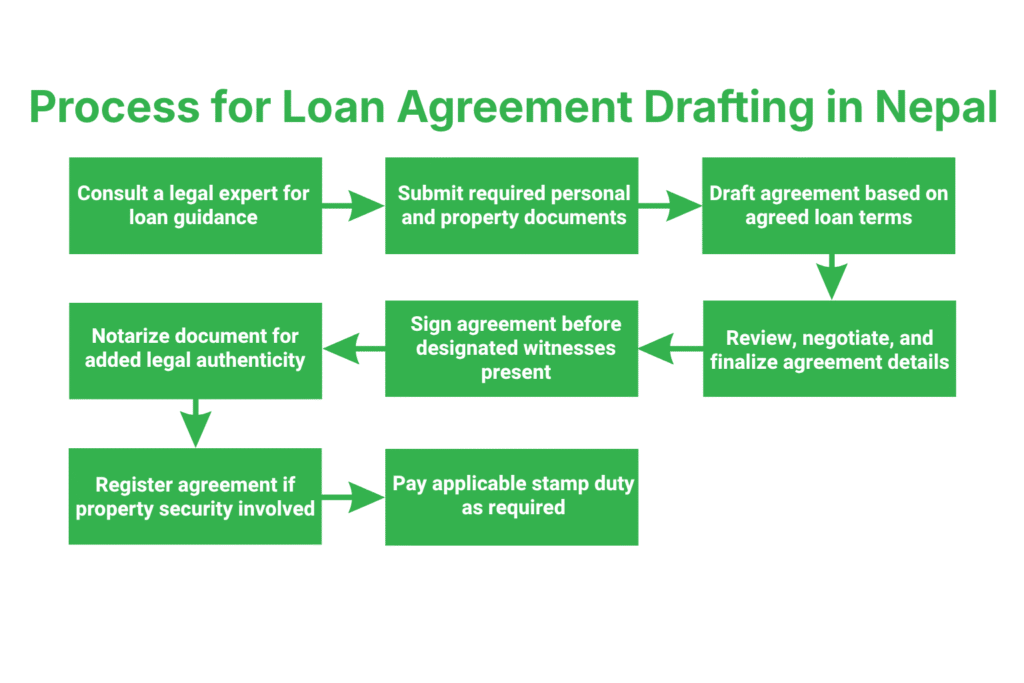
The process of getting a loan agreement drafted in Nepal through a legal professional follows a structured procedure:
- Consultation with a legal professional – Meet with a lawyer or legal firm specializing in financial contracts in Nepal to discuss the nature and terms of the loan
- Collection of client information – Provide citizenship cards, passport photos, property documents (for secured loans), and agreed terms between parties
- Drafting of the agreement – The lawyer prepares the first draft of the loan agreement incorporating all agreed terms and applicable Nepalese laws
- Review and negotiation – Both parties review the draft, suggest changes, and finalize the terms
- Execution and signing – Both lender and borrower sign the document in the presence of witnesses
- Notarization – The signed document is notarized by a registered notary public in Nepal for additional legal validity
- Registration (if applicable) – For mortgage loan agreements or agreements involving real property, registration at the concerned District Land Revenue Office is mandatory
- Stamping – Stamp duty is paid as required under the Stamp Duty Act, 2019 BS and its amendments
Documents Required for Loan Agreement Drafting in Nepal
To draft a valid loan agreement in Nepal, you need to provide the following documents:
For Individual Borrowers/Lenders:
- Citizenship certificate copy of both parties
- Passport-size photographs
- Permanent address proof
- Contact details
For Business Entities:
- Company registration certificate from the Office of the Company Registrar
- Tax clearance certificate or PAN registration
- Board resolution authorizing the loan (for companies)
- Memorandum and Articles of Association
For Secured Loans (Collateral Documents):
- Land ownership certificate (Lalpurja)
- Cadastral map (Naksā)
- Latest land revenue payment receipt
- Valuation report from a certified property valuer
For Guarantors (if applicable):
- Citizenship certificate of guarantor
- Income proof or financial statement
- Guarantee declaration letter
Interest Rate Rules for Loan Agreements in Nepal
The interest rate in a loan agreement in Nepal must comply with regulations set by Nepal Rastra Bank (NRB) for institutional lenders. For private loan agreements between individuals, the Civil Code, 2074 sets limitations.
The Civil Code, 2074, Section 505 provides that the interest rate in a private loan agreement shall not exceed 10% per annum in cases where the rate is not specified, and total interest collected shall not exceed the principal amount (no compound interest rule for private loans beyond principal limit).
For banks and financial institutions, NRB circulars and the Bank and Financial Institutions Act, 2073 regulate the maximum interest rates permissible. Always consult the latest Nepal Rastra Bank directives before finalizing the rate.
Loan Agreement Registration and Stamp Duty in Nepal
| Document Type | Registration Required | Stamp Duty |
|---|---|---|
| Personal Loan Agreement | Optional (notarization generally sufficient) | As per applicable Stamp Duty Act provisions |
| Mortgage Loan Agreement | Mandatory at the Land Revenue Office | Based on property value |
| Promissory Note (Tamasuk) | Not mandatory but advisable | Fixed stamp duty |
| Business Loan Agreement | Recommended for large amounts | As per transaction value |
| Inter-Company Loan | Recommended | As per applicable company law requirements |
Registration of a mortgage-backed loan agreement at the Department of Land Management and Archive gives the lender a security interest that is publicly recorded and legally enforceable against third parties.
Legal Remedies for Loan Default in Nepal
When a borrower defaults on a loan, the lender has the following legal remedies under Nepalese law:
- Filing a claim at the Debt Recovery Tribunal under the Debt Recovery Tribunal Act, 2058, for loans above the threshold limit set by institutional lenders
- Filing a civil suit at the District Court under the Civil Code, 2074 for private loan recovery
- Initiating collateral enforcement proceedings through the Land Revenue Office for mortgaged properties
- Filing a complaint under cheque dishonor provisions if post-dated cheques were issued as security
- Mediation and arbitration as an alternative dispute resolution mechanism if the agreement includes an arbitration clause
A well-drafted loan agreement that specifies jurisdiction and dispute resolution mechanisms significantly speeds up the legal recovery process in Nepal.
How to Find a Loan Agreement Drafting Service in Nepal
You can access loan agreement drafting services in Nepal through:
- Licensed advocate offices registered under the Nepal Bar Association
- Legal firms and law offices in Kathmandu, Lalitpur, Pokhara, and other major cities
- Notary public offices for simpler agreements
- Online legal service platforms offering document drafting in Nepal
- Cooperative legal departments for cooperative loan agreements
Always verify that the service provider is a licensed advocate under the Advocates Act, 2028 (1972) and is registered with the Nepal Bar Association.
Common Mistakes to Avoid in Loan Agreement Drafting in Nepal
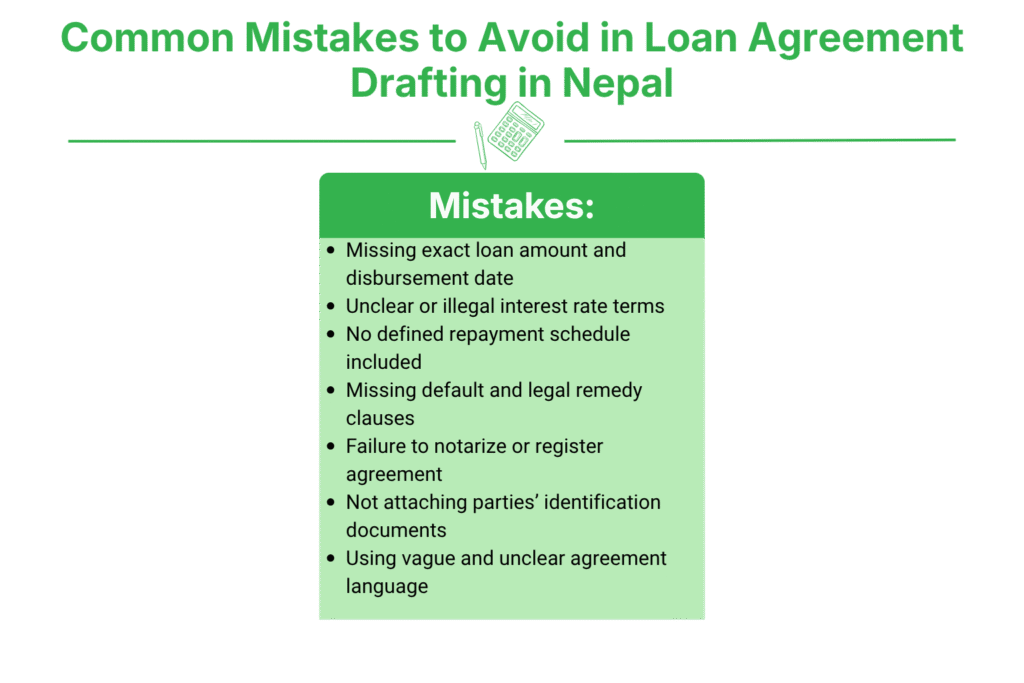
Many loan disputes arise because of poorly drafted agreements. The most common mistakes include:
- Failing to mention the exact loan amount and disbursement date
- Not specifying the interest rate or using an illegal interest rate
- Omitting the repayment schedule
- Not including a default clause or legal remedy section
- Failing to notarize or register the document
- Not attaching identification documents of both parties
- Using vague language that causes multiple interpretations
FAQs
1. Is a loan agreement legally binding in Nepal without notarization?
Yes, a loan agreement is legally binding in Nepal even without notarization if it meets the requirements of the Contract Act, 2056. However, notarization strengthens the document’s evidentiary value significantly in court proceedings.
2. What is the maximum interest rate allowed in a private loan agreement in Nepal?
Under the Civil Code, 2074, private loan agreements must not charge compound interest beyond the principal amount. Nepal Rastra Bank regulates institutional rates. Consult the NRB website at www.nrb.org.np for updated rates.
3. Do I need to register a loan agreement at the Land Revenue Office in Nepal?
Registration is mandatory only for mortgage loan agreements where land or property is pledged as collateral. Other loan agreements do not require registration but benefit from notarization for legal protection.
4. Can a foreign national enter into a loan agreement in Nepal?
Yes, a foreign national can be a party to a loan agreement in Nepal. However, foreign currency loans and cross-border transactions require prior approval from Nepal Rastra Bank under the Foreign Exchange Regulation Act, 2019 (1962).
5. How long does it take to draft a loan agreement in Nepal?
A standard loan agreement can be drafted within one to three working days by a qualified legal professional in Nepal. Complex agreements involving multiple parties, business assets, or real property may take longer.
6. What happens if the borrower dies before repaying the loan in Nepal?
Under the Civil Code, 2074, the debt obligation passes to the deceased borrower’s legal heirs to the extent of the inherited estate. The loan agreement should include a succession clause to address this situation clearly.
Conclusion
Loan agreement drafting service in Nepal is an essential legal service for anyone involved in lending or borrowing money. A properly drafted, notarized, and registered loan agreement under the Contract Act, 2056, the Civil Code, 2074, and applicable NRB regulations protects both parties and makes legal enforcement possible. Always engage a licensed advocate registered with the Nepal Bar Association to draft your loan agreement and ensure full legal compliance.