


Nepal has steadily positioned itself as an emerging destination for IT investment in South Asia. The government of Nepal has introduced several legal reforms to attract foreign investors into the IT sector. IT company Registration for Foreigners in Nepal must comply with specific laws, meet minimum investment thresholds, and follow a defined registration process.
This article covers every aspect of IT company registration for foreigners in Nepal, from legal requirements to the step-by-step process.
What Is the Legal Framework for IT Company Registration for Foreigners in Nepal?
The legal framework governing IT company registration for foreigners in Nepal includes several key statutes:
- Company Act, 2063 (2006): This Act governs the formation, registration, and operation of all companies in Nepal, including those with foreign ownership. It is administered by the Office of the Company Registrar (OCR).
- Foreign Investment and Technology Transfer Act, 2075 (2019) (FITTA 2019): This is the primary law governing foreign direct investment (FDI) in Nepal. It defines the conditions under which foreigners can invest in Nepalese businesses, including IT companies.
- Industrial Enterprises Act, 2076 (2020): This Act classifies industries and provides the legal basis for establishing and operating industries, including IT and software companies.
- Income Tax Act, 2058 (2002): This Act governs the taxation of businesses, including foreign-owned IT companies operating in Nepal.
- Special Economic Zone Act, 2073 (2016): This Act provides special facilities to IT companies operating in designated zones.
Under Section 3 of FITTA 2019, foreign investors are permitted to invest in industries listed in Schedule 1 of the Act. The IT sector falls under the permissible category for foreign investment in Nepal.
What Types of IT Companies Can Foreigners Register in Nepal?
Foreigners can register IT companies in Nepal under several structural forms. The Company Act 2063 allows the following types:
| Company Type | Foreign Ownership Allowed | Minimum Paid-Up Capital |
|---|---|---|
| Private Limited Company | Up to 100% | As per Foreign Investment and Technology Transfer Act, 2075 (FITTA 2019) |
| Public Limited Company | Up to 100% | As per Foreign Investment and Technology Transfer Act, 2075 (FITTA 2019) |
| Branch Office | Parent company ownership | As per Foreign Investment and Technology Transfer Act, 2075 (FITTA 2019) |
| Liaison / Representative Office | Foreign parent company | Remittance from parent company |
| Joint Venture Company | Partial foreign ownership | Negotiable |
Most foreign investors prefer to establish a Private Limited Company (Pvt. Ltd.) in Nepal because it offers limited liability protection and allows up to 100% foreign ownership in the IT sector.
What Is the Minimum Investment Requirement for Foreign IT Companies in Nepal?
Under FITTA 2019, Section 7, the minimum foreign investment required to establish a company in Nepal is NPR 50,000,000 (fifty million Nepalese Rupees) or its foreign currency equivalent, approximately USD 375,000 to USD 400,000 depending on exchange rates.
However, the Department of Industry (DoI) has recommended revisions to make Nepal more competitive. In the IT and technology sector, discussions around reducing the minimum threshold for software and digital service companies have taken place, but as of the latest update, the NPR 50 million floor remains in force under FITTA 2019.
Foreign investors must bring the investment through proper banking channels and obtain approval from the relevant authorities before commencing operations.
What Are the Pre-Registration Requirements for Foreign IT Company Registration?
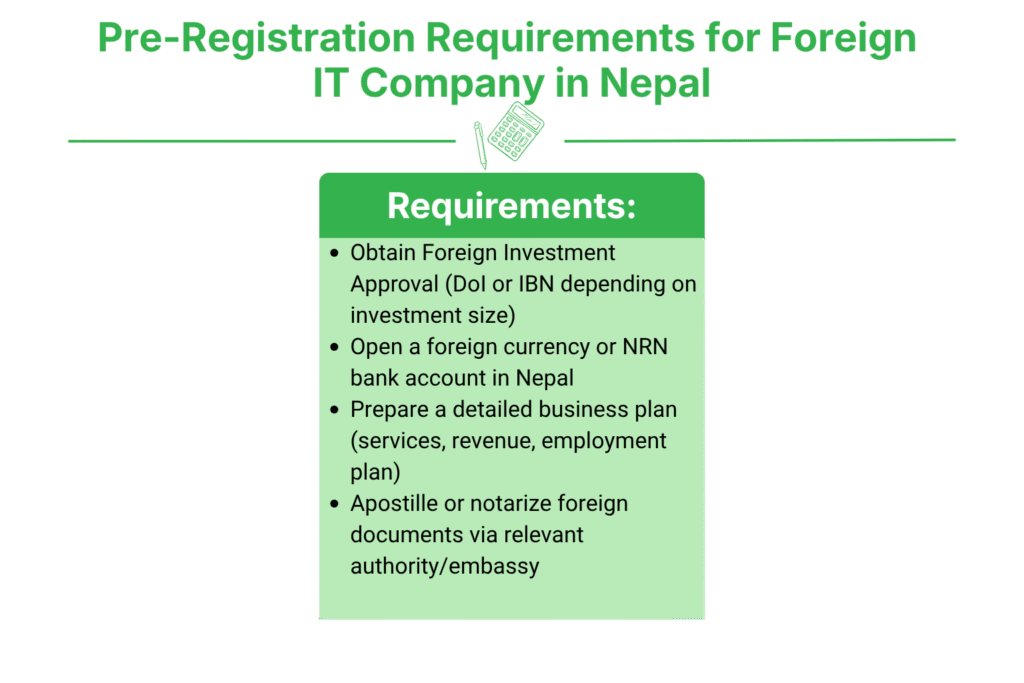
Before registering an IT company in Nepal, foreign nationals must fulfil these pre-registration conditions:
- Obtain Foreign Investment Approval: Apply to the Department of Industry (DoI) or the Investment Board Nepal (IBN) depending on the investment size.
- Open a Non-Resident Nepali (NRN) or Foreign Currency Account: The investment must be remitted through a Nepalese bank.
- Prepare a Business Plan: The DoI requires a detailed business plan describing the nature of IT services, projected employment, and revenue.
- Apostille or Notarize Foreign Documents: All foreign documents must be apostilled or notarized by the relevant Nepalese embassy abroad.
What Documents Are Required for IT Company Registration for Foreigners in Nepal?
The following documents are required to register an IT company in Nepal as a foreigner:
For Company Registration at OCR:
- Memorandum of Association (MoA)
- Articles of Association (AoA)
- Application form as prescribed by the OCR
- Copies of passports of all foreign shareholders
- Proof of residential address of all shareholders
- Photographs of all directors and shareholders
- Board resolution (for foreign corporate shareholders)
- Certificate of Incorporation of parent company (if applicable)
- Power of Attorney (if applicable)
For Foreign Investment Approval at DoI:
- Foreign investment approval application form
- Detailed project proposal or business plan
- Financial statements or proof of financial capacity
- Bank reference letter from the investor’s home country bank
- Passport copies of foreign investors
- Proposed investment amount and source of funds documentation
- Technology transfer agreement (if applicable under FITTA 2019)
For PAN/Tax Registration at Inland Revenue Department (IRD):
- Copy of company registration certificate
- Copy of foreign investment approval
- Lease agreement of registered office
- Passport copies of directors
- Photographs of directors
What Is the Step-by-Step Process to Register an IT Company in Nepal as a Foreigner?
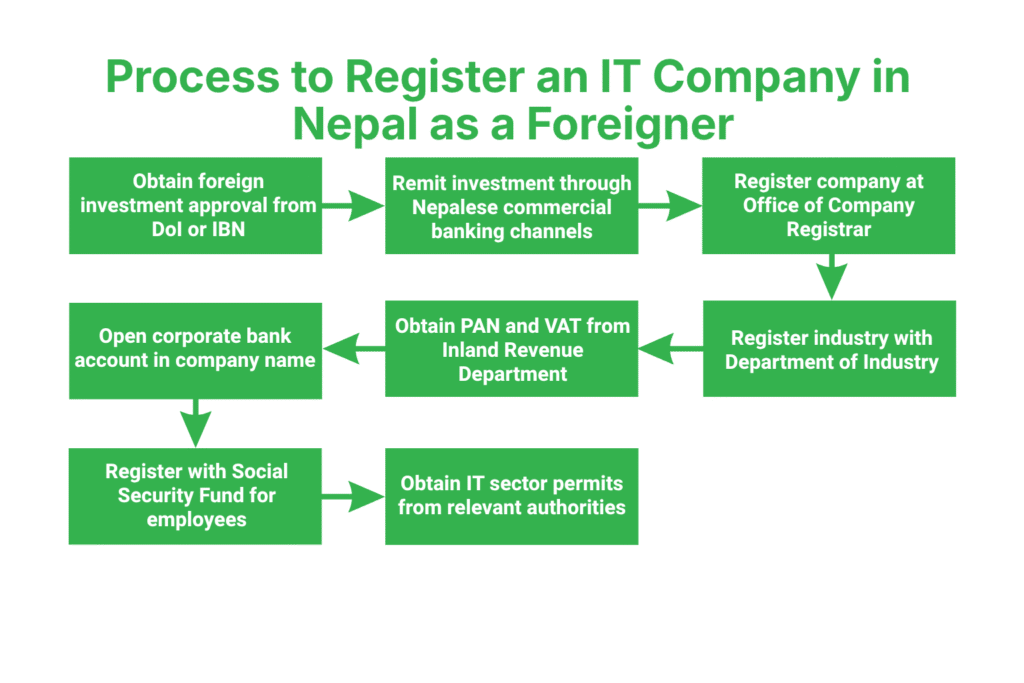
Step 1: Obtain Foreign Investment Approval
Submit an application to the Department of Industry (DoI) along with the required documents. For investments above NPR 6 billion, the Investment Board Nepal (IBN) handles the approval under the Investment Board Act, 2068 (2011). The DoI issues a foreign investment approval certificate typically within 15 working days.
Step 2: Remit Investment Through Banking Channels
Transfer the foreign investment through a recognized Nepalese commercial bank. The bank will issue a remittance certificate, which serves as proof of fund transfer.
Step 3: Register the Company at the Office of the Company Registrar (OCR)
File the MoA, AoA, application form, and other required documents at the Office of the Company Registrar. The OCR processes the application and issues a Certificate of Registration under the Company Act 2063. The registration fee is calculated based on the authorized share capital.
Step 4: Register at the Department of Industry
After obtaining the OCR certificate, register the IT company at the DoI to formalize the foreign investment and receive the Industry Registration Certificate. This is mandatory under the Industrial Enterprises Act 2076.
Step 5: Obtain PAN and VAT Registration
Register for a Permanent Account Number (PAN) and Value Added Tax (VAT) at the Inland Revenue Department (IRD). IT companies providing software services and digital products are generally required to register for VAT if their annual turnover exceeds NPR 5,000,000.
Step 6: Open a Corporate Bank Account
Open a corporate bank account in the name of the company at a Nepalese commercial bank. Submit the registration certificates, PAN certificate, and company documents.
Step 7: Register for Social Security Fund (SSF)
Under the Social Security Act, 2074 (2017), all employers must register their company with the Social Security Fund (SSF) and contribute to employee social security.
Step 8: Obtain Necessary IT Sector Permits
Depending on the nature of IT services, the company may need to register with the Nepal Telecommunications Authority (NTA) for internet service-related activities or with the Department of Information Technology under the Ministry of Communication and Information Technology.
What Are the Tax Incentives for Foreign IT Companies in Nepal?
Nepal offers several tax incentives for IT companies under the Income Tax Act 2058 and the Industrial Enterprises Act 2076:
| Incentive | Details |
|---|---|
| Income Tax Exemption | IT companies operating in technology parks or SEZs receive a 50% tax rebate on income tax for up to 5 years |
| Export Income Tax Rebate | Companies exporting IT services receive a 50% tax exemption on export income |
| VAT Exemption | Software development and IT-enabled services may qualify for VAT exemptions under Schedule 1 of Value Added Tax Act, 2052 |
| Repatriation of Profit | Foreign Investment and Technology Transfer Act, 2075 guarantees the right to repatriate profits, dividends, and capital after tax payment |
| No Nationalization Guarantee | Section 5 of Foreign Investment and Technology Transfer Act, 2075 prohibits nationalization of foreign-invested enterprises |
Can Foreigners Obtain Work Permits for Their IT Company in Nepal?
Yes. Foreign nationals working in their own IT company in Nepal must obtain a Work Permit from the Department of Labour and Employment (DoLE) and a Business Visa from the Department of Immigration.
Under the Foreign Employment Act, 2064 (2007) and related regulations, the ratio of foreign employees to Nepalese employees must not exceed a prescribed limit. Generally, companies must employ Nepalese nationals for positions that Nepalese workers can fill, while foreign expertise is permitted for technical and managerial roles not readily available locally.
What Are the Benefits of Registering an IT Company in Nepal as a Foreigner?
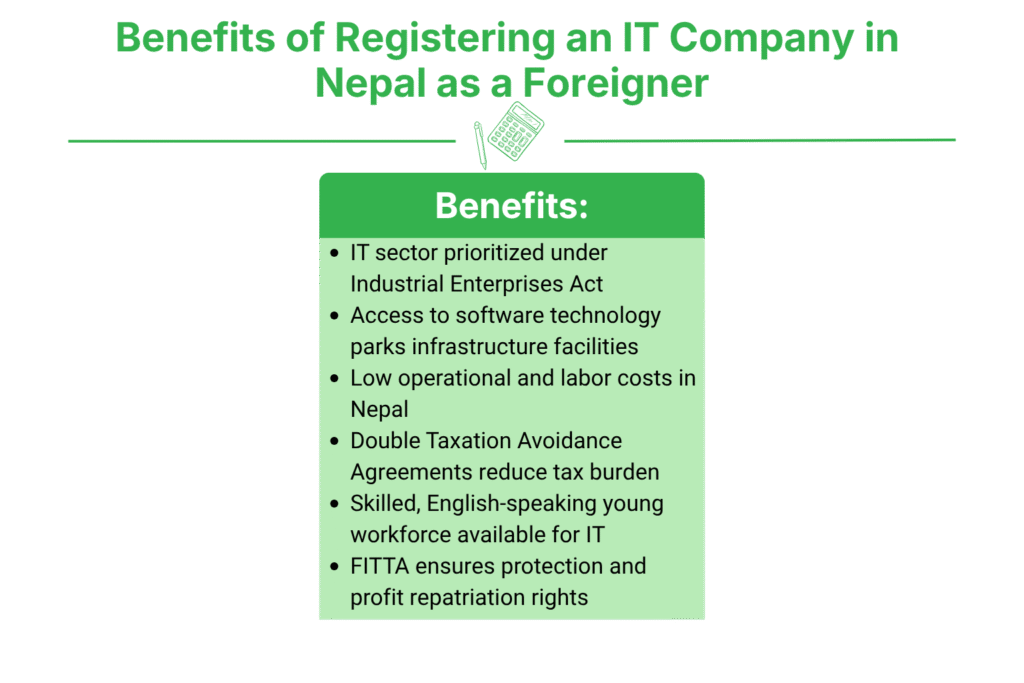
- Nepal’s IT sector is listed as a high-priority industry under the Industrial Enterprises Act 2076, making it eligible for special facilities.
- The government has established Software Technology Parks in Kathmandu and other cities to provide infrastructure.
- Nepal offers low operational costs compared to India and Southeast Asian countries.
- Nepal has signed Double Taxation Avoidance Agreements (DTAA) with several countries, including India, China, and others.
- The young, English-speaking workforce makes Nepal suitable for IT-enabled services (ITES) and software development companies.
- FITTA 2019 guarantees investor protection, profit repatriation rights, and non-discriminatory treatment for foreign investors.
FAQs
1. Can a foreigner own 100% of an IT company in Nepal?
Yes. Under FITTA 2019, foreigners can own 100% of an IT company in Nepal. The IT sector is not restricted and allows full foreign ownership without mandatory Nepalese partnership.
2. What is the minimum investment required for a foreign IT company in Nepal?
Under FITTA 2019, the minimum foreign investment threshold is NPR 50,000,000 (approximately USD 375,000). This applies to all foreign-invested companies, including IT companies.
3. How long does the IT company registration process take for foreigners in Nepal?
The complete registration process typically takes 30 to 60 working days, including foreign investment approval from DoI, company registration at OCR, and PAN/VAT registration at IRD.
4. Is it mandatory to have a local Nepalese partner to register an IT company in Nepal?
No. FITTA 2019 allows 100% foreign ownership in the IT sector. A local Nepalese partner or shareholder is not legally mandatory for IT companies.
5. Does Nepal offer tax benefits to foreign IT companies?
Yes. The Income Tax Act 2058 and Industrial Enterprises Act 2076 provide tax rebates, export income exemptions, and special facilities for IT companies, particularly those operating in technology parks and SEZs.
6. Can a foreign IT company repatriate profits from Nepal?
Yes. Section 10 of FITTA 2019 guarantees the right to repatriate profits, dividends, royalties, and capital gains after payment of applicable taxes through proper banking channels.
Conclusion
Registering an IT company in Nepal as a foreigner involves compliance with FITTA 2019, Company Act 2063, Industrial Enterprises Act 2076, and associated tax laws. The process requires foreign investment approval from the Department of Industry, company registration at the Office of the Company Registrar, and subsequent tax and regulatory registrations. Nepal’s IT sector offers genuine incentives, investor protection guarantees, and a growing digital economy that makes it a viable destination for foreign IT investment.