

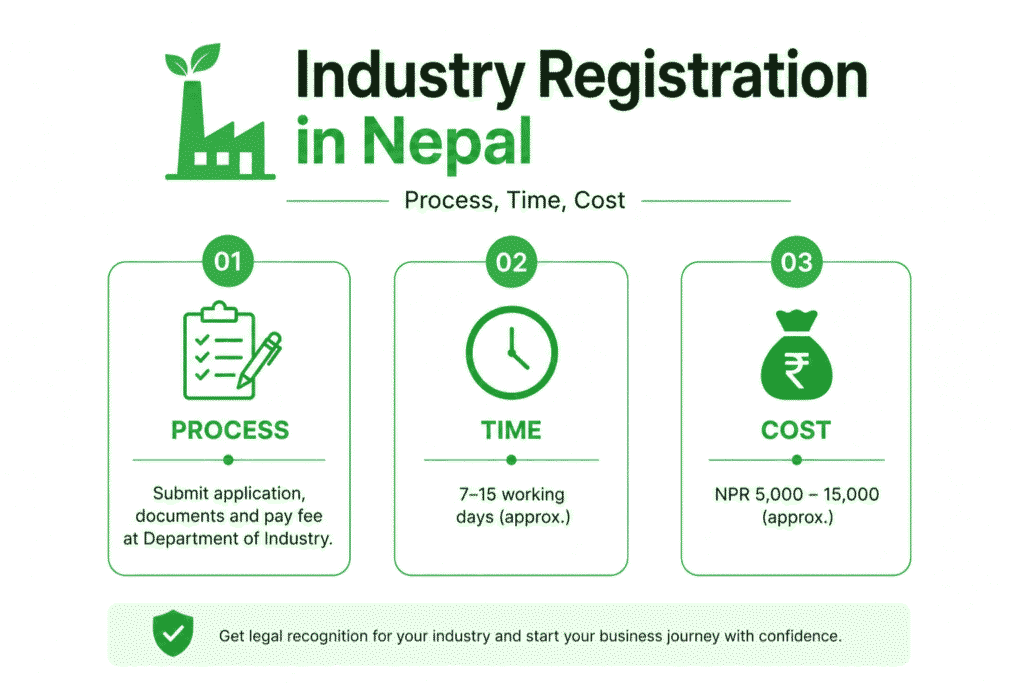
Industry Registration in Nepal is a formal legal process that gives an enterprise the official right to operate as an industrial entity under the laws of Nepal. Whether you are establishing a cottage industry, small industry, medium industry, or large industry, you must complete industry registration with the relevant government authority before beginning operations. The Industrial Enterprises Act, 2076 (2020) is the primary law that governs industry registration in Nepal and defines the classification, process, and requirements for registering industries in the country.
This article provides a complete, factual, and detailed guide on how to register an industry in Nepal, including the applicable laws, required documents, registration procedures, fees, and frequently asked questions.
What is Industry Registration in Nepal?
Industry registration in Nepal is the legal process through which a business entity obtains government recognition to operate as an industrial enterprise. Under the Industrial Enterprises Act, 2076 (2020), any person or organization willing to establish and operate an industry in Nepal must register the industry with the Department of Industry (DoI) or the respective District Cottage and Small Industry Office (DCSI), depending on the size and capital of the industry.
The registration process formally establishes the industry’s existence, entitles it to government incentives, tax benefits, and legal protections provided under Nepal’s industrial policy. Without proper registration, operating an industry in Nepal is considered illegal and may invite penalties under the applicable laws.
The Department of Industry (DoI) under the Ministry of Industry, Commerce and Supplies oversees the registration of medium and large industries. The Cottage and Small Industry Development Board (CSIDB) and District Cottage and Small Industry Offices handle registration of cottage and small industries.
- Official Website of Department of Industry: www.doind.gov.np
- Official Website of CSIDB: www.csidb.gov.np
Legal Framework Governing Industry Registration in Nepal
Industry registration in Nepal operates under several key laws and regulations:
| Law / Regulation | Year | Purpose |
|---|---|---|
| Industrial Enterprises Act (Audyogik Byabasaya Ain) | 2076 (2020) | Primary law for industry classification, registration, and operation |
| Companies Act, 2063 | 2063 (2006) | Governs company formation related to industries |
| Foreign Investment and Technology Transfer Act | 2075 (2019) | Governs foreign-owned or foreign-invested industries |
| Special Economic Zone Act, 2073 | 2073 (2016) | Regulates industries within Special Economic Zones |
| Labour Act, 2074 | 2074 (2017) | Governs employment within registered industries |
| Environment Protection Act, 2076 | 2076 (2019) | Mandates environmental clearance for applicable industries |
The Industrial Enterprises Act, 2076 replaced the earlier Industrial Enterprises Act, 2049 (1992) and introduced a reformed, more streamlined system for industry registration in Nepal. It defines industries by investment size and provides a legal framework for the One Stop Service Center (OSSC) established within the Department of Industry.
Classification of Industries in Nepal
Under the Industrial Enterprises Act, 2076, industries in Nepal are classified based on fixed capital investment. Understanding the classification is essential because the registration authority varies depending on the category.
Industry Classification Table
| Industry Category | Fixed Capital Investment (NPR) | Registration Authority |
|---|---|---|
| Micro Industry | Up to Rs. 20 Lakhs | Ward Office / Municipality |
| Cottage Industry | Traditional skills-based, not defined by capital alone | District Cottage and Small Industry Office (DCSI) |
| Small Industry | Rs. 20 Lakhs to Rs. 15 Crores | District Cottage and Small Industry Office (DCSI) |
| Medium Industry | Rs. 15 Crores to Rs. 50 Crores | Department of Industry (DoI) |
| Large Industry | Above Rs. 50 Crores | Department of Industry (DoI) |
Industries are also classified by type, including manufacturing industries, tourism industries, energy-based industries, infrastructure industries, information technology industries, and service industries. Each type may have specific registration requirements.
Who Can Register an Industry in Nepal?
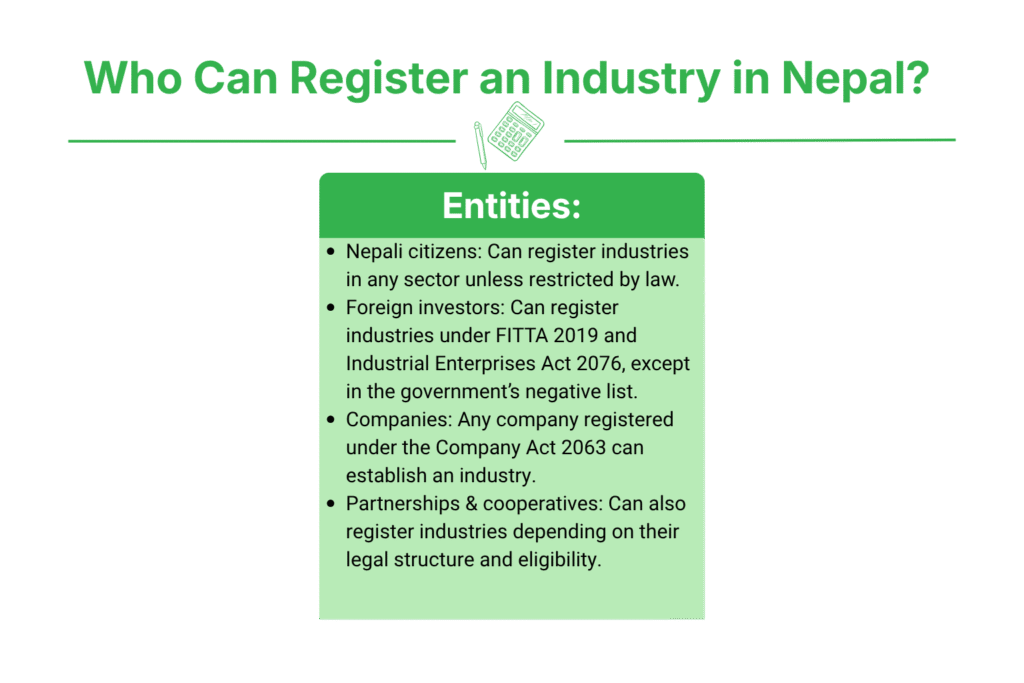
Both Nepali nationals and foreign nationals or entities can register an industry in Nepal, subject to conditions under applicable laws.
- Nepali Citizens: Any Nepali citizen can register an industry in any sector unless restricted.
- Foreign Investors: Foreign nationals can invest and register industries in Nepal under the Foreign Investment and Technology Transfer Act, 2075 (2019) and the Industrial Enterprises Act, 2076. Foreign investment is not permitted in a negative list of industries defined by the Government of Nepal.
- Companies: A company registered under the Company Act, 2063 can also register an industry in Nepal.
- Partnerships and Cooperatives: Registered partnerships and cooperatives may also register industries depending on their structure and capital.
Documents Required for Industry Registration in Nepal
The documents required for industry registration in Nepal vary slightly depending on whether it is a cottage/small industry or a medium/large industry. The following are the standard documents:
For Cottage and Small Industry Registration:
- Application form duly filled (available at DCSI office or CSIDB portal)
- Copy of citizenship certificate of the applicant(s)
- Passport-size photographs of the applicant
- Map and description of the proposed industry location
- Copy of land ownership certificate or tenancy agreement of the proposed site
- Details of proposed products/services
- Copy of company registration certificate (if applicable)
- PAN/VAT registration certificate (if applicable)
- Recommendation letter from the local government (Ward Office or Municipality)
- Environmental consideration document (if required)
For Medium and Large Industry Registration (Department of Industry):
- Duly filled application form
- Copy of citizenship certificate or passport (for foreign investors)
- Copy of company registration certificate from the Office of Company Registrar
- Memorandum of Association and Articles of Association
- Feasibility study or project report
- Environmental Impact Assessment (EIA) or Initial Environmental Examination (IEE) report (where applicable under the Environmental Protection Act, 2076)
- Map and description of project location
- Foreign Investment approval documents (for foreign investors)
- Tax clearance certificate
- Financial projections and capital structure details
Step-by-Step Process for Industry Registration in Nepal
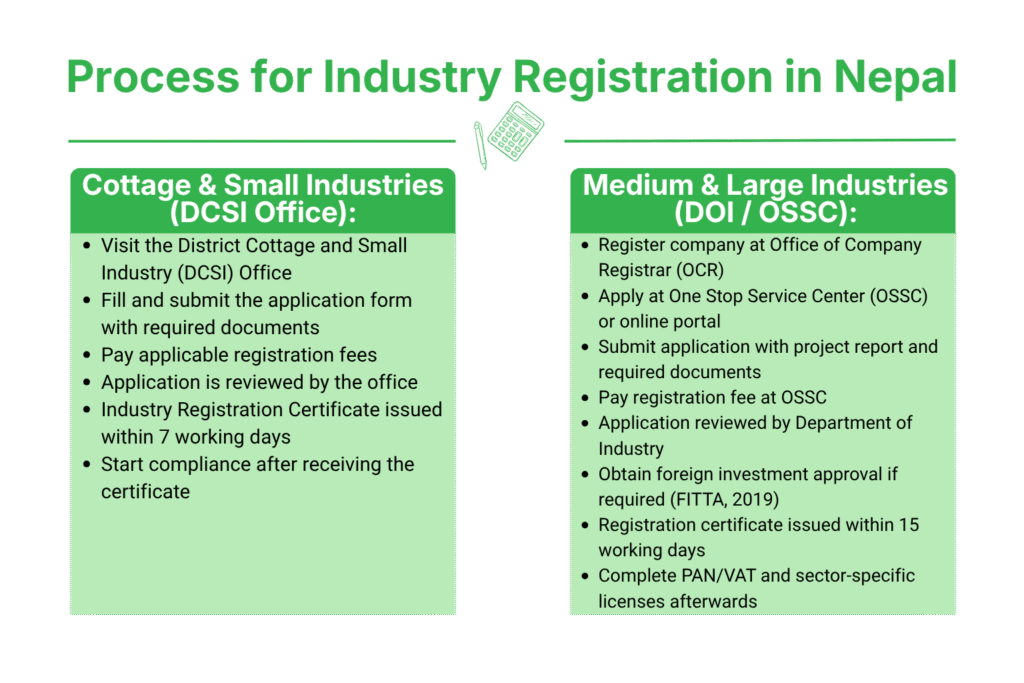
The industry registration process in Nepal follows a structured sequence. The One Stop Service Center (OSSC) at the Department of Industry facilitates multiple registrations under one roof for medium and large industries.
For Cottage and Small Industries:
- Visit the respective District Cottage and Small Industry (DCSI) Office.
- Collect and fill the prescribed application form.
- Prepare and attach all required documents.
- Submit the application with applicable fees at the DCSI office counter.
- The office reviews the application and documents.
- If complete, the office issues the Industry Registration Certificate within 7 working days (as per the Industrial Enterprises Act, 2076).
- Obtain the registration certificate and begin complying with applicable regulations.
For Medium and Large Industries (Department of Industry / OSSC):
- Register the company with the Office of the Company Registrar (OCR) under the Company Act, 2063.
- Visit the One Stop Service Center (OSSC) at the Department of Industry, Kathmandu, or apply through the online portal.
- Fill the prescribed industry registration application form.
- Attach all required documents including the project report, EIA/IEE (if applicable), and company registration documents.
- Pay the prescribed registration fee at the OSSC counter.
- The Department of Industry reviews the application.
- If foreign investment is involved, obtain clearance from the Investment Board Nepal or the Department of Industry under FITTA, 2075.
- The Department issues the Industry Registration Certificate within 15 working days for most categories.
- Obtain PAN/VAT registration from the Inland Revenue Department.
- Obtain any sector-specific licenses (electricity, water, labor registration, etc.)
Industry Registration Fees in Nepal
Industry registration fees in Nepal are defined by the Government of Nepal through gazette notifications under the Industrial Enterprises Act, 2076. Fees are generally based on the investment size and industry category.
- Cottage industries typically pay minimal registration fees ranging from NPR 500 to NPR 2,000.
- Small industries pay fees ranging from NPR 2,000 to NPR 10,000 depending on capital.
- Medium industries pay fees in the range of NPR 10,000 to NPR 25,000.
- Large industries pay fees upward of NPR 25,000 depending on capital investment.
Fees are subject to revision by the Government of Nepal. Applicants should verify the current fee schedule with the Department of Industry or the respective DCSI office before submitting applications.
Benefits of Industry Registration in Nepal
Registering an industry in Nepal provides several legal and financial benefits under the Industrial Enterprises Act, 2076 and Nepal’s industrial policy:
- Tax Incentives: Registered industries receive income tax exemptions and concessions based on industry type, location, and investment size.
- Customs Duty Exemptions: Import of machinery and raw materials may qualify for customs duty reductions.
- Access to Industrial Land: Registered industries can apply for land at industrial estates managed by the Industrial District Management Limited (IDML).
- Repatriation Rights: Foreign-invested industries have the right to repatriate profits under FITTA, 2075.
- Legal Protection: Registered industries receive legal protection against arbitrary closure and enjoy dispute resolution mechanisms.
- Concessional Loans: Registered industries may access concessional financing from banks and financial institutions under government schemes.
- Export Promotion: Registered exporting industries qualify for export incentives under the Trade Policy and related regulations.
Renewal of Industry Registration in Nepal
Industry registration in Nepal requires periodic renewal. Under the Industrial Enterprises Act, 2076, industries must renew their registration certificate as per the prescribed schedule. Failure to renew on time attracts penalties and may result in cancellation of the registration.
- Industries must submit annual progress reports to the registering authority.
- Any change in ownership, capital, or product line must be reported and updated in the registration.
- The Department of Industry maintains a registry of all medium and large industries and monitors compliance.
Special Provisions for Foreign Investment in Industry Registration
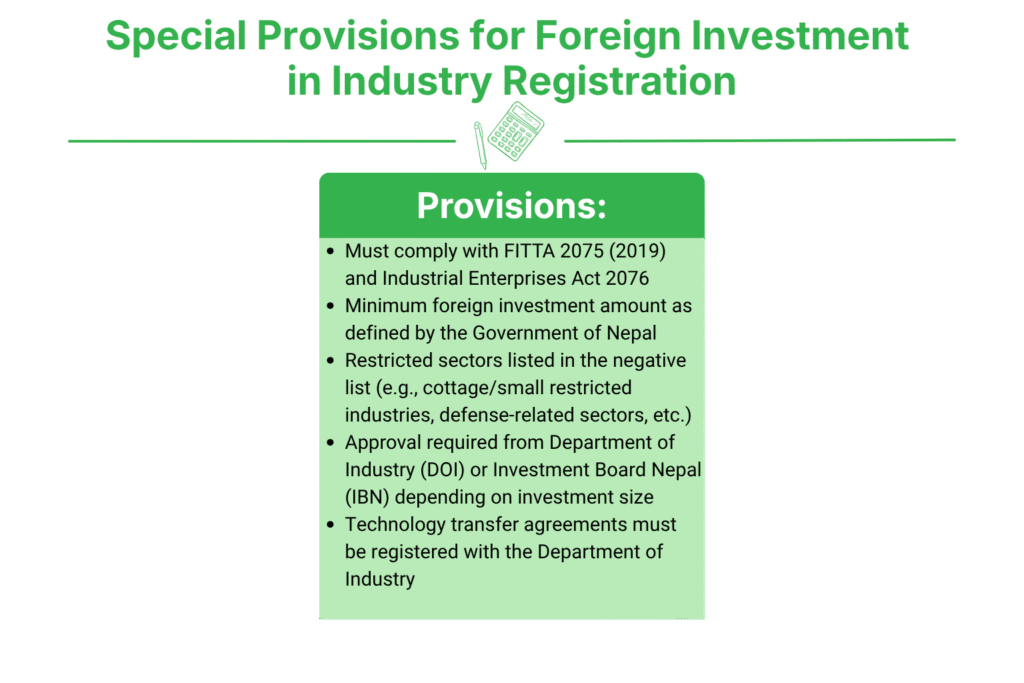
Foreign nationals and entities investing in industries in Nepal must comply with the Foreign Investment and Technology Transfer Act (FITTA), 2075 (2019) in addition to the Industrial Enterprises Act, 2076.
Key provisions include:
- Minimum foreign investment threshold as defined by the Government of Nepal.
- Foreign investment is not permitted in industries listed in the negative list (e.g., cottage industries, small industries below defined thresholds, defense-related industries, etc.).
- Foreign investors must obtain approval from the Department of Industry or Investment Board Nepal depending on investment size.
- Technology transfer agreements must be registered with the Department of Industry.
FAQs
1. What is the primary law for industry registration in Nepal?
The Industrial Enterprises Act, 2076 (2020) is the primary law governing industry registration in Nepal. It defines industry categories, registration processes, authorities, and incentives applicable to all registered industries.
2. Which authority registers small industries in Nepal?
Small industries in Nepal are registered at the District Cottage and Small Industry (DCSI) Office under the Cottage and Small Industry Development Board (CSIDB). The respective office in each district handles registrations.
3. Can a foreigner register an industry in Nepal?
Yes, foreigners can register an industry in Nepal under the Foreign Investment and Technology Transfer Act, 2075 (2019). However, investment in industries on the government’s negative list is prohibited for foreign nationals.
4. How long does industry registration take in Nepal?
Industry registration in Nepal typically takes 7 working days for cottage and small industries and 15 working days for medium and large industries, as provided under the Industrial Enterprises Act, 2076.
5. Is it mandatory to register a micro industry in Nepal?
Yes, micro industries with fixed capital up to NPR 20 Lakhs must register with the local Ward Office or Municipality. Registration is mandatory for legal operation and access to government benefits.
6. What happens if I operate an industry without registration in Nepal?
Operating an industry without registration in Nepal is illegal under the Industrial Enterprises Act, 2076. It may result in penalties, fines, closure orders, and legal action by the Department of Industry or DCSI.
Conclusion
Industry registration in Nepal is a structured and legally mandated process governed primarily by the Industrial Enterprises Act, 2076. Whether you are registering a cottage industry, small industry, medium industry, or large industry, you must follow the prescribed process, submit the required documents, and comply with all applicable laws. The Department of Industry and the CSIDB offices are the primary registration authorities. Registered industries benefit from tax concessions, legal protection, and access to government programs. Compliance with registration requirements is not optional — it is a legal obligation for all industrial enterprises operating in Nepal