

Franchise Agreement Drafting Service in Nepal is an essential legal requirement for businesses seeking to expand through franchise models. Whether you are a domestic brand offering franchise rights or an international company entering the Nepali market, a well-drafted franchise agreement protects both parties legally and commercially. In Nepal, franchise agreements are governed by multiple laws, including the Contract Act 2056, the Companies Act 2063, and the Foreign Investment and Technology Transfer Act (FITTA) 2075. Understanding the legal landscape is necessary before entering any franchise arrangement in Nepal.
What Is a Franchise Agreement in Nepal?
A franchise agreement in Nepal is a legally binding contract between a franchisor and a franchisee. The franchisor grants the franchisee the right to operate a business using the franchisor’s brand name, trademark, proprietary systems, and operational methods in exchange for fees, royalties, or other financial compensation.
In Nepal, franchise agreements are commonly used in:
- Food and beverage chains
- Educational institutions and coaching centers
- Retail outlets and apparel brands
- Service-based businesses
- Healthcare and wellness centers
- International brands entering Nepal
The franchise agreement must comply with Nepali law to be legally enforceable. A poorly drafted or absent franchise agreement can expose both parties to disputes, financial losses, and legal liability.
Legal Framework Governing Franchise Agreements in Nepal
Nepal does not have a standalone Franchise Act. However, several laws regulate the creation, validity, and enforcement of franchise agreements in Nepal.
| Law / Regulation | Relevance to Franchise Agreement |
|---|---|
| Contract Act, 2056 (2000) | Governs validity, offer, acceptance, and enforceability of agreements |
| Companies Act, 2063 (2006) | Regulates business structures involved in franchise operations |
| Foreign Investment and Technology Transfer Act (FITTA), 2075 (2019) | Governs technology transfer, royalty payments, and foreign franchises |
| Trademark Act, 2022 (1965) | Protects brand names and trademarks used in franchise operations |
| Income Tax Act, 2058 (2002) | Covers tax obligations on royalty income and franchise fees |
| Nepal Rastra Bank Regulations | Governs repatriation of royalty and franchise fees for foreign franchisors |
| Industrial Enterprises Act, 2076 | Regulates industrial and commercial enterprises operating under franchise arrangements |
For foreign franchise brands operating in Nepal, the Department of Industry (DoI) under FITTA 2075 requires registration of technology transfer agreements, which includes franchise agreements involving brand licensing and royalty payments.
Key Components of a Franchise Agreement in Nepal
A professional franchise agreement drafting service in Nepal ensures that all critical clauses are included and legally sound. The following are the essential components of a franchise agreement in Nepal:
1. Grant of Franchise Rights
This section defines the scope of the franchise license granted to the franchisee, including the territory covered, exclusivity rights, and the specific products or services permitted under the franchise arrangement.
2. Term and Renewal Clause
The agreement must specify the duration of the franchise relationship. Most franchise agreements in Nepal range from 3 to 10 years with an option for renewal. The conditions for renewal must be clearly stated.
3. Franchise Fees and Royalty Structure
This section outlines:
- Initial franchise fee payable upon signing
- Ongoing royalty payments (usually a percentage of monthly revenue)
- Marketing fund contributions
- Payment schedule and method of payment
For international franchises, all royalty payments must comply with Nepal Rastra Bank directives and FITTA 2075 provisions for foreign exchange remittance.
4. Intellectual Property Rights
The agreement must address the use of trademarks, trade names, logos, copyrights, and proprietary business systems. The franchisor retains ownership of all intellectual property. The franchisee is granted only a limited, non-transferable license.
5. Training and Support Obligations
This section specifies the training programs the franchisor provides, operational manuals, ongoing technical support, and marketing assistance.
6. Quality Control and Standards
The franchisor must outline the standards that the franchisee must maintain to protect the brand reputation. Regular audits, inspections, and performance benchmarks are included here.
7. Non-Compete and Confidentiality Clause
The franchise agreement must include restrictions preventing the franchisee from engaging in competing businesses during the term and after its termination. Confidentiality provisions protect the franchisor’s trade secrets.
8. Termination and Exit Clause
This section defines the grounds for termination by either party, the notice period required, and the consequences of termination, including the return of materials and cessation of brand use.
9. Dispute Resolution Mechanism
In Nepal, franchise agreement disputes are resolved through:
- Negotiation and mediation
- Arbitration under the Arbitration Act 2055
- Nepal’s court system if arbitration fails
Most well-drafted franchise agreements in Nepal include an arbitration clause specifying the seat and rules of arbitration.
10. Governing Law Clause
This clause specifies that the franchise agreement is governed by the laws of Nepal, which is mandatory for agreements executed and performed within Nepal.
Process of Franchise Agreement Drafting in Nepal
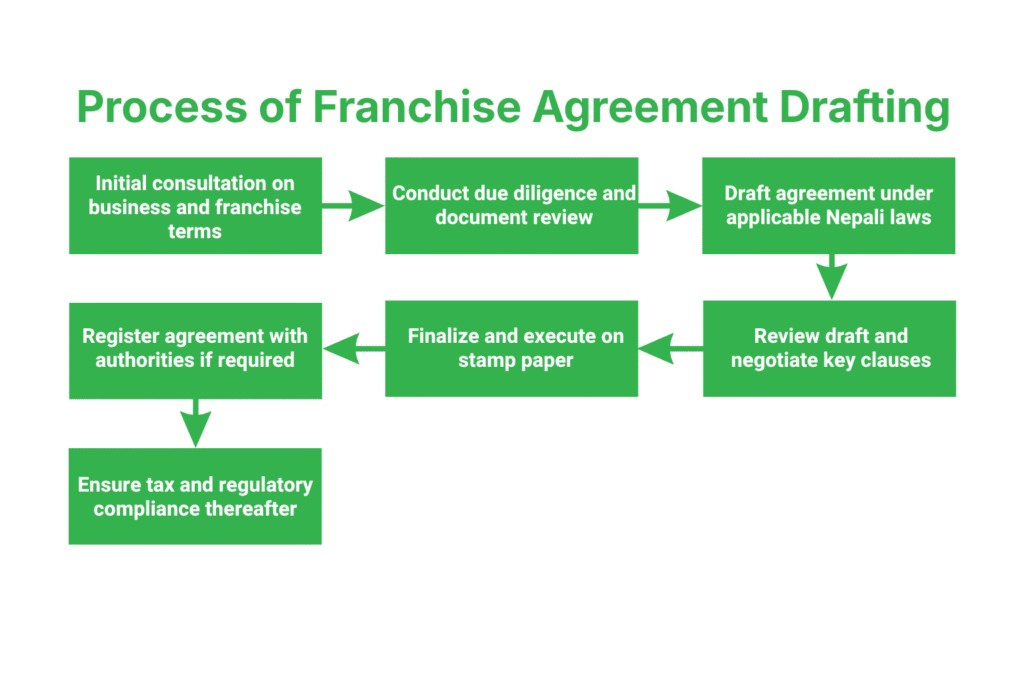
Professional franchise agreement drafting service in Nepal follows a systematic process to ensure legal compliance and commercial adequacy.
Step 1: Initial Consultation
The franchisor and the legal team discuss the nature of the business, franchise structure, territory, fees, and key business terms.
Step 2: Business Due Diligence
The legal team reviews the franchisor’s business model, existing intellectual property registrations, company registration documents, and any existing agreements.
Step 3: Drafting the Agreement
A qualified legal professional drafts the franchise agreement incorporating all essential clauses in accordance with Nepali law.
Step 4: Review and Negotiation
Both parties review the draft agreement. Revisions are made based on mutual negotiations. Legal counsel for both parties may participate.
Step 5: Finalization and Execution
The final agreement is executed with signatures of both parties on stamp paper of appropriate value as per the Stamp Duty Act.
Step 6: Registration (If Applicable)
For foreign franchise agreements involving technology transfer or royalty payments, registration with the Department of Industry under FITTA 2075 is required.
Step 7: Compliance Post-Execution
Post-execution, parties must comply with tax registration, Nepal Rastra Bank reporting requirements for foreign payments, and intellectual property registrations.
Documents Required for Franchise Agreement Drafting in Nepal
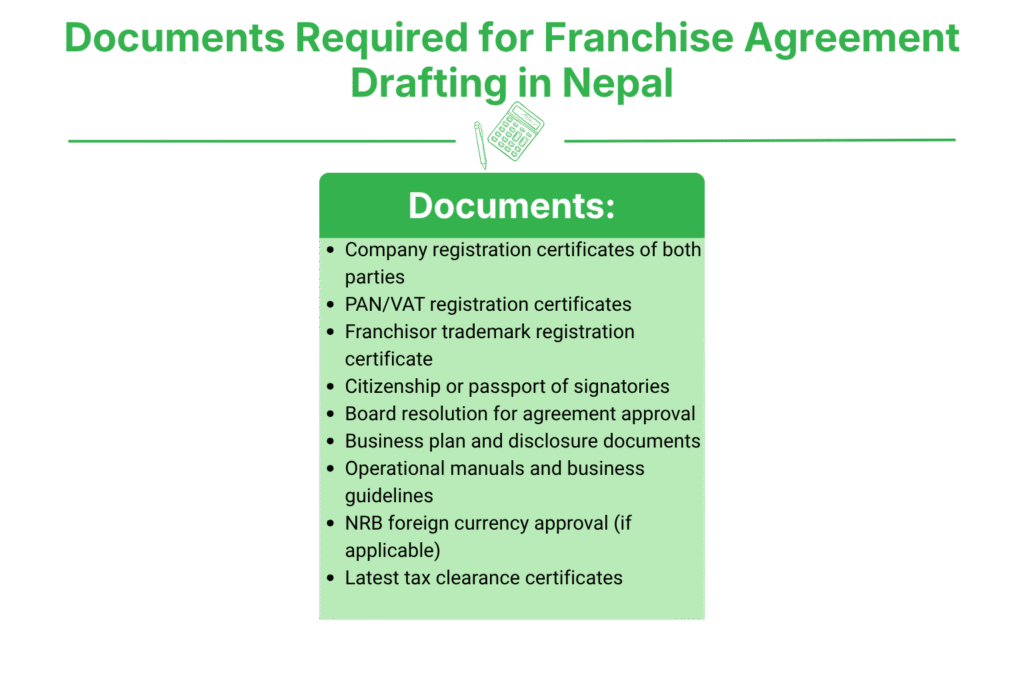
The following documents are required for franchise agreement drafting and registration in Nepal:
- Company registration certificate of both franchisor and franchisee
- PAN/VAT registration certificates
- Trademark registration certificate of the franchisor
- Citizenship certificate or passport of authorized signatories
- Board resolution authorizing the execution of the agreement
- Business plan and franchise disclosure documents
- Existing operational manuals or guidelines
- Foreign currency approval from Nepal Rastra Bank (for international franchises)
- Tax clearance certificates
Franchise Agreement for Foreign Brands in Nepal
Foreign franchise brands entering Nepal must comply with FITTA 2075. Under Section 3 of FITTA 2075, foreign entities can transfer technology and brand licenses to Nepali businesses. The technology transfer agreement, which encompasses the franchise arrangement, must be registered with the Department of Industry.
Key requirements for foreign franchise agreements in Nepal:
- The royalty rate is subject to approval and must be commercially reasonable
- Nepal Rastra Bank approval is required for remittance of franchise fees and royalties abroad
- The agreement must be translated into Nepali if required by the relevant authority
- Foreign investment must comply with the negative list under FITTA 2075
The Investment Board Nepal also facilitates large-scale franchise investments under its one-stop service mechanism.
Cost of Franchise Agreement Drafting Service in Nepal
| Service Type | Estimated Cost (NPR) |
|---|---|
| Basic Domestic Franchise Agreement Drafting | NPR 15,000 – NPR 50,000 |
| Complex Domestic Franchise Agreement | NPR 50,000 – NPR 1,50,000 |
| International Franchise Agreement Drafting | NPR 1,00,000 – NPR 3,00,000 |
| Franchise Agreement Review and Advisory | NPR 10,000 – NPR 50,000 |
| DoI Registration for Technology Transfer | NPR 5,000 – NPR 25,000 (Government Fee + Professional Fee) |
Note: Costs vary based on the complexity of the agreement, the legal firm engaged, and whether registration with government authorities is required.
Why Professional Franchise Agreement Drafting Service in Nepal Matters
Many businesses in Nepal enter franchise arrangements using template agreements or informal arrangements. This approach carries significant legal risk. A professionally drafted franchise agreement:
- Protects the franchisor’s intellectual property rights in Nepal
- Clearly defines obligations, rights, and remedies of both parties
- Ensures compliance with Nepali tax, foreign investment, and intellectual property laws
- Minimizes the risk of disputes by including clear dispute resolution mechanisms
- Facilitates smooth termination or renewal of the franchise relationship
- Enables enforcement of the agreement before Nepali courts or arbitration tribunals
The Nepal Bar Association maintains a list of registered legal practitioners who specialize in commercial and contract law in Nepal.
Common Mistakes in Franchise Agreements in Nepal
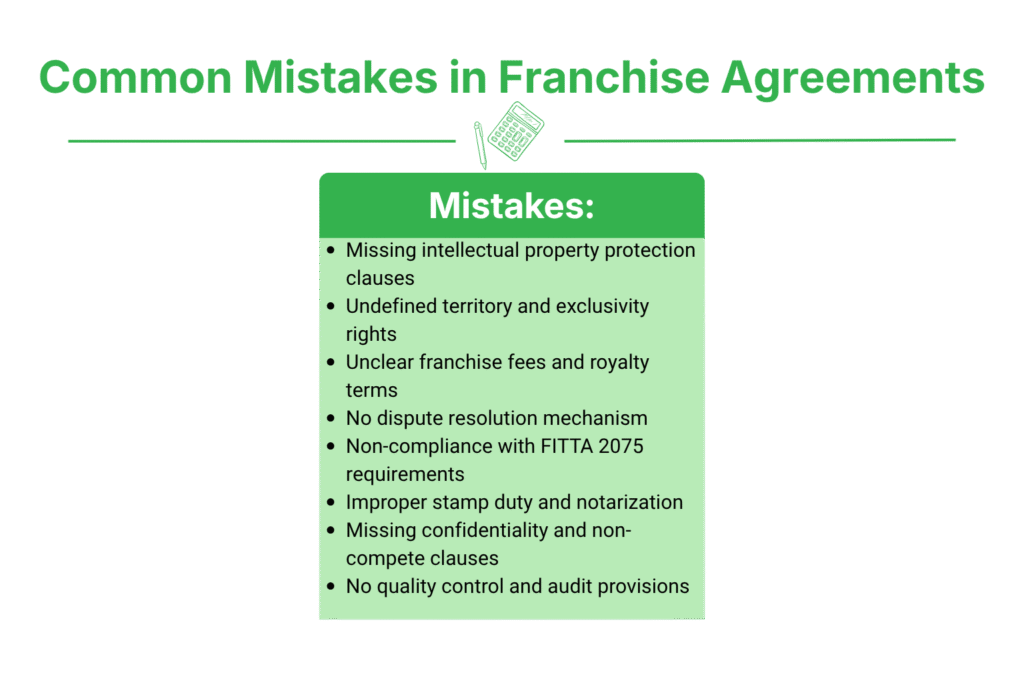
Many franchise agreements in Nepal are poorly structured and contain the following common errors:
- Absence of intellectual property protection clauses
- No defined territory or exclusivity provisions
- Unclear payment and royalty structures
- Missing dispute resolution clauses
- Non-compliance with FITTA 2075 for foreign franchises
- Lack of proper stamp duty and notarization
- No confidentiality or non-compete provisions
- Absence of quality control standards and audit rights
Avoiding these mistakes through professional franchise agreement drafting service is the most effective way to protect business interests in Nepal.
FAQs
1. Is a franchise agreement legally enforceable in Nepal?
Yes, a franchise agreement is legally enforceable in Nepal under the Contract Act 2056. It must satisfy the elements of a valid contract, including offer, acceptance, consideration, and free consent between competent parties.
2. Does Nepal have a specific Franchise Law?
No, Nepal does not have a standalone Franchise Act. Franchise agreements are governed by the Contract Act 2056, FITTA 2075, Companies Act 2063, and relevant intellectual property laws.
3. Do foreign franchise agreements need to be registered in Nepal?
Yes, foreign franchise agreements involving technology transfer, brand licensing, and royalty payments must be registered with the Department of Industry under FITTA 2075. Nepal Rastra Bank approval is required for fee remittances.
4. What is the standard royalty rate in a Nepal franchise agreement?
There is no fixed standard rate. Royalty rates are negotiated between parties and are typically 3% to 10% of monthly sales. For foreign franchises, the rate must be commercially reasonable and approved by concerned authorities.
5. Can a franchise agreement be terminated early in Nepal?
Yes, early termination is possible if the agreement includes such provisions. Grounds for termination, notice periods, and consequences must be clearly defined in the agreement to avoid legal disputes.
6. How long does franchise agreement drafting take in Nepal?
A standard franchise agreement drafting process in Nepal takes 7 to 21 working days depending on complexity, negotiation requirements, and the need for government registration under FITTA 2075.
Conclusion
Franchise Agreement Drafting Service in Nepal is a professional legal service that businesses must engage before entering any franchise arrangement. Whether you are a domestic franchisor or an international brand licensing your business model to a Nepali entity, a properly drafted franchise agreement ensures legal protection, commercial clarity, and regulatory compliance. Consulting a qualified legal professional with expertise in Nepali commercial and immigration law is the most reliable step toward a legally sound franchise relationship in Nepal.