


Nepal has emerged as a growing destination for foreign direct investment (FDI) due to its strategic location between India and China, abundant natural resources, and a young labor force. The Government of Nepal has introduced several legal reforms to simplify the foreigner business setup in Nepal, making it more accessible for international entrepreneurs and corporations. This article explains the legal framework, procedures, required documents, eligible sectors, and other key aspects of foreign business registration in Nepal.
What is the Legal Framework for Foreign Business Setup in Nepal?
The primary law governing foreign investment in Nepal is the Foreign Investment and Technology Transfer Act (FITTA), 2019. This act replaced the earlier FITTA of 1992 and introduced more streamlined procedures for foreign direct investment (FDI) in Nepal.
Other relevant laws include:
- Companies Act, 2006 – governs company formation and registration
- Industrial Enterprises Act, 2020 – regulates industrial licenses and operations
- Nepal Investment Board Act, 2011 – governs large-scale foreign investments
- Special Economic Zone (SEZ) Act, 2016 – provides incentives for businesses in SEZ areas
- Income Tax Act, 2002 – governs taxation of foreign-invested companies
- Foreign Exchange Regulation Act, 2019 – regulates capital repatriation and foreign currency transactions
The Department of Industry (DoI) under the Ministry of Industry, Commerce and Supplies handles most foreign investment approvals. For investments above NPR 6 billion (approximately USD 45 million), the Nepal Investment Board (NIB) is the approving authority.
What Types of Business Entities Can Foreigners Register in Nepal?
Foreign nationals and foreign companies can register the following types of business entities in Nepal:
1. Private Limited Company (Pvt. Ltd.)
This is the most common structure for foreign company registration in Nepal. A private limited company requires a minimum of one shareholder and one director. Foreign nationals can hold up to 100% equity in many sectors.
2. Public Limited Company
Suitable for large-scale operations. Public limited companies can list shares on the Nepal Stock Exchange (NEPSE) after meeting listing requirements.
3. Branch Office
A foreign company can register a branch office in Nepal to conduct business activities. This is governed under the Companies Act, 2006, and requires approval from the Office of the Company Registrar (OCR).
4. Liaison Office / Representative Office
A liaison office cannot engage in direct commercial activities but can perform market research, coordination, and promotional work on behalf of the parent company.
5. Joint Venture Company
Foreign investors frequently enter joint ventures in Nepal with Nepali partners. This allows shared ownership and leverages local market knowledge.
What is the Minimum Investment Requirement for Foreigners in Nepal?
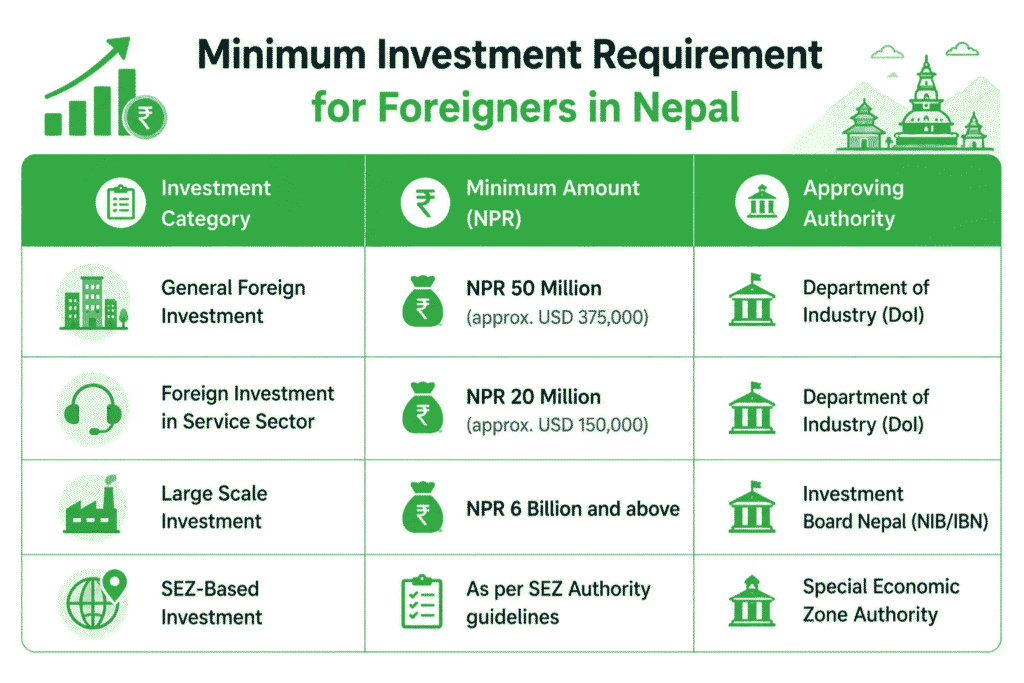
Under FITTA 2019, the minimum foreign investment threshold is as follows:
| Investment Category | Minimum Amount (NPR) | Approving Authority |
|---|---|---|
| General Foreign Investment | NPR 50 Million (approx. USD 375,000) | Department of Industry (DoI) |
| Foreign Investment in Service Sector | NPR 20 Million (approx. USD 150,000) | Department of Industry (DoI) |
| Large Scale Investment | NPR 6 Billion and above | Investment Board Nepal (NIB/IBN) |
| SEZ-Based Investment | As per SEZ Authority guidelines | Special Economic Zone Authority |
The minimum investment requirement was revised upward through FITTA 2019 to ensure meaningful economic contributions from foreign investors.
Which Sectors Are Open and Restricted for Foreign Investment in Nepal?
Open Sectors
Nepal maintains a Positive List of sectors where foreign investment is permitted. These include:
- Manufacturing industries
- Tourism and hospitality
- Hydropower and energy
- Information technology and software
- Agriculture and agro-processing
- Education (higher education)
- Health services (hospitals and clinics)
- Infrastructure development
- Mining and natural resources (with restrictions)
Restricted/Prohibited Sectors
The Negative List under FITTA 2019 and Industrial Enterprises Act, 2020 prohibits foreign investment in:
- Cottage and small industries
- Personal service businesses (beauty salons, tailoring shops)
- Arms and ammunition manufacturing
- Currency and coin production
- Atomic energy-related industries
- Tourism-related businesses reserved for Nepali citizens (trekking agencies below certain thresholds, local travel agencies)
- Retail trade (with certain exceptions)
- Real estate (with restrictions)
- Poultry farming and fisheries at cottage scale
Investors should verify the current positive and negative lists through the Department of Industry Nepal at www.doind.gov.np.
What is the Step-by-Step Process for Foreigner Business Setup in Nepal?

Step 1: Select Business Sector and Structure
Determine whether the chosen sector is on the positive list under FITTA 2019. Select the appropriate business structure (private limited, public limited, branch office, etc.).
Step 2: Apply for Foreign Investment Approval
Submit an application to the Department of Industry (DoI) or Nepal Investment Board (NIB) depending on investment size. The application includes business plan, investment details, and personal/company documents.
Step 3: Obtain Company Registration
Register the company at the Office of the Company Registrar (OCR) under the Companies Act, 2006. The OCR is accessible at www.ocr.gov.np.
Step 4: Register for PAN/VAT
Obtain a Permanent Account Number (PAN) from the Inland Revenue Department (IRD). If annual turnover exceeds NPR 5 million (services) or NPR 10 million (goods), VAT registration is mandatory.
Step 5: Obtain Industry Registration / License
Apply for an industry registration certificate from the Department of Industry or the relevant sector-specific authority (Nepal Tourism Board, Nepal Electricity Authority, etc.).
Step 6: Open a Bank Account
Open a business bank account in a Nepal Rastra Bank-licensed commercial bank. Foreign currency brought as investment must be documented through banking channels as required by the Foreign Exchange Regulation Act, 2019.
Step 7: Apply for Work Permit and Business Visa
Foreign investors and employees need a Business Visa for Nepal and a Work Permit from the Department of Labor and Occupational Safety (DoLOS) for working in Nepal.
What Documents Are Required for Foreign Business Registration in Nepal?
The following documents are required for foreigner business setup in Nepal:
For Individual Foreign Investors:
- Valid passport copy (notarized)
- Recent passport-size photographs
- Personal financial statement or bank statement
- Project report or business plan
- Application form for foreign investment approval
For Foreign Corporate Investors:
- Certificate of Incorporation of the parent company (notarized and apostilled)
- Memorandum and Articles of Association of the parent company
- Board resolution authorizing investment in Nepal
- Audited financial statements of the parent company (last 3 years)
- Authorization letter for the authorized representative in Nepal
- Project report or feasibility study
For Company Registration at OCR:
- Memorandum of Association (MoA)
- Articles of Association (AoA)
- Citizenship certificate or passport of directors/shareholders
- Proof of registered office address (rent agreement or ownership deed)
- Foreign investment approval letter from DoI or NIB
What Are the Tax Obligations for Foreign-Invested Companies in Nepal?
| Tax Type | Rate | Governing Law |
|---|---|---|
| Corporate Income Tax (Manufacturing) | 20% | Income Tax Act, 2058 (2002) |
| Corporate Income Tax (General) | 25% | Income Tax Act, 2058 (2002) |
| Corporate Income Tax (Special Industries) | 15–20% | Industrial Enterprises Act, 2076 (2020) |
| Dividend Withholding Tax | 5% | Income Tax Act, 2058 (2002) |
| Value Added Tax (VAT) | 13% | Value Added Tax Act, 2052 (1995) |
| Customs Duty | Varies | Customs Act, 2007 |
| Capital Gains Tax | 10–15% | Income Tax Act, 2058 (2002) |
Nepal has signed Double Taxation Avoidance Agreements (DTAA) with several countries including India, China, Norway, Austria, Mauritius, South Korea, Sri Lanka, Thailand, and Qatar. These agreements help avoid double taxation for foreign investors.
Foreign investors are also entitled to profit repatriation after paying applicable taxes, as guaranteed under FITTA 2019, Section 11, which protects the rights of foreign investors to repatriate invested capital, returns, and royalties.
What Incentives Does Nepal Offer to Foreign Investors?
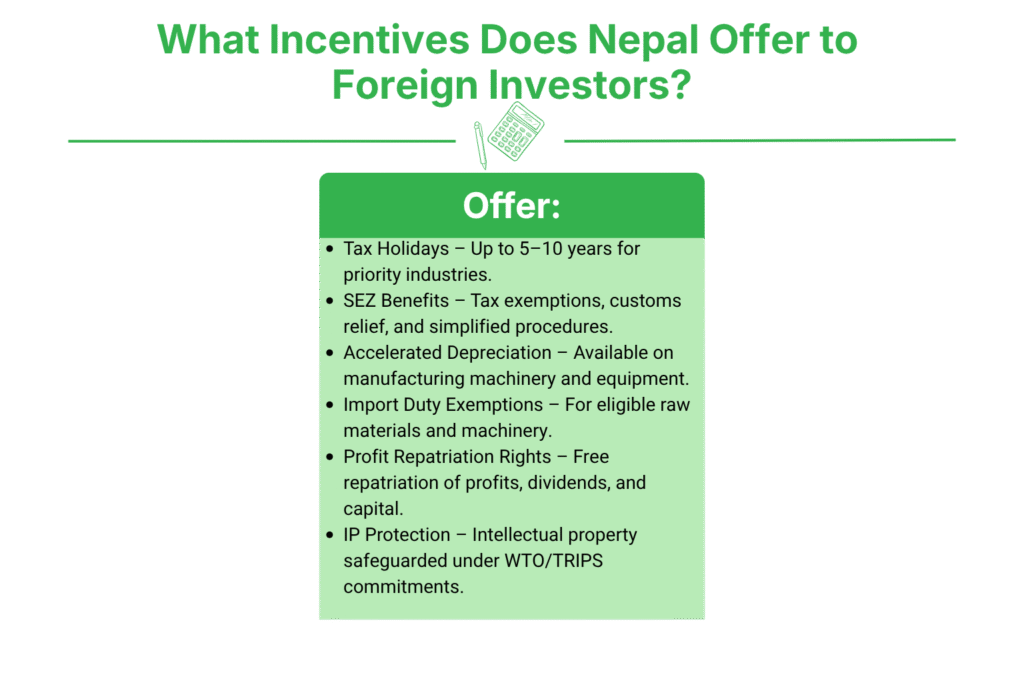
The Government of Nepal and relevant legislation provide the following incentives:
- Tax Holiday: Up to 5 to 10 years for industries in priority and special priority sectors under the Industrial Enterprises Act, 2020
- SEZ Benefits: Industries in Special Economic Zones enjoy customs exemption, income tax exemption for a defined period, and simplified procedures under the SEZ Act, 2016
- Accelerated Depreciation: Available for machinery and equipment in manufacturing sectors
- Exemption on Import Duties: For raw materials and machinery used in export-oriented industries
- Repatriation Rights: Guaranteed under FITTA 2019 for profit, dividends, and capital
- Intellectual Property Protection: Nepal is a signatory to TRIPS under WTO obligations
Can a 100% Foreign-Owned Company Operate in Nepal?
Yes. Under FITTA 2019, 100% foreign ownership is permitted in sectors included in the positive list. There is no mandatory Nepali partner requirement in most sectors. However, some sectors such as media, certain services, and agricultural industries may have ownership caps or require Nepali participation.
For example:
- Manufacturing: 100% FDI allowed
- IT and BPO Services: 100% FDI allowed
- Hydropower: 100% FDI allowed with government agreements
- Education and Health: Allowed with sector-specific regulations
FAQs
1. What is the minimum investment required for a foreigner to start a business in Nepal?
Under FITTA 2019, the minimum foreign investment is NPR 50 million for general sectors and NPR 20 million for the service sector. Investments above NPR 6 billion require Nepal Investment Board approval.
2. Can a foreigner own 100% of a company in Nepal?
Yes, 100% foreign ownership is allowed in most sectors listed in the positive list under FITTA 2019. Some sectors may have restrictions or require joint venture arrangements with Nepali nationals.
3. Which authority approves foreign investment applications in Nepal?
The Department of Industry (DoI) approves general foreign investments, while the Nepal Investment Board (NIB) handles investments above NPR 6 billion or strategically important projects.
4. Is it mandatory to hire Nepali employees in a foreign-invested company?
Yes. The Labor Act, 2017 requires that at least 90% of the total workforce must be Nepali nationals. Foreigners can be hired for technical and managerial roles with proper work permits.
5. How long does the foreign business registration process take in Nepal?
The process typically takes 30 to 90 days depending on the sector, completeness of documents, and approving authority. Online portals have reduced processing time significantly in recent years.
6. Can a foreign company repatriate profits from Nepal?
Yes. Under FITTA 2019, Section 11, foreign investors have the legal right to repatriate profits, dividends, royalties, and invested capital after paying applicable taxes through banking channels.
Conclusion
Foreigner business setup in Nepal follows a structured legal framework primarily governed by FITTA 2019, the Companies Act 2006, and the Industrial Enterprises Act 2020. With clear investment thresholds, defined sector approvals, and guaranteed repatriation rights, Nepal provides a legally sound environment for foreign direct investment. Foreign investors must comply with all registration, tax, and employment laws to operate legally in Nepal. Consulting a registered legal practitioner or corporate advisor in Nepal is strongly recommended before initiating the investment process.
For official information, visit:
- Department of Industry: www.doind.gov.np
- Office of the Company Registrar: www.ocr.gov.np
- Nepal Investment Board: www.nib.gov.np
- Inland Revenue Department: www.ird.gov.np