


Foreign investment in Nepal has grown steadily over the past decade. Investors from India, China, the United States, and other countries seek business opportunities in Nepal’s growing economy. However, the foreign investment approval process in Nepal involves multiple legal steps, government agencies, and documents. A foreign investment approval lawyer in Nepal helps foreign investors understand the law, prepare documents, and obtain approvals efficiently.
This article explains the role of a foreign investment approval lawyer, the legal framework, the approval process, required documents, and frequently asked questions.
What Is Foreign Investment in Nepal?
Foreign investment in Nepal refers to investment made by a foreign individual, company, or institution in a Nepalese business. This includes equity investment, reinvested earnings, and technology transfer. The primary law governing this area is the Foreign Investment and Technology Transfer Act (FITTA), 2019 (2076 B.S.), which replaced the earlier FITTA of 1992.
Under FITTA 2019, foreign investment is defined as:
- Investment in shares or debentures of a Nepalese company
- Investment through loans from a foreign source
- Technology transfer agreements with a Nepalese company
- Reinvestment of earnings from existing foreign investment
The minimum threshold for foreign investment in Nepal is NPR 20 million (approximately USD 150,000) for most sectors, as specified in the Foreign Investment and One Window Committee (FIOWC) regulations.
Why Do You Need a Foreign Investment Approval Lawyer in Nepal?
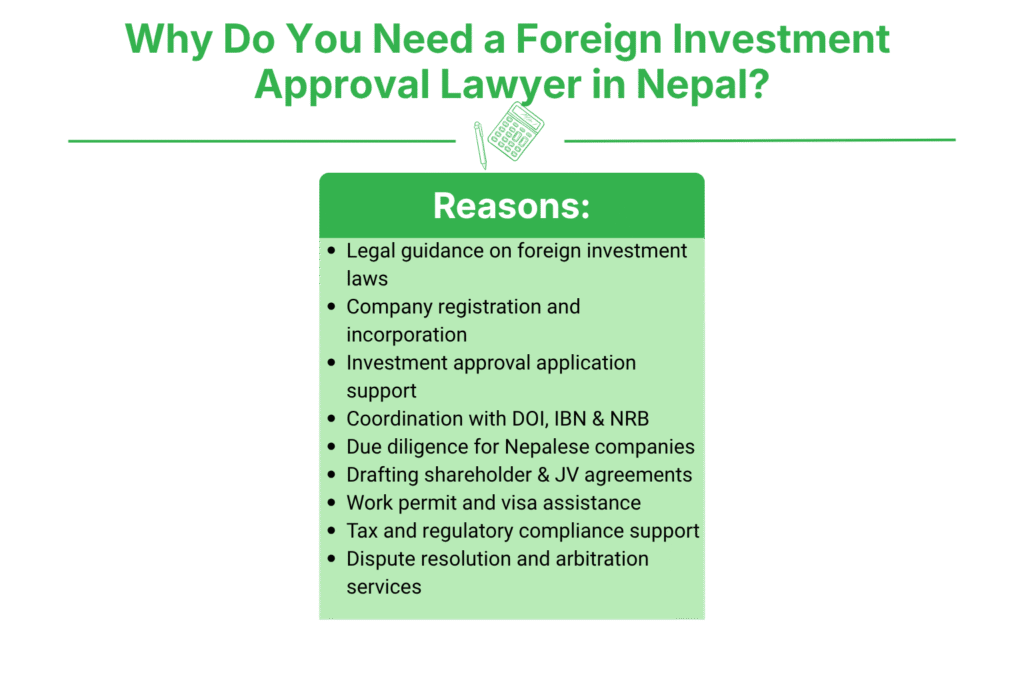
The foreign investment approval process in Nepal involves multiple government bodies, including the Department of Industry (DOI), the Investment Board Nepal (IBN), the Nepal Rastra Bank (NRB), and the Office of the Company Registrar (OCR). Each body has its own requirements, timelines, and procedures.
A foreign investment lawyer in Nepal provides the following services:
- Legal advice on applicable laws and regulations
- Company incorporation and registration with OCR
- Preparation and filing of investment approval applications
- Liaison with DOI, IBN, and NRB on behalf of the client
- Due diligence on existing Nepalese companies
- Drafting of shareholder agreements, joint venture agreements, and technology transfer agreements
- Assistance with work permit and visa applications for foreign employees
- Tax and compliance advisory
- Dispute resolution and arbitration support
Without proper legal assistance, foreign investors often face delays, rejections, or compliance issues that can be avoided with experienced legal representation.
Legal Framework Governing Foreign Investment in Nepal
Understanding the legal framework is essential before starting any foreign investment process. The following laws and regulations govern foreign direct investment (FDI) in Nepal:
| Law / Regulation | Year | Key Provision |
|---|---|---|
| Foreign Investment and Technology Transfer Act, 2075 (FITTA) | 2019 | Primary law for FDI approval and technology transfer |
| Companies Act, 2063 | 2006 | Governs company incorporation and registration |
| Industrial Enterprises Act, 2076 | 2020 | Regulates industrial businesses and licenses |
| Foreign Exchange (Regulation) Act, 1962 | 2019* | Controls foreign currency transactions and repatriation |
| Income Tax Act, 2058 | 2002 | Tax obligations for foreign-invested companies |
| Investment Board Act, 2068 | 2011 | Governs large-scale investments through Investment Board Nepal |
| Labor Act, 2074 | 2017 | Regulates employment including foreign workers |
FITTA 2019 provides the most comprehensive framework. It guarantees the right to repatriate profits, dividends, and capital after fulfilling tax obligations in Nepal. It also protects foreign investors from nationalization without adequate compensation.
Sectors Open and Restricted for Foreign Investment in Nepal
Not all sectors in Nepal are open for foreign investment. The Government of Nepal periodically publishes a Negative List of sectors closed to foreign investors and a Restricted List for sectors requiring special approval.
Sectors Closed to Foreign Investment:
- Cottage and small industries specifically reserved for Nepali citizens
- Poultry farming, fisheries, and bee-keeping at small scale
- Personal service businesses such as hair salons and tailoring
- Retail trade (below specified thresholds)
- Printing press and publishing (newspapers and media)
Sectors Open for Foreign Investment with Special Approval:
- Hydropower and energy
- Telecommunications
- Tourism and hotel industry
- Banking and financial services
- Health and education
- Information technology
- Manufacturing industries
A foreign investment approval lawyer in Nepal advises clients on whether their proposed business falls within open, restricted, or closed categories before filing any application.
Foreign Investment Approval Process in Nepal
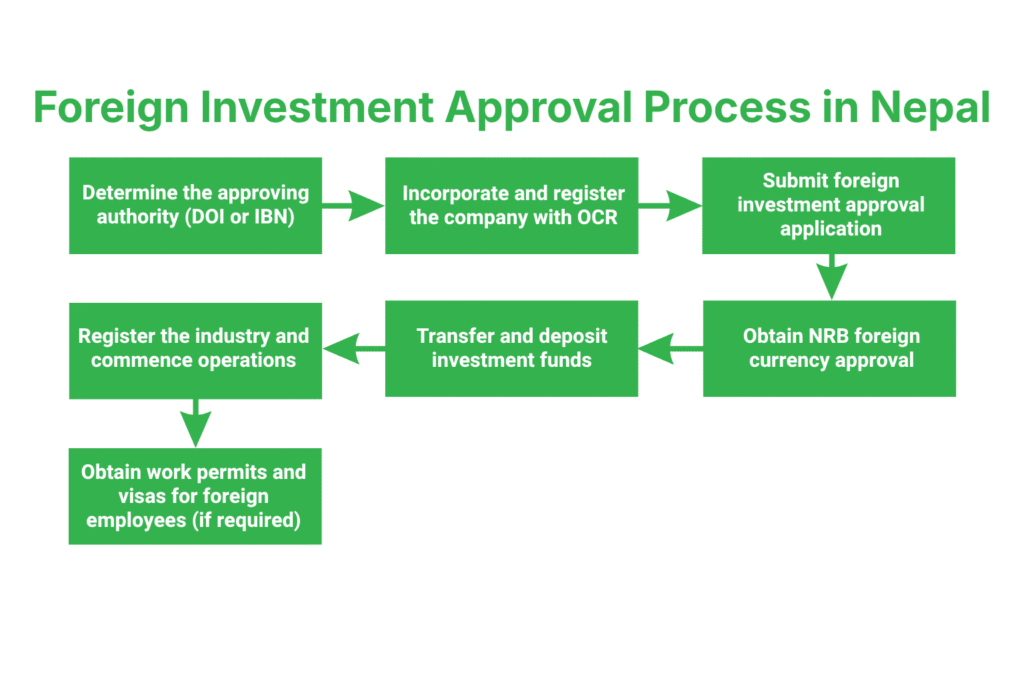
The approval process for foreign investment in Nepal follows a structured path. The process may vary depending on the investment amount and sector.
Step 1: Determine the Approving Authority
- Department of Industry (DOI): For investments up to NPR 6 billion
- Investment Board Nepal (IBN): For investments above NPR 6 billion or in strategic sectors
Step 2: Incorporate a Company in Nepal
Before obtaining investment approval, the foreign investor must register a company with the Office of the Company Registrar (OCR). This involves:
- Choosing a company name and verifying availability
- Preparing the Memorandum of Association (MOA) and Articles of Association (AOA)
- Submitting incorporation documents to OCR
- Obtaining a company registration certificate
Required Documents for Company Registration:
- Passport copies of all foreign shareholders
- Proof of address of foreign shareholders
- Company name approval letter from OCR
- MOA and AOA
- Specimen signatures of directors and shareholders
- Power of Attorney (if filing through a lawyer)
Step 3: Apply for Foreign Investment Approval at DOI or IBN
After company registration, the investor must apply for foreign investment approval at the DOI or IBN.
Required Documents for Investment Approval:
- Completed application form
- Company registration certificate
- MOA and AOA
- Board resolution authorizing investment
- Audited financial statements of the foreign investing company
- Bank solvency certificate or proof of source of funds
- Business plan or project report
- Technology transfer agreement (if applicable)
- Tax clearance certificate of the foreign company
- Passport copies of all foreign investors
- Power of Attorney in favor of the lawyer
Step 4: Foreign Currency Approval from Nepal Rastra Bank (NRB)
After receiving investment approval from DOI or IBN, the investor must obtain foreign currency inward remittance approval from NRB to legally bring investment funds into Nepal. This is mandatory under the Foreign Exchange Regulation Act, 2019.
Step 5: Deposit Investment Amount
The approved foreign investment amount must be deposited in a Nepalese bank account in foreign currency and then converted to NPR as per the NRB’s prevailing exchange rate.
Step 6: Obtain Industry Registration Certificate
After completing investment and deposit, the investor must register the industry with the DOI under the Industrial Enterprises Act, 2020 to start operations.
Step 7: Apply for Work Permit (If Required)
If the company employs foreign nationals, work permits are required under the Labor Act, 2017. The employer applies to the Department of Labor and Occupational Safety.
Role of a Foreign Investment Lawyer in the Approval Process
A foreign investment approval lawyer in Nepal plays a direct and active role throughout the process:
- Pre-investment advisory: Advises on the legal structure, sector-specific regulations, and tax implications
- Company formation: Prepares and files all incorporation documents with OCR
- Application drafting: Prepares investment approval applications and supporting documents
- Government liaison: Represents the client before DOI, IBN, NRB, and other agencies
- Agreement drafting: Drafts joint venture agreements, shareholder agreements, and technology transfer agreements
- Compliance monitoring: Ensures the company meets annual reporting and compliance obligations
- Dispute resolution: Represents the investor in arbitration or court proceedings if disputes arise
The Department of Industry Nepal (www.doi.gov.np) and the Investment Board Nepal (www.ibn.gov.np) are the primary government portals for foreign investment information and applications.
Investment Approval Timeline and Fees
| Stage | Approving Authority | Estimated Timeline |
|---|---|---|
| Company Registration | Office of Company Registrar | 3–7 working days |
| Foreign Investment Approval | Department of Industry or Investment Board Nepal | 7–15 working days |
| NRB Foreign Currency Approval | Nepal Rastra Bank | 5–10 working days |
| Industry Registration | Department of Industry | 5–7 working days |
| Work Permit (if applicable) | Department of Labour | 15–30 working days |
The DOI charges a processing fee based on the approved investment amount. The IBN also charges administrative fees for larger investments. Legal fees for a foreign investment approval lawyer in Nepal vary depending on the complexity of the case, investment size, and services required.
Technology Transfer Agreements in Nepal
A technology transfer agreement is a common component of foreign investment in Nepal. Under FITTA 2019, foreign companies may enter into technology transfer agreements with Nepalese companies without mandatory equity participation. These agreements must be registered with the DOI.
Key provisions regulated under FITTA 2019 for technology transfer:
- Royalty payments to the foreign technology provider
- Duration and renewal terms of the agreement
- Restrictions on sub-licensing
- Governing law and dispute resolution mechanism
A foreign investment lawyer in Nepal drafts and reviews technology transfer agreements to ensure compliance with FITTA 2019 and NRB regulations on royalty remittances.
Repatriation of Profits and Capital
One of the key protections under FITTA 2019 is the right of foreign investors to repatriate their investment and profits from Nepal. A foreign investor may repatriate:
- Profit and dividend after tax payment
- Proceeds from the sale of shares
- Principal amount of loans after repayment
- Royalties from technology transfer after tax deduction
All repatriation requires NRB approval and compliance with the Foreign Exchange Regulation Act, 2019. A foreign investment lawyer in Nepal assists clients in preparing repatriation applications and ensuring all tax obligations are cleared before filing.
Common Challenges in Foreign Investment Approval in Nepal
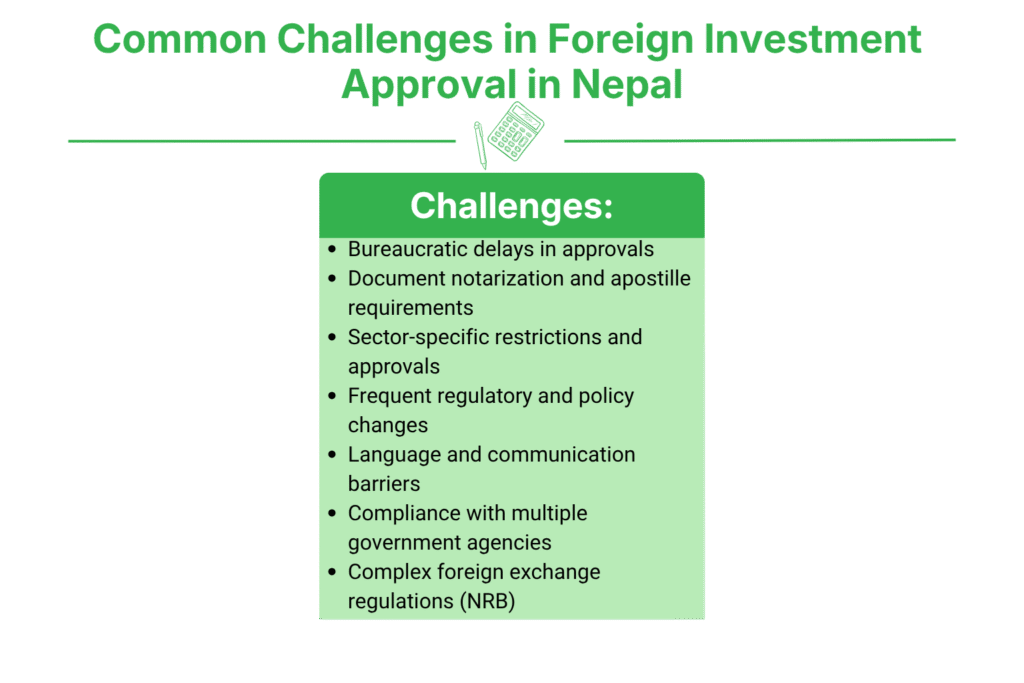
Foreign investors frequently face the following challenges:
- Bureaucratic delays at DOI, NRB, or OCR
- Document authentication issues for foreign company documents requiring notarization and apostille
- Sector-specific restrictions that may require additional approvals from line ministries
- Frequent regulatory changes in investment policies and negative lists
- Language barriers as most government forms and communications are in Nepali
An experienced foreign investment lawyer in Nepal mitigates these challenges by preparing complete and accurate applications, following up with government agencies, and addressing deficiencies promptly.
Government Resources for Foreign Investment in Nepal
- Department of Industry Nepal: http://www.doi.gov.np
- Investment Board Nepal: https://www.ibn.gov.np
- Office of the Company Registrar: https://www.ocr.gov.np
- Nepal Rastra Bank: https://www.nrb.org.np
- Department of Labor and Occupational Safety: https://www.dolidar.gov.np
FAQs
1. What is the minimum foreign investment amount required in Nepal?
The minimum foreign investment threshold in Nepal is NPR 20 million (approximately USD 150,000) for most sectors under FITTA 2019. Some sectors may have higher minimum thresholds depending on sector-specific regulations.
2. Can a foreign investor own 100% shares in a Nepalese company?
Yes, a foreign investor can own 100% equity in a Nepalese company in most open sectors. However, some sectors require mandatory joint venture arrangements with Nepalese partners under sector-specific laws.
3. How long does foreign investment approval take in Nepal?
The DOI typically processes foreign investment approval within 7-15 working days after receiving a complete application. Delays occur when documents are incomplete or require additional clarification from the applicant.
4. Is a work permit required for foreign nationals working in Nepal?
Yes, foreign nationals employed in Nepal must obtain a work permit from the Department of Labor and Occupational Safety under the Labor Act, 2017. The employer applies on behalf of the foreign employee.
5. Can a foreign investor repatriate profits from Nepal?
Yes, FITTA 2019 guarantees the right to repatriate profits, dividends, and capital after fulfilling all tax obligations in Nepal. NRB approval is required for each repatriation transaction.
6. What does a foreign investment approval lawyer charge in Nepal?
Legal fees vary based on investment size, complexity, and services required. Most lawyers charge a fixed retainer fee or a percentage-based fee. Investors should obtain a detailed fee agreement before engaging legal services.
Conclusion
The foreign investment approval process in Nepal requires compliance with FITTA 2019, the Companies Act 2006, the Industrial Enterprises Act 2020, and multiple regulatory frameworks. A qualified foreign investment approval lawyer in Nepal provides essential legal support from company registration to obtaining investment approval, NRB clearance, and ongoing compliance. Engaging a competent lawyer reduces delays, avoids legal errors, and protects the investor’s interests throughout the investment lifecycle in Nepal.