


Setting up a foreign company in Nepal requires careful legal compliance, government approvals, and an understanding of Nepal’s business laws. A foreign company setup consultant in Nepal helps foreign investors and businesses complete the registration process in line with Nepal’s legal framework. This article covers everything you need to know about foreign company setup, legal requirements, the role of consultants, and the applicable laws in Nepal.
What Is a Foreign Company Setup Consultant in Nepal?
A foreign company setup consultant in Nepal is a legal or business advisory professional who assists foreign nationals and companies in establishing their business presence in Nepal. These consultants have expertise in foreign company registration in Nepal, Foreign Direct Investment (FDI) in Nepal, and compliance with the Foreign Investment and Technology Transfer Act (FITTA) 2019.
Foreign investors who wish to set up a business in Nepal must comply with multiple regulatory bodies, including the Office of Company Registrar (OCR) Nepal, the Department of Industry (DOI) Nepal, and the Nepal Rastra Bank (NRB). A consultant coordinates with all these bodies to ensure smooth company registration.
Why Do Foreign Investors Need a Consultant for Company Setup in Nepal?
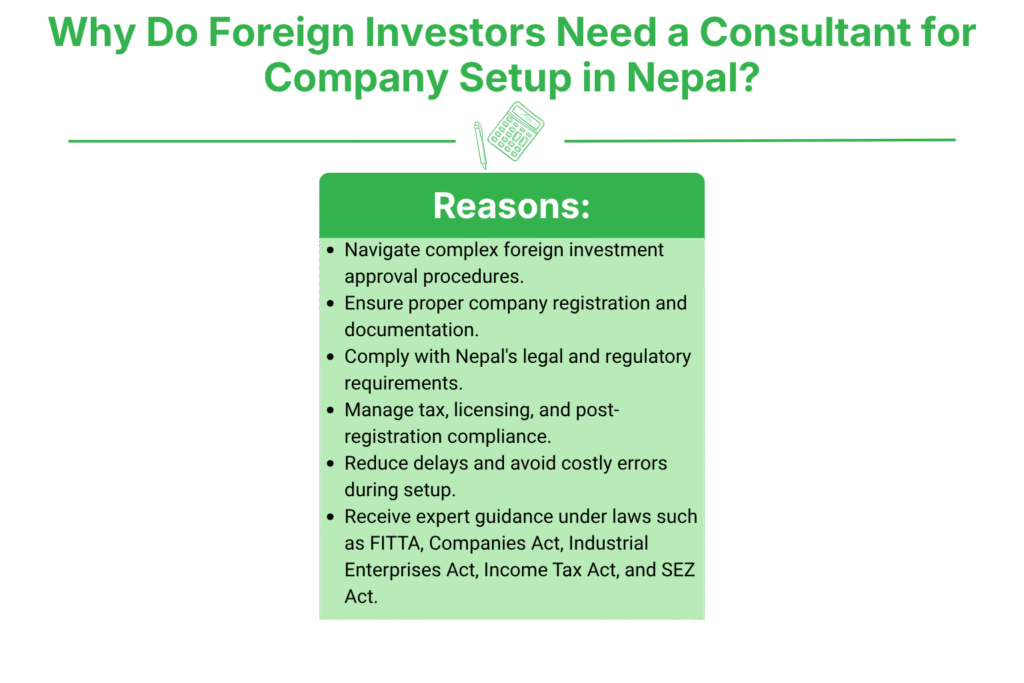
Foreign investors face multiple legal and procedural requirements when they plan business setup in Nepal. These include obtaining foreign investment approval, registering the company, and completing post-registration compliance. The regulatory framework involves several laws, including:
- Foreign Investment and Technology Transfer Act (FITTA), 2019
- Companies Act, 2006 (2063 BS)
- Industrial Enterprises Act, 2020 (2076 BS)
- Income Tax Act, 2002 (2058 BS)
- Special Economic Zone Act, 2016
A consultant understands all these laws and helps foreign investors avoid delays, legal errors, and rejection of applications. They also assist in preparing the necessary documentation, translating documents, and liaising directly with government offices.
Types of Foreign Company Structures Available in Nepal
Before starting the registration process, foreign investors must decide on the type of business entity they want to establish in Nepal. The Office of Company Registrar Nepal recognizes the following structures for foreign businesses:
1. Private Limited Company (Joint Venture)
A joint venture company in Nepal is one of the most common structures for foreign businesses. Foreign investors can hold up to 100% equity in many sectors or enter a joint venture with a Nepali partner. The minimum foreign investment under FITTA 2019 is NPR 20 million (approximately USD 150,000).
2. Branch Office in Nepal
A branch office in Nepal is an extension of a foreign parent company. It can carry out business activities in Nepal but is treated as a non-resident entity for tax purposes. The branch office must be registered with both the OCR and the DOI.
3. Liaison Office in Nepal
A liaison office in Nepal is established for communication and coordination purposes only. It cannot generate revenue or engage in commercial activities directly. It is registered with the DOI and is typically valid for a specified period with renewal required.
4. Public Limited Company
Foreign investors can also set up a public limited company in Nepal, which can list shares on the Nepal Stock Exchange (NEPSE). This requires additional SEBON (Securities Board of Nepal) registration.
Legal Framework Governing Foreign Company Registration in Nepal
The legal framework for foreign company registration in Nepal is governed by multiple laws. Below is a summary of the key legislation:
| Law | Governing Body | Key Provisions |
|---|---|---|
| Foreign Investment and Technology Transfer Act, 2075 (FITTA, 2019) | Department of Industry | FDI approval, minimum investment, repatriation of profit |
| Companies Act, 2063 (2006) | Office of Company Registrar | Company incorporation, share structure, governance |
| Industrial Enterprises Act, 2076 (2020) | Department of Industry | Business classification, industry registration |
| Income Tax Act, 2058 (2002) | Inland Revenue Department | Taxation of foreign entities, withholding tax |
| Nepal Rastra Bank Act, 2058 | Nepal Rastra Bank | Foreign currency management, capital repatriation |
| Special Economic Zone Act, 2073 | SEZ Authority | Tax incentives for SEZ-based companies |
Under FITTA 2019, the Government of Nepal guarantees the right to repatriate profit, dividends, and capital after paying applicable taxes. This legal protection is a key incentive for foreign direct investment in Nepal.
Step-by-Step Process for Foreign Company Setup in Nepal
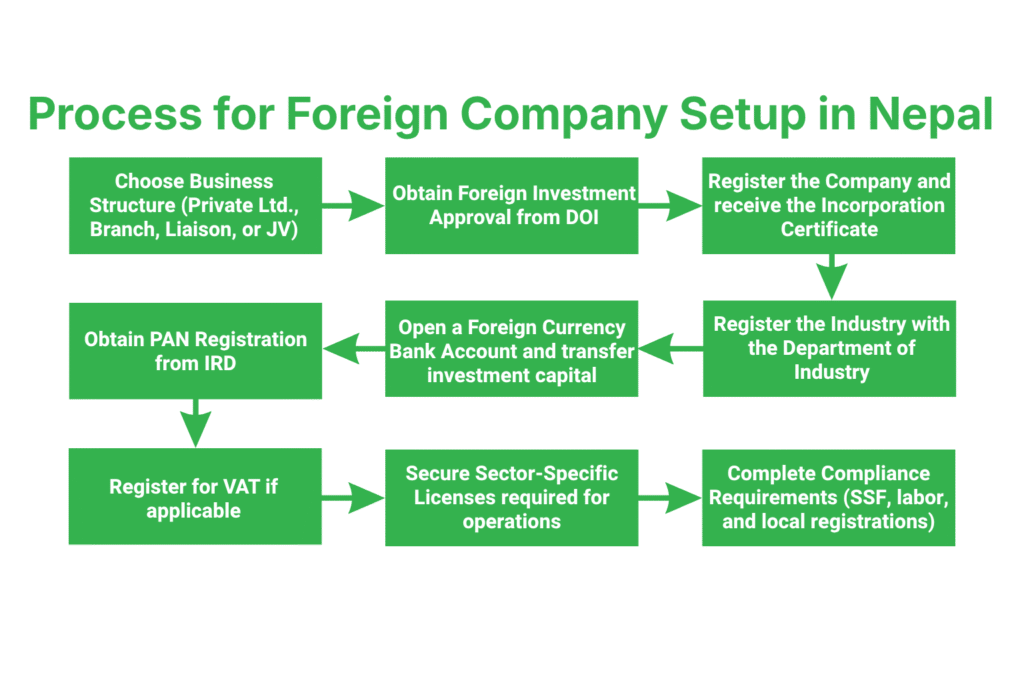
The company registration in Nepal for foreign investors involves multiple steps across different government departments. Below is the standard process:
Step 1: Choose the Business Structure
- Decide between a private limited company, branch office, liaison office, or joint venture based on your business objectives.
Step 2: Apply for Foreign Investment Approval (DOI)
- Submit the foreign investment application to the Department of Industry (DOI) Nepal.
- Receive the Foreign Investment Approval Letter (FI Approval).
Step 3: Register the Company at the Office of Company Registrar
- Submit Memorandum of Association (MoA) and Articles of Association (AoA).
- Pay the registration fee based on authorized capital.
- Receive the Certificate of Incorporation from the Office of Company Registrar.
Step 4: Register with the Department of Industry
- Obtain the Industry Registration Certificate under the Industrial Enterprises Act, 2020.
Step 5: Open a Foreign Currency Bank Account
- Open a non-resident foreign currency account at a Nepal Rastra Bank-authorized commercial bank.
- Transfer the minimum foreign investment amount.
Step 6: Obtain Permanent Account Number (PAN)
- Register with the Inland Revenue Department (IRD) to obtain the PAN for tax purposes.
Step 7: Register for Value Added Tax (VAT)
- If annual turnover exceeds NPR 5 million, VAT registration is mandatory.
Step 8: Obtain Sector-Specific Licenses
- Depending on the industry (banking, telecom, education, etc.), additional licenses from relevant regulatory bodies are required.
Step 9: Complete Post-Registration Compliance
- Register with the Social Security Fund (SSF), obtain labor registration, and complete municipality-level business registration.
Documents Required for Foreign Company Registration in Nepal
A foreign company setup consultant in Nepal helps compile and verify all necessary documents. The following documents are required:
- Certified copy of the foreign parent company’s Certificate of Incorporation
- Memorandum of Association and Articles of Association of the parent company
- Board Resolution authorizing the establishment of a company in Nepal
- Passport copies of all foreign directors/shareholders
- Proposed company name, registered address in Nepal
- Project report/business plan
- Power of Attorney in favor of a local representative
- Bank statement showing financial capacity
- Specimen signatures of authorized signatories
- Recent passport-sized photographs of all directors
All foreign documents must be notarized and apostilled (or legalized through the Nepali Embassy in the respective country).
Sectors Open and Restricted for Foreign Investment in Nepal
Under FITTA 2019 and its corresponding Negative List, the Government of Nepal has specified sectors where foreign investment is either restricted or completely prohibited.
| Category | Examples |
|---|---|
| Fully Open to FDI (100%) | Manufacturing, IT/ITES, hydropower, tourism, education |
| Open with Conditions | Banking (Nepal Rastra Bank approval needed), insurance, telecom |
| Restricted (Below 51% Foreign Equity) | Retail trading, small industries |
| Prohibited for FDI | Cottage industries, arms & ammunition, atomic energy, poultry farming (small scale), real estate brokerage |
The DOI publishes and updates the Negative List periodically. A foreign company setup consultant in Nepal ensures that your business activity falls within the permissible investment categories before initiating registration.
Role and Services of a Foreign Company Setup Consultant in Nepal
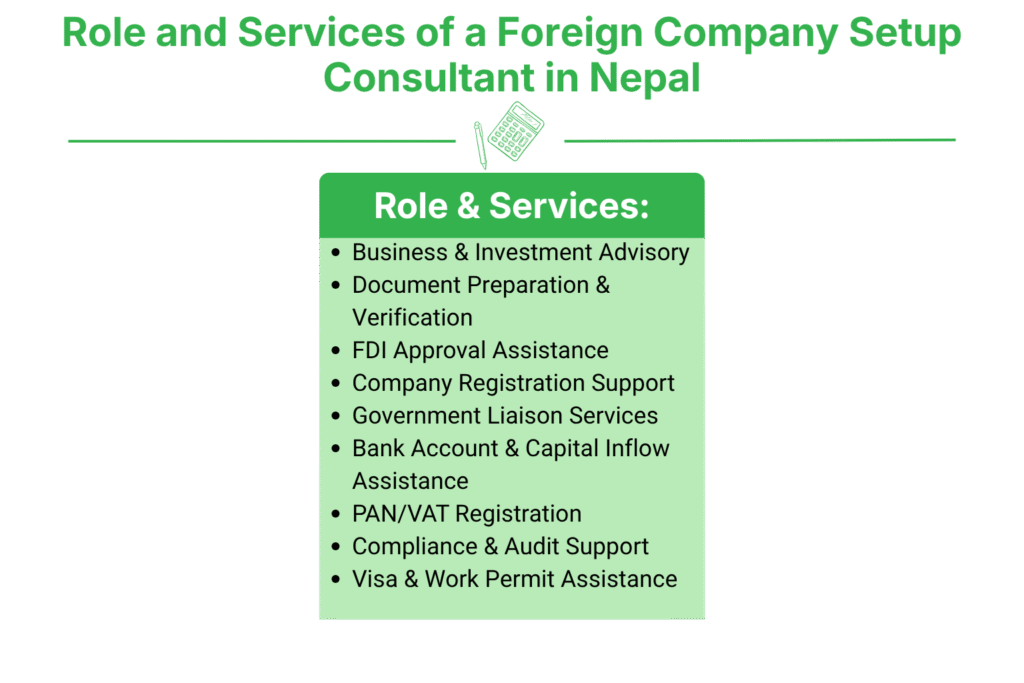
A foreign company setup consultant provides end-to-end assistance for business setup in Nepal. Their services typically include:
- Pre-investment advisory: Advising on the right business structure, sector eligibility, and minimum investment requirements
- Document preparation and verification: Drafting MoA, AoA, board resolutions, and other legal documents
- Government liaison: Coordinating with the OCR, DOI, IRD, NRB, and other agencies
- FDI approval process: Managing the entire foreign investment approval application
- Company registration: Completing incorporation with the Office of Company Registrar
- Bank account opening: Assisting in opening foreign currency accounts at authorized banks
- Tax registration: Obtaining PAN and VAT registration
- Post-registration compliance: Annual filings, audit support, and regulatory compliance
- Visa and work permit assistance: Helping foreign directors and employees obtain business visas and work permits from the Department of Immigration Nepal
Cost of Setting Up a Foreign Company in Nepal
The cost of foreign company registration in Nepal varies based on the type of business entity and the authorized capital. Registration fees at the OCR are calculated on a sliding scale based on authorized capital. The DOI also charges a processing fee for foreign investment approval.
A professional foreign company setup consultant in Nepal typically charges a service fee ranging from NPR 50,000 to NPR 300,000 or more depending on the complexity of the business structure and the services included.
Timeline for Foreign Company Registration in Nepal
The total time required for company registration in Nepal for foreign investors typically ranges from 30 to 90 days, depending on the completeness of documents, the type of entity, and sector-specific approvals. The DOI foreign investment approval alone may take 15 to 30 working days. Company registration at the OCR takes approximately 3 to 7 working days after document submission.
FAQs
1. What is the minimum foreign investment required to set up a company in Nepal?
Under FITTA 2019, the minimum foreign investment required to register a foreign company in Nepal is NPR 20 million (approximately USD 150,000). This applies to all sectors unless otherwise specified.
2. Can a foreign investor own 100% shares in a Nepali company?
Yes, foreign investors can own 100% equity in many sectors including manufacturing, IT, hydropower, and tourism. However, certain sectors restrict foreign ownership below 100% as defined in the FITTA 2019 Negative List.
3. What is the difference between a branch office and a liaison office in Nepal?
A branch office can conduct commercial business and generate revenue in Nepal. A liaison office can only perform non-commercial activities like coordination and communication. Both require registration with the Department of Industry Nepal.
4. Which government body approves foreign direct investment in Nepal?
The Department of Industry (DOI) Nepal is the primary authority that approves foreign direct investment under the Foreign Investment and Technology Transfer Act (FITTA) 2019. The DOI website provides application guidelines.
5. How long does it take to register a foreign company in Nepal?
The entire process from FDI approval to company incorporation typically takes 30 to 90 days. The timeline depends on document completeness, sector, and the efficiency of government processing at the OCR and DOI.
6. Do foreign companies in Nepal need to pay taxes?
Yes, foreign companies operating in Nepal are subject to corporate income tax at 25% under the Income Tax Act, 2002. Branch offices pay an additional 5% repatriation tax. Foreign companies must also comply with VAT and withholding tax regulations.
Conclusion
Setting up a foreign company in Nepal involves multiple legal steps, regulatory approvals, and compliance requirements under the FITTA 2019, the Companies Act 2006, and the Industrial Enterprises Act 2020. A qualified foreign company setup consultant in Nepal simplifies this process by managing documentation, government liaison, FDI approval, and post-registration compliance. Foreign investors must verify sector eligibility, maintain minimum investment requirements, and register with all relevant authorities including the Office of Company Registrar, the Department of Industry, and the Inland Revenue Department to operate legally in Nepal.