


Foreign companies seeking to establish a presence in Nepal can do so through a branch office. A branch office is not a separate legal entity and is often used for Foreign Company Branch Office Registration in Nepal as it allows the setup to function as an extension of the parent foreign company that operates within Nepal under Nepali law. The registration process involves multiple government agencies and follows specific legal requirements under Nepali corporate and investment law.
What is a Foreign Company Branch Office in Nepal?
A foreign company branch office in Nepal is an operational unit of an overseas company that conducts business activities within the territory of Nepal. Unlike a subsidiary company, a branch office does not have independent legal status. The parent company remains fully liable for the branch office’s obligations and liabilities in Nepal.
The branch office can conduct the same business activities as the parent company, subject to the restrictions and conditions imposed by Nepali law. It operates under the name of the parent foreign company and must comply with all applicable Nepali regulations including tax, labor, and company laws.
Legal Framework Governing Foreign Branch Office Registration in Nepal
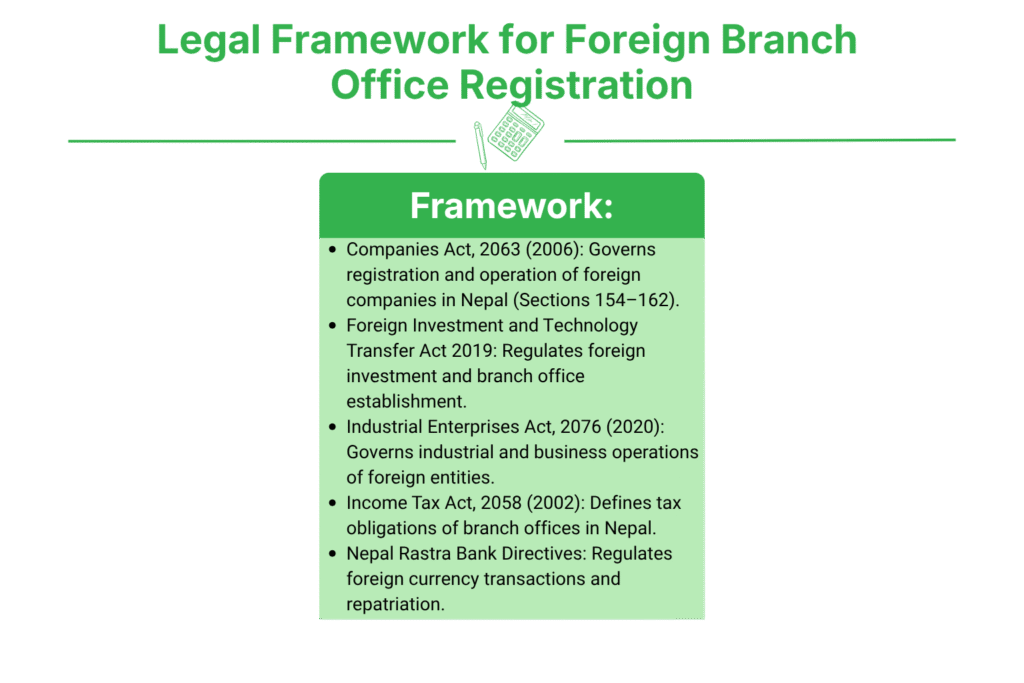
The registration and operation of a foreign company branch office in Nepal is governed by several key laws:
- Companies Act, 2063 (2006): Sections 154 to 162 specifically deal with the registration and regulation of foreign companies operating in Nepal.
- Foreign Investment and Technology Transfer Act (FITTA), 2075 (2019): This Act governs foreign investment, including the establishment of branch offices by foreign entities.
- Industrial Enterprises Act, 2076 (2020): Regulates industrial operations including those carried out by foreign companies.
- Income Tax Act, 2058 (2002): Governs the tax obligations of foreign branch offices operating in Nepal.
- Nepal Rastra Bank (NRB) Directives: Regulate foreign currency transactions and remittances related to branch office operations.
Under Section 154 of the Companies Act 2063, no foreign company shall establish a place of business in Nepal unless it is registered with the Office of the Company Registrar (OCR). This is a mandatory requirement and cannot be bypassed under any circumstance.
Which Government Bodies Are Involved in Branch Office Registration?
| Government Body | Role |
|---|---|
| Department of Industry (DOI) | Grants approval for foreign investment and business operations |
| Office of Company Registrar (OCR) | Registers the foreign company branch office in Nepal |
| Inland Revenue Department (IRD) | Issues PAN/VAT registration for tax compliance |
| Nepal Rastra Bank (NRB) | Regulates foreign currency inflow and outflow |
| Investment Board Nepal (IBN) | Handles large-scale investment approvals above NPR 6 billion |
The primary regulatory authority for branch office registration is the Office of the Company Registrar, which operates under the Ministry of Industry, Commerce and Supplies. The official website of OCR is www.ocr.gov.np.
For investment approvals, the Department of Industry under the Government of Nepal is the competent authority. You can access DOI services at www.doi.gov.np.
Who Can Register a Branch Office in Nepal?
Any foreign company incorporated and legally registered in its home country can register a branch office in Nepal, provided:
- The proposed business activity is permitted under Nepali law for foreign investment.
- The business does not fall under the negative list under Schedule 1 of FITTA 2075, which prohibits foreign investment in certain sectors.
- The company has a valid and subsisting legal existence in its country of origin.
- The business activity aligns with approved foreign investment sectors as listed under FITTA 2075.
Certain sectors such as cottage industries, personal service businesses, retail trading, and arms-related businesses are restricted or prohibited for foreign entities. It is advisable to verify sector eligibility before proceeding with registration.
Step-by-Step Process for Foreign Company Branch Office Registration in Nepal
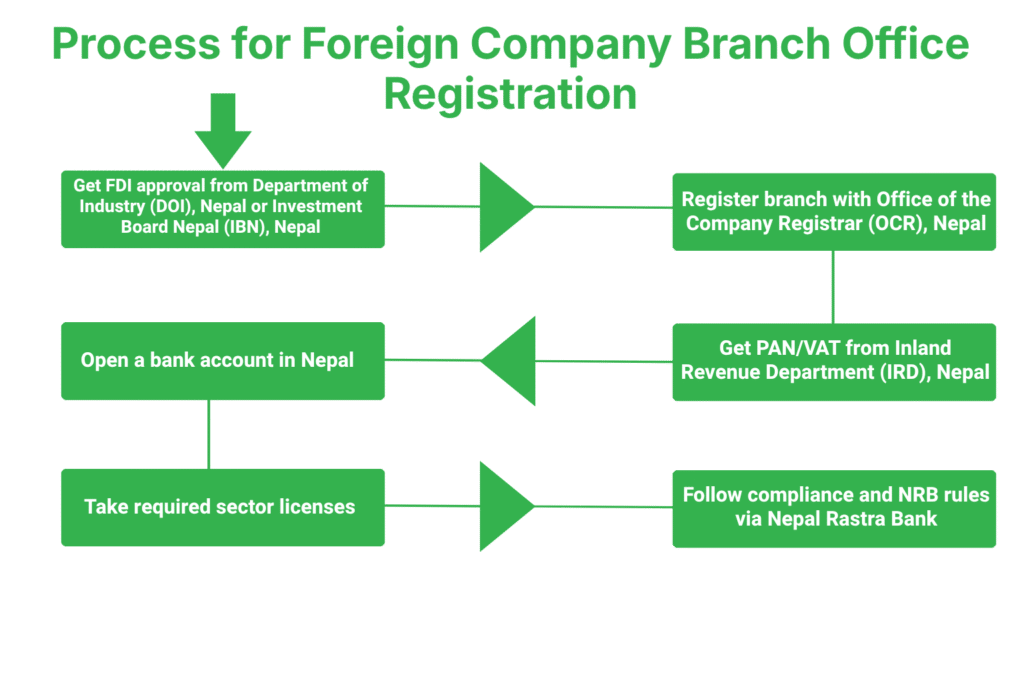
Step 1: Obtain Foreign Investment Approval from Department of Industry
Before registering with OCR, the foreign company must obtain investment approval from the Department of Industry (DOI). The application must include the proposed business activities, investment amount, and supporting corporate documents from the parent company.
For investments exceeding NPR 6 billion, approval must be obtained from the Investment Board Nepal (IBN) instead of DOI.
Step 2: Register with the Office of the Company Registrar (OCR)
After receiving DOI approval, the foreign company must apply to the OCR for formal registration as a foreign company operating in Nepal. The OCR registers the branch office under the Companies Act 2063.
Step 3: Obtain PAN Registration from Inland Revenue Department
After OCR registration, the branch office must register with the Inland Revenue Department (IRD) to obtain a Permanent Account Number (PAN). If the annual turnover is expected to exceed NPR 5 million, VAT registration is also required.
Step 4: Open a Bank Account in Nepal
The branch office must open a bank account with a licensed commercial bank in Nepal. This account is used for all local financial transactions. NRB regulations govern the repatriation of profits to the parent company abroad.
Step 5: Obtain Sector-Specific Licenses
Depending on the nature of business, additional licenses or approvals may be required from sector-specific regulatory bodies such as Nepal Telecommunications Authority, Nepal Electricity Regulatory Commission, or Department of Tourism.
Documents Required for Foreign Company Branch Office Registration in Nepal
The following documents are required at the time of application to OCR:
Corporate Documents of Parent Company:
- Certificate of Incorporation of the parent foreign company (notarized and apostilled)
- Memorandum of Association and Articles of Association (notarized and apostilled)
- Latest audited financial statements of the parent company (minimum last 2 years)
- Board Resolution authorizing establishment of a branch office in Nepal
- Power of Attorney in favor of the authorized representative in Nepal
Personal Documents:
- Passport copy of the authorized representative/branch manager
- Passport-size photographs of the authorized representative
- Proof of residence of the authorized representative in Nepal
Operational Documents:
- Details of the proposed business activities in Nepal
- Registered office address proof in Nepal (lease agreement or ownership document)
- DOI approval letter for foreign investment
Additional Requirements:
- All foreign documents must be notarized in the country of origin
- Documents must be apostilled under the Hague Convention or authenticated through the Nepali Embassy in the country of origin
- All documents in foreign languages must be translated into Nepali or English by a certified translator
Minimum Capital Requirement for Foreign Branch Office in Nepal
Under FITTA 2075, the minimum foreign investment for establishing a branch office or any form of foreign enterprise in Nepal is NPR 20 million (approximately USD 150,000). This capital must be brought into Nepal through proper banking channels and reported to Nepal Rastra Bank.
The capital must be deposited in a bank account in Nepal and proof of remittance must be submitted to DOI and OCR as part of the registration process.
Tax Obligations of a Foreign Branch Office in Nepal
| Tax Type | Rate | Governing Law |
|---|---|---|
| Corporate Income Tax | 25% (general) / 20% (manufacturing) | Income Tax Act, 2058 |
| Value Added Tax (VAT) | 13% | Value Added Tax Act, 2052 |
| Withholding Tax on Dividends | 5% | Income Tax Act, 2058 |
| Tax on Repatriated Profits | 5% on repatriation | Foreign Investment and Technology Transfer Act, 2075 / Income Tax Act, 2058 |
| Social Security Fund Contribution | 31% of basic salary (employer share) | Social Security Act, 2074 |
A foreign branch office in Nepal is treated as a permanent establishment under the Income Tax Act 2058 and is taxed on its Nepal-sourced income. The branch office must file annual income tax returns with the Inland Revenue Department.
Rights and Restrictions of Foreign Branch Office in Nepal
Rights:
- Can enter into contracts in Nepal in the name of the parent company
- Can hire both Nepali and foreign nationals, subject to labor law
- Can repatriate profits after payment of applicable taxes, subject to NRB approval
- Can own movable property required for business operations
Restrictions:
- Cannot own land or immovable property in Nepal (foreign nationals and entities are prohibited from owning land under Nepali law)
- Cannot operate in sectors restricted under FITTA 2075 Schedule 1
- Must comply with annual reporting requirements under the Companies Act 2063
- Cannot operate as an independent legal entity all liabilities rest with the parent company
Annual Compliance Requirements for Foreign Branch Office
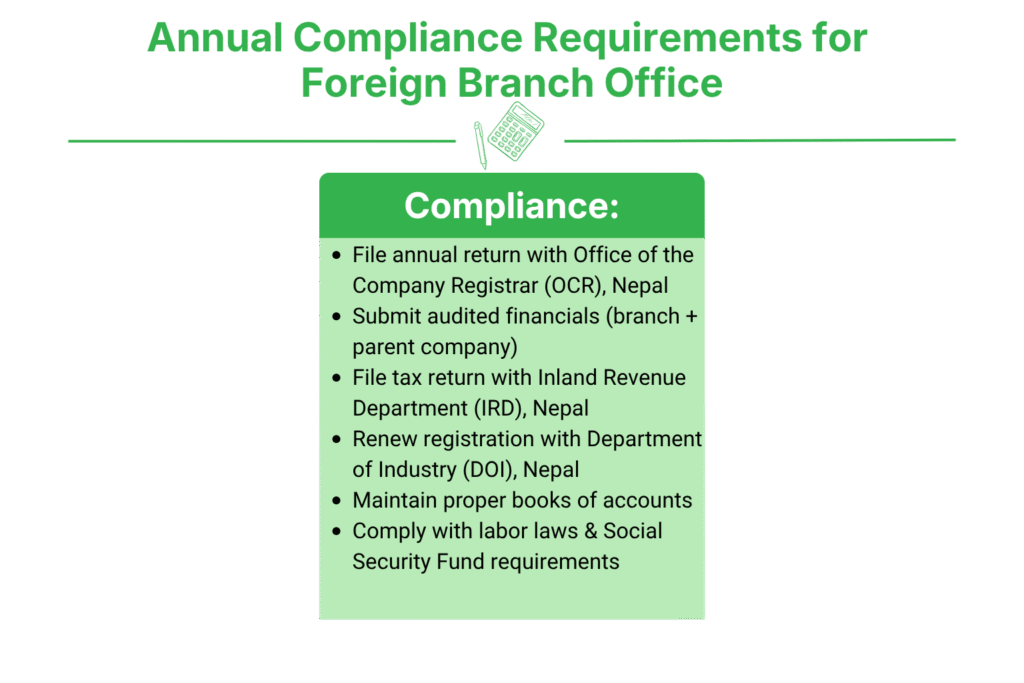
After registration, a foreign branch office in Nepal must fulfill the following annual compliance requirements:
- File annual returns with the OCR within 3 months of the end of each fiscal year
- Submit audited financial statements of both the branch and the parent company
- File annual income tax returns with IRD
- Renew industry registration with DOI periodically
- Maintain proper books of accounts as required under the Companies Act 2063 and Income Tax Act 2058
- Comply with labor law requirements including Social Security Fund contributions
Failure to meet annual compliance obligations can result in fines, suspension, or cancellation of the branch office registration.
How Long Does Branch Office Registration Take in Nepal?
The entire registration process typically takes 4 to 8 weeks, depending on the completeness of documents and the processing time at DOI and OCR. The timeline can be longer if documents require additional authentication or if sector-specific approvals are needed.
DOI approval generally takes 15 to 30 working days. OCR registration is completed within 7 to 15 working days after submission of complete documents.
FAQs
1. Is a branch office the same as a subsidiary company in Nepal?
No. A branch office is an extension of the parent foreign company and is not a separate legal entity. A subsidiary is a distinct legal entity registered under Nepali law. The parent company bears full liability for the branch office’s obligations.
2. What is the minimum capital required to open a foreign branch office in Nepal?
Under FITTA 2075, the minimum foreign investment required is NPR 20 million. This must be remitted through proper banking channels and reported to Nepal Rastra Bank and the Department of Industry.
3. Can a foreign branch office own land in Nepal?
No. Foreign companies and foreign nationals are prohibited from owning land in Nepal under applicable property laws. A branch office can only lease office space or property for its operations.
4. Which authority approves foreign investment for branch office registration?
The Department of Industry (DOI) approves foreign investment up to NPR 6 billion. The Investment Board Nepal (IBN) handles approvals for investments exceeding NPR 6 billion as per FITTA 2075.
5. Can a foreign branch office repatriate profits from Nepal?
Yes. A foreign branch office can repatriate profits after paying applicable taxes. A 5% withholding tax applies on profit repatriation, subject to Nepal Rastra Bank approval and compliance with NRB foreign exchange regulations.
6. What happens if a foreign branch office fails to file annual returns in Nepal?
Failure to file annual returns with OCR or tax returns with IRD results in financial penalties. Prolonged non-compliance may lead to suspension or cancellation of the branch office registration under the Companies Act 2063.
Conclusion
Foreign company branch office registration in Nepal follows a structured legal process under the Companies Act 2063, FITTA 2075, and related laws. The process involves obtaining investment approval from the Department of Industry, registering with the Office of the Company Registrar, and fulfilling tax and compliance obligations. Foreign companies must ensure full document compliance, meet the minimum capital requirement of NPR 20 million, and adhere to annual reporting requirements. Understanding the legal framework and working with qualified legal professionals helps ensure smooth and compliant operations in Nepal.