
What is the DOI and Why Does It Matter for Investors?
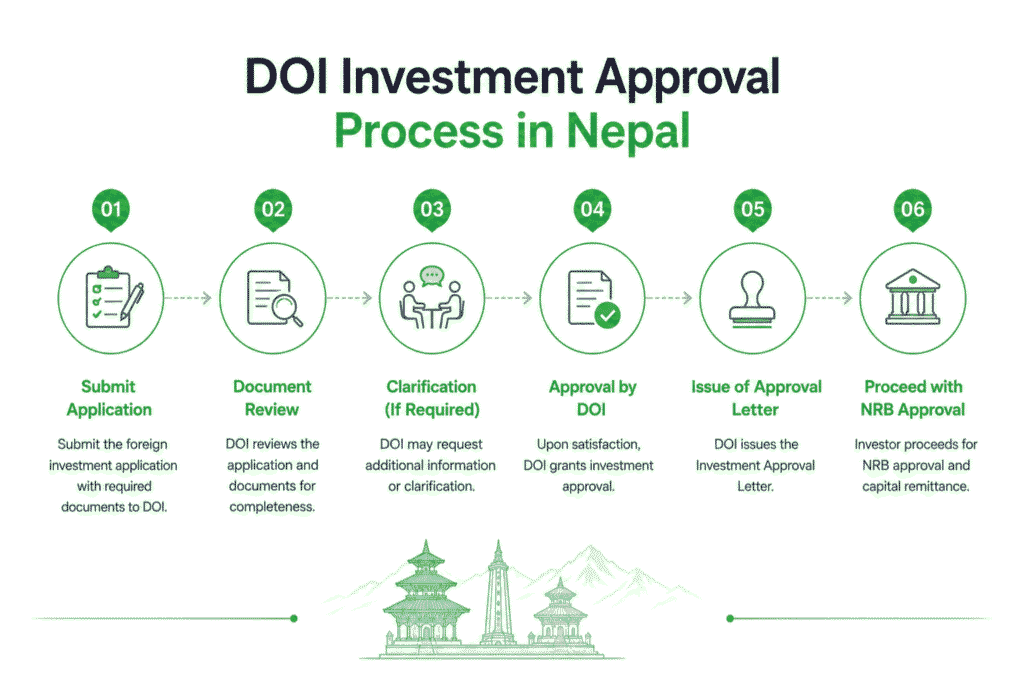
Understanding the DOI investment approval process in Nepal is essential for any investor planning to enter Nepal’s market. The Department of Industry (DOI) Nepal is the primary government body responsible for regulating, promoting, and approving industrial investments in Nepal. It operates under the Ministry of Industry, Commerce and Supplies. Both domestic and foreign investors must interact with the DOI to establish industries, obtain investment approvals, and register industrial enterprises in Nepal.
The DOI handles investment approvals under the Foreign Investment and Technology Transfer Act, 2019 (FITTA 2019) and the Industrial Enterprises Act, 2076 (2020). These two laws form the legal backbone of industrial investment regulation in Nepal. The DOI is the authorized institution for granting approval to foreign investors who wish to invest in Nepal, particularly those investing below NPR 6 billion. Investments above NPR 6 billion fall under the jurisdiction of the Investment Board Nepal (IBN).
The DOI also manages the Industry Registration Certificate, Foreign Investment Approval, Technology Transfer Agreements, and Repatriation Approvals for foreign investors.
What Laws Govern DOI Investment Approval in Nepal?
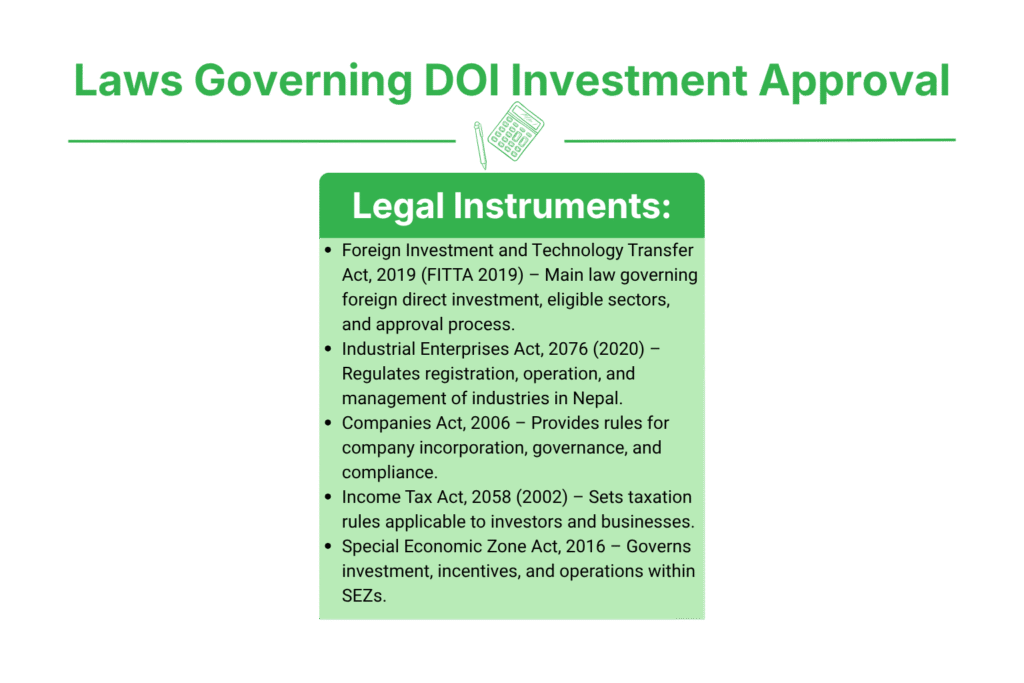
Nepal’s investment approval framework rests on several key legal instruments:
- Foreign Investment and Technology Transfer Act, 2019 (FITTA 2019) – Governs foreign direct investment (FDI) in Nepal, including the types of investments allowed, sectors open to foreign investors, and the approval process.
- Industrial Enterprises Act, 2076 (2020) – Regulates the establishment, operation, and closure of industrial enterprises in Nepal.
- Companies Act, 2006 (as amended) – Governs company incorporation and operation.
- Income Tax Act, 2058 (2002) – Provides the tax framework applicable to industries.
- Special Economic Zone Act, 2016 – Governs investments in SEZ areas.
Under Section 4 of FITTA 2019, foreign investors may invest in Nepal through equity investment, reinvestment of earnings, or technology transfer. The DOI processes these applications and issues approvals accordingly.
Who Needs DOI Investment Approval in Nepal?
Not every investor needs a DOI investment approval. The requirement depends on the nature and size of the investment.
Foreign investors must obtain DOI approval if:
- They are investing foreign capital in a Nepali company.
- They are entering into a technology transfer agreement with a Nepali entity.
- Their total investment is below NPR 6 billion (investments above this threshold go to the Investment Board Nepal).
Domestic investors need DOI registration if:
- They are establishing an industry classified under cottage, small, medium, or large industry categories as defined under the Industrial Enterprises Act, 2020.
Sectors Restricted for Foreign Investment:
Under Schedule 1 of FITTA 2019, certain sectors are completely closed to foreign investment. These include:
- Cottage and small industries (generally)
- Retail trading
- Arms and ammunition production
- Real estate business (except construction industries)
- Poultry farming, fishery below specific thresholds
- Personal service businesses
What are the Types of Investment Approvals Issued by DOI Nepal?
The DOI issues several types of approvals and registrations depending on the investor’s needs:
| Type of Approval | Applicable To | Governing Law |
|---|---|---|
| Foreign Investment Approval | Foreign investors bringing FDI | Foreign Investment and Technology Transfer Act, 2075 (FITTA 2019), Section 4 |
| Technology Transfer Approval | Foreign entities transferring technology | Foreign Investment and Technology Transfer Act, 2075 (FITTA 2019), Section 5 |
| Industry Registration Certificate | Domestic and foreign industries | Industrial Enterprises Act, 2076 (2020) |
| Repatriation Approval | Foreign investors repatriating profits | Foreign Investment and Technology Transfer Act, 2075 (FITTA 2019), Section 10 |
| Expansion / Amendment Approval | Existing industries expanding capacity | Industrial Enterprises Act, 2076 (2020) |
What is the Step-by-Step DOI Investment Approval Process in Nepal?
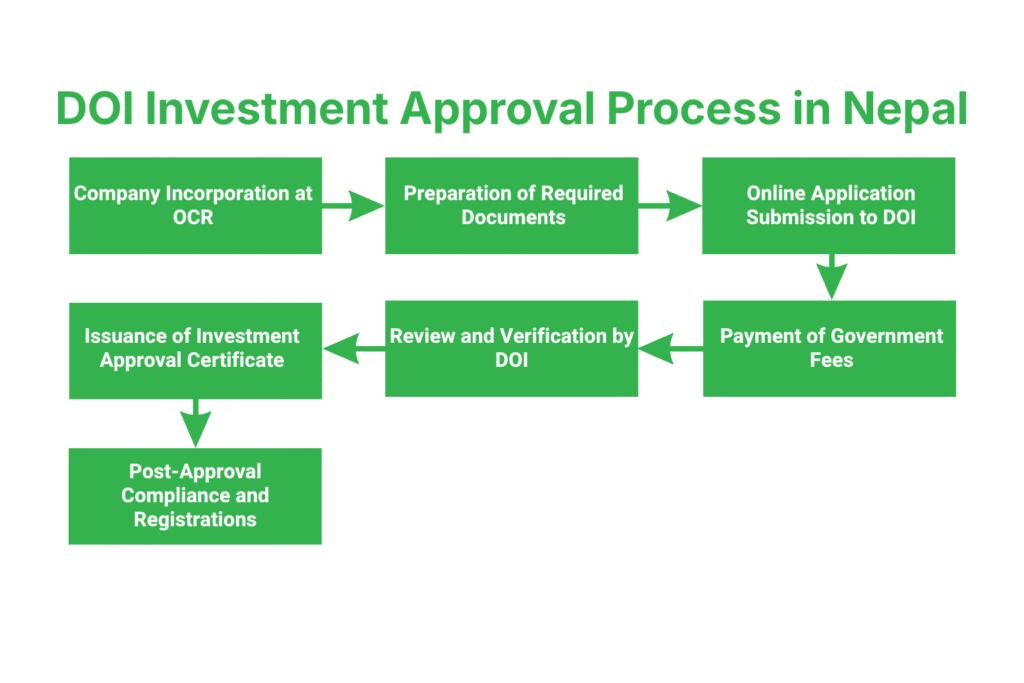
The DOI investment approval process follows a defined procedure. Since 2019, Nepal has implemented an online investment approval system through the DOI portal to simplify the process.
Step 1: Company Incorporation at the Office of Company Registrar (OCR)
Before applying to the DOI, a foreign investor must first incorporate a company in Nepal under the Companies Act, 2006. The company can be:
- A wholly foreign-owned company (100% FDI where allowed)
- A joint venture company (Nepali and foreign partnership)
The company registration is done at the Office of the Company Registrar (OCR), which is accessible at www.ocr.gov.np.
Step 2: Prepare Required Documents
Once the company is incorporated, the investor must gather the following documents for the DOI application:
For Foreign Investment Approval:
- Completed application form (available on DOI portal)
- Certificate of Incorporation of the company
- Memorandum of Association (MoA) and Articles of Association (AoA)
- Company registration certificate of the foreign investor’s parent company
- Audited financial statements of the foreign investor (last 2 years)
- Board Resolution approving the investment in Nepal
- Project proposal/feasibility study
- Tax clearance certificate
- Passport copy of the foreign investor/directors
- Bank statements showing source of funds
- Technology transfer agreement (if applicable)
- Power of Attorney (if applying through a representative)
Step 3: Submit Application through DOI Online System
Nepal’s DOI has established the Online Investment Approval System accessible at www.doind.gov.np. Investors must:
- Register on the DOI online portal.
- Fill in the investment application form with accurate details.
- Upload all required documents in the specified format.
- Pay the applicable processing fees online.
- Submit the application and note the application reference number.
Step 4: Document Verification by DOI Officials
After submission, DOI officials review the application and uploaded documents. If any documents are missing or incorrect, the DOI sends a notice to the applicant to submit the corrected documents within a specified timeframe. The applicant must respond promptly to avoid delays.
Step 5: Approval and Issuance of Investment Approval Certificate
If the application meets all requirements and the proposed investment is in a sector open to foreign investment, the DOI issues the Foreign Investment Approval Certificate. Under Section 7 of FITTA 2019, the DOI must process the application within 7 working days of receiving a complete application.
Step 6: Industry Registration
After receiving the Investment Approval Certificate, the investor must register the industry with the DOI to obtain the Industry Registration Certificate under the Industrial Enterprises Act, 2020. This certificate is mandatory before commencing business operations.
Step 7: Post-Approval Registrations
After DOI approval and industry registration, the investor must complete the following post-approval registrations:
- PAN/VAT Registration at the Inland Revenue Department (IRD)
- Social Security Fund (SSF) Registration
- Labor Registration under the Labor Act, 2017
- Local Municipality Business Registration (depending on location)
What are the Fees for DOI Investment Approval in Nepal?
The DOI charges registration and approval fees based on the fixed assets of the industry. The fee structure is prescribed under the Industrial Enterprises Act, 2020 and related regulations.
| Industry Category | Fixed Assets (NPR) | Registration Fee (NPR) |
|---|---|---|
| Cottage Industry | Up to 1.5 million | 1,000 |
| Small Industry | 1.5 million to 150 million | 2,000 – 10,000 |
| Medium Industry | 150 million to 500 million | 15,000 – 25,000 |
| Large Industry | Above 500 million | 30,000 – 50,000 |
Note: Fee structures may be updated periodically. Investors should confirm the current fee schedule at the official DOI website www.doind.gov.np.
What is the Minimum Foreign Investment Required in Nepal?
Under FITTA 2019 and the Foreign Investment Policy, Nepal has set minimum thresholds for foreign investment:
- The minimum foreign investment amount was set at NPR 50 million (approximately USD 400,000) per project for general FDI.
- For specific sectors like tourism, education, and IT, lower minimums may apply under separate sectoral policies.
- The government has revised these thresholds in the Foreign Investment Policy 2015 and subsequent amendments.
Foreign investors should verify the current minimum investment threshold with the DOI or Nepal’s Investment Board before proceeding with investment plans.
What are the Key Rights of Foreign Investors After DOI Approval?
Once the DOI issues the Foreign Investment Approval Certificate, foreign investors enjoy specific rights under FITTA 2019:
- Right to repatriate profits after paying applicable taxes (Section 10, FITTA 2019).
- Right to repatriate capital on sale or liquidation of investment.
- Protection against nationalization except in public interest with adequate compensation.
- Right to use technology transfer proceeds after tax deduction.
- Access to One Stop Service under the One Stop Service Centre established at the Department of Industry.
The One Stop Service Centre (OSSC) at the DOI brings together various government agencies under one roof to reduce bureaucratic delays for investors. This includes representatives from OCR, IRD, Nepal Rastra Bank, Department of Labor, and others.
What Challenges Do Investors Face in the DOI Approval Process?
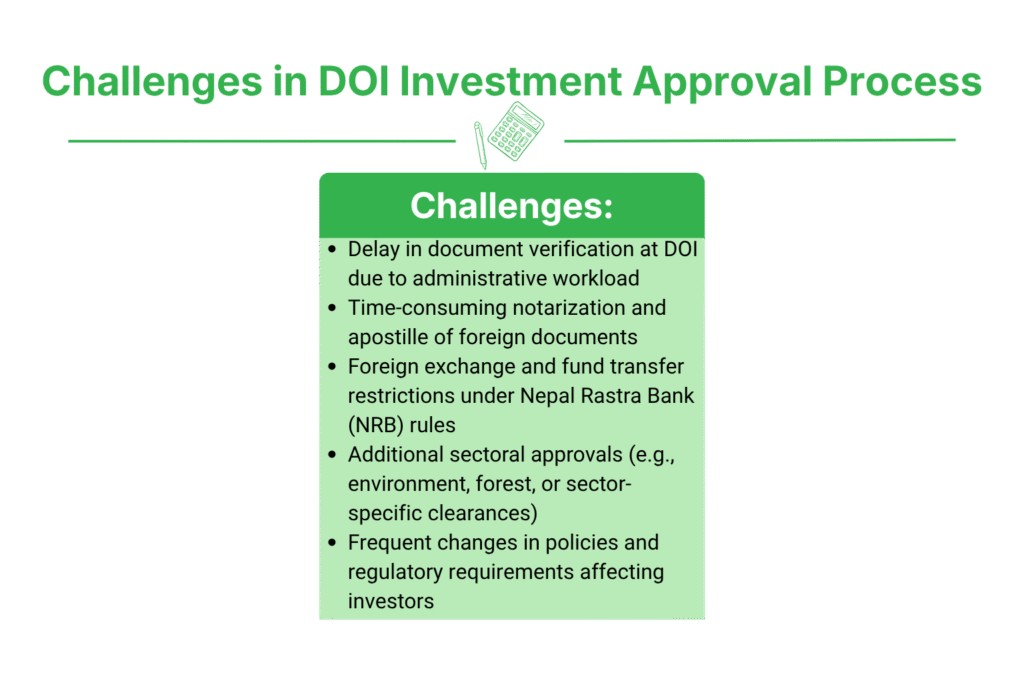
While Nepal has improved its investment climate, investors may face several practical challenges:
- Delays in document verification due to workload at the DOI.
- Requirement for notarized and apostilled documents from the investor’s home country, which takes time.
- Currency and banking regulations under Nepal Rastra Bank (NRB) directives that affect fund transfer.
- Sector-specific clearances required from other government agencies before DOI registration is completed (e.g., environment clearance, forest clearance).
- Frequent policy changes that may affect investment conditions.
Investors are advised to work with registered legal advisors or consultants familiar with Nepal’s investment law to minimize procedural delays.
FAQs
1. How long does the DOI investment approval process take in Nepal?
Under FITTA 2019, the DOI must issue the investment approval within 7 working days of receiving a complete application. However, delays occur when documents are incomplete or additional clearances are required from other agencies.
2. Can a foreign investor own 100% shares in a Nepali company?
Yes. Under FITTA 2019, foreign investors can own 100% equity in companies operating in sectors open to foreign investment. However, some sectors require joint ventures with Nepali partners.
3. Is it mandatory to register with both OCR and DOI?
Yes. Company incorporation at the Office of the Company Registrar (OCR) is the first step. After that, foreign investment approval and industry registration at the DOI are mandatory before commencing operations.
4. What happens if an investor invests without DOI approval?
Investing without DOI approval is illegal under FITTA 2019. It may result in penalties, cancellation of the investment, and inability to repatriate funds through official banking channels in Nepal.
5. Can a foreign investor repatriate profits from Nepal?
Yes. Under Section 10 of FITTA 2019, foreign investors can repatriate profits, dividends, and capital gains after paying applicable taxes. Repatriation requires approval from Nepal Rastra Bank and DOI.
6. What is the difference between DOI and Investment Board Nepal for investment approval?
The DOI handles investment approvals for projects below NPR 6 billion. The Investment Board Nepal (IBN) handles larger projects above NPR 6 billion in priority sectors. Both operate under separate legal frameworks.
Conclusion
The DOI investment approval process in Nepal involves multiple steps including company incorporation, application submission through the DOI online portal, document verification, approval issuance, and post-approval registrations. The process is governed by FITTA 2019 and the Industrial Enterprises Act, 2020. Foreign investors must ensure full legal compliance to enjoy investment protection rights and profit repatriation facilities available under Nepal’s investment laws. For official information, investors should visit www.doind.gov.np or the Investment Board Nepal website.