


Nepal presents a growing landscape for foreign investors and businesses seeking to establish a presence in South Asia. The country holds a strategic geographic position between India and China, two of the world’s largest economies. Market entry services in Nepal cover a wide range of legal, regulatory, and operational procedures that foreign companies and individuals must follow to legally operate within the country. This article covers all key aspects of complete market entry services in Nepal, including business registration, foreign direct investment (FDI) regulations, required documents, applicable laws, and step-by-step processes.
What Are Market Entry Services in Nepal?
Market entry services in Nepal refer to the complete set of professional, legal, and administrative services that help foreign companies and investors establish, register, and operate a business in Nepal. These services include:
- Company registration under the Companies Act, 2006 (2063 B.S.)
- Foreign investment approval from the Investment Board Nepal (IBN) or Department of Industry (DOI)
- Tax registration at the Inland Revenue Department (IRD)
- Bank account opening with approval from Nepal Rastra Bank (NRB)
- Import/export licensing from the Department of Commerce
- Intellectual Property registration at the Department of Industry
- Labor and employment compliance under the Labour Act, 2017 (2074 B.S.)
- Sector-specific licensing from relevant regulatory bodies
These services collectively ensure that a business can legally function, employ workers, import/export goods, repatriate profits, and comply with all applicable Nepalese laws.
What Laws Govern Market Entry and Foreign Investment in Nepal?
Several laws regulate how foreign entities can enter and operate in the Nepalese market. Understanding these laws is the foundation of any market entry plan.
| Law / Regulation | Purpose |
|---|---|
| Companies Act, 2063 (2006) | Governs company formation, structure, and operations |
| Foreign Investment and Technology Transfer Act, 2075 (FITTA, 2019) | Regulates FDI, technology transfer, and profit repatriation |
| Industrial Enterprises Act, 2076 (2020) | Regulates industrial businesses and provides incentives |
| Income Tax Act, 2058 (2002) | Governs corporate and personal taxation |
| Labor Act, 2074 (2017) | Regulates employment, wages, and worker rights |
| Foreign Exchange (Regulation) Act, 1962 | Controls foreign currency transactions |
| Special Economic Zone Act, 2073 (2016) | Governs businesses operating in SEZs |
The Foreign Investment and Technology Transfer Act (FITTA), 2019 is the primary legislation for foreign companies seeking market entry in Nepal. Under Section 3 of FITTA, foreign investors can invest in Nepal through equity investment, reinvestment of earnings, or through technology transfer agreements.
What Types of Business Entities Can Foreign Investors Register in Nepal?
Foreign investors have several business structure options when entering the Nepalese market. Each structure has different legal requirements, liability implications, and ownership limits.
1. Private Limited Company (Pvt. Ltd.)
This is the most common structure for foreign investment in Nepal. Under the Companies Act, 2006, a private limited company requires a minimum of one shareholder and one director. Foreign investors can hold up to 100% equity in most sectors, subject to the Negative List under FITTA, 2019.
2. Public Limited Company
A public limited company requires at least seven shareholders. It can raise capital from the public through share issuance. This structure is common for large-scale industrial and infrastructure projects.
3. Branch Office
Foreign companies can operate a branch office in Nepal. However, a branch office cannot independently generate revenue in Nepal without specific approval. It primarily serves as a liaison or representative function.
4. Liaison Office
A liaison office handles communication and coordination activities on behalf of the parent foreign company. It cannot engage in commercial profit-making activities in Nepal.
5. Joint Venture Company
Foreign investors can enter Nepal through a joint venture with a Nepali partner. This is encouraged in sectors where local knowledge and networks are critical, such as agriculture, construction, and services.
What Is the Process for Company Registration in Nepal for Foreign Investors?
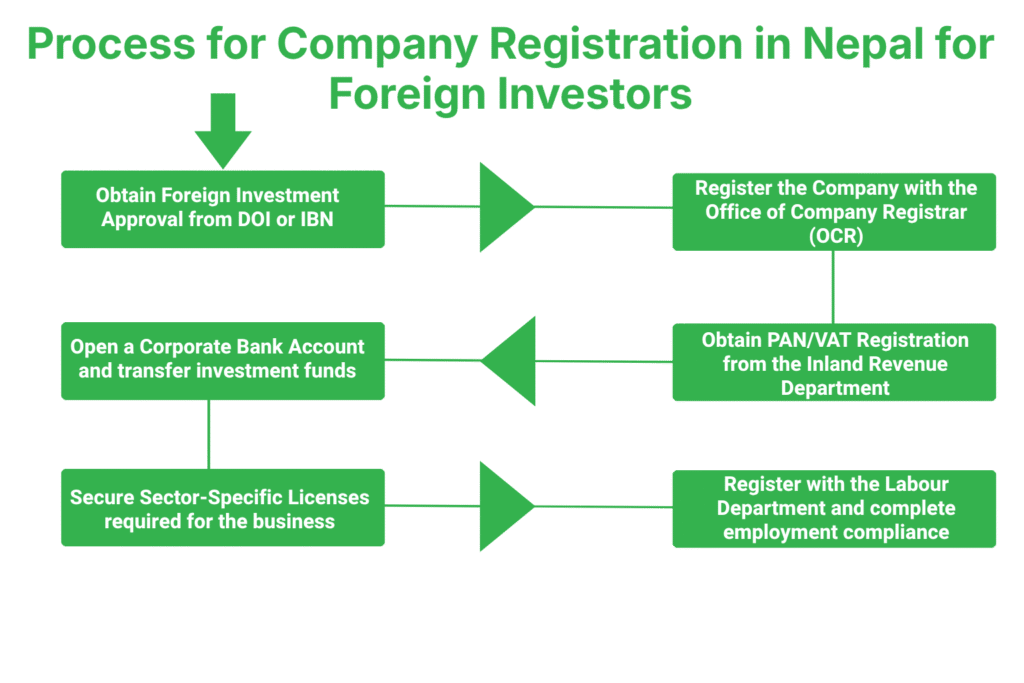
The company registration process in Nepal for foreign investors involves multiple government agencies. Below is the step-by-step process:
Step 1: Obtain Foreign Investment Approval
- Submit an application to the Department of Industry (DOI) or Investment Board Nepal (IBN) depending on the investment size.
- Projects with investment above NPR 6 billion go to IBN; others go to DOI.
- Submit the application through the Online Single Window System at doi.gov.np
Step 2: Register the Company with the Office of Company Registrar (OCR)
- Submit the Memorandum of Association (MOA) and Articles of Association (AOA)
- Complete the registration form at ocr.gov.np
- Pay the applicable registration fee based on authorized capital
Step 3: Register for PAN/VAT at the Inland Revenue Department
- Obtain a Permanent Account Number (PAN) from ird.gov.np
- Register for VAT if annual turnover exceeds NPR 5 million (goods) or NPR 2 million (services)
Step 4: Open a Corporate Bank Account
- Open a bank account in a commercial bank licensed by Nepal Rastra Bank
- Foreign currency accounts require NRB approval under the Foreign Exchange Regulation Act, 1962
Step 5: Obtain Sector-Specific Licenses
- Apply for relevant operating licenses depending on the business sector
- Examples: Department of Tourism, Nepal Electricity Authority, Department of Mines and Geology
Step 6: Register with the Labour Department
- Register with the Department of Labour and Occupational Safety under the Labour Act, 2017
- Submit details of employees, wages, and social security contributions
What Documents Are Required for Foreign Company Registration in Nepal?
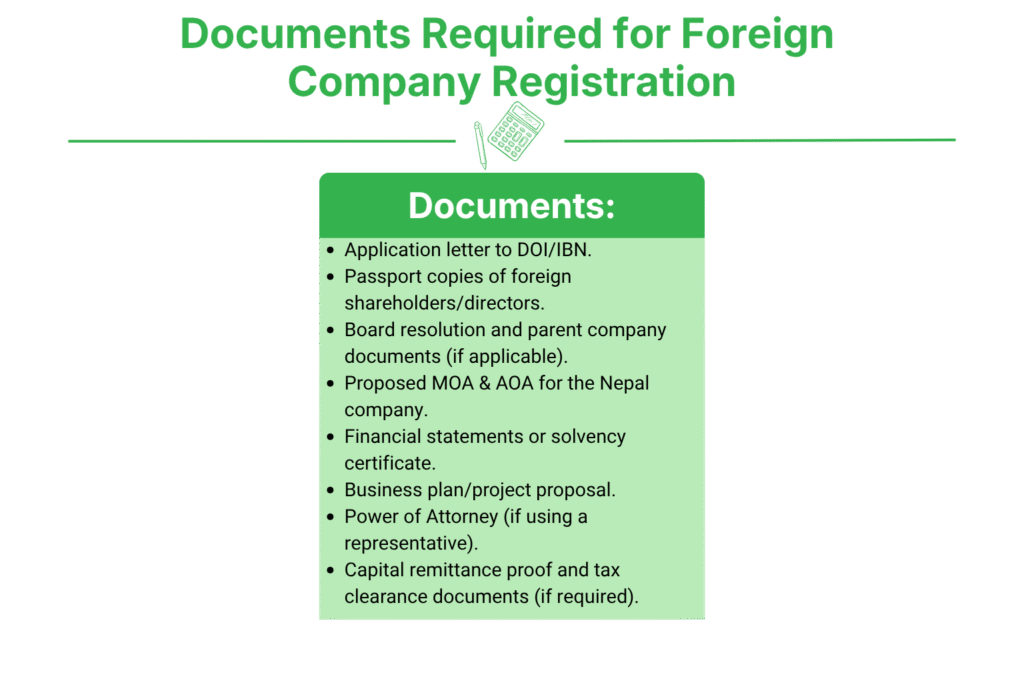
The following documents are required for market entry and company registration in Nepal:
- Application letter addressed to DOI or IBN
- Copy of passport of foreign shareholders/directors
- Board resolution from the parent company (if applicable)
- Memorandum and Articles of Association of the parent company
- Financial statements or solvency certificate of the parent company
- Proposed Memorandum of Association for the new Nepali company
- Articles of Association for the new Nepali company
- Power of Attorney if filed through a representative
- Project proposal or business plan
- Proof of remittance of initial capital (after bank account opening)
- Tax clearance certificate from the home country (in some cases)
All foreign documents must be notarized and apostilled or certified by the Nepali Embassy in the respective country.
What Sectors Are Open and Restricted for Foreign Investment in Nepal?
FITTA, 2019 and its Negative List define which sectors are open, restricted, or prohibited for foreign investment.
| Category | Examples of Sectors |
|---|---|
| Fully Open (100% FDI allowed) | IT, hydropower, manufacturing, tourism, education, health |
| Partially Open (Joint Venture only) | Some financial services, construction, media |
| Restricted / Prohibited | Cottage industries, arms, retail trade below threshold, poultry farming, money lending at local level |
Under the Industrial Enterprises Act, 2020, industries are categorized as micro, cottage, small, medium, and large. Foreign investment is generally permitted in medium and large industries. The Investment Board Nepal manages major foreign investment projects and provides facilitation under the One-Stop-Service (OSS) mechanism.
Visit ibn.gov.np for the latest approved sector list and investment procedures.
What Are the Tax Obligations for Foreign Companies in Nepal?
Foreign companies operating in Nepal are subject to the Income Tax Act, 2002 and its subsequent amendments.
- Corporate Income Tax Rate: 25% for general companies; 20% for manufacturing companies; 30% for banks and financial institutions
- Value Added Tax (VAT): 13% on taxable goods and services
- Withholding Tax: Applied to dividends, royalties, interest, and service payments to foreign entities
- Dividend Repatriation Tax: Under FITTA, 2019, foreign investors can repatriate profits after paying applicable taxes
- Double Taxation Avoidance Agreements (DTAA): Nepal has signed DTAAs with several countries including India, China, Austria, and Norway
Tax registration is mandatory before commencing business operations. The Inland Revenue Department manages all tax-related filings and compliance at ird.gov.np.
What Are Special Economic Zones (SEZs) in Nepal?
Nepal has established Special Economic Zones (SEZs) under the Special Economic Zone Act, 2016 to attract foreign investment through additional incentives.
Key SEZ benefits include:
- Income tax exemption for the first 10 years and 50% exemption for the next 5 years
- Custom duty exemption on raw materials and machinery
- VAT exemption on purchases within the SEZ
- 100% foreign ownership permitted in SEZ-based enterprises
- Simplified import/export procedures
Currently operational SEZs include Bhairahawa SEZ and Simara SEZ. More zones are in development under the Special Economic Zone Authority (SEZA). Businesses in manufacturing, export-oriented production, and logistics benefit most from SEZ registration.
What Role Does Nepal Rastra Bank Play in Market Entry?
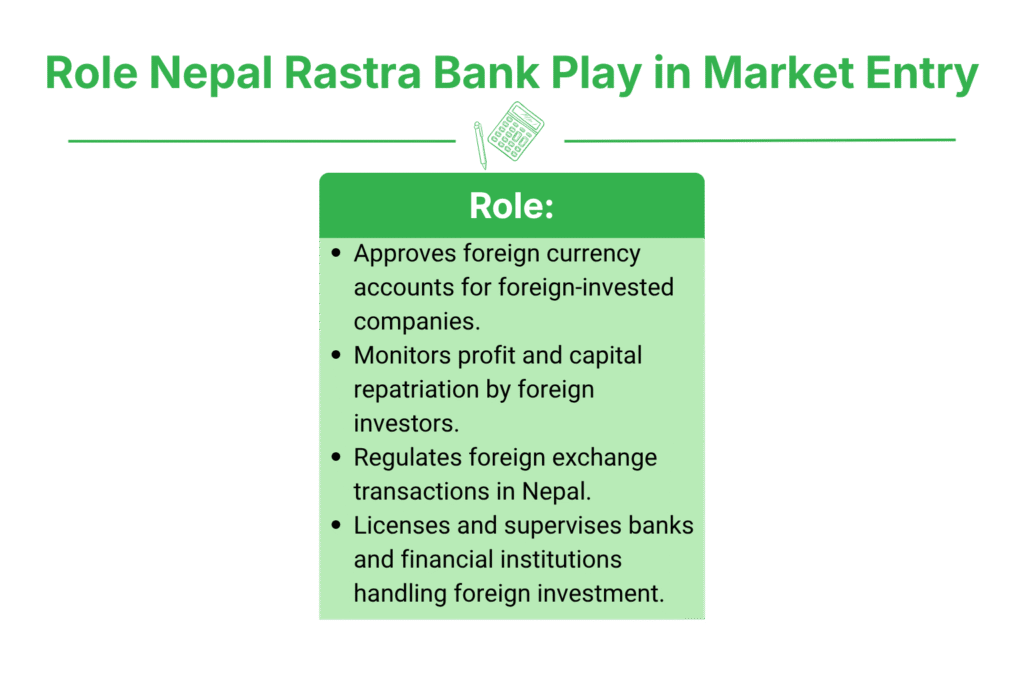
Nepal Rastra Bank (NRB) is the central banking authority of Nepal, established under the Nepal Rastra Bank Act, 2002. NRB plays a direct role in foreign investment and market entry through:
- Approving foreign currency accounts for foreign-invested companies
- Monitoring repatriation of profits by foreign investors
- Regulating foreign exchange under the Foreign Exchange Regulation Act, 1962
- Licensing banks and financial institutions where foreign investment is planned
Any remittance of capital, dividends, or royalties to foreign countries requires NRB approval. Visit nrb.org.np for foreign exchange guidelines.
How Long Does the Market Entry Process Take in Nepal?
The timeline for completing market entry in Nepal depends on the sector and investment size:
- DOI foreign investment approval: 7-15 working days
- OCR company registration: 3-7 working days
- PAN/VAT registration: 1-3 working days
- Bank account opening: 5-10 working days
- Sector-specific licenses: 15-45 working days depending on the sector
For IBN-level projects, the timeline can extend to 30-60 days due to additional review processes. The One-Stop-Service (OSS) at DOI and IBN is designed to reduce delays.
FAQs
1. Can a foreign individual register a 100% foreign-owned company in Nepal?
Yes. Under FITTA, 2019, foreign individuals can register a 100% foreign-owned company in most sectors except those listed in the Negative List. Approval from the Department of Industry is required.
2. What is the minimum investment required for foreign investors in Nepal?
Under FITTA, 2019, the minimum foreign investment threshold is NPR 20 million (approximately USD 150,000) for most sectors. Sector-specific minimums may apply under separate regulations.
3. Is a local Nepali partner mandatory for all foreign-invested companies?
No. A local partner is not mandatory in most sectors. However, for sectors listed under the joint venture requirement in the Negative List, a Nepali partner is compulsory.
4. Can foreign companies repatriate profits from Nepal?
Yes. FITTA, 2019 guarantees the right to repatriate dividends, profits, royalties, and capital after payment of all applicable taxes, subject to NRB procedures and foreign exchange regulations.
5. Which government body handles large-scale foreign investment in Nepal?
The Investment Board Nepal (IBN) handles projects exceeding NPR 6 billion. Smaller foreign investments are handled by the Department of Industry (DOI).
6. Are there tax incentives for foreign investors in Nepal?
Yes. Manufacturing companies enjoy a 20% tax rate. SEZ-based businesses get a 10-year full tax holiday. Export-oriented businesses and IT companies also receive specific tax concessions under the Income Tax Act, 2002.
Conclusion
Market entry services in Nepal cover a broad and well-defined legal framework governed by multiple acts, regulations, and government agencies. Foreign investors must follow the procedures under FITTA, 2019, the Companies Act, 2006, and the Industrial Enterprises Act, 2020 to legally establish and operate a business in Nepal. Engaging qualified legal and business advisory professionals, along with understanding the regulatory requirements from DOI, OCR, IRD, NRB, and IBN, ensures a smooth and compliant market entry process in Nepal.