

Foreign Direct Investment (FDI) in Nepal has grown steadily over the past decade. Nepal offers legal frameworks, investment incentives, and a structured approval process for foreign investors who wish to register a company and operate legally. The Government of Nepal has enacted specific laws to facilitate foreign investment, streamline company registration, and protect investor rights. This article covers every aspect of company registration with FDI approval in Nepal in a detailed and factual manner.
What Is FDI and How Does It Work in Nepal?
Foreign Direct Investment (FDI) refers to investment made by a foreign individual, company, or entity in a business enterprise located in Nepal. The foreign investor either establishes a new company, acquires shares in an existing Nepali company, or forms a joint venture with a local partner.
In Nepal, FDI is primarily governed by the Foreign Investment and Technology Transfer Act, 2019 (FITTA 2019). This Act replaced the earlier Foreign Investment and Technology Transfer Act, 1992, and introduced more liberal and investor-friendly provisions. Additional laws that apply to foreign investors include the Companies Act, 2006, the Industrial Enterprises Act, 2020, and the Special Economic Zone Act, 2016.
The primary regulatory authority for FDI approval in Nepal is the Department of Industry (DOI) under the Ministry of Industry, Commerce and Supplies. For large-scale investments above a specified threshold, the Investment Board Nepal (IBN) serves as the approving authority.
What Are the Legal Frameworks Governing FDI in Nepal?
Nepal has established a clear legal foundation for foreign investment:
| Law | Year | Purpose |
|---|---|---|
| Foreign Investment and Technology Transfer Act, 2075 | 2019 | Governs FDI entry, approval, repatriation, and protection |
| Companies Act, 2063 | 2006 | Governs company formation and corporate governance |
| Industrial Enterprises Act, 2076 | 2020 | Regulates industries and provides investment incentives |
| Special Economic Zone Act, 2073 | 2016 | Regulates FDI in SEZ areas |
| Foreign Exchange (Regulation) Act, 1962 | 2019 | Governs foreign currency transactions and remittance |
Under Section 3 of FITTA 2019, a foreign investor can invest in Nepal through:
- Foreign equity investment in a company registered in Nepal
- Reinvestment of earnings from existing foreign investment
- Investment through loans from foreign sources
What Types of Companies Can a Foreign Investor Register in Nepal?
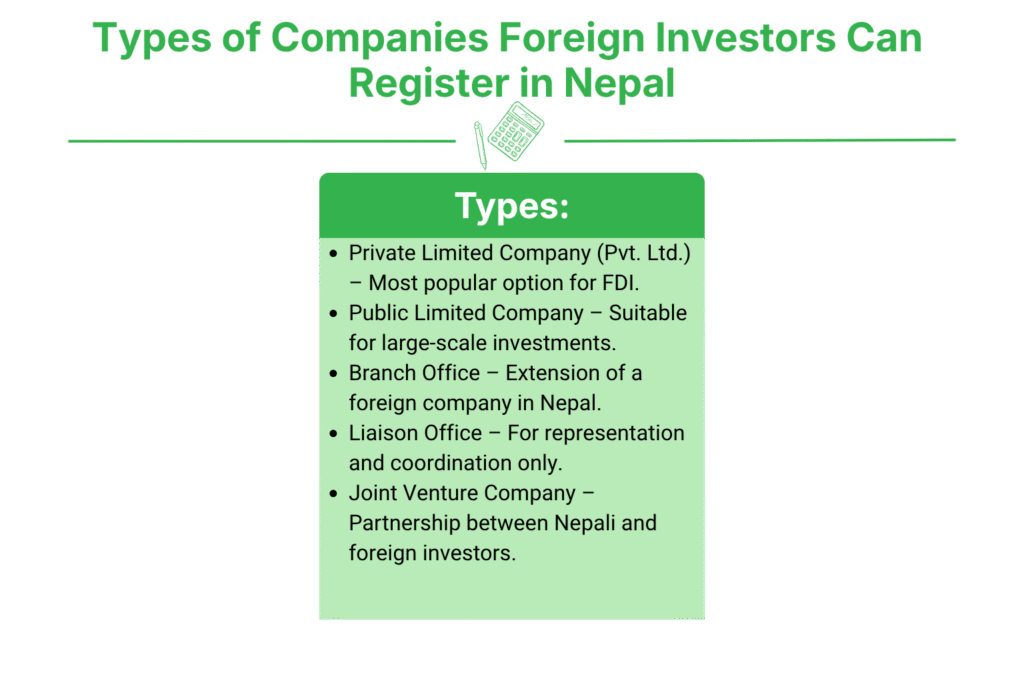
A foreign investor can register the following types of companies under the Companies Act, 2006:
- Private Limited Company (Pvt. Ltd.): Most common structure for FDI. Minimum two shareholders, maximum 101 shareholders.
- Public Limited Company: Minimum seven shareholders. Suitable for larger investment projects.
- Branch Office: A foreign company can open a branch office in Nepal with prior approval.
- Liaison Office: Allowed for representation purposes only; cannot conduct commercial activities.
- Joint Venture Company: A Nepali and foreign investor together form a company by contributing capital and sharing profits.
Most foreign investors prefer registering a Private Limited Company in Nepal due to its simpler compliance requirements and limited liability structure.
What Sectors Are Open and Restricted for Foreign Investment in Nepal?
Nepal allows FDI in most sectors but restricts or prohibits foreign investment in certain industries.
Sectors Open to 100% Foreign Ownership:
- Manufacturing and export industries
- Information Technology and Software
- Hydropower and energy
- Tourism and hospitality
- Infrastructure and construction
- Education and healthcare (with conditions)
- Agro-processing industries
Sectors with Restricted or Conditional FDI:
Under Schedule 1 of FITTA 2019, the following sectors are closed to foreign investment:
- Cottage and small-scale industries (reserved for Nepali nationals)
- Arms and ammunition production
- Explosives and radioactive materials
- Real estate business (buying and selling of land)
- Money lending businesses
- Travel agencies (except for trekking, rafting, mountaineering)
- Primary agriculture
- Internal courier services
- Mass communication and media (newspapers, radio, television restricted)
- Retail trade with investment below USD 500,000
Foreign investors should verify the current Negative List published by the Department of Industry before proceeding with registration.
What Is the Minimum Foreign Investment Required in Nepal?
Under FITTA 2019, the minimum threshold for foreign investment approval in Nepal is:
| Investment Type | Minimum Amount |
|---|---|
| General FDI (excluding services) | NPR 20 Million (approx. USD 150,000) |
| Service Sector Investment | NPR 50 Million (approx. USD 375,000) |
| Technology Transfer (Royalty) | As agreed, subject to Department of Industry approval |
The Department of Industry reviews the investment amount and approves or rejects applications based on whether they meet the minimum threshold and sector eligibility criteria.
What Is the Process for Company Registration with FDI Approval in Nepal?
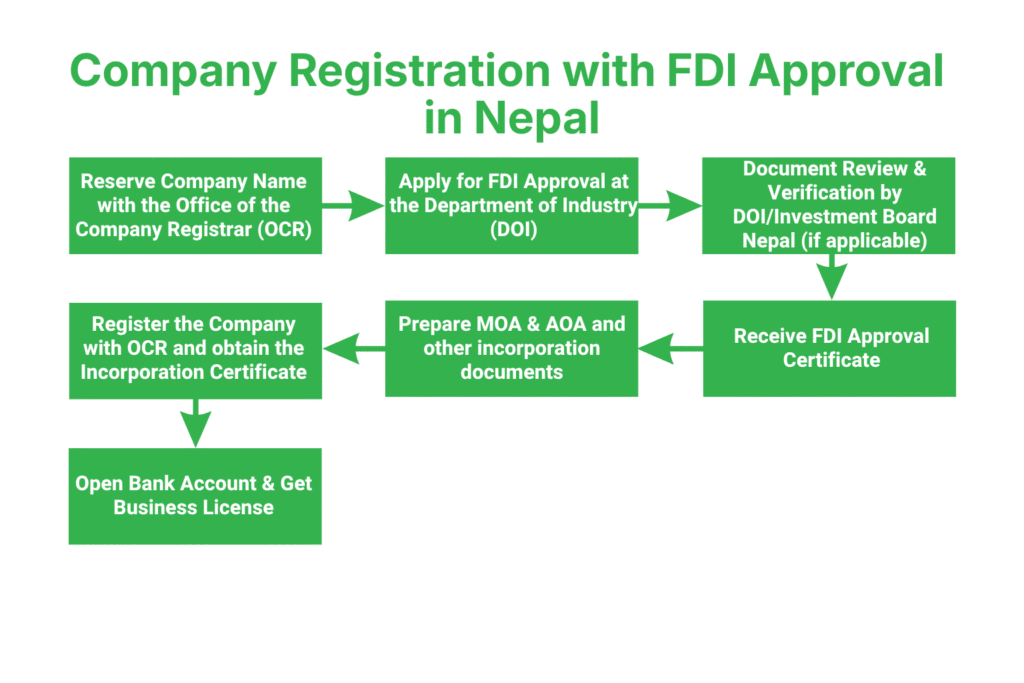
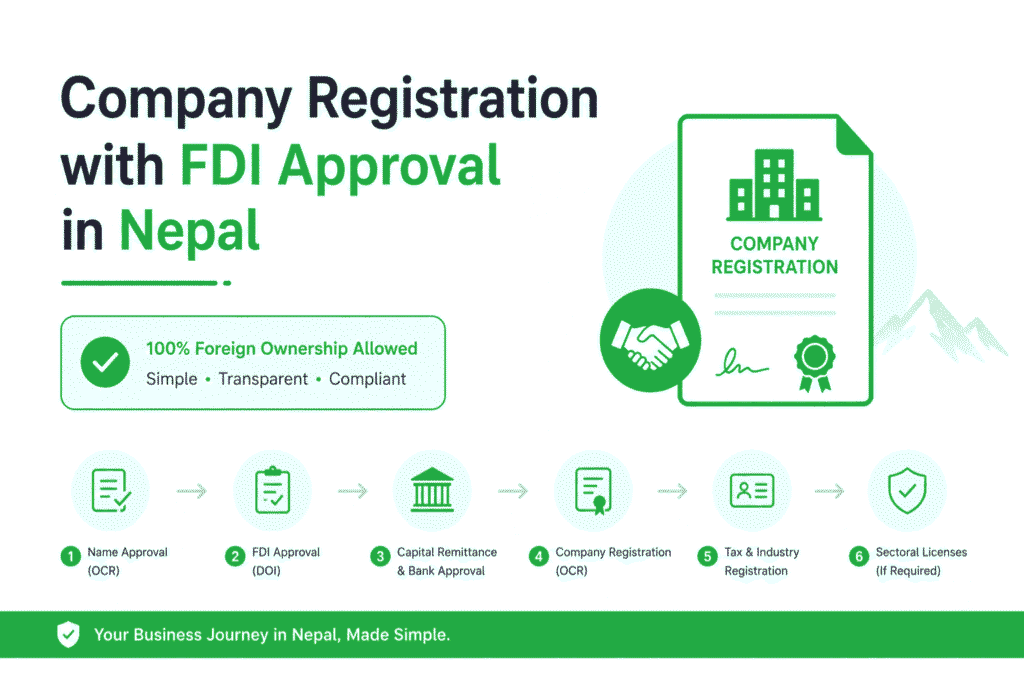
The process involves two parallel stages: obtaining FDI approval from the Department of Industry and registering the company with the Office of the Company Registrar (OCR). The One Stop Service Center (OSSC) located at Singha Durbar, Kathmandu, facilitates both processes under one roof.
Step-by-Step Process:
Step 1: Name Reservation
- Submit a company name reservation application to the Office of the Company Registrar (OCR) at ocr.gov.np.
- The OCR verifies name availability and reserves the name for 35 days.
Step 2: FDI Approval Application
- Submit a foreign investment approval application to the Department of Industry at doind.gov.np.
- The application must include details of the proposed investment, sector, investment amount, and the foreign investor’s credentials.
Step 3: Document Review by DOI
- DOI reviews the application against FITTA 2019 provisions, sector eligibility, and minimum investment requirements.
- For investments above NPR 6 Billion, the application goes to the Investment Board Nepal (IBN) at ibn.gov.np.
Step 4: FDI Approval Certificate Issuance
- Upon successful review, DOI issues a Foreign Investment Approval Certificate.
- This certificate authorizes the foreign investor to bring in foreign capital and proceed with company registration.
Step 5: Memorandum and Articles of Association Preparation
- Prepare the Memorandum of Association (MOA) and Articles of Association (AOA) as required under Sections 10 and 11 of the Companies Act, 2006.
Step 6: Company Registration at OCR
- Submit the company registration application along with all required documents to OCR.
- OCR processes the application and issues the Certificate of Incorporation.
Step 7: Post-Registration Compliance
- Register with the Inland Revenue Department (IRD) at ird.gov.np for a Permanent Account Number (PAN) and Value Added Tax (VAT) registration if applicable.
- Open a corporate bank account in Nepal.
- Register with the concerned municipality for a Business Operating License.
What Documents Are Required for Company Registration with FDI Approval?
Documents Required for FDI Approval (DOI):
- Duly filled FDI application form
- Passport copies of all foreign investors
- Proof of financial capability of the foreign investor (bank statement, audited financial reports)
- Project proposal or business plan
- Proposed shareholding structure
- Power of Attorney if represented by an agent
- In case of corporate investor: Certificate of Incorporation of the parent company, Board Resolution, and Memorandum of Association of the parent company
Documents Required for Company Registration (OCR):
- Name reservation approval letter from OCR
- FDI Approval Certificate from DOI
- Memorandum of Association (MOA)
- Articles of Association (AOA)
- Passport copies of all shareholders and directors
- Passport-sized photographs of all shareholders and directors
- Registered office address proof (rental agreement or ownership document)
- Consent letters from all proposed directors
- Share allotment details and capital structure
How Long Does the FDI Approval and Company Registration Process Take?
Under FITTA 2019 and the Companies Act 2006, the authorities are required to process applications within specified timeframes:
- Name Reservation: 1–3 working days
- FDI Approval from DOI: 7–15 working days
- Company Registration at OCR: 3–7 working days
- PAN/VAT Registration: 3–5 working days
The One Stop Service Center (OSSC) aims to complete the entire registration process within 15 working days for eligible projects.
What Are the Rights and Protections Available to Foreign Investors in Nepal?
Under FITTA 2019, foreign investors in Nepal enjoy several legally guaranteed rights:
- Right to repatriate profit, dividend, royalty, and principal investment in convertible foreign currency
- Protection against nationalization or expropriation without compensation
- Right to obtain visas for foreign technicians, managers, and skilled personnel
- Right to use and enforce arbitration for dispute resolution under international arbitration rules
- Right to receive non-discriminatory treatment compared to domestic investors in similar sectors
- Right to technology transfer agreements duly approved by DOI
These provisions are outlined under Chapter 3 and Chapter 4 of FITTA 2019.
What Are the Tax Incentives Available for Foreign Investors in Nepal?
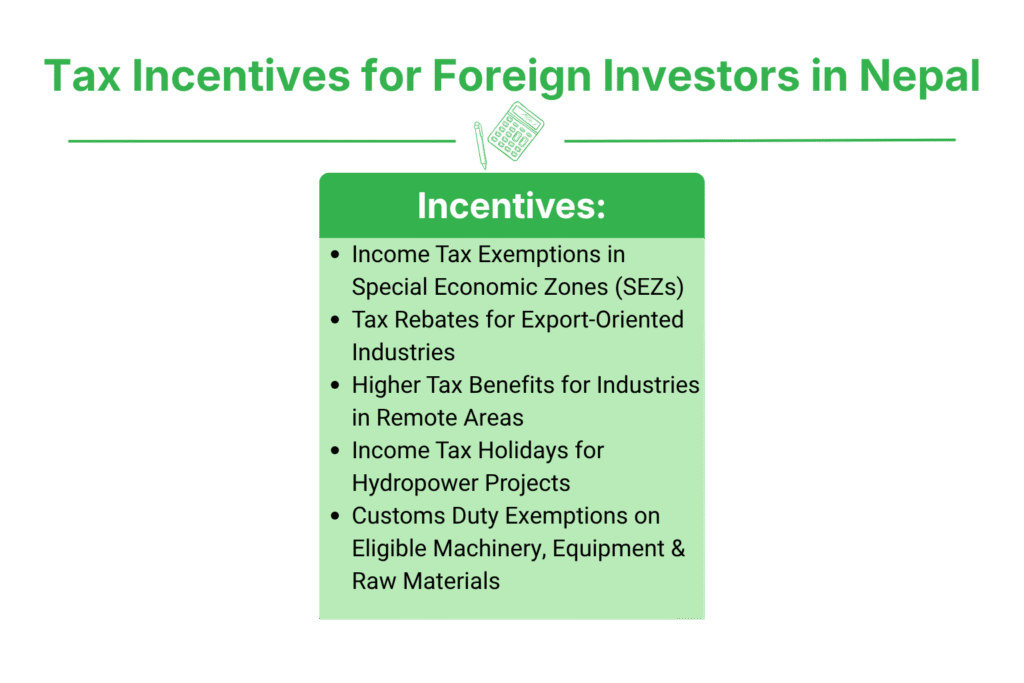
Under the Industrial Enterprises Act 2020 and the annual Finance Act, Nepal provides the following tax benefits to foreign investors:
- Income tax exemption for industries established in Special Economic Zones (SEZ)
- Income tax rebate for export-oriented industries
- Industries established in remote areas of Nepal receive higher tax exemptions
- Hydropower projects receive income tax exemptions for specific periods
- No customs duty on import of machinery, equipment, and raw materials for certain industries
FAQs
1. Can a foreign investor own 100% shares in a Nepali company?
Yes. Under FITTA 2019, a foreign investor can hold 100% equity in a Nepali company in most sectors except those listed in the Negative List or sectors reserved for Nepali nationals under Schedule 1 of the Act.
2. Is it mandatory to have a Nepali partner for FDI in Nepal?
No, it is not mandatory. Nepal allows fully foreign-owned companies. However, in sectors like media, travel agencies, and cottage industries, joint ventures or Nepali ownership may be required.
3. What is the role of Investment Board Nepal (IBN) in FDI approval?
IBN handles large-scale investments exceeding NPR 6 Billion. For such projects, IBN provides a single-window service, coordinates with all government bodies, and issues approvals directly.
4. Can a foreign investor register a company online in Nepal?
OCR has introduced an online company registration portal at ocr.gov.np. However, FDI approval still requires physical submission or coordinated processing through the One Stop Service Center.
5. What is the minimum paid-up capital for a private limited company with FDI?
Under the Companies Act 2006, no specific minimum paid-up capital is fixed. However, under FITTA 2019, the minimum foreign investment must be NPR 20 Million for general sectors and NPR 50 Million for service sectors.
6. Can a foreign-invested company in Nepal hire foreign employees?
Yes. Under FITTA 2019 and the Labour Act 2017, a foreign-invested company can hire foreign employees for technical and managerial positions. The company must obtain work permits from the Department of Labour for such employees.
Conclusion
Company registration with FDI approval in Nepal follows a structured legal process governed by FITTA 2019, the Companies Act 2006, and the Industrial Enterprises Act 2020. Foreign investors must obtain approval from the Department of Industry, prepare proper incorporation documents, and register with the Office of the Company Registrar. Nepal’s One Stop Service Center simplifies this process. Understanding sector eligibility, minimum investment thresholds, and document requirements is essential before starting the registration process.
For official information, visit:
- Office of the Company Registrar: ocr.gov.np
- Department of Industry: doind.gov.np
- Investment Board Nepal: ibn.gov.np
- Inland Revenue Department: ird.gov.np