
Company capital increasing process in Nepal is a formal legal procedure that registered companies must follow when they want to raise their authorized or paid-up capital. The process is governed by the Companies Act, 2063 (2006) and regulated by the Office of the Company Registrar (OCR) under the Government of Nepal. Whether a company wants to expand its business operations, take on new investors, or meet regulatory requirements, increasing company capital is a structured and document-heavy process that requires full compliance with Nepalese company law.
What is Company Capital in Nepal?
Company capital in Nepal refers to the total financial resources that a company is authorized to raise from shareholders or investors. Under the Companies Act, 2063, capital is broadly categorized into:
- Authorized Capital (Registered Capital): The maximum amount of capital a company is legally permitted to raise as stated in its Memorandum of Association.
- Issued Capital: The portion of authorized capital that the company has offered to shareholders.
- Subscribed Capital: The portion of issued capital that shareholders have agreed to take.
- Paid-Up Capital: The actual amount paid by shareholders for the shares they hold.
When companies refer to increasing capital, they generally mean increasing either the authorized capital, the paid-up capital, or both. Each type of increase follows a slightly different procedure and has different legal implications under Nepalese law.
Legal Framework Governing Capital Increase in Nepal
The primary law that governs the company capital increasing process in Nepal is the Companies Act, 2063 (2006). Section 30 of the Act specifically addresses alterations to share capital. Additionally, the following regulations apply:
- Companies Regulation, 2063 (2006)
- Securities Act, 2063 (for public companies listed on Nepal Stock Exchange)
- Foreign Investment and Technology Transfer Act, 2075 (2019) (for companies with foreign investment)
- Income Tax Act, 2058 (for tax implications arising from capital increase)
Public companies listed on NEPSE must also obtain approval from the Securities Board of Nepal (SEBON) before issuing new shares or increasing paid-up capital. Private companies, on the other hand, follow a relatively simpler process through the OCR.
Why Do Companies Increase Capital in Nepal?
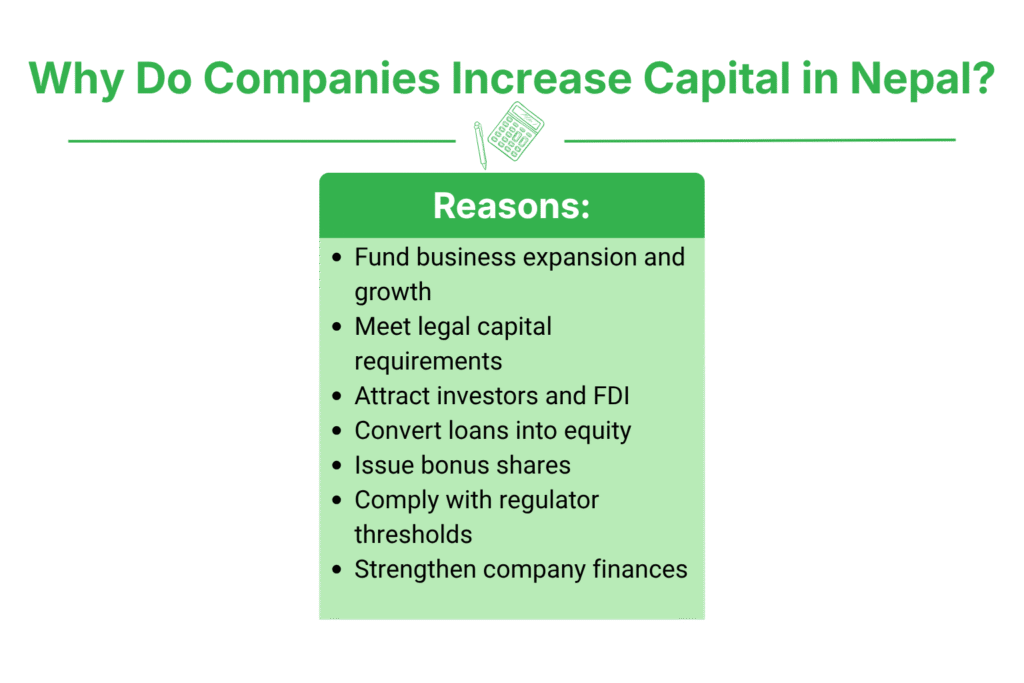
Companies in Nepal increase their capital for several legitimate business and legal reasons:
- To fund business expansion and new projects
- To comply with sector-specific minimum capital requirements (e.g., banking, insurance, microfinance)
- To attract new investors or foreign direct investment (FDI)
- To convert loans or reserves into equity
- To issue bonus shares from retained earnings
- To meet the minimum paid-up capital thresholds set by regulatory bodies like Nepal Rastra Bank or Insurance Authority of Nepal
Types of Capital Increase Methods in Nepal
1. Increase in Authorized Capital
A company increases its authorized capital by amending its Memorandum of Association. This requires a special resolution passed at the general meeting and subsequent registration with OCR.
2. Increase via Rights Issue
In a rights issue, existing shareholders are offered new shares in proportion to their current holdings. This is a common method for private and public companies.
3. Increase via Bonus Shares
Companies convert their accumulated profits or reserves into share capital. This does not bring in new cash but increases the paid-up capital.
4. Increase via New Share Issuance (Public Offering)
Public companies can issue new shares to the general public through Initial Public Offerings (IPO) or Further Public Offerings (FPO), regulated by SEBON.
5. Increase via Foreign Investment
Foreign investors can invest in Nepalese companies under the Foreign Investment and Technology Transfer Act, 2075, which requires approval from the Department of Industry (DOI) or Investment Board Nepal (IBN) depending on investment size.
Step-by-Step Company Capital Increasing Process in Nepal
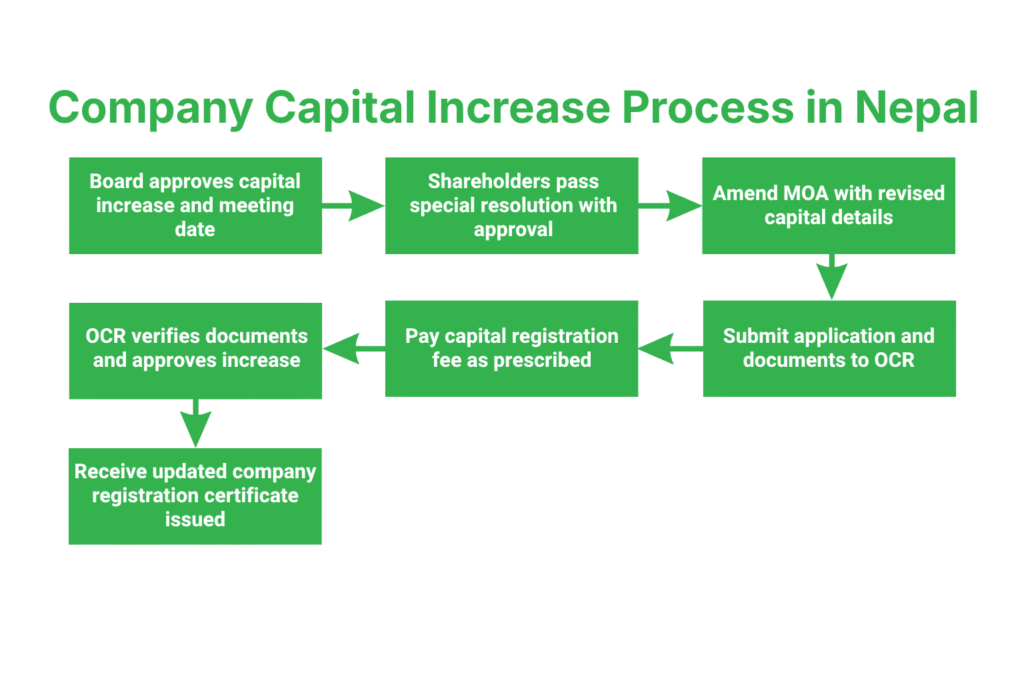
The following is the standard process for increasing the authorized and paid-up capital of a private limited company in Nepal:
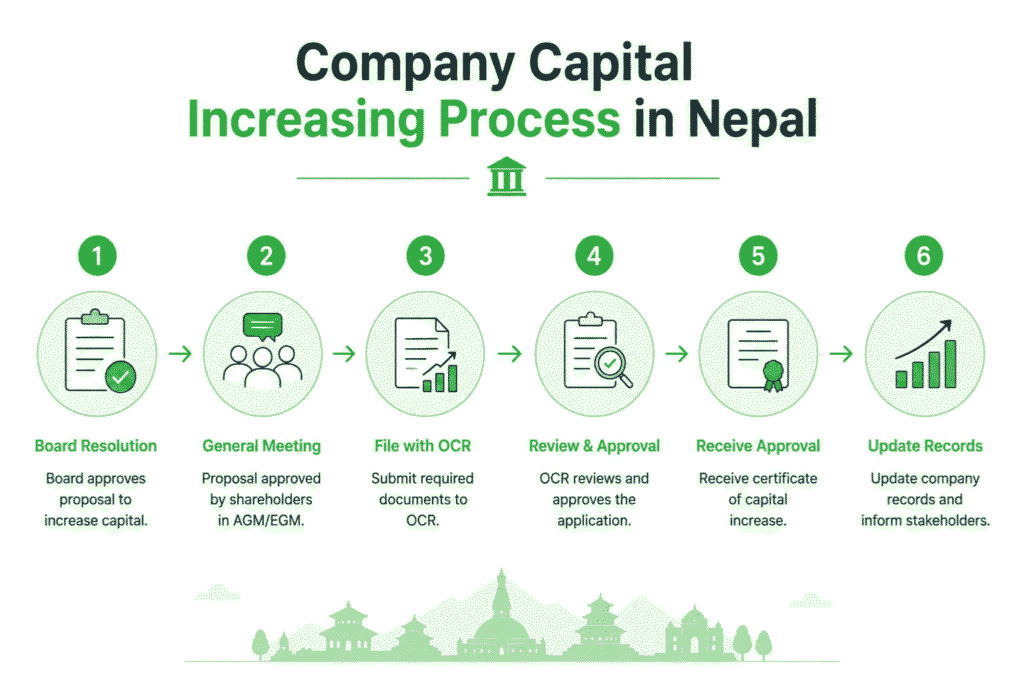
Step 1: Board of Directors Meeting
- The Board of Directors passes a resolution recommending capital increase.
- The board sets the date for a General Meeting (Annual General Meeting or Extraordinary General Meeting).
Step 2: General Meeting and Special Resolution
- Shareholders convene in a General Meeting.
- A Special Resolution is passed with at least 75% approval from shareholders present (as per Section 68 of the Companies Act, 2063).
- Minutes of the meeting are recorded and signed.
Step 3: Amendment of Memorandum of Association
- If authorized capital is being increased, the Memorandum of Association (MOA) is amended.
- The amended MOA must reflect the new authorized capital amount.
Step 4: Filing Application at OCR
- The company files an application with the Office of the Company Registrar.
- All required documents are submitted along with applicable fees.
Step 5: Payment of Capital Registration Fee
- The company pays the prescribed fee to OCR based on the increased amount of capital.
- Fees are structured on a slab basis as per the Companies Regulation, 2063.
Step 6: Verification and Approval by OCR
- OCR verifies the documents and resolution.
- If everything is in order, OCR updates the company’s capital in its registry.
Step 7: Updated Certificate Issuance
- OCR issues an updated company registration certificate reflecting the new authorized and/or paid-up capital.
Documents Required for Capital Increase in Nepal
The following documents are required when filing for capital increase at the Office of the Company Registrar:
- Application letter addressed to the Company Registrar
- Certified copy of the Special Resolution passed at the General Meeting
- Minutes of the General Meeting
- Amended Memorandum of Association (in case of authorized capital increase)
- Amended Articles of Association (if applicable)
- Updated share register
- Bank voucher showing payment of applicable fee
- Updated list of shareholders with share allotment details
- Tax clearance certificate (Rajaswa Chukt Praman Patra)
- PAN/VAT registration certificate copy
- Citizenship copies of directors and shareholders
For public companies, additional documents from SEBON approval, prospectus, and auditor’s certificate are required.
Fee Structure for Capital Registration in Nepal
The OCR charges registration fees based on the amount of authorized capital. Below is an approximate fee schedule based on the Companies Regulation, 2063:
| Authorized Capital (NPR) | Registration Fee (NPR) |
|---|---|
| Up to 1,00,000 | 1,000 |
| 1,00,001 to 5,00,000 | 4,500 |
| 5,00,001 to 25,00,000 | 9,500 |
| 25,00,001 to 1,00,00,000 | 19,500 |
| 1,00,00,001 to 2,00,00,000 | 49,500 |
| Above 2,00,00,000 | 99,500 + additional slabs |
Note: Fee amounts are subject to revision by the Government of Nepal. Always verify current fees at www.ocr.gov.np.
Timeline for Capital Increase Process in Nepal
| Stage | Estimated Time |
|---|---|
| Board Meeting and Resolution | 1–3 days |
| General Meeting Notice Period | At least 15 days prior |
| General Meeting and Special Resolution | 1 day |
| Document Preparation and Submission | 3–7 days |
| OCR Processing and Verification | 7–15 working days |
| Certificate Issuance | 1–3 days after approval |
| Total Estimated Time | 4–6 weeks |
The timeline may vary depending on the completeness of submitted documents and the workload at OCR.
Capital Increase for Companies with Foreign Investment
Foreign-invested companies in Nepal must follow additional procedures under the Foreign Investment and Technology Transfer Act, 2075 (2019). If foreign investment results from a capital increase, the company must:
- Obtain prior approval from the Department of Industry (DOI) for investments below NPR 6 billion
- Approach the Investment Board Nepal (IBN) for investments above NPR 6 billion
- Register the foreign investment with Nepal Rastra Bank for foreign exchange control purposes
- Comply with the repatriation rules under the Foreign Exchange Regulation Act, 2019
Foreign investors remitting funds for capital subscription must do so through banking channels and obtain a Foreign Investment Approval Certificate before the OCR registration.
Common Mistakes to Avoid During Capital Increase Process
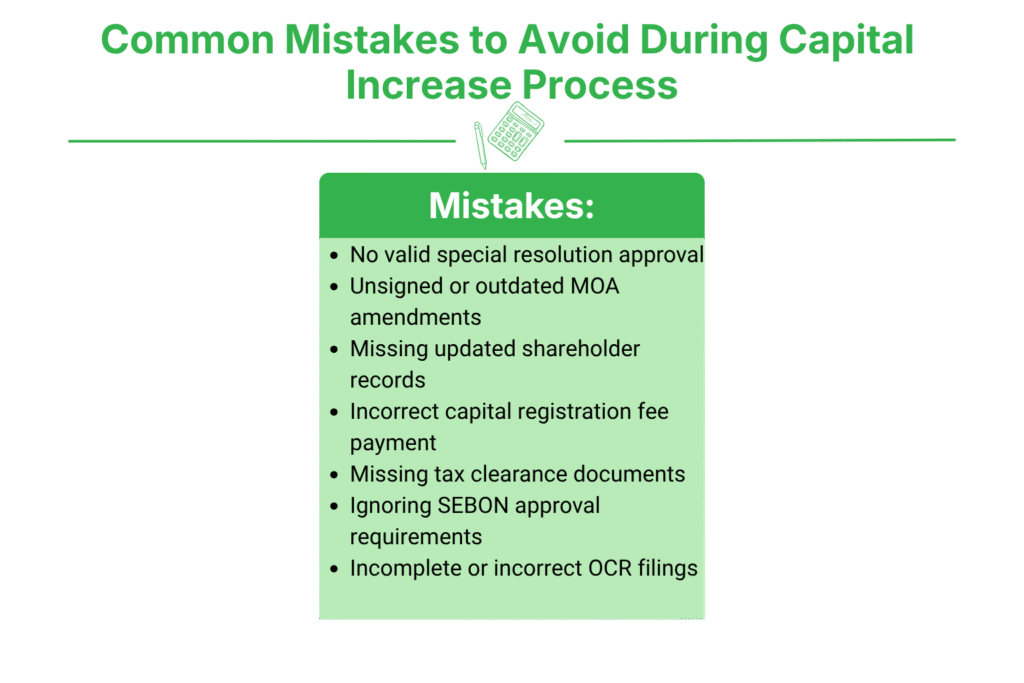
- Filing documents without a valid Special Resolution
- Submitting outdated or unsigned MOA amendments
- Failing to provide updated shareholder lists
- Not paying the correct fee based on the new authorized capital
- Missing tax clearance certificates
- Ignoring SEBON approval for public companies
Regulatory Authorities Involved in Capital Increase
- Office of the Company Registrar (OCR): www.ocr.gov.np — Primary registration authority
- Securities Board of Nepal (SEBON): www.sebon.gov.np — For listed public companies
- Department of Industry (DOI): www.doi.gov.np — For foreign-invested companies
- Nepal Rastra Bank (NRB): www.nrb.org.np — For banking and forex regulation
- Inland Revenue Department (IRD): www.ird.gov.np — For tax clearance
FAQs
1. What is the minimum capital required to register a company in Nepal?
There is no fixed minimum capital for private companies under the Companies Act, 2063. However, sector-specific regulators like Nepal Rastra Bank mandate minimum capital for banks, finance companies, and insurance firms.
2. Can a private company increase its capital without a General Meeting?
No. A private company must pass a Special Resolution at a General Meeting with at least 75% shareholder approval before filing for capital increase at OCR, as required under Section 68 of the Companies Act, 2063.
3. How long does the capital increase process take at OCR in Nepal?
The entire process typically takes 4 to 6 weeks, including the 15-day notice period for the General Meeting and OCR processing time of 7 to 15 working days after document submission.
4. Is SEBON approval required for private company capital increase?
No. SEBON approval is only required for public companies listed on the Nepal Stock Exchange (NEPSE) that intend to raise capital through rights issues, IPOs, or FPOs to the general public.
5. What happens if a company increases paid-up capital without OCR registration?
Any capital increase without proper registration at OCR is legally invalid under the Companies Act, 2063. The company may face penalties, and the new shares issued will have no legal standing.
6. Can foreign nationals invest in Nepalese companies during a capital increase?
Yes. Foreign nationals can invest during a capital increase under the Foreign Investment and Technology Transfer Act, 2075. Prior DOI or IBN approval and NRB registration are mandatory for such investments.
Conclusion
The company capital increasing process in Nepal is a structured legal procedure governed primarily by the Companies Act, 2063 and regulated by the Office of the Company Registrar. Companies must pass a Special Resolution, amend the Memorandum of Association, pay applicable fees, and submit required documents to OCR. Public companies and foreign-invested companies must comply with additional regulatory requirements from SEBON, DOI, and NRB. Proper understanding of this process ensures legal compliance and smooth business expansion in Nepal.