
The Company Capital Increasing Process in Nepal is a formal legal procedure that allows registered companies to raise their authorized capital, issued capital, or paid-up capital beyond the limits set at the time of incorporation. Whether a company wants to expand operations, attract new investors, or meet regulatory requirements, increasing company capital in Nepal follows a structured legal pathway governed by the Companies Act, 2063 (2006) and its related regulations. Understanding this process is essential for company directors, shareholders, and business owners operating in Nepal.
What Is Company Capital in Nepal?
Company capital in Nepal refers to the financial base of a registered company. It is broadly divided into three categories:
- Authorized Capital: The maximum amount of capital a company is permitted to raise through share issuance as per its Memorandum of Association.
- Issued Capital: The portion of authorized capital that has been formally offered to shareholders.
- Paid-Up Capital: The actual amount shareholders have paid against the issued capital.
A company can only issue shares up to the limit of its authorized capital. If a company wants to issue more shares or raise more funds, it must first increase its authorized capital by following the prescribed legal process in Nepal.
Legal Framework Governing Capital Increase in Nepal
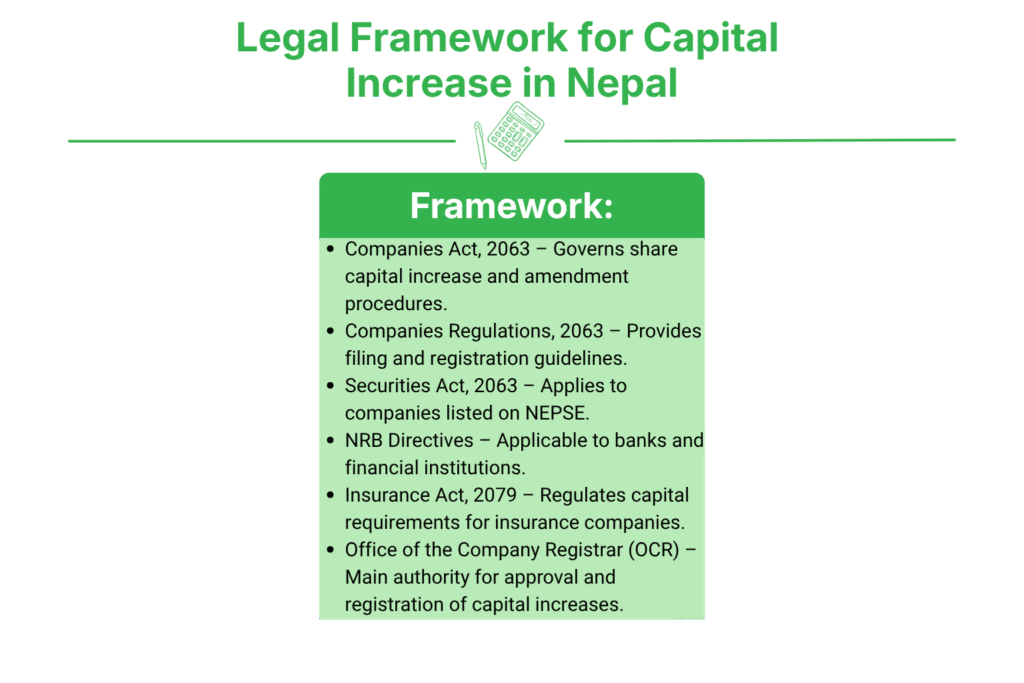
The primary legal authority for the company capital increasing process in Nepal is:
- Companies Act, 2063 (2006) – Sections 21, 22, 23, and 29 deal with alterations to share capital.
- Companies Regulations, 2063 – Procedural guidelines for filing and registration.
- Securities Act, 2063 (2006) – Applicable if the company is listed on the Nepal Stock Exchange (NEPSE).
- Nepal Rastra Bank Directives – Applicable to banks and financial institutions regulated by NRB.
- Insurance Act, 2079 (2023) – Applicable to insurance companies for capital adequacy requirements.
The Office of the Company Registrar (OCR), Nepal, is the primary authority to register any increase in a company’s capital. You can visit the official OCR website at www.ocr.gov.np for official forms and notifications.
Why Do Companies Increase Their Capital in Nepal?
Companies in Nepal pursue capital increase for several operational and regulatory reasons:
- To fund business expansion and new projects
- To meet the minimum paid-up capital requirement set by regulatory bodies (NRB, SEBON, Beema Samiti)
- To bring in new investors or issue fresh shares
- To convert loans or debt into equity
- To strengthen the company’s financial position and creditworthiness
- To qualify for government contracts or sector-specific licenses
Types of Capital Increase in Nepal
Understanding the type of capital increase a company intends to pursue determines the specific process to follow.
| Type of Capital Increase | Description |
|---|---|
| Increase in Authorized Capital | Amending the Memorandum of Association to raise the maximum permissible capital limit |
| Increase in Issued Capital | Issuing additional shares within the existing authorized capital |
| Increase in Paid-Up Capital | Collecting payment from shareholders against newly issued shares |
| Rights Share Issuance | Offering new shares to existing shareholders proportionally |
| Bonus Share Issuance | Distributing shares from retained earnings or reserves (no cash inflow) |
| Public Share Issuance | Offering shares to the general public via IPO or FPO (regulated by Securities Board of Nepal) |
Step-by-Step Company Capital Increasing Process in Nepal

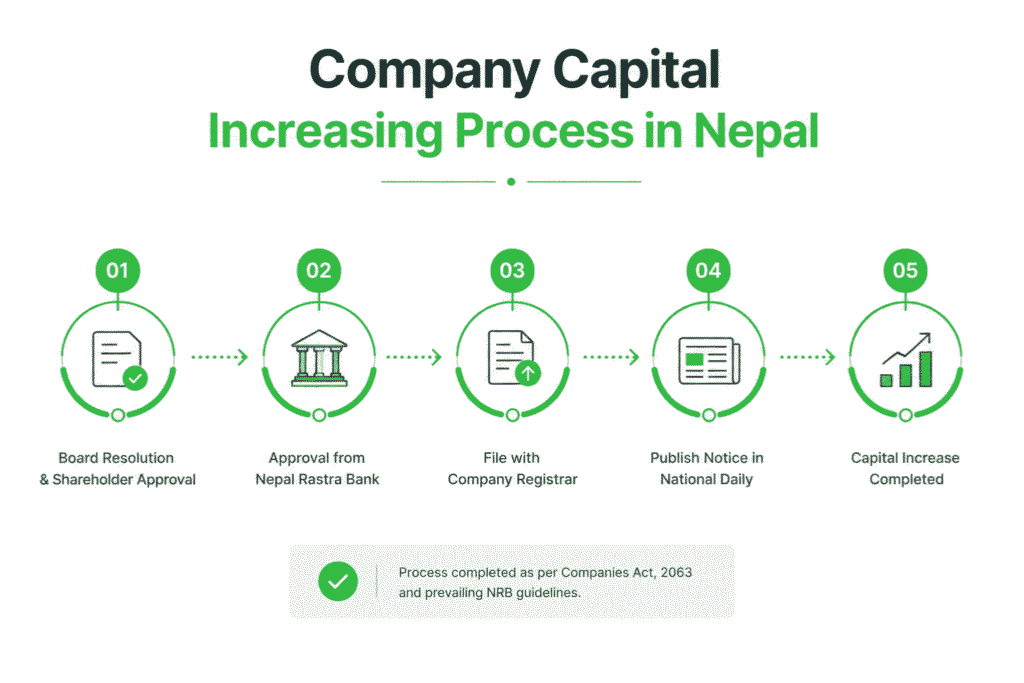
The following is the detailed procedure to increase company capital in Nepal, particularly for private limited companies and public limited companies.
Step 1: Board of Directors Meeting
The capital increasing process begins with a formal Board of Directors (BOD) Meeting. The board must:
- Pass a resolution recommending the increase in authorized or paid-up capital
- Determine the amount of capital increase and the proposed structure
- Decide on the mode of capital increase (rights shares, new share issuance, etc.)
- Fix the date for the General Meeting or Extraordinary General Meeting (EGM)
Step 2: Convene an Extraordinary General Meeting (EGM) or Annual General Meeting (AGM)
Per Section 68 of the Companies Act, 2063, shareholders must approve any amendment to the Memorandum of Association, which includes capital increase. The company must:
- Issue notice of EGM at least 21 days in advance for public companies and 15 days for private companies
- Prepare the agenda clearly stating the proposed capital increase
- Pass a Special Resolution with at least 75% vote of the shareholders present
Step 3: Pass a Special Resolution
A special resolution approving the capital increase must be passed during the EGM or AGM. This resolution must clearly state:
- The current authorized capital
- The proposed new authorized capital
- The reason for the increase
Step 4: Amend the Memorandum of Association (MOA)
As per Section 21 of the Companies Act, 2063, any increase in authorized capital requires an amendment to the Memorandum of Association (MOA). The amended MOA must reflect:
- New authorized capital amount
- Number and value of shares after the increase
- Date of the special resolution approving the amendment
Step 5: File Application with the Office of Company Registrar (OCR)
Within 15 days of passing the special resolution, the company must submit the required documents and application to the Office of Company Registrar, Nepal. Late submission attracts penalties under the Companies Act.
Documents Required for Capital Increase in Nepal
The following documents must be submitted to the OCR Nepal for processing the company capital increase application:
- Application Form as prescribed by OCR (available at ocr.gov.np)
- Certified copy of the Board Resolution recommending capital increase
- Certified copy of the Special Resolution passed at EGM/AGM
- Amended Memorandum of Association (MOA)
- Updated Articles of Association (AOA), if necessary
- Minutes of the EGM/AGM with shareholder attendance sheet
- Notice of EGM sent to shareholders
- Receipt of government fee payment for capital increase
- Company’s PAN Certificate copy
- Company Registration Certificate copy
- Tax Clearance Certificate (in some cases)
Government Fees for Capital Increase in Nepal
The OCR charges a registration fee based on the amount of capital increase. The fee structure is determined by Schedule 1 of the Companies Regulations, 2063.
| Authorized Capital Range | Registration Fee (Approximate) |
|---|---|
| Up to NPR 1,00,000 | NPR 1,000 |
| NPR 1,00,001 to NPR 5,00,000 | NPR 4,500 |
| NPR 5,00,001 to NPR 25,00,000 | NPR 9,500 |
| NPR 25,00,001 to NPR 1,00,00,000 | NPR 19,500 |
| NPR 1,00,00,001 to NPR 5,00,00,000 | NPR 49,500 |
| Above NPR 5,00,00,000 | As per OCR schedule |
Note: Fees are subject to change. Always verify the latest fee schedule at ocr.gov.np.
Capital Increase Process for Banks and Financial Institutions (BFIs) in Nepal
For banks and financial institutions, the capital increasing process in Nepal involves an additional regulatory layer. The Nepal Rastra Bank (NRB) sets minimum paid-up capital requirements under its Unified Directive. BFIs must:
- Obtain prior approval from NRB before increasing capital
- Submit an application to NRB along with the board resolution and business justification
- Receive NRB’s No Objection Letter (NOC)
- Then follow the standard OCR process for capital increase registration
Similarly, insurance companies must obtain approval from the Insurance Authority of Nepal (Beema Pradhikaran) before initiating capital increase proceedings.
Capital Increase for Public Companies Listed on NEPSE
For companies listed on the Nepal Stock Exchange (NEPSE), the capital increasing process involves additional steps regulated by SEBON (Securities Board of Nepal):
- File an application with SEBON for approval of rights share issuance or IPO/FPO
- Publish a prospectus as required under the Securities Act, 2063
- Use a registered Issue Manager (merchant banker) for public share issuance
- Follow SEBON’s timeline and regulatory guidelines
- Report to NEPSE after completing the share issuance
The SEBON official website is www.sebon.gov.np.
Timeline for Company Capital Increase Registration in Nepal
The typical processing timeline at OCR Nepal for capital increase registration is as follows:
- Board Resolution: Day 1
- EGM Notice Period: 15–21 days
- EGM and Special Resolution: After notice period
- Filing at OCR: Within 15 days of special resolution
- OCR Processing Time: Approximately 7–15 working days (standard)
- Issuance of Updated Registration Certificate: After successful verification
The total process from initiation to completion generally takes 30–60 days depending on document completeness and regulatory involvement.
Common Mistakes in Capital Increase Process in Nepal
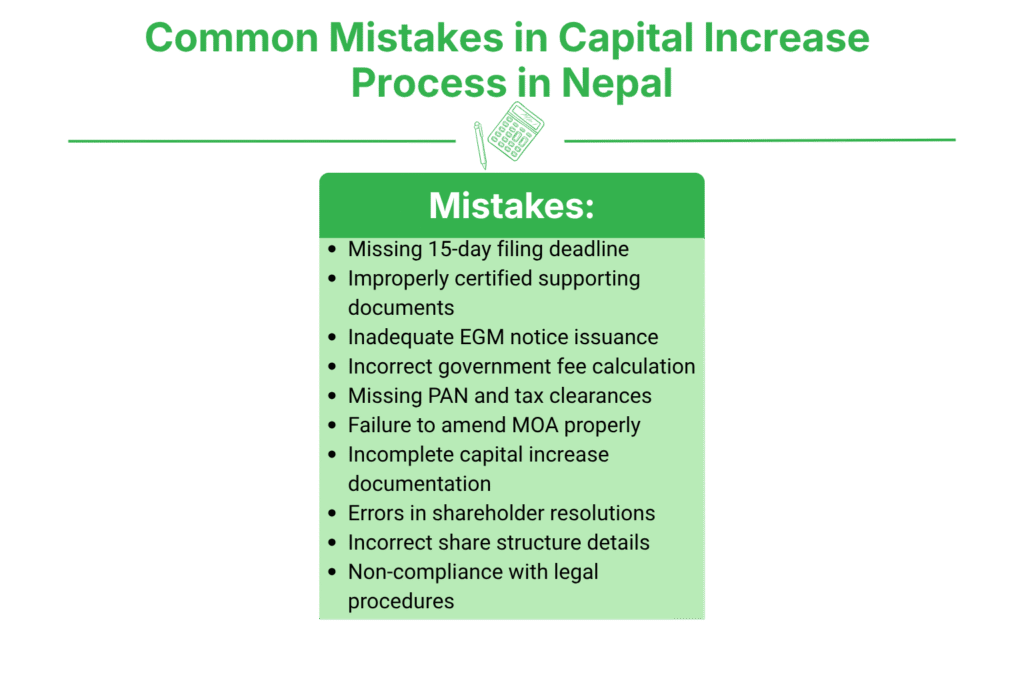
Companies often face delays or rejections due to the following errors:
- Filing documents after the 15-day deadline from the special resolution date
- Submitting improperly certified copies of MOA or board resolutions
- Failing to give proper statutory notice for EGM
- Incorrect fee calculation based on capital amount
- Missing PAN or tax clearance documents
- Not amending the MOA to reflect the new capital structure
FAQs
1. What is the minimum capital required to register a company in Nepal?
Under the Companies Act, 2063, there is no fixed minimum authorized capital for private limited companies. However, regulatory bodies like NRB and Beema Pradhikaran set sector-specific minimum paid-up capital requirements.
2. Can a company increase capital without shareholder approval in Nepal?
No. Under Section 68 of the Companies Act, 2063, any amendment to the Memorandum of Association, including capital increase, requires a special resolution passed by at least 75% of shareholders at a duly convened general meeting.
3. How long does it take to complete the capital increase process in Nepal?
The entire process from board resolution to OCR registration typically takes 30 to 60 days, depending on the EGM notice period, document preparation, and OCR processing time.
4. Does increasing authorized capital automatically increase paid-up capital in Nepal?
No. Increasing authorized capital only raises the ceiling for permissible share issuance. Paid-up capital increases only when new shares are actually issued and payment is received from shareholders.
5. Is a tax clearance certificate mandatory for capital increase in Nepal?
A tax clearance certificate is required in certain cases, especially when processing amendments at the OCR. It is advisable to obtain it to avoid delays during the capital registration process.
6. Do banks need NRB approval before increasing capital in Nepal?
Yes. Nepal Rastra Bank (NRB) requires all licensed banks and financial institutions to obtain prior approval through a No Objection Letter before initiating capital increase proceedings under the NRB Unified Directive.
Conclusion
The Company Capital Increasing Process in Nepal is a legally defined multi-step process governed primarily by the Companies Act, 2063 and administered by the Office of Company Registrar, Nepal. The process involves board resolutions, shareholder approval through a special resolution at an EGM or AGM, MOA amendment, and timely filing with OCR. For regulated entities such as banks, financial institutions, and insurance companies, additional approval from NRB or Beema Pradhikaran is mandatory. Companies listed on NEPSE must also comply with SEBON regulations for public share issuance. Completing each step accurately and within the legal timeframe ensures a smooth and legally valid capital increase for any company operating in Nepal.