
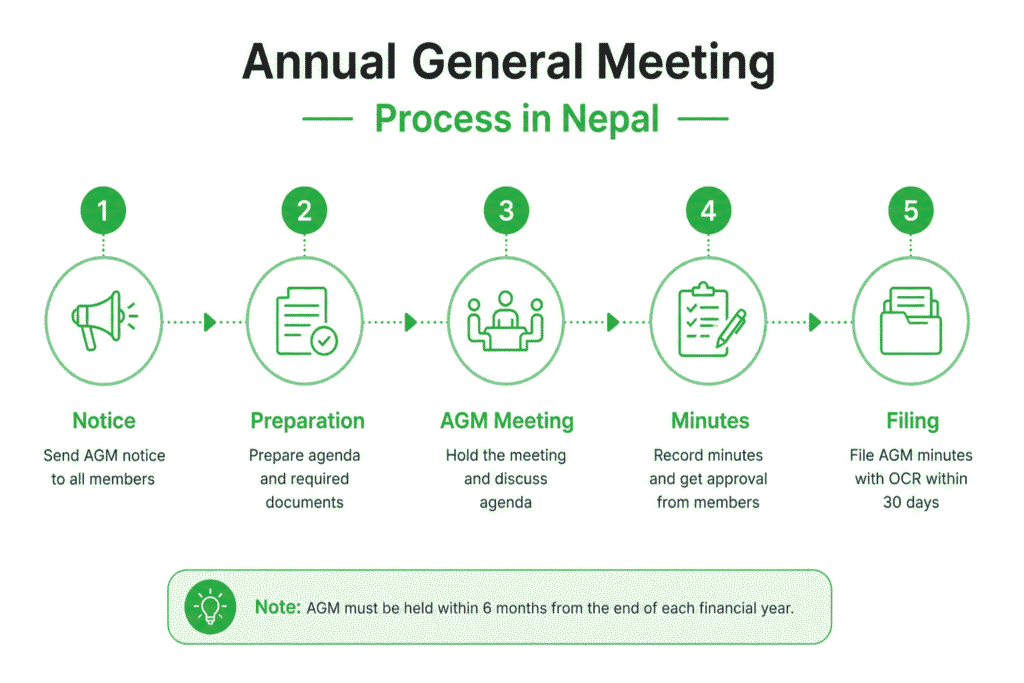
The Annual General Meeting Process in Nepal is a mandatory legal requirement for companies registered under the Companies Act, 2063 (2006). Every company incorporated in Nepal must hold an Annual General Meeting within a specific timeframe to remain legally compliant. The AGM process in Nepal involves shareholders, the Board of Directors, and regulatory bodies such as the Office of the Company Registrar (OCR). This article explains the complete AGM process in Nepal, its legal provisions, required documents, timelines, and penalties for non-compliance.
What is an Annual General Meeting (AGM) in Nepal?
An Annual General Meeting in Nepal is a formal assembly of shareholders and directors of a company held once every fiscal year. The meeting allows shareholders to review the company’s financial performance, approve audited financial statements, appoint auditors, and make key decisions regarding the company’s future.
Under Section 68 of the Companies Act, 2063 (2006), every company registered in Nepal is legally required to hold an AGM within six months from the end of the fiscal year. Nepal follows the Nepali fiscal year, which runs from Shrawan 1 to Ashadh end (mid-July to mid-July). Therefore, most companies must hold their AGM by Poush end (mid-January) of the following year.
The AGM in Nepal is governed primarily by:
- Companies Act, 2063 (2006) — Sections 68 to 83
- Securities Act, 2063 (2007) — For publicly listed companies
- Nepal Rastra Bank Act — For banking and financial institutions
- Insurance Act, 2049 (1992) — For insurance companies
- Cooperative Act, 2074 (2017) — For cooperatives
Who is Required to Hold an AGM in Nepal?
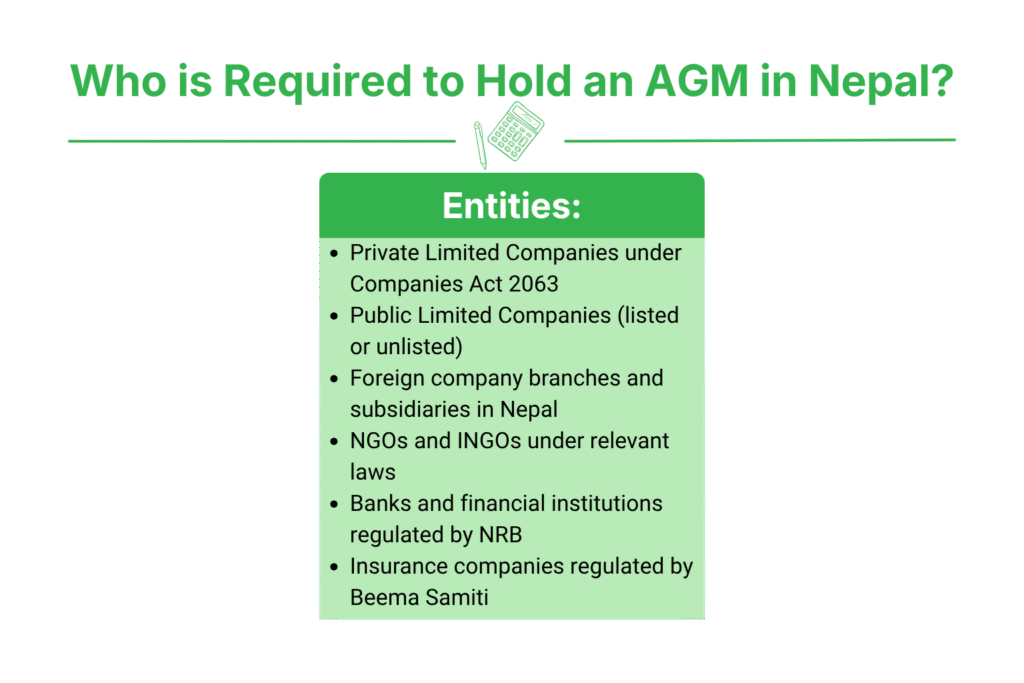
The requirement to hold an Annual General Meeting in Nepal applies to different categories of companies:
- Private Limited Companies (Pvt. Ltd.) registered under the Companies Act, 2063
- Public Limited Companies (Ltd.) listed or unlisted on the Nepal Stock Exchange (NEPSE)
- Branch offices and subsidiary companies of foreign companies operating in Nepal
- Non-Profit Organizations (NGOs/INGOs) as per their respective registration laws
- Banks and Financial Institutions (BFIs) regulated by Nepal Rastra Bank
- Insurance Companies regulated by the Insurance Board of Nepal (Beema Samiti)
Legal Timeline for Holding AGM in Nepal
Under the Companies Act, 2063, Section 68, the following timelines apply to AGM in Nepal:
| Company Type | AGM Deadline | Legal Reference |
|---|---|---|
| Private Limited Company | Within 6 months of fiscal year end | Companies Act, 2063, Section 68 |
| Public Limited Company | Within 6 months of fiscal year end | Companies Act, 2063, Section 68 |
| Banks and Financial Institutions | Within 6 months (NRB directives apply) | Bank and Financial Institutions Act, 2073 |
| Insurance Companies | As per Insurance Board directives | Insurance Act, 2049 |
| Listed Public Companies | Within 6 months (SEBON directives apply) | Securities Act, 2063 |
For the first Annual General Meeting, a newly incorporated company must hold its AGM within 15 months of its incorporation date, as provided under Section 68(2) of the Companies Act, 2063.
AGM Notice Requirements Under the Companies Act, 2063
Before holding an AGM in Nepal, the company must issue a formal notice to all shareholders. Section 69 of the Companies Act, 2063 governs the notice requirements for the Annual General Meeting.
Minimum Notice Period
- Private Limited Companies: A minimum of 15 days notice must be given before the AGM date.
- Public Limited Companies: A minimum of 21 days notice must be given.
- The notice must be sent to all registered shareholders, directors, and auditors.
Contents of AGM Notice in Nepal
The AGM notice must include the following information:
- Full name and registered address of the company
- Date, time, and venue of the Annual General Meeting
- Detailed agenda of the AGM
- Proxy appointment information (if allowed)
- Copies of audited financial statements (for public companies)
- Any special business or resolution to be discussed
- Information on the right of shareholders to attend and vote
For publicly listed companies, the AGM notice must also be published in at least one national newspaper and submitted to the Securities Board of Nepal (SEBON) and Nepal Stock Exchange (NEPSE).
Standard Agenda of an Annual General Meeting in Nepal
The agenda of an AGM in Nepal typically includes the following items as prescribed under the Companies Act, 2063:
- Reading and approval of the Minutes of the previous AGM
- Presentation and approval of the Annual Report by the Board of Directors
- Presentation and approval of audited financial statements, Balance Sheet, Profit and Loss Account
- Declaration of dividends (if any) from profits
- Appointment or re-appointment of Directors as per the Articles of Association
- Appointment of Auditors for the upcoming fiscal year and fixing their remuneration
- Approval of Directors’ remuneration for the year
- Approval of special resolutions (if any) such as capital increase, merger, or amendment of Memorandum/Articles of Association
- Any other business with the permission of the chairperson
Step-by-Step Process of Conducting an AGM in Nepal
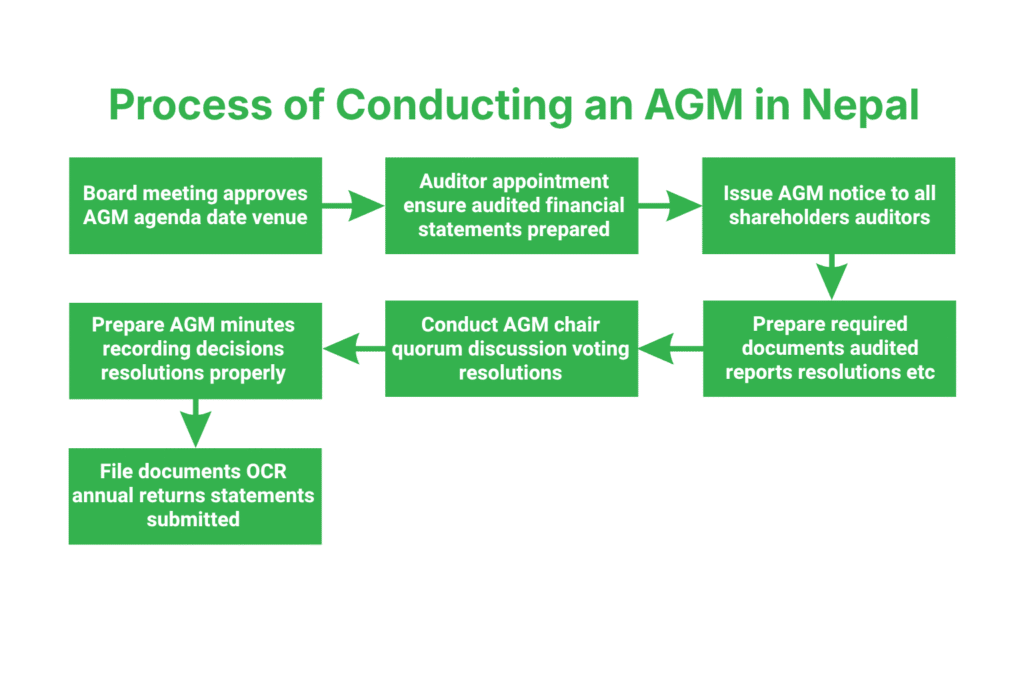
The Annual General Meeting process in Nepal follows a structured legal procedure. Below are the steps involved:
Step 1: Board of Directors Meeting
- The Board of Directors must pass a resolution to call an AGM.
- The Board approves the agenda, date, time, and venue.
- The Board reviews and approves the audited financial statements before presenting them to shareholders.
Step 2: Appointment of Auditor for Report
- If not already appointed, the company must ensure the audited financial statements are prepared by a registered auditor (member of (ICAN Institute of Chartered Accountants of Nepal).
Step 3: Issue AGM Notice
- Send the formal AGM notice to all shareholders, directors, and auditors.
- Observe the mandatory notice period (15 days for private, 21 days for public companies).
- For public companies, publish the notice in a national newspaper.
Step 4: Preparation of Documents
- Compile all required documents including audited reports, director reports, and resolutions.
Step 5: Conduct the AGM
- The Chairperson or Managing Director chairs the meeting.
- Quorum must be met as prescribed under Section 72 of the Companies Act, 2063.
- For private limited companies, the quorum is at least two shareholders or their proxies.
- For public limited companies, the quorum is five shareholders or one-third of total shareholders, whichever is less.
- Agenda items are discussed, voted upon, and resolutions are passed.
Step 6: Preparation of AGM Minutes
- The Company Secretary prepares detailed minutes of the meeting.
- Minutes must record all resolutions passed, votes cast, and decisions made.
- Minutes must be signed by the Chairperson.
Step 7: Filing with the Office of the Company Registrar (OCR)
- After the AGM, the company must file required documents with the Office of the Company Registrar (OCR) within the stipulated timeframe.
- This includes submission of audited financial statements, AGM minutes, and annual returns.
Documents Required for AGM Filing in Nepal
After completing the Annual General Meeting, companies must submit the following documents to the OCR Nepal:
- Certified copy of AGM Minutes
- Audited Financial Statements (Balance Sheet, Profit & Loss Account, Cash Flow Statement)
- Annual Report of the Board of Directors
- Auditor’s Report issued by a registered ICAN member
- Updated shareholder register
- Details of Directors (any changes in directorship)
- Annual Return Form (as prescribed by OCR)
- Tax Clearance Certificate from the Inland Revenue Department (IRD)
- Dividend declaration details (if applicable)
Post-AGM Compliance and Filing with OCR Nepal
After the Annual General Meeting is conducted, companies must complete the following compliance tasks:
Annual Return Filing
Under Section 80 of the Companies Act, 2063, every company must file an Annual Return with the OCR within three months of holding the AGM. The annual return must include details of the company’s share capital, shareholders, directors, and financial summary.
You can access the OCR filing portal at ocr.gov.np.
Tax Filing Compliance
Companies must also ensure that annual financial statements are filed with the Inland Revenue Department (IRD) at ird.gov.np for tax assessment purposes.
SEBON Compliance for Listed Companies
Publicly listed companies must submit AGM results, financial disclosures, and dividend declarations to the Securities Board of Nepal (SEBON) at sebon.gov.np and NEPSE within the prescribed deadline.
Penalties for Not Holding AGM in Nepal
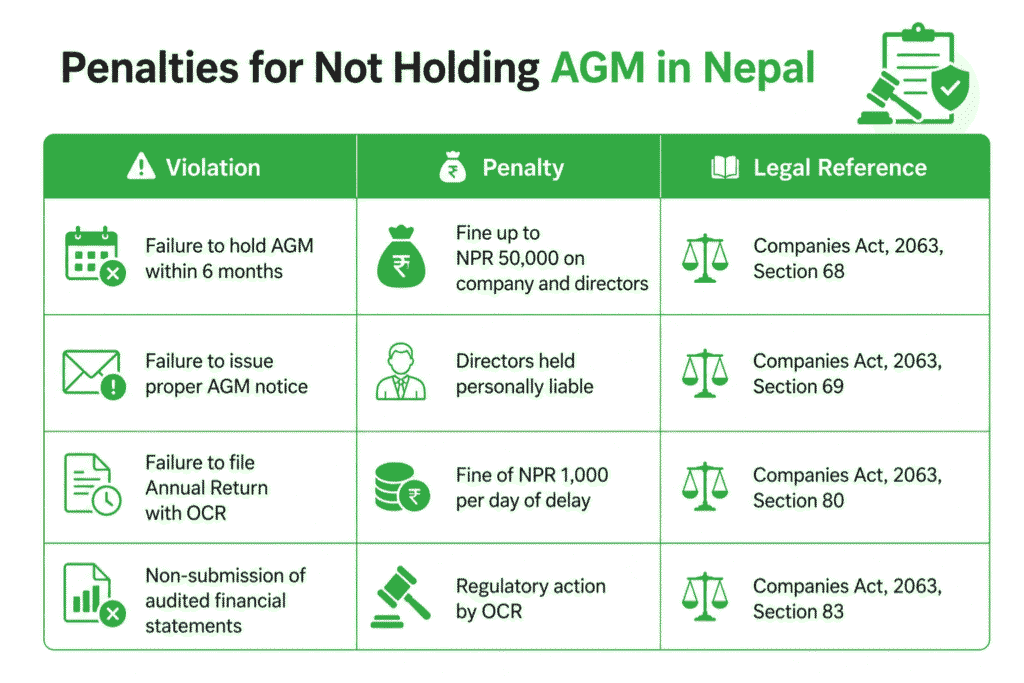
Failure to hold the Annual General Meeting within the prescribed time or failure to comply with AGM requirements in Nepal attracts legal penalties.
| Violation | Penalty | Legal Reference |
|---|---|---|
| Failure to hold AGM within 6 months | Fine up to NPR 50,000 on company and directors | Companies Act, 2063, Section 68 |
| Failure to issue proper AGM notice | Directors held personally liable | Companies Act, 2063, Section 69 |
| Failure to file Annual Return with OCR | Fine of NPR 1,000 per day of delay | Companies Act, 2063, Section 80 |
| Non-submission of audited financial statements | Regulatory action by OCR | Companies Act, 2063, Section 83 |
Under Section 159 of the Companies Act, 2063, persistent non-compliance can result in the deregistration of the company by the OCR.
FAQs
1. What is the legal deadline for holding an AGM in Nepal?
Under Section 68 of the Companies Act, 2063, companies in Nepal must hold their Annual General Meeting within six months from the end of the fiscal year, which means by Poush end (mid-January) for most companies.
2. What is the minimum notice period for AGM in Nepal?
Under Section 69 of the Companies Act, 2063, private limited companies must give a minimum of 15 days notice, while public limited companies must give a minimum of 21 days notice before the AGM date to all shareholders and directors.
3. Can a shareholder attend AGM through a proxy in Nepal?
Yes, under Section 71 of the Companies Act, 2063, a shareholder who cannot attend the AGM personally can appoint a proxy in writing to attend and vote on their behalf at the Annual General Meeting.
4. What quorum is required for AGM in Nepal?
For private limited companies, the quorum is at least two shareholders. For public limited companies, the quorum is five shareholders or one-third of total shareholders, whichever is less, under Section 72 of the Companies Act, 2063.
5. Where do companies file AGM documents in Nepal?
Companies in Nepal must file AGM-related documents including the Annual Return, audited financial statements, and AGM minutes with the Office of the Company Registrar (OCR) at ocr.gov.np within three months after the AGM.
6. What happens if a company fails to hold AGM in Nepal?
If a company fails to hold its Annual General Meeting within the prescribed deadline, the directors and the company face fines up to NPR 50,000 under Section 68 of the Companies Act, 2063, and continued non-compliance may lead to deregistration by the OCR.
Conclusion
The Annual General Meeting process in Nepal is a legally mandated obligation under the Companies Act, 2063. Every company whether private, public, or a financial institution must conduct the AGM within six months of the fiscal year end, issue proper notices, maintain quorum, pass required resolutions, and file all documents with the Office of the Company Registrar (OCR). Compliance with the AGM process protects the rights of shareholders, ensures corporate governance, and keeps the company in good standing with regulatory authorities in Nepal.