
Every organization operating in Nepal whether a private company, NGO, bank, or manufacturing firm must have written workplace policies that comply with the Labor Act, 2074 (2017) and related regulations. A workplace policy drafting lawyer in Nepal helps businesses create legally sound, enforceable, and compliant workplace policies. Without proper legal guidance, employers risk disputes, penalties, and labor court proceedings.
What Is Workplace Policy Drafting?
Workplace policy drafting is the process of creating formal written documents that govern how an organization manages its employees, operations, conduct, and disciplinary procedures. These documents include employee handbooks, HR manuals, codes of conduct, leave policies, grievance procedures, and more.
In Nepal, workplace policies must align with the Labor Act, 2074, Labor Rules, 2075, Social Security Act, 2074, and Bonus Act, 2030. A workplace policy drafting lawyer in Nepal ensures that each document satisfies statutory requirements while also serving the employer’s operational needs.
Why Does Your Business Need a Workplace Policy Drafting Lawyer in Nepal?
Many employers in Nepal draft workplace policies using generic templates downloaded from the internet or copied from other companies. This practice creates serious legal risks.
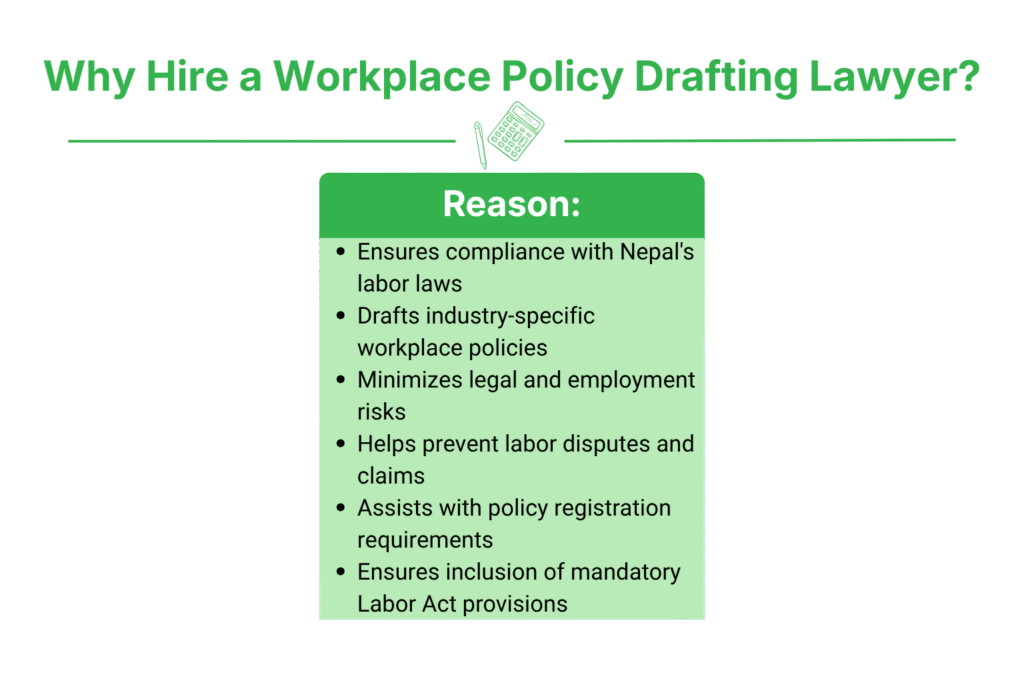
A qualified labor lawyer in Nepal specializing in workplace policy drafting:
- Ensures compliance with Nepal’s labor laws and regulations
- Tailors policies to the specific industry and size of the organization
- Protects employers from wrongful termination claims
- Reduces the risk of labor disputes and Labor Court proceedings
- Helps companies register their workplace regulations with the Department of Labour and Occupational Safety
- Advises on mandatory provisions under the Labor Act, 2074
Under Section 67 of the Labor Act, 2074, every establishment employing 10 or more workers must formulate workplace rules (Sthapana Niyamawali) and register them with the Department of Labour. Failure to comply can result in legal penalties.
Key Workplace Policies That Require Legal Drafting in Nepal
A workplace policy drafting lawyer in Nepal typically assists with the following documents:
1. Employment Contract and Appointment Letter
Under Section 6 of the Labor Act, 2074, every employer must provide a written employment contract to each employee. The contract must specify:
- Nature and duration of employment (regular, fixed-term, piece-rate, or casual)
- Remuneration and benefits
- Working hours and leave entitlements
- Terms of termination
2. Workplace Rules (Sthapana Niyamawali)
This is the primary internal governance document for any company. It must be registered with the Department of Labour and Occupational Safety under Rule 37 of the Labor Rules, 2075. It covers:
- Working hours
- Leave policies (annual, sick, maternity, paternity, mourning)
- Disciplinary procedures
- Promotion and demotion criteria
- Termination and resignation procedures
3. Code of Conduct
A code of conduct defines acceptable and unacceptable behavior in the workplace. A lawyer ensures this document aligns with the Labor Act, 2074 and does not violate employee rights or fundamental rights guaranteed under the Constitution of Nepal, 2072.
4. Sexual Harassment Policy
Under the Sexual Harassment at Workplace Prevention Act, 2071 (2015), every workplace must have a written policy on the prevention of sexual harassment and establish a complaint committee. A workplace policy drafting lawyer drafts this policy and structures the complaint resolution mechanism.
5. Grievance Handling Policy
The Labor Act, 2074 (Sections 83–86) mandates that employers establish an internal grievance handling procedure. This policy defines how employees can file complaints and the timelines for resolution.
6. Health and Safety Policy
Under Section 97 of the Labor Act, 2074 and the Occupational Safety and Health Regulations, employers must ensure a safe working environment. The health and safety policy outlines responsibilities, reporting procedures, and emergency protocols.
Mandatory Workplace Policies Under Nepal Law
| Policy / Document | Governing Law | Applicable To |
|---|---|---|
| Labor Act, 2074 | Section 6 | All employers |
| Workplace Rules (Sthapana Niyamawali) | Labor Act, 2074 – Section 67 | Establishments with 10+ workers |
| Sexual Harassment Prevention Policy | Sexual Harassment at Workplace Prevention Act, 2071 | All workplaces |
| Grievance Handling Procedure | Labor Act, 2074 – Sections 83–86 | All employers |
| Health and Safety Policy | Labor Act, 2074 – Section 97 | All establishments |
| Social Security Enrollment Policy | Contribution Based Social Security Act, 2074 | All formal employers |
What Does a Workplace Policy Drafting Lawyer in Nepal Do?
A labor lawyer in Nepal engaged for workplace policy drafting performs the following tasks:
- Legal audit: Reviews existing policies and identifies gaps or non-compliance with current law
- Drafting: Prepares new policy documents from scratch based on the organization’s structure
- Translation: Drafts bilingual policies in both Nepali and English as required
- Registration assistance: Files workplace rules with the Department of Labour and Occupational Safety
- Negotiation support: Assists in presenting policies to trade unions under the Trade Union Act, 2049
- Training: Educates HR teams on implementing and enforcing policies legally
- Revision: Updates existing policies when laws change
The Process of Workplace Policy Drafting in Nepal
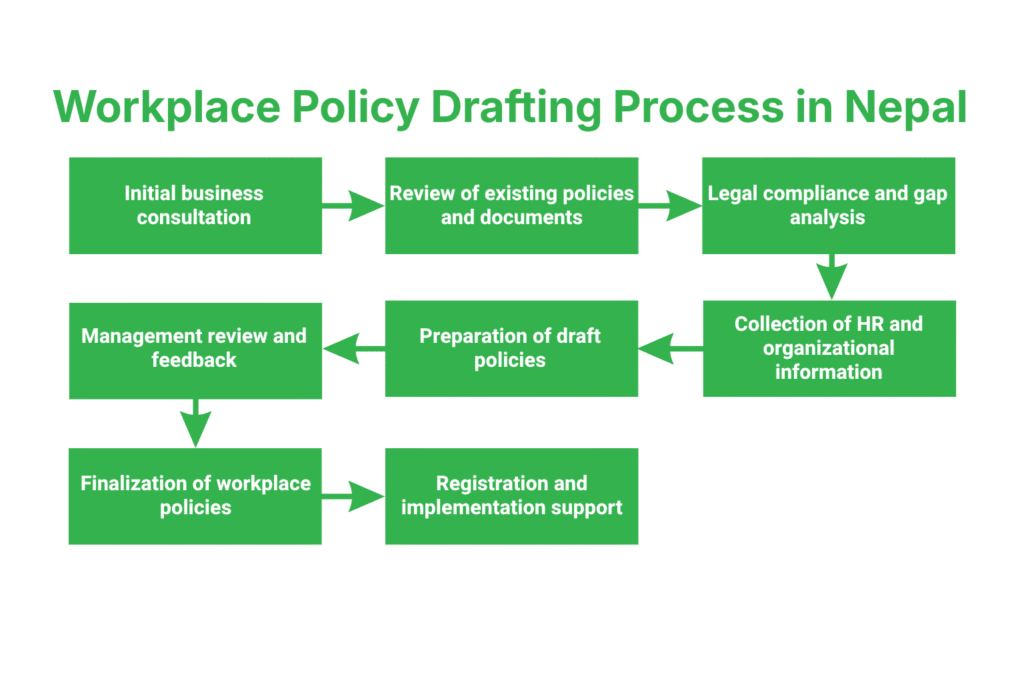
The typical process followed by a workplace policy drafting lawyer in Nepal is:
- Initial consultation – Understanding the business structure, number of employees, and industry
- Legal gap analysis – Reviewing existing documents against current labor laws
- Information gathering – Collecting HR data, organizational hierarchy, and operational requirements
- First draft preparation – Preparing initial draft policies in Nepali or English
- Client review – Sharing drafts with management for review and feedback
- Finalization – Incorporating feedback and finalizing the documents
- Registration – Filing workplace rules with the Department of Labour and Occupational Safety (for establishments employing 10 or more workers)
- Implementation support – Helping management communicate and implement the policies
Key Laws That Govern Workplace Policy in Nepal
A workplace policy drafting lawyer in Nepal must have in-depth knowledge of the following statutes:
- Labor Act, 2074 (2017) – The primary law governing employment relations, working conditions, termination, and labor rights
- Labor Rules, 2075 (2018) – Regulations implementing the Labor Act
- Social Security Act, 2074 (2017) – Governs employee contribution to social security funds
- Trade Union Act, 2049 (1992) – Regulates formation and activities of trade unions
- Bonus Act, 2030 (1974) – Mandates profit-sharing bonuses for eligible employees
- Sexual Harassment at Workplace Prevention Act, 2071 (2015) – Requires written prevention policies
- Constitution of Nepal, 2072 (2015) – Guarantees fundamental labor rights under Articles 34 and 35
- Child Labor (Prohibition and Regularization) Act, 2056 (2000) – Prohibits employment of children under 14
Types of Leave Policies Required Under Labor Act, 2074
| Leave Type | Entitlement | Section Reference |
|---|---|---|
| Annual Leave | 1 day per 20 working days | Section 53 |
| Sick Leave | 12 days per year (with pay) | Section 54 |
| Maternity Leave | 98 days (60 days with full pay) | Section 55 |
| Paternity Leave | 15 days | Section 55A |
| Mourning Leave | 13 days | Section 57 |
| Public Holidays | As per Government Gazette | Section 52 |
How to Find a Qualified Workplace Policy Drafting Lawyer in Nepal
When selecting a workplace policy lawyer in Nepal, consider the following criteria:
- Bar Council registration – The lawyer must be enrolled with the Nepal Bar Association
- Specialization in labor and employment law – General practice lawyers may lack deep knowledge of labor regulations
- Experience with companies similar to yours – Industry-specific experience matters
- Bilingual drafting capability – Workplace rules must be in Nepali for registration purposes
- Knowledge of recent amendments – The labor law landscape in Nepal has changed significantly since 2017
- Familiarity with the Department of Labour’s registration process
Common Mistakes in Workplace Policy Drafting Without Legal Help
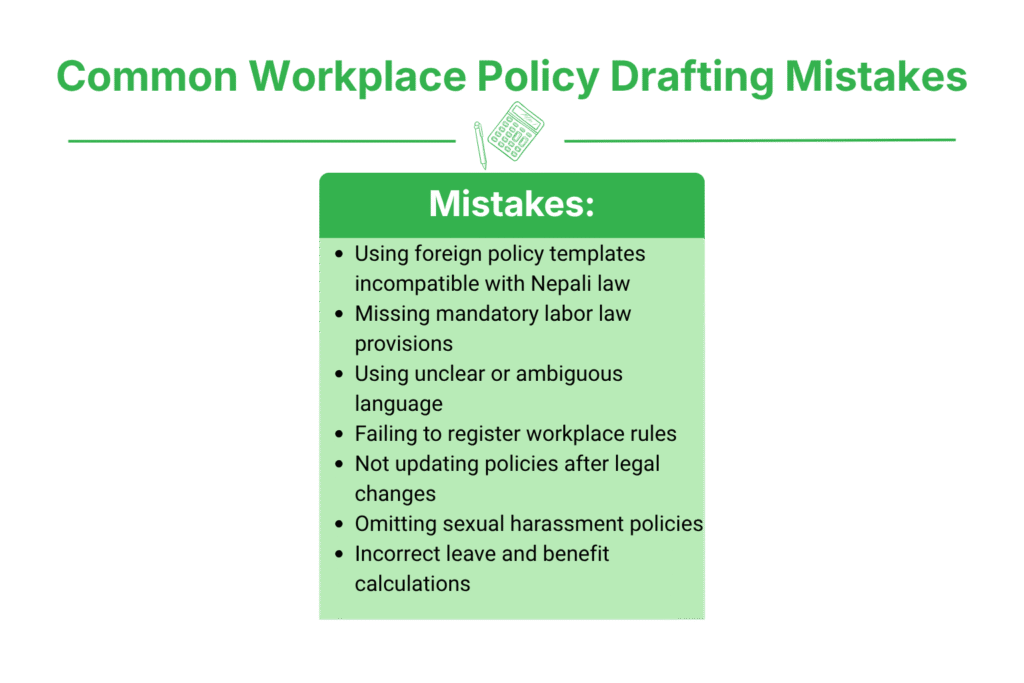
Employers who draft workplace policies without a qualified lawyer frequently make the following errors:
- Copying policies from foreign jurisdictions that conflict with Nepal’s Labor Act
- Omitting mandatory provisions such as grievance procedures and termination protocols
- Using vague language that creates disputes during interpretation
- Failing to register workplace rules with the Department of Labour
- Not updating policies after legislative amendments
- Excluding sexual harassment provisions despite legal requirements under the 2071 Act
- Incorrect leave calculations that violate the Labor Act, 2074
These mistakes can lead to complaints before the Labor Relations Committee, the Labor Court, or the Appellate Court.
Cost of Hiring a Workplace Policy Drafting Lawyer in Nepal
Legal fees for workplace policy drafting in Nepal vary based on:
- The size and complexity of the organization
- The number of documents required
- Whether registration assistance is included
- The lawyer’s experience and reputation
Generally, lawyers in Kathmandu charge between NPR 15,000 to NPR 1,00,000+ for a complete workplace policy drafting engagement. Some law firms offer packaged services covering drafting, registration, and implementation support.
FAQs
1. Is it mandatory to register workplace rules in Nepal?
Yes. Under Section 67 of the Labor Act, 2074, every establishment employing 10 or more workers must register workplace rules with the Department of Labour and Occupational Safety. Non-compliance may result in penalties.
2. Can workplace policies override the Labor Act, 2074?
No. Any provision in a workplace policy that provides less benefit than what the Labor Act, 2074 guarantees is legally void. Policies can provide more benefits, but cannot reduce statutory entitlements.
3. Does a small company with fewer than 10 employees need workplace policies?
Yes, even small employers must provide written employment contracts under Section 6 of the Labor Act, 2074. Formal workplace rules registration is, however, mandatory only for establishments with 10 or more workers.
4. What happens if an employer lacks a sexual harassment policy?
Under the Sexual Harassment at Workplace Prevention Act, 2071, employers without a formal prevention policy and complaint committee can face legal liability and penalties when complaints arise.
5. How often should workplace policies be updated?
Workplace policies should be reviewed and updated whenever a relevant law changes or at least every two years. Nepal’s labor law framework has evolved significantly since 2017 requiring regular policy updates.
6. Can an employee challenge workplace policies in Nepal?
Yes. Employees can challenge policies before the Labor Relations Committee or the Labor Court if policies violate the Labor Act, 2074 or infringe on constitutional rights guaranteed under the Constitution of Nepal, 2072.
Conclusion
A workplace policy drafting lawyer in Nepal plays a central role in helping businesses remain compliant with the Labor Act, 2074, the Social Security Act, 2074, and all related regulations. From drafting employment contracts and workplace rules to ensuring compliance with the Sexual Harassment at Workplace Prevention Act, 2071, a qualified labor lawyer in Nepal protects both employers and employees. Organizations of all sizes should engage experienced legal counsel to draft, register, and implement legally sound workplace policies rather than relying on generic templates that may not satisfy Nepal’s statutory requirements. Proper workplace policies reduce disputes, improve organizational governance, and build a more transparent and lawful work environment.