
A regulatory lawyer service in Nepal helps clients understand, follow, and respond to government regulations, licensing requirements, and compliance obligations. Businesses and individuals operating in Nepal face a wide range of legal obligations under various regulatory frameworks. Whether you operate a bank, a manufacturing unit, a pharmaceutical company, or a foreign-invested enterprise, regulatory legal services in Nepal are a fundamental part of conducting lawful business operations.
This article covers what regulatory lawyers do in Nepal, which laws govern regulatory practice, how to hire one, what services they provide, and answers to the most frequently asked questions.
What Is a Regulatory Lawyer?
A regulatory lawyer is a legal professional who specializes in laws and rules issued by government bodies, regulatory agencies, and ministries. In Nepal, regulatory lawyers advise clients on compliance with sector-specific laws, licensing norms, government approvals, dispute resolution with regulators, and enforcement proceedings.
Regulatory law in Nepal covers a broad range of sectors, including:
- Banking and Finance – governed by Nepal Rastra Bank (NRB)
- Securities and Capital Markets – governed by Securities Board of Nepal (SEBON)
- Insurance – governed by Beema Samiti (Insurance Board of Nepal)
- Telecommunications – governed by Nepal Telecommunications Authority (NTA)
- Energy and Electricity – governed by Electricity Regulatory Commission (ERC)
- Environment – governed by Ministry of Forests and Environment
- Food and Drug – governed by Department of Food Technology and Quality Control (DFTQC)
- Foreign Investment – governed by Investment Board Nepal (IBN) and Department of Industry
Regulatory lawyers in Nepal bridge the gap between clients and these regulatory bodies by providing legal advice, filing applications, drafting compliance documents, and representing clients in regulatory proceedings.
Legal Framework Governing Regulatory Practice in Nepal
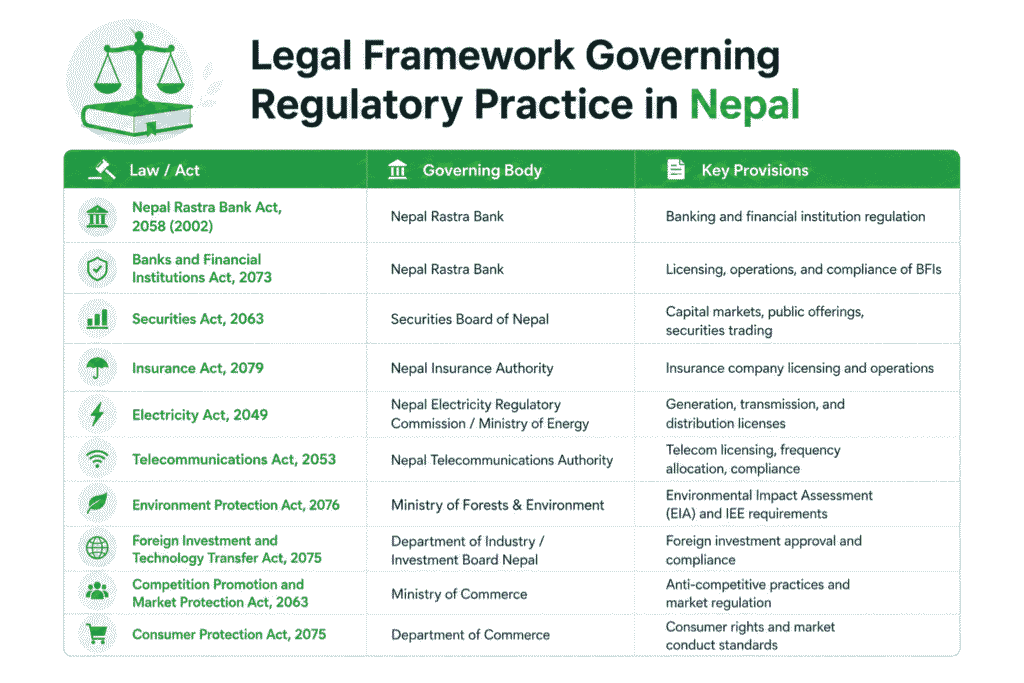
Nepal has enacted numerous laws that define the regulatory landscape. Regulatory lawyers in Nepal work extensively with the following legislation:
| Law / Act | Governing Body | Key Provisions |
|---|---|---|
| Nepal Rastra Bank Act, 2058 (2002) | Nepal Rastra Bank | Banking and financial institution regulation |
| Banks and Financial Institutions Act, 2073 | Nepal Rastra Bank | Licensing, operations, and compliance of BFIs |
| Securities Act, 2063 | Securities Board of Nepal | Capital markets, public offerings, securities trading |
| Insurance Act, 2079 | Nepal Insurance Authority | Insurance company licensing and operations |
| Electricity Act, 2049 | Nepal Electricity Regulatory Commission / Ministry of Energy | Generation, transmission, and distribution licenses |
| Telecommunications Act, 2053 | Nepal Telecommunications Authority | Telecom licensing, frequency allocation, compliance |
| Environment Protection Act, 2076 | Ministry of Forests & Environment | Environmental Impact Assessment (EIA) and IEE requirements |
| Foreign Investment and Technology Transfer Act, 2075 | Department of Industry / Investment Board Nepal | Foreign investment approval and compliance |
| Competition Promotion and Market Protection Act, 2063 | Ministry of Commerce | Anti-competitive practices and market regulation |
| Consumer Protection Act, 2075 | Department of Commerce | Consumer rights and market conduct standards |
These laws form the backbone of regulatory legal practice in Nepal. A skilled regulatory compliance lawyer in Nepal must be thoroughly versed in all applicable statutes and secondary regulations.
What Services Do Regulatory Lawyers in Nepal Provide?
Regulatory law firms and individual regulatory attorneys in Nepal offer a comprehensive range of services to corporate clients, foreign investors, NGOs, financial institutions, and individuals.
1. Regulatory Licensing and Approvals
Obtaining a license from a government body in Nepal requires preparation of detailed applications, submission of financial records, compliance declarations, and sometimes environmental or technical assessments.
Steps in Regulatory Licensing:
- Identify the applicable regulatory authority for your business sector
- Review statutory requirements and eligibility conditions
- Prepare all required documents as per regulatory norms
- Draft and file the license application with the relevant authority
- Respond to queries or notices issued by the regulatory body
- Obtain the license and ensure ongoing compliance with license conditions
Regulatory lawyers in Nepal manage this entire process, reducing the risk of rejection or delay.
2. Regulatory Compliance Advisory
Regulatory compliance in Nepal is an ongoing obligation. Regulatory agencies issue circulars, directives, and guidelines that companies must follow. A regulatory compliance lawyer in Nepal monitors these developments and advises clients on how to adjust their operations accordingly.
For example, Nepal Rastra Bank regularly issues unified directives (Ekikrit Nirdeshan) that banks and financial institutions must comply with on a rolling basis. Similarly, SEBON issues regulations governing mutual funds, broker conduct, and listed company disclosures.
3. Environmental Regulatory Compliance
The Environment Protection Act, 2076 and Environment Protection Rules, 2077 require businesses in certain sectors to conduct an Initial Environmental Examination (IEE) or an Environmental Impact Assessment (EIA) before commencing operations.
Documents Required for EIA/IEE Compliance:
- Project description and feasibility report
- Baseline environmental data
- Assessment of environmental impacts
- Mitigation measures and environmental management plan
- Public consultation records
- Approval from Ministry of Forests and Environment or designated authority
Regulatory lawyers coordinate with environmental consultants and government offices to obtain these mandatory approvals.
4. Foreign Investment Regulatory Services
Under the Foreign Investment and Technology Transfer Act, 2075 (FITTA 2075), foreign investors must obtain approval from the Department of Industry or Investment Board Nepal, depending on the investment amount and sector.
Regulatory lawyers assist foreign investors with:
- Filing foreign investment applications
- Obtaining approval under FITTA 2075
- Complying with repatriation conditions under Nepal Rastra Bank regulations
- Technology Transfer Agreement (TTA) registration
- Ensuring sector-wise compliance (restricted vs. open sectors)
Sectors restricted or prohibited for foreign investment are listed in the Negative List issued by the Government of Nepal under FITTA 2075.
5. Representation Before Regulatory Authorities
When a regulatory agency issues a show-cause notice, initiates an inquiry, or imposes a penalty, a regulatory lawyer represents the client before the authority. This includes:
- Drafting and filing replies to show-cause notices
- Attending hearings before regulatory commissions or boards
- Filing appeals under the applicable statutes
- Negotiating settlements or consent orders with the regulator
Under the Securities Act, 2063, SEBON has the power to suspend or cancel licenses, impose fines, and initiate legal action. Regulatory lawyers defend clients in such proceedings.
6. Drafting Regulatory Compliance Documents
Regulatory lawyers in Nepal draft various compliance-related documents, including:
- Internal compliance policies
- Anti-money laundering (AML) and Know Your Customer (KYC) programs
- Data protection and privacy policies
- Environmental management plans
- License renewal applications
- Annual compliance reports for submission to regulators
7. Sector-Specific Regulatory Advisory
| Sector | Key Regulatory Issues | Applicable Law |
|---|---|---|
| Banking & Finance | Capital adequacy, KYC, AML, liquidity ratio | Banks and Financial Institutions Act, 2073 |
| Telecommunications | Spectrum licensing, tariff regulation | Telecommunications Act, 2053 |
| Pharmaceuticals | Drug registration, import approval, labeling norms | Drug Act, 2035 |
| Energy | Generation license, power purchase agreements | Electricity Act, 2049 |
| Media & Broadcasting | Broadcasting license, content regulation | National Broadcasting Act, 2049 |
| Insurance | Solvency margin, product filing, reinsurance norms | Insurance Act, 2079 |
How to Choose a Regulatory Lawyer in Nepal
Choosing the right regulatory lawyer in Nepal depends on several factors:
- Specialization: Confirm the lawyer has direct experience in your specific regulatory sector (banking, energy, telecom, environment, etc.)
- Bar Council Enrollment: The lawyer must be enrolled with the Nepal Bar Council under the Nepal Bar Council Act, 2050. Verify their license at Nepal Bar Council
- Track Record: Review whether the lawyer has previously handled regulatory matters before NRB, SEBON, ERC, or other relevant bodies
- Communication: The lawyer should communicate clearly about timelines, procedures, fees, and risks
- Location: Regulatory matters often require in-person appearances in Kathmandu, where most regulatory offices are headquartered
Regulatory Lawyer Fees in Nepal
Regulatory lawyer fees in Nepal vary depending on the complexity of the matter, the regulatory body involved, and the scope of services required.
General Fee Structure:
- Consultation Fee: NPR 2,000 to NPR 10,000 per session
- License Application Assistance: NPR 30,000 to NPR 2,00,000+
- EIA/IEE Compliance: NPR 50,000 to NPR 5,00,000+ depending on project size
- Regulatory Dispute Representation: NPR 50,000 to NPR 5,00,000+
- Retainer-Based Advisory: NPR 25,000 to NPR 1,50,000 per month
These are approximate figures and vary based on the firm, experience of the lawyer, and specific regulatory requirements.
Role of Nepal Bar Council in Regulating Legal Practitioners
The Nepal Bar Council Act, 2050 establishes the Nepal Bar Council as the apex body for regulating lawyers in Nepal. All lawyers, including regulatory lawyers, must hold a valid license issued by the Nepal Bar Council to practice law. The Bar Council also sets ethical standards and handles complaints against lawyers.
Any person or entity seeking regulatory legal services in Nepal should verify that their chosen lawyer holds a current Nepal Bar Council license.
Common Regulatory Challenges Businesses Face in Nepal
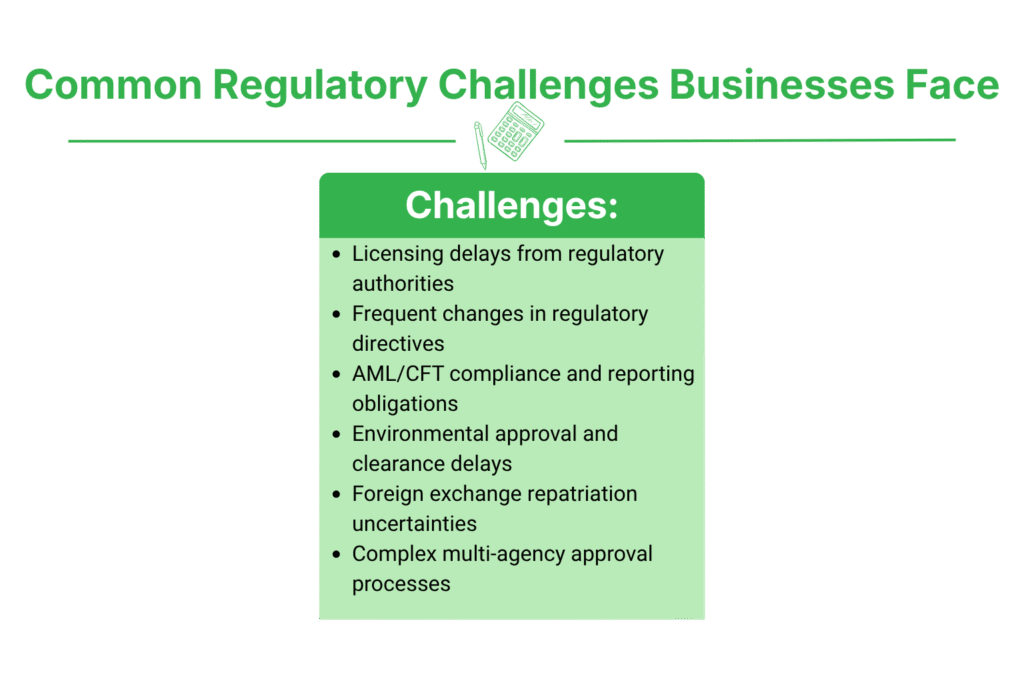
Businesses in Nepal frequently encounter the following regulatory challenges:
- Delays in obtaining licenses from sector-specific regulators
- Frequent amendments to NRB, SEBON, and other regulatory directives
- Compliance gaps in AML/CFT regulations under the Asset (Money) Laundering Prevention Act, 2064
- Environmental clearance delays for hydropower and infrastructure projects
- Uncertainty in foreign exchange repatriation rules for foreign investors
- Complex multi-agency approval requirements for large projects
Regulatory lawyers in Nepal help businesses address these challenges systematically through proactive legal compliance strategies.
FAQs
1. What does a regulatory lawyer do in Nepal?
A regulatory lawyer in Nepal advises clients on government regulations, obtains licenses, ensures compliance with sector-specific laws, drafts regulatory documents, and represents clients before regulatory authorities such as NRB, SEBON, ERC, and Beema Samiti.
2. Is it mandatory to hire a regulatory lawyer for business licensing in Nepal?
It is not always legally mandatory, but highly advisable. Complex licensing procedures under laws like the Banks and Financial Institutions Act, 2073 or FITTA 2075 require detailed legal knowledge that a qualified regulatory compliance lawyer in Nepal can provide.
3. Which regulatory bodies does a regulatory lawyer in Nepal commonly deal with?
Regulatory lawyers in Nepal commonly appear before Nepal Rastra Bank (NRB), SEBON, Beema Samiti, Nepal Telecommunications Authority (NTA), Electricity Regulatory Commission (ERC), Department of Industry, and the Ministry of Forests and Environment.
4. How long does regulatory licensing take in Nepal?
Timelines vary by sector and regulatory body. Banking licenses can take 6–18 months. Environmental clearances depend on whether an IEE or EIA is required. A regulatory lawyer tracks and expedites these processes through proper filing and follow-up.
5. Can a foreign company hire a regulatory lawyer in Nepal for investment compliance?
Yes. Foreign companies investing in Nepal under FITTA 2075 can and should engage a regulatory lawyer in Nepal for investment approval, sector compliance, technology transfer agreement registration, and ongoing regulatory advisory services.
6. What is the Nepal Bar Council’s role in regulatory legal services?
The Nepal Bar Council, established under the Nepal Bar Council Act, 2050, licenses and regulates all legal practitioners in Nepal. A regulatory lawyer must hold a valid Nepal Bar Council license to legally represent clients before regulatory bodies and courts.
Conclusion
Regulatory legal services in Nepal cover a wide spectrum of government regulations, compliance obligations, licensing requirements, and enforcement proceedings across banking, finance, energy, telecommunications, environment, insurance, and foreign investment sectors. A qualified regulatory lawyer in Nepal provides the legal expertise required to operate within the regulatory framework established by Nepal’s statutes and regulatory bodies. Businesses and individuals should seek lawyers enrolled with the Nepal Bar Council who have demonstrated experience in the relevant regulatory sector. Proactive regulatory compliance is the most effective way to avoid penalties, license cancellations, and legal disputes with government authorities in Nepal.