


India Nepal Business Setup Lawyer in Nepal plays a crucial role for foreign investors navigating the legal framework of establishing a business in Nepal, especially for Indian nationals and companies. Setting up a business in Nepal as an Indian national or Indian company involves a structured legal process governed by multiple Nepalese laws. This article covers all legal aspects, requirements, procedures, and common questions Indian investors ask when establishing a business presence in Nepal.
Why Indian Investors Choose Nepal for Business
Nepal and India share one of the most integrated bilateral economic relationships in South Asia. The two countries are connected by the Treaty of Peace and Friendship 1950, which grants Indian nationals rights similar to Nepali nationals in many commercial activities. This treaty significantly lowers barriers for Indian investors compared to investors from other foreign countries.
Indian investors enter Nepal for several reasons:
- Geographic proximity and open border between Nepal and India
- Access to Nepal’s hydropower, tourism, manufacturing, and agriculture sectors
- Preferential market access under bilateral trade agreements
- Lower labor costs compared to India
- Growing consumer market in Nepal
Despite these advantages, business setup in Nepal for Indian nationals still requires full compliance with Nepalese company law, foreign investment law, and sector-specific regulations. This is where an experienced business setup lawyer in Nepal becomes essential.
Legal Framework Governing India-Nepal Business Setup
Any Indian individual or Indian company seeking to establish a business in Nepal must operate within the following legal framework:
1. Foreign Investment and Technology Transfer Act (FITTA) 2019
The Foreign Investment and Technology Transfer Act 2019 is the primary law governing foreign investment in Nepal. It defines the types of permissible foreign investments, sectors open and closed to foreign investment, and the approval process. Indian investors are classified as foreign investors under FITTA 2019 unless they qualify for special treatment under the 1950 Treaty.
2. Industrial Enterprises Act 2020
The Industrial Enterprises Act 2020 governs registration of industries in Nepal. It classifies industries by size micro, cottage, small, medium, and large and sets the regulatory requirements for each category. Indian investors in manufacturing must comply with this Act.
3. Companies Act 2006
The Companies Act 2006 governs the formation, registration, management, and dissolution of companies in Nepal. All companies, including those with Indian investment, must register under this Act with the Office of the Company Registrar (OCR).
4. Foreign Exchange Regulation Act 2019
This Act governs foreign currency transactions, repatriation of profits, and capital transfers between Nepal and India. Indian investors must comply with its provisions when bringing capital into Nepal or repatriating dividends and profits.
5. Special Economic Zone Act 2016
Indian companies investing in Nepal’s Special Economic Zones (SEZs) receive additional incentives and are governed by the SEZ Act 2016 alongside FITTA.
What Does an India Nepal Business Setup Lawyer Do?
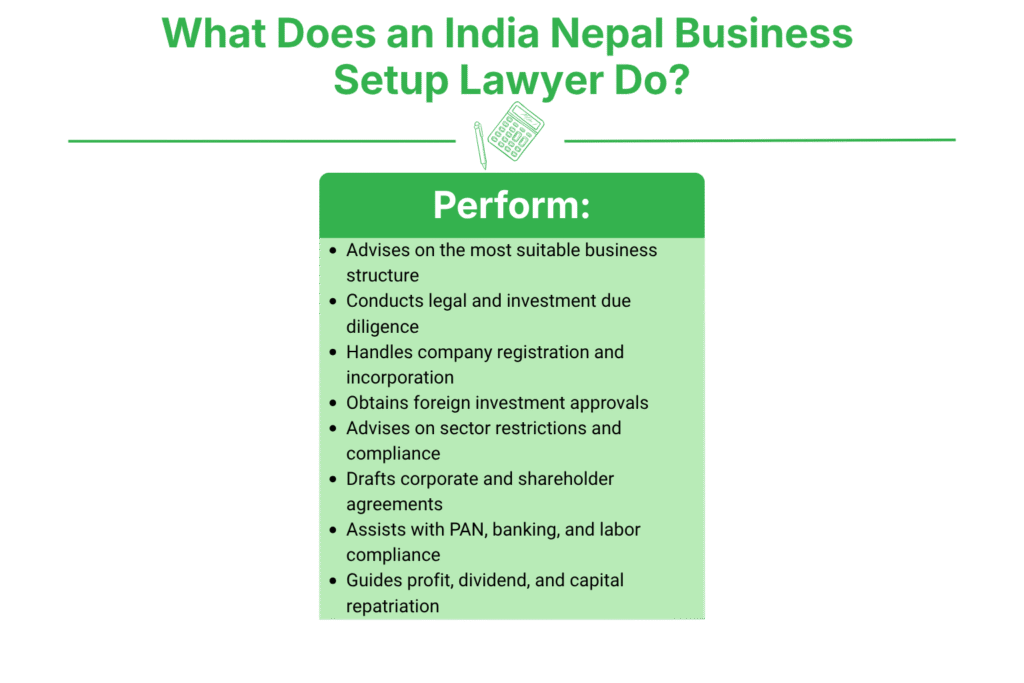
A business setup lawyer in Nepal working with Indian clients performs the following functions:
- Advises on the most suitable business structure (private limited company, public company, branch office, liaison office, or joint venture)
- Conducts legal due diligence on the sector and investment amount
- Prepares and files company registration documents with the Office of the Company Registrar
- Obtains foreign investment approval from the Department of Industry or Investment Board Nepal
- Advises on sector restrictions under Schedule 1 and Schedule 2 of FITTA 2019
- Drafts Memorandum of Association, Articles of Association, and shareholder agreements
- Assists with PAN registration, bank account opening, and labor compliance
- Advises on repatriation of profits, dividends, and capital under the Foreign Exchange Regulation Act
Business Structures Available for Indian Investors in Nepal
Indian investors can choose from several legal business structures in Nepal. The choice depends on the nature of the business, investment amount, and operational requirements.
| Business Structure | Description | Minimum Investment |
|---|---|---|
| Private Limited Company | Most common structure; limited liability for shareholders | NPR 1 Lakh (Small/Medium); USD 50,000+ for Foreign Invested Company |
| Public Limited Company | Suitable for large enterprises; can raise capital publicly | Varies by sector |
| Branch Office | Extension of Indian parent company in Nepal | As per Foreign Investment and Technology Transfer Act, 2075 norms |
| Liaison Office | Non-commercial presence for coordination purposes | No commercial activities allowed |
| Joint Venture | Partnership between Indian and Nepali entities | As agreed and approved |
A Nepal company registration lawyer will advise on which structure best suits the Indian investor’s long-term business goals.
Sectors Open and Restricted for Indian Investment in Nepal
Under FITTA 2019, most sectors are open to foreign investment. However, Schedule 1 lists sectors completely closed to foreign investment, and Schedule 2 lists sectors reserved for Nepali nationals or requiring special approval.
Sectors Closed to Foreign Investment (Schedule 1, FITTA 2019):
- Cottage and small-scale industries using local raw materials and traditional skills
- Personal service businesses (hair salons, tailor shops, driving schools)
- Arms and ammunition manufacturing
- Real estate business (excluding construction companies)
- Mass media and broadcasting
Sectors Open to Indian Investment (General):
- Hydropower generation, transmission, and distribution
- Manufacturing and export industries
- Tourism, hotel, and hospitality industry
- Information technology and software
- Education and health sectors (with specific approval)
- Infrastructure development
An India Nepal investment lawyer will verify whether the intended sector is open, restricted, or requires specific government approval before beginning the registration process.
Step-by-Step Process for India Nepal Business Registration
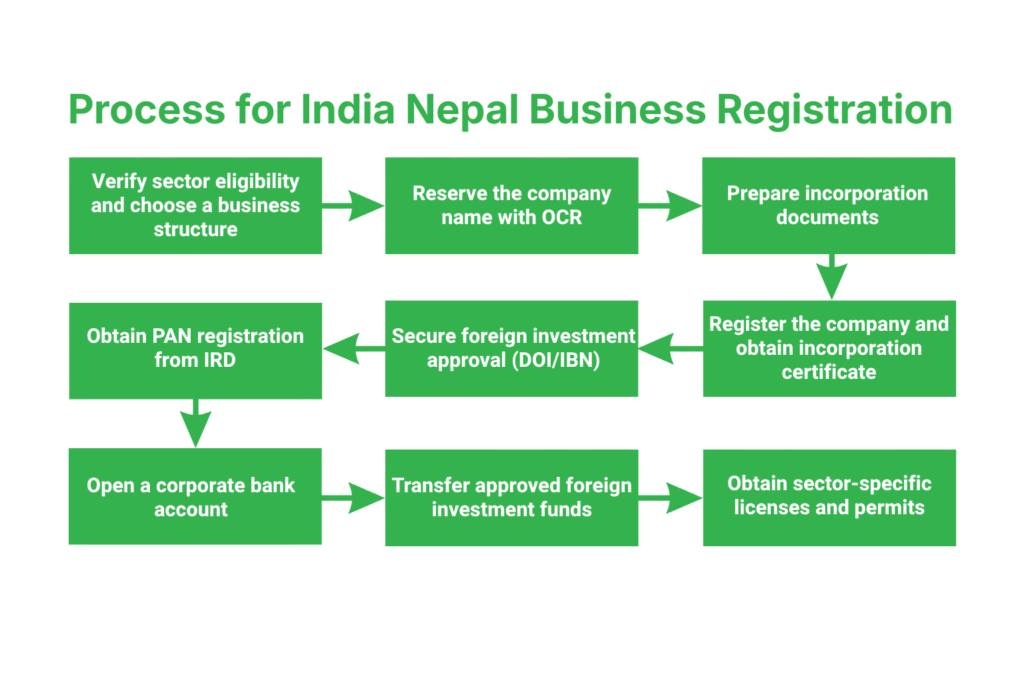
The process for an Indian investor to register a business in Nepal involves multiple stages and government departments.
Step 1: Determine Business Structure and Sector Eligibility
Consult with a qualified business setup lawyer in Nepal to confirm the sector is open under FITTA 2019 and determine the appropriate business structure.
Step 2: Name Reservation
Apply for company name reservation at the Office of the Company Registrar (OCR) through the OCR online portal.
Step 3: Prepare Incorporation Documents
Prepare Memorandum of Association, Articles of Association, and consent letters from directors and shareholders.
Step 4: Register the Company at OCR
Submit incorporation documents along with the required fee to the OCR. The OCR issues the Certificate of Incorporation upon verification.
Step 5: Obtain Foreign Investment Approval
- For investments below NPR 6 billion: Apply to the Department of Industry (DOI)
- For investments above NPR 6 billion: Apply to the Investment Board Nepal (IBN)
Step 6: Obtain PAN Registration
Register the company with the Inland Revenue Department (IRD) for a Permanent Account Number (PAN), which is mandatory for tax compliance.
Step 7: Open a Bank Account
Open a company bank account in Nepal to receive foreign investment funds.
Step 8: Bring Foreign Investment
Transfer the approved investment amount through banking channels as per Foreign Exchange Regulation Act 2019.
Step 9: Obtain Sector-Specific Licenses
Obtain any additional licenses required for the specific business (tourism license, manufacturing permit, etc.).
Documents Required for Indian Investors Registering a Business in Nepal
The following documents are required at various stages of the business setup process:
For Indian Individual Investors:
- Valid Indian Passport (notarized copy)
- Indian PAN Card
- Passport-size photographs
- Bank statements (last 6 months)
- Source of funds documentation
For Indian Company Investors:
- Certificate of Incorporation of Indian company
- Memorandum and Articles of Association of Indian company
- Board Resolution authorizing investment in Nepal
- Audited financial statements (last 2 years)
- Company PAN and GST registration documents
- Power of Attorney in favor of Nepal-based representative or lawyer
For Nepal Company Registration:
- Proposed company name (minimum 3 options)
- Memorandum of Association (MoA)
- Articles of Association (AoA)
- Consent letters from proposed directors
- Identity documents of all shareholders and directors
- Proof of registered office address in Nepal
Role of Investment Board Nepal and Department of Industry
Two government bodies oversee foreign investment approvals in Nepal.
| Authority | Investment Threshold | Contact |
|---|---|---|
| Department of Industry (DOI) | Below NPR 6 Billion | DOI Official Website |
| Investment Board Nepal (IBN) | NPR 6 Billion and above | IBN Official Website |
A Nepal foreign investment lawyer will prepare and file the complete application package with the relevant authority, respond to queries, and follow up on approval timelines.
Tax and Compliance Obligations for Indian-Owned Businesses in Nepal
After business setup, Indian investors must comply with Nepalese tax laws:
- Corporate Income Tax: 25% standard rate; 20% for special industries (manufacturing, tourism, hydropower)
- Dividend Tax: 5% withholding tax on dividends distributed to foreign shareholders
- VAT Registration: Mandatory if annual turnover exceeds NPR 5 million
- Annual Audit: All companies must submit annual audited financial statements to IRD and OCR
- Profit Repatriation: Allowed after payment of applicable taxes, subject to Foreign Exchange Regulation Act 2019
Why Hire a Dedicated India Nepal Business Setup Lawyer

Indian investors unfamiliar with Nepalese law face procedural, regulatory, and language barriers. A dedicated India Nepal business setup lawyer in Nepal provides:
- Legal opinion on investment viability and compliance
- Drafting of all legal documents in English and Nepali
- Liaison with OCR, DOI, IBN, IRD, and other government departments
- Representation in negotiations with Nepalese joint venture partners
- Ongoing legal advisory post-registration for compliance and dispute resolution
Law firms in Kathmandu with experience in India Nepal trade law handle both the technical legal requirements and the practical coordination necessary for smooth business setup.
FAQs
1. Can an Indian national set up a 100% owned company in Nepal?
Yes, an Indian national can set up a 100% foreign-owned company in Nepal in sectors open under FITTA 2019. However, certain sectors reserve a minimum percentage of equity for Nepali nationals. A business setup lawyer will confirm ownership limits for your specific sector.
2. What is the minimum investment required for an Indian to register a company in Nepal?
Under FITTA 2019, the minimum foreign investment threshold for a foreign-invested company is approximately USD 50,000 or its Nepalese Rupee equivalent. This applies to investments requiring foreign investment approval from the Department of Industry.
3. How long does it take to register a company in Nepal for Indian investors?
The standard company registration at OCR takes 3–7 working days. However, obtaining foreign investment approval from DOI or IBN may take 30–60 days depending on the sector and investment size.
4. Do Indian investors need a local Nepali partner to set up a business in Nepal?
Not in most sectors. Indian investors can own 100% equity in sectors open under FITTA 2019. A Nepali partner is required only in sectors listed in Schedule 2 of FITTA 2019 that mandate local equity participation.
5. Can an Indian company open a branch office in Nepal?
Yes, an Indian company can open a branch office in Nepal subject to foreign investment approval from the Department of Industry or Investment Board Nepal, depending on the investment size, and compliance with the Companies Act 2006.
6. What is the role of the 1950 India-Nepal Treaty in business setup?
The Treaty of Peace and Friendship 1950 grants Indian nationals reciprocal rights with Nepali nationals in certain commercial activities. However, this does not exempt Indian investors from compliance with FITTA 2019, the Companies Act 2006, and other applicable Nepalese laws.
Conclusion
Setting up a business in Nepal as an Indian investor is a well-structured legal process governed by FITTA 2019, the Companies Act 2006, the Industrial Enterprises Act 2020, and other applicable laws. An experienced India Nepal business setup lawyer in Nepal ensures full legal compliance at every stage from company incorporation and foreign investment approval to tax registration and ongoing compliance. Indian investors seeking to enter Nepal’s growing market should engage a qualified lawyer early in the process to avoid procedural delays and legal complications.