


Foreign investment in Nepal has grown steadily over the past decade, and Indian nationals represent one of the largest groups of foreign investors in Nepal. Indian shareholders seeking to register a company in Nepal must follow a specific legal process governed by multiple laws. This article covers every aspect of Indian shareholder company registration in Nepal, from applicable laws and eligible business sectors to required documents and step-by-step procedures.
What Is Indian Shareholder Company Registration in Nepal?
Indian shareholder company registration in Nepal refers to the process by which Indian nationals or Indian companies establish a business entity in Nepal by holding shares in that company. Since India and Nepal share an open border and a unique bilateral relationship, Indian investors enjoy certain privileges compared to other foreign nationals. However, they must still comply with Nepal’s foreign investment laws when registering a company.
An Indian shareholder can register a company in Nepal either as a wholly owned foreign company or as a joint venture company with a Nepali partner. The ownership structure, applicable sector, and minimum investment threshold determine the type of registration required.
What Laws Govern Indian Shareholder Company Registration in Nepal?
Several laws regulate foreign investment and company registration in Nepal. Indian shareholders must understand and comply with the following:
- Foreign Investment and Technology Transfer Act, 2019 (FITTA 2019) – The primary law governing all foreign investment activities in Nepal. It defines foreign investor, outlines permissible sectors, and sets conditions for repatriation of profits.
- Companies Act, 2006 (2063 BS) – Governs the incorporation and management of all companies in Nepal, including those with foreign shareholders.
- Industrial Enterprises Act, 2020 (2076 BS) – Regulates industrial enterprises and defines the categories of industries open to foreign investment.
- Foreign Exchange Regulation Act, 2019 – Controls the inflow and outflow of foreign currency, including Indian Rupees.
- Investment Board Act, 2011 – Applicable for large-scale investments routed through the Investment Board Nepal (IBN).
Under FITTA 2019, Section 2(b), a foreign investor is defined as a foreign individual, firm, company, or government that invests in Nepal. Indian nationals and Indian-incorporated companies fall within this definition.
Can Indian Nationals Register a Company Individually or Only in Joint Venture?
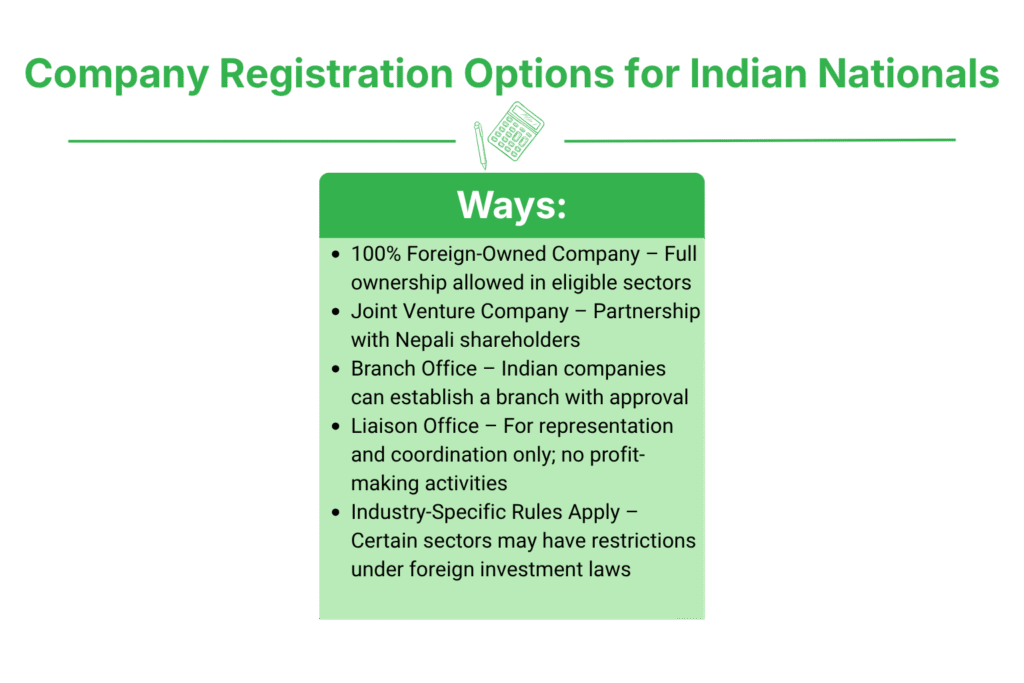
Indian nationals can register a company in Nepal in the following ways:
- 100% Foreign-Owned Company – Indian shareholders can own 100% equity in sectors open to full foreign ownership.
- Joint Venture Company – Indian shareholders partner with Nepali nationals, with shares distributed as agreed within legal limits.
- Branch Office – An Indian company can open a branch office in Nepal with prior approval.
- Liaison Office – Allowed for specific representation purposes, not for profit-generating activities.
The Industrial Enterprises Act, 2020 and FITTA 2019 together define which sectors permit 100% foreign ownership and which require mandatory Nepali equity participation.
What Are the Minimum Investment Requirements for Indian Shareholders?
Under FITTA 2019, foreign investors including Indian nationals must meet minimum investment thresholds. The thresholds are defined based on the nature of the investment:
| Investment Type | Minimum Investment Requirement |
|---|---|
| Foreign Investment in Services Sector | NPR 2 Crore (approx. USD 150,000) |
| Foreign Investment in Industries/Manufacturing | NPR 2 Crore (approx. USD 150,000) |
| Technology Transfer Only | No minimum capital requirement |
| Investment Board Nepal Projects | NPR 6 Billion or more |
These figures are subject to revision by the Government of Nepal. It is advisable to verify current thresholds from the Department of Industry, Nepal or the Investment Board Nepal.
Indian investors investing amounts above NPR 6 Billion must route their investment through Investment Board Nepal (IBN) under the Investment Board Act, 2011.
Which Sectors Are Open to Indian Shareholders for Investment in Nepal?
Nepal has a Negative List that prohibits foreign investment in certain sectors. Indian shareholders cannot invest in industries on this negative list. The negative list is specified under Schedule 1 of FITTA 2019 and includes:
- Cottage and small industries producing goods for domestic consumption
- Personal service businesses such as hair salons, tailoring, and similar trades
- Arms and ammunition manufacturing
- Currency and coin printing
- Real estate business (buying and selling of land)
- Retail trade
- Internal courier services
- Atomic energy
- Tourism businesses such as travel agencies, trekking agencies, and similar services below specified investment levels
- Poultry farming and fisheries below specified scales
- Consultancy services related to management, accounting, engineering below specified thresholds
Sectors open to Indian shareholders include:
- Manufacturing and processing industries
- Hydropower and energy
- Tourism (hotels, resorts above specified investment)
- Information technology and IT-enabled services
- Education and health services (with conditions)
- Infrastructure development
- Agriculture and agro-processing at a commercial scale
- Banking and finance (subject to Nepal Rastra Bank regulations)
What Is the Step-by-Step Process for Indian Shareholder Company Registration in Nepal?

The registration process involves multiple government agencies. Below is the complete step-by-step procedure:
Step 1: Obtain Foreign Investment Approval
- Indian shareholders must first obtain approval from the Department of Industry (DoI) under FITTA 2019.
- Submit a foreign investment application with required documents.
- DoI reviews the application and grants approval for foreign investment.
Step 2: Name Registration at the Office of Company Registrar
- Apply for company name registration at the Office of the Company Registrar (OCR).
- The name must not conflict with existing registered company names.
- OCR is accessible via www.ocr.gov.np.
Step 3: Prepare Memorandum of Association and Articles of Association
- Draft the Memorandum of Association (MOA) and Articles of Association (AOA) as per the Companies Act, 2006.
- MOA must state the company’s objectives, share capital, and shareholder details.
Step 4: Company Registration at OCR
- Submit all required documents to OCR.
- Pay the applicable registration fees.
- OCR issues the Certificate of Incorporation.
Step 5: Register at Department of Industry
- After incorporation, register the company as an industry at the Department of Industry.
- Obtain the Industry Registration Certificate.
Step 6: Bring in Foreign Investment (FDI Inflow)
- Transfer the investment amount through banking channels.
- Report the inflow to Nepal Rastra Bank for foreign exchange purposes.
Step 7: Tax Registration
- Register for Permanent Account Number (PAN) and VAT at the Inland Revenue Department.
- Accessible via www.ird.gov.np.
Step 8: Other Licenses and Permits
- Obtain sector-specific licenses (e.g., tourism license from the Department of Tourism, manufacturing permit from DoI).
What Documents Are Required for Indian Shareholder Company Registration in Nepal?
Documents from Indian Individual Shareholders:
- Passport copy (valid)
- Citizenship certificate or national identity card
- Passport-size photographs
- Bank reference letter from an Indian bank
- Indian PAN card copy
- Tax clearance certificate from India
- Address proof document
Documents from Indian Company as Shareholder:
- Certificate of Incorporation of the Indian company
- Memorandum and Articles of Association of the Indian company
- Board resolution authorizing investment in Nepal
- Latest audited financial statements
- Tax clearance certificate
- Company PAN/GST registration documents
- Authorized signatory details with specimen signatures
Documents for Company Registration in Nepal:
- Proposed company name (first, second, third choice)
- Memorandum of Association (MOA)
- Articles of Association (AOA)
- Foreign investment approval letter from DoI
- Details of shareholders (foreign and Nepali, if joint venture)
- Office address proof in Nepal
- Consent letter from the property owner (for office address)
What Are the Key Differences Between Indian and Other Foreign Investors in Nepal?
Indian investors hold a unique position in Nepal’s foreign investment framework due to the Treaty of Peace and Friendship, 1950 between India and Nepal. Under this treaty, Indian nationals are granted national treatment in Nepal in many respects. However, for formal foreign direct investment purposes, Indian nationals are still treated as foreign investors under FITTA 2019 and must obtain proper foreign investment approvals.
What Are the Tax Obligations for Indian Shareholder Companies in Nepal?
Companies with Indian shareholders registered in Nepal are subject to Nepal’s tax laws. The major tax obligations include:
- Corporate Income Tax: 25% for general companies, 20% for manufacturing industries, 15% for special industries under the Income Tax Act, 2002 (2058 BS).
- Dividend Tax: 5% withholding tax on dividends distributed to foreign shareholders, including Indian investors.
- Double Taxation Avoidance Agreement (DTAA): Nepal and India have signed a DTAA to avoid double taxation. Indian investors can claim relief under this agreement.
- VAT: 13% VAT applicable on taxable transactions.
- TDS (Tax Deducted at Source): Applicable on various payments as per the Income Tax Act.
For full details on tax rates, refer to the Inland Revenue Department Nepal.
What Are the Profit Repatriation Rules for Indian Shareholders in Nepal?
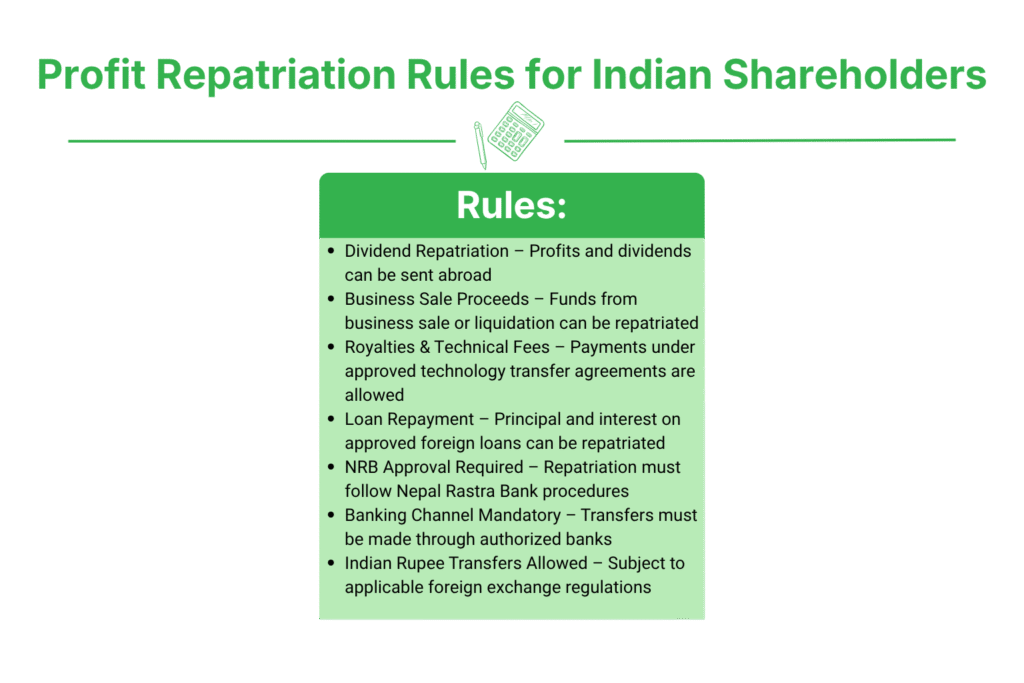
Under FITTA 2019, Section 10, foreign investors including Indian shareholders have the right to repatriate the following:
- Dividends and profits earned from investment
- Amount received from the sale or liquidation of a business
- Royalties and fees from technology transfer agreements
- Principal and interest from approved foreign loans
Repatriation must be made through proper banking channels with approval from Nepal Rastra Bank. Indian Rupees can be repatriated to India since the Indian Rupee is a convertible currency within the Nepal-India bilateral trade framework.
FAQs
1. Can an Indian national register a company alone without a Nepali partner in Nepal?
Yes, Indian nationals can register a 100% foreign-owned company in Nepal in sectors permitted under FITTA 2019. A Nepali partner is not mandatory unless the specific sector requires mandatory Nepali equity participation under applicable regulations.
2. What is the minimum investment required for Indian shareholders to register a company in Nepal?
The minimum foreign investment threshold under FITTA 2019 is NPR 2 Crore for most sectors. This applies equally to Indian investors. Investments above NPR 6 Billion require Investment Board Nepal approval.
3. Is a physical office in Nepal mandatory for Indian shareholder company registration?
Yes, a registered office address in Nepal is mandatory under the Companies Act, 2006. The company must provide proof of office address at the time of registration at the Office of the Company Registrar.
4. Can an Indian company (not an individual) be a shareholder in a Nepali company?
Yes, Indian-incorporated companies can be shareholders in Nepal-registered companies. The Indian company must submit incorporation documents, board resolution, and audited financial statements as part of the application.
5. How long does it take to complete the Indian shareholder company registration process in Nepal?
The complete process generally takes between 30 to 60 working days, depending on the completeness of documents and processing time at the Department of Industry and the Office of the Company Registrar.
6. Are Indian investors protected under any bilateral agreement with Nepal?
Yes, Indian investors benefit from the Treaty of Peace and Friendship, 1950 and the Nepal-India Double Taxation Avoidance Agreement (DTAA). These agreements provide certain protections and tax relief benefits to Indian investors operating in Nepal.
Conclusion
Indian shareholder company registration in Nepal is a well-defined process governed by FITTA 2019, the Companies Act 2006, and the Industrial Enterprises Act 2020. Indian nationals and Indian companies must obtain foreign investment approval from the Department of Industry, complete company registration at the Office of the Company Registrar, and comply with tax and repatriation regulations. The Nepal-India bilateral framework, including the Treaty of Peace and Friendship and DTAA, provides a favorable environment for Indian investors. Proper documentation, sector eligibility verification, and compliance with the negative list are essential steps before commencing the registration process.Add to Conversation