


Company Registration in Nepal for Indian National Foreign nationals, including Indian citizens, can register a company in Nepal under specific legal provisions. Nepal has established a clear regulatory framework that governs foreign direct investment (FDI) and company formation by non-Nepali nationals. This guide covers everything an Indian national needs to know about registering a company in Nepal from applicable laws to required documents and step-by-step procedures.
Can an Indian National Register a Company in Nepal?
Yes, an Indian national can register a company in Nepal. The Government of Nepal permits foreign nationals, including citizens of India, to invest and establish businesses in Nepal under the Foreign Investment and Technology Transfer Act (FITTA), 2019 and the Company Act, 2006.
However, Indian nationals must comply with Nepal’s foreign investment policies. They cannot independently own 100% of a company in most sectors. In many cases, a joint venture with a Nepali partner is required, while some sectors are entirely closed to foreign investors.
The Department of Industry (DoI) and the Office of the Company Registrar (OCR) are the two primary government bodies that handle company registration for Indian nationals in Nepal.
Legal Framework Governing Company Registration for Indian Nationals
Understanding the legal foundation is essential before registering a business in Nepal.
1. Foreign Investment and Technology Transfer Act (FITTA), 2019
This is the primary law that governs foreign investment in Nepal. Under FITTA 2019, foreign investors including Indian nationals can invest in Nepal through:
- Foreign direct investment
- Technology transfer
- Reinvestment of earnings
2. Company Act, 2006
This act governs the formation, registration, operation, and dissolution of companies in Nepal. Foreign investors must comply with this law when incorporating a private or public limited company.
3. Industrial Enterprises Act, 2020
This act governs industries in Nepal and outlines which sectors are open, restricted, or prohibited for foreign investment.
4. Nepal Investment Board Act, 2011
Large-scale investments above a certain threshold must go through the Investment Board Nepal (IBN) rather than the Department of Industry.
Types of Companies an Indian National Can Register in Nepal
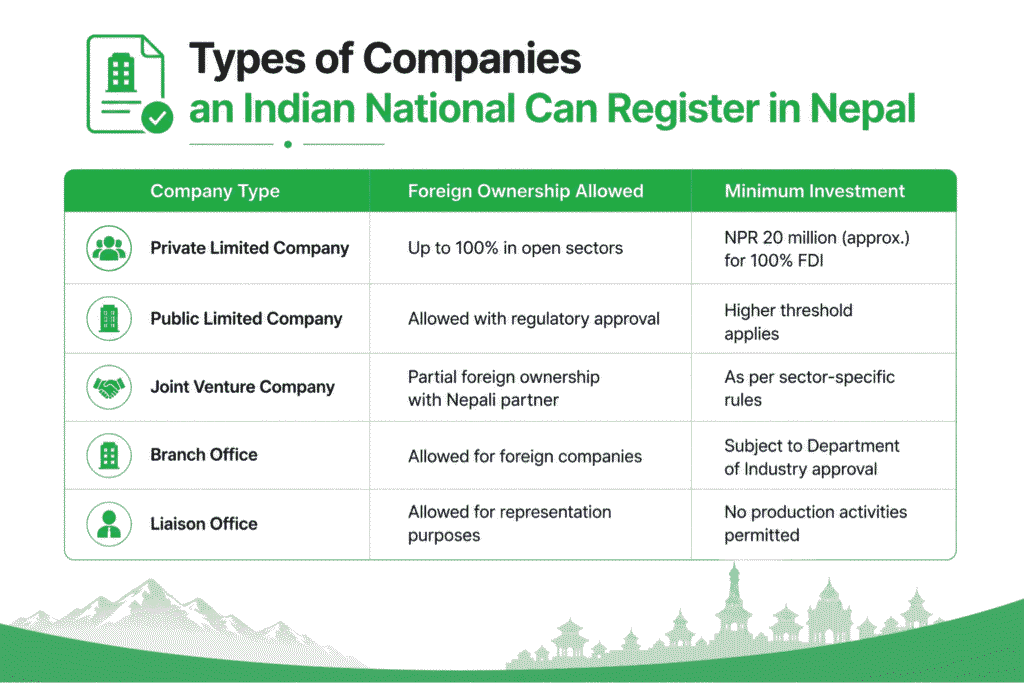
Indian nationals can register the following types of companies in Nepal:
| Company Type | Foreign Ownership Allowed | Minimum Investment |
|---|---|---|
| Private Limited Company | Up to 100% in open sectors | NPR 20 million (approx.) for 100% FDI |
| Public Limited Company | Allowed with regulatory approval | Higher threshold applies |
| Joint Venture Company | Partial foreign ownership with Nepali partner | As per sector-specific rules |
| Branch Office | Allowed for foreign companies | Subject to Department of Industry approval |
| Liaison Office | Allowed for representation purposes | No production activities permitted |
The Private Limited Company is the most preferred structure for Indian investors entering Nepal for the first time.
Sectors Open and Restricted for Indian Nationals
Not all business sectors in Nepal are open for foreign investment. The Government of Nepal has categorized sectors into open, restricted, and prohibited lists.
Sectors Open for Foreign Investment:
- Manufacturing industries
- Tourism and hospitality
- Information technology and software
- Hydropower and energy
- Education and healthcare (with conditions)
- Export-oriented industries
Restricted Sectors (Require Special Permission):
- Media and publishing
- Banking and financial services
- Cooperative institutions
- Poultry and fisheries (small-scale)
Prohibited Sectors for Foreign Investment (as per FITTA 2019 and Industrial Enterprises Act):
- Cottage and small-scale industries reserved for Nepali citizens
- Arms and ammunition
- Security printing
- Real estate (for individual buying, not development)
- Retail trade below USD 500,000 investment
Minimum Foreign Investment Requirement for Indian Nationals
Under FITTA 2019, the minimum foreign investment required to register a company in Nepal is NPR 50 million (approximately USD 380,000) for a foreign-invested enterprise in most sectors.
However, for technology transfer agreements and some service sectors, the threshold may differ. Indian investors must confirm the applicable minimum with the Department of Industry before proceeding.
Documents Required for Company Registration in Nepal by Indian Nationals
The following documents are required when an Indian national applies for company registration in Nepal:
For the Indian National (Foreign Investor):
- Valid Indian Passport (copy)
- Passport-size photographs
- Proof of address (bank statement or utility bill)
- Financial proof or bank solvency certificate
- PAN card or tax identification from India
- No Objection Certificate (if employed elsewhere)
- Business plan or project proposal
- Criminal background clearance certificate
For the Company Formation:
- Memorandum of Association (MoA)
- Articles of Association (AoA)
- Application form from the Office of the Company Registrar
- Proposed company name approval certificate
- Details of shareholders and directors
- Registered office address proof in Nepal
- Details of share capital structure
If Forming a Joint Venture with a Nepali Partner:
- Joint Venture Agreement (notarized)
- Nepali partner’s citizenship certificate
- Nepali partner’s PAN card
Step-by-Step Process for Company Registration in Nepal for Indian Nationals
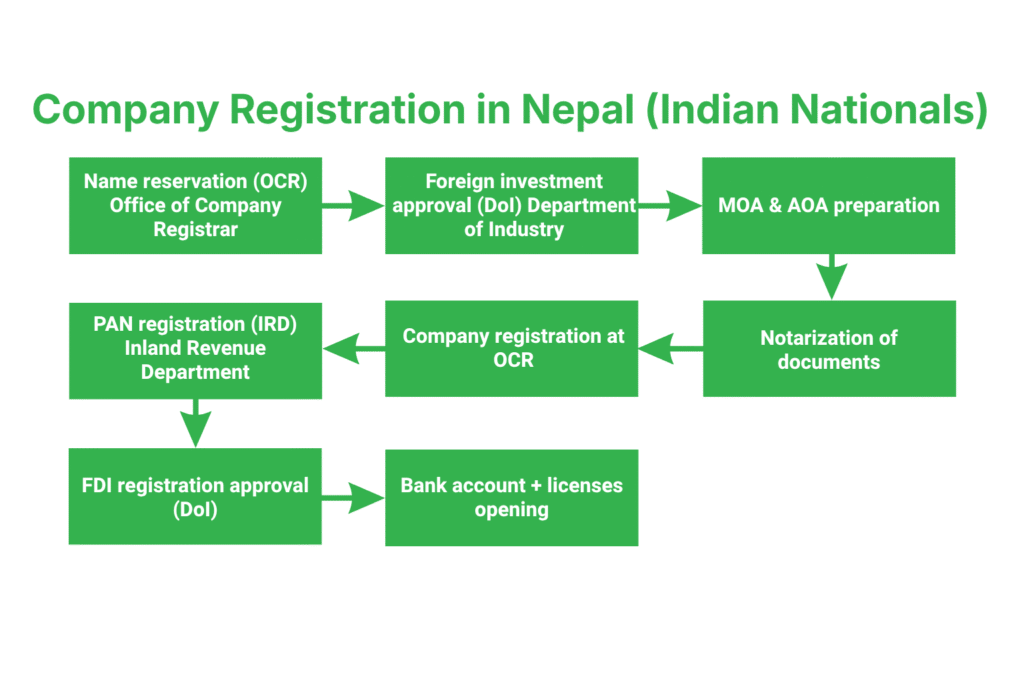
The company registration process involves multiple stages across different government offices.
Step 1: Name Reservation
- Apply for company name availability at the Office of the Company Registrar (OCR) online portal: https://ocr.gov.np
- Submit proposed company name choices
- Pay the name reservation fee
Step 2: Obtain Foreign Investment Approval
- Submit an investment proposal to the Department of Industry (DoI): https://www.doind.gov.np
- Provide project report, financial details, and intended sector
- DoI reviews and grants approval under FITTA 2019
- This approval is mandatory before registering the company at OCR
Step 3: Draft and Notarize Company Documents
- Prepare the Memorandum of Association and Articles of Association
- Get these notarized at a recognized notary in Nepal
- Translate all Indian documents into Nepali if required
Step 4: Register at the Office of the Company Registrar
- Submit all documents to OCR
- Pay registration fees (based on authorized capital)
- OCR verifies documents and issues the Certificate of Incorporation
Step 5: Register at the Inland Revenue Department (IRD)
- Obtain a Permanent Account Number (PAN) from the Inland Revenue Department
- PAN is required for tax purposes and business operations
- IRD Portal: https://ird.gov.np
Step 6: Register at the Department of Industry
- After company registration, register the foreign investment at DoI
- Receive the Foreign Investment Approval Certificate
- This formalizes the FDI entry in Nepal
Step 7: Open a Corporate Bank Account
- Open a company bank account at a Nepal Rastra Bank-licensed commercial bank
- Bring the Certificate of Incorporation, PAN, and DoI approval
Step 8: Obtain Sector-Specific Licenses
- Depending on the nature of the business, apply for relevant licenses
- Examples: Tourism License from Nepal Tourism Board, Construction License from relevant ministry
Fees and Timeline for Company Registration
| Stage | Estimated Fee | Estimated Time |
|---|---|---|
| Name Reservation | NPR 500 – 1,000 | 1–3 working days |
| DoI Foreign Investment Approval | NPR 2,000 – 5,000 | 15–35 working days |
| OCR Company Registration | Based on share capital | 3–7 working days |
| PAN Registration | Free | 1–2 working days |
| Sector License (if required) | Varies by sector | 7–30 working days |
The total estimated timeline for completing all stages ranges from 30 to 60 working days, depending on the sector, document readiness, and regulatory review.
Tax Obligations for Indian-Owned Companies in Nepal
Once registered, an Indian national’s company in Nepal is subject to:
- Corporate Income Tax: 25% for general industries, 20% for export industries, and 20% for IT companies
- Value Added Tax (VAT): 13% on goods and services
- Dividend Tax: 5% on dividends remitted to foreign shareholders
- Withholding Tax: Applicable on royalties and service fees transferred abroad
- Double Taxation Avoidance Agreement (DTAA): Nepal and India have a DTAA signed to avoid double taxation, which benefits Indian investors
Profit Repatriation for Indian Investors in Nepal
Under FITTA 2019, Indian nationals who invest in Nepal can legally repatriate:
- Profits and dividends
- Returns on technology transfer
- Principal amount of investment (on dissolution)
- Capital gains after taxes
Repatriation must be done through Nepal Rastra Bank (NRB) approved banking channels. Nepal Rastra Bank: https://www.nrb.org.np
Visa and Residency for Indian Business Investors in Nepal
Indian nationals have a special status in Nepal. Under the 1950 Treaty of Peace and Friendship between Nepal and India, Indian citizens do not require a visa to enter and stay in Nepal. They can work and conduct business without a separate work permit in most cases.
However, for formal FDI registration and business operations, Indian investors are still required to comply with FITTA 2019 and other applicable laws regardless of visa-free entry privileges.
Common Challenges Faced by Indian Nationals During Registration
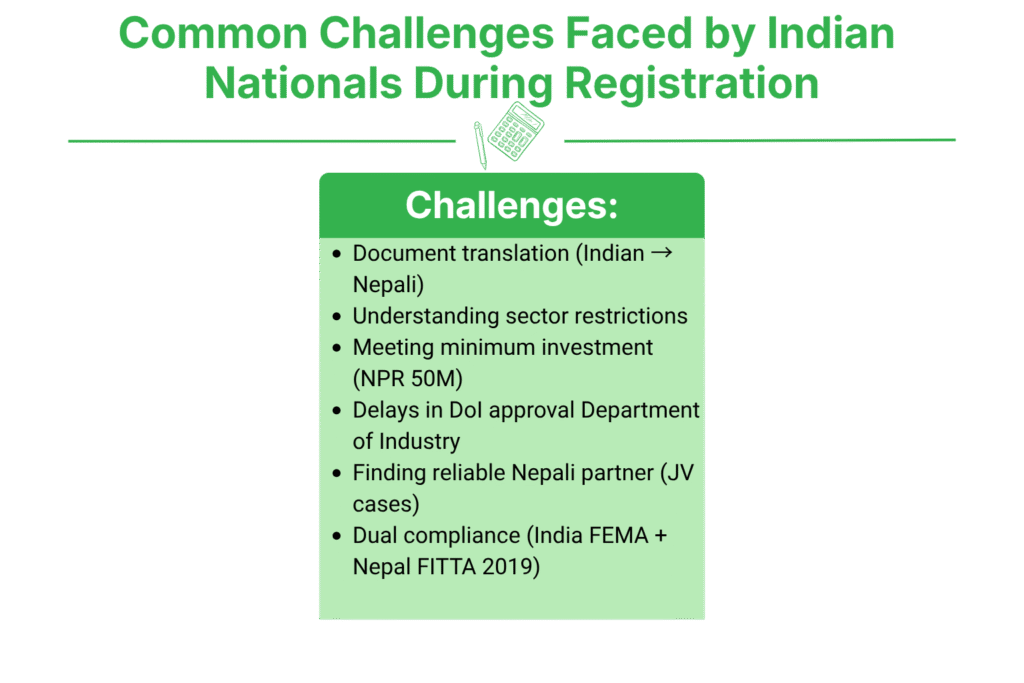
- Translating Indian documents into Nepali
- Understanding sector-specific investment restrictions
- Meeting the minimum investment threshold of NPR 50 million
- Delays in DoI approval for complex sectors
- Finding a reliable local Nepali partner for joint ventures
- Compliance with both Indian FEMA regulations and Nepal’s FITTA 2019
FAQs
1. Can an Indian national own 100% shares in a Nepal company?
Yes, in sectors open under FITTA 2019, an Indian national can own 100% shares. However, minimum investment thresholds apply, and certain sectors require joint venture arrangements with Nepali partners.
2. What is the minimum investment required for Indian nationals to register a company in Nepal?
Under FITTA 2019, the minimum foreign investment requirement is NPR 50 million. Some sectors may have different thresholds, so confirmation from the Department of Industry is advised.
3. Do Indian nationals need a visa to register a company in Nepal?
No. Under the 1950 Nepal-India Treaty of Peace and Friendship, Indian nationals can enter and reside in Nepal without a visa. However, foreign investment registration under FITTA 2019 is still mandatory.
4. How long does company registration take for Indian nationals in Nepal?
The entire process typically takes 30 to 60 working days, depending on DoI approval timelines, document preparation, and sector-specific licensing requirements.
5. Can Indian nationals repatriate profits from Nepal?
Yes. Under FITTA 2019, Indian investors can legally repatriate profits, dividends, and capital through Nepal Rastra Bank-approved banking channels after paying applicable taxes.
6. Is there a Double Taxation Avoidance Agreement between Nepal and India?
Yes. Nepal and India have a DTAA that prevents the same income from being taxed twice. This agreement benefits Indian investors who earn income from their Nepal-registered companies.
Conclusion
Company registration in Nepal for Indian nationals is a structured process governed by FITTA 2019, the Company Act 2006, and the Industrial Enterprises Act 2020. Indian investors must obtain Department of Industry approval, meet minimum investment thresholds, and register at the Office of the Company Registrar. With Nepal’s growing economy, favorable tax treaties, and open investment climate in key sectors, Nepal presents a genuine business opportunity for Indian entrepreneurs and corporate entities seeking regional expansion.