

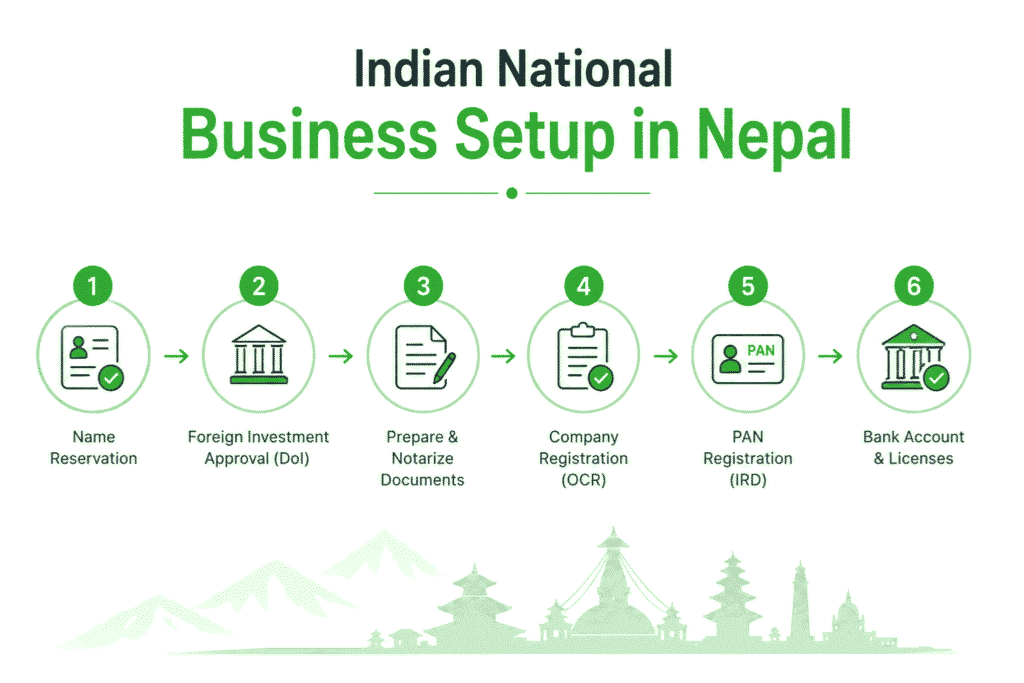
Indian national business setup in Nepal hold a unique position . Due to the historical, geographical, and diplomatic ties between India and Nepal, Indian investors enjoy certain privileges that other foreign nationals do not. However, setting up a business in Nepal as an Indian national still requires compliance with Nepali law, proper registration, and sector-specific approvals. This article covers every aspect of the process from legal framework to documentation, registration steps, and tax obligations.
Why Indian Nationals Choose Nepal for Business
Nepal and India share an open border, a common cultural fabric, and a long-standing economic relationship. Indian nationals are among the largest foreign investors in Nepal. The proximity to India, low labor costs, abundant hydropower resources, and access to South Asian markets make Nepal an attractive destination for Indian businesses.
The Treaty of Peace and Friendship between India and Nepal (1950) grants Indian nationals the right to engage in industrial and economic activities in Nepal on the same basis as Nepali citizens. This is a significant legal advantage that no other foreign national enjoys. Despite this treaty provision, Indian investors must still follow the Foreign Investment and Technology Transfer Act (FITTA), 2019 and other applicable Nepali laws when making formal foreign investments.
Legal Framework Governing Indian National Business Setup in Nepal
Several laws and regulations govern foreign investment and business setup in Nepal. Indian nationals must understand the following legal instruments:
- Foreign Investment and Technology Transfer Act (FITTA), 2019 — The primary law regulating all forms of foreign investment in Nepal.
- Companies Act, 2006 — Governs the registration and operation of companies in Nepal.
- Industrial Enterprises Act, 2020 — Provides framework for industrial registration, incentives, and operations.
- Income Tax Act, 2002 — Governs corporate and personal tax obligations.
- Foreign Exchange Regulation Act, 2019 — Controls the inflow and outflow of foreign currency.
- Nepal-India Treaty of Peace and Friendship, 1950 — Grants special economic rights to Indian nationals.
- Special Economic Zone Act, 2016 — Governs business operations within designated SEZ areas.
Under Section 2(c) of FITTA 2019, foreign investment includes equity investment, reinvestment of earnings, and technology transfer agreements. Indian nationals making formal investments in Nepal fall under this definition and must register their investment accordingly.
Special Status of Indian Nationals Under the 1950 Treaty
The 1950 Treaty between India and Nepal is the foundation of the special business rights that Indian nationals enjoy. Under Article 7 of the Treaty, Indian nationals are granted the same privileges as Nepali citizens in matters of:
- Participation in trade and commerce
- Movement and residence
- Ownership of property
- Access to industrial and economic activities
This means Indian nationals can establish sole proprietorships and partnerships in Nepal without requiring foreign investment approval in many cases. However, for formal foreign direct investment (FDI) where profit repatriation to India is expected registration under FITTA 2019 is mandatory.
Types of Business Entities Available to Indian Nationals in Nepal
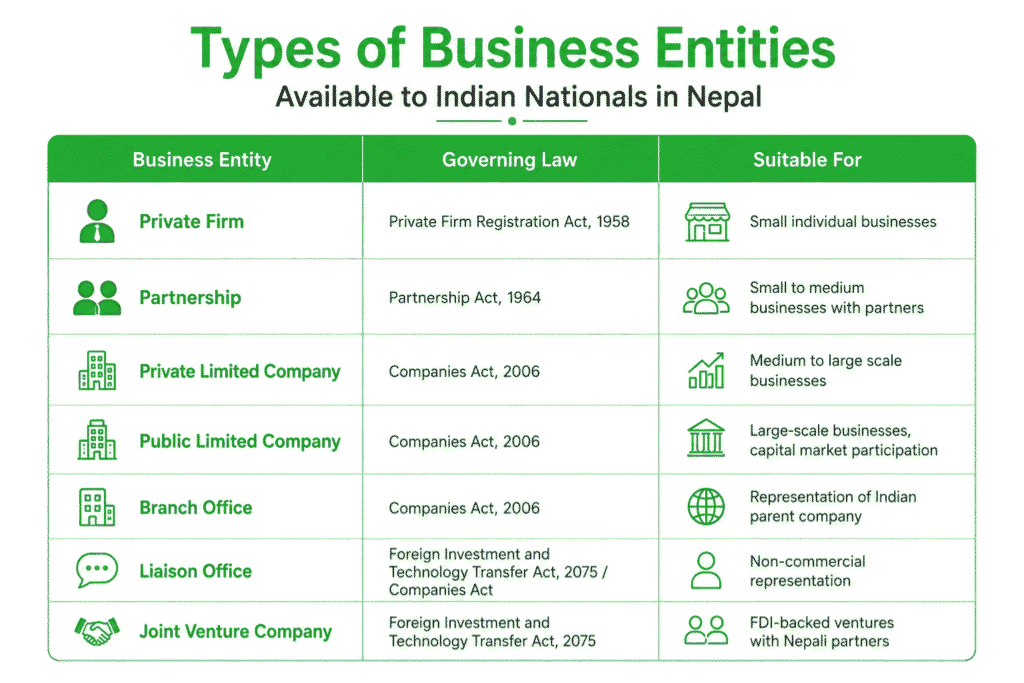
Indian nationals can choose from several business structures when setting up in Nepal:
| Business Entity | Governing Law | Suitable For |
|---|---|---|
| Private Firm Registration Act, 1958 | Private Firm Registration Act, 1958 | Small individual businesses |
| Partnership Act, 1964 | Partnership Act, 1964 | Small to medium businesses with partners |
| Companies Act, 2006 | Companies Act, 2006 | Medium to large scale businesses |
| Companies Act, 2006 | Companies Act, 2006 | Large-scale businesses, capital market participation |
| Branch Office | Companies Act, 2006 | Representation of Indian parent company |
| Liaison Office | Foreign Investment and Technology Transfer Act, 2075 / Companies Act | Non-commercial representation |
| Joint Venture Company | Foreign Investment and Technology Transfer Act, 2075 | FDI-backed ventures with Nepali partners |
The Private Limited Company structure is the most commonly chosen by Indian nationals for medium-to-large investments due to its liability protection, clear ownership structure, and suitability for profit repatriation.
Sectors Open for Indian Investment in Nepal
Under Schedule 1 of FITTA 2019, foreign nationals including Indian investors can invest in a wide range of sectors. The Department of Industry (DOI) and the Investment Board Nepal (IBN) manage investment approvals based on investment thresholds.
Open sectors include:
- Hydropower and energy production
- Tourism, hotels, and hospitality
- Manufacturing and agro-processing
- Information technology and software development
- Education and healthcare services
- Infrastructure development and construction
- Banking, insurance, and financial services (subject to Nepal Rastra Bank regulations)
- Export-oriented industries
For investments above NPR 6 billion, approval from the Investment Board Nepal (IBN) is required. For investments below NPR 6 billion, the Department of Industry (DOI) is the approving authority. Indian nationals can visit the Investment Board Nepal official website for updated sector guidelines.
Restricted and Prohibited Sectors for Indian Nationals
Despite the privileges under the 1950 Treaty, Indian nationals cannot invest in sectors that are reserved exclusively for Nepali citizens under Nepali law.
Prohibited sectors for foreign investors under FITTA 2019 include:
- Cottage industries and small-scale traditional crafts
- Personal service industries (e.g., hair salons, tailoring below defined thresholds)
- Arms and ammunition manufacturing
- Currency and coin production
- Real estate business (buying and selling land for profit)
- Retail trade (below specified investment limits)
- Travel agencies (subject to conditions)
- Money lending and microfinance (without special approval)
- Consultancy services in certain categories
Indian nationals must review Schedule 2 of FITTA 2019 carefully before selecting a business sector to ensure compliance.
Step-by-Step Business Registration Process for Indian Nationals in Nepal

The process to set up a business in Nepal as an Indian national involves multiple steps across different government offices.
Step 1: Obtain Foreign Investment Approval
- Submit an application to the Department of Industry (DOI) or Investment Board Nepal (IBN) depending on the investment amount.
- The DOI office can be accessed at www.doi.gov.np.
- Submit a business proposal, investment plan, and required personal documents.
Step 2: Company Registration at the Office of Company Registrar (OCR)
- Register the company at the Office of Company Registrar (OCR) under the Companies Act, 2006.
- Submit the Memorandum of Association (MOA) and Articles of Association (AOA).
- OCR website: www.ocr.gov.np
Step 3: PAN/VAT Registration
- Register for Permanent Account Number (PAN) at the Inland Revenue Office under the Income Tax Act, 2002.
- If annual turnover exceeds NPR 5 million (for goods) or NPR 2 million (for services), VAT registration is mandatory under the Value Added Tax Act, 1995.
Step 4: Industry Registration
- Register the industry at the Department of Industry under the Industrial Enterprises Act, 2020 to obtain an industry registration certificate.
Step 5: Open a Bank Account
- Open a corporate bank account at a Nepal Rastra Bank (NRB) licensed commercial bank.
- Bring foreign investment funds through banking channels to maintain legal foreign exchange records under the Foreign Exchange Regulation Act, 2019.
Step 6: Obtain Sector-Specific Licenses
- Depending on the business type, obtain sector-specific approvals from relevant regulatory bodies (e.g., Nepal Rastra Bank for finance, Civil Aviation Authority for aviation-related businesses, etc.).
Documents Required for Indian National Business Registration in Nepal
For Foreign Investment Approval (DOI/IBN):
- Duly filled application form
- Valid Indian passport copy (all pages)
- Recent passport-size photographs
- Detailed project/business proposal
- Proof of source of funds (bank statements, financial documents)
- Business plan with financial projections
- Proposed company name and structure details
For Company Registration (OCR):
- Memorandum of Association (MOA)
- Articles of Association (AOA)
- Shareholder details and share allocation
- Director identification documents (passport/national ID)
- Address proof of the registered office in Nepal
- Foreign Investment Approval Certificate from DOI/IBN
For PAN/VAT Registration:
- Company registration certificate
- Foreign investment approval certificate
- Passport copy of directors/owners
- Business address proof in Nepal
Minimum Investment Requirements for Indian Nationals
Under FITTA 2019, the minimum foreign investment threshold for most sectors is NPR 20 million (approximately USD 150,000). However, Indian nationals due to the 1950 Treaty can establish certain businesses in Nepal as domestic investors (such as sole proprietorships and partnerships) without meeting this threshold, as long as they are not seeking formal FDI status or profit repatriation rights.
| Investment Type | Minimum Threshold | Approving Authority |
|---|---|---|
| General Foreign Investment | NPR 20 million | Department of Industry |
| Large-Scale Investment | Above NPR 6 billion | Investment Board Nepal |
| Domestic Business (Treaty-Based) | No FDI minimum | Local Ward Office / Department of Industry |
| Technology Transfer | As per agreement | Department of Industry |
Tax Obligations for Indian National Businesses in Nepal
Indian national businesses operating in Nepal are subject to the following taxes under the Income Tax Act, 2002:
- Corporate Income Tax: 25% standard rate; 20% for manufacturing industries; 15% for special industry categories.
- Value Added Tax (VAT): 13% on goods and services (where applicable).
- Withholding Tax: Applicable on dividends, royalties, and service fees paid to foreign entities.
- Customs Duty: On import of goods and machinery under the Customs Act, 2007.
Nepal and India have a Double Tax Avoidance Agreement (DTAA), which prevents Indian nationals from being taxed twice on the same income in both countries. Indian investors should reference the DTAA when structuring their profit repatriation.
Profit Repatriation Rules for Indian Investors
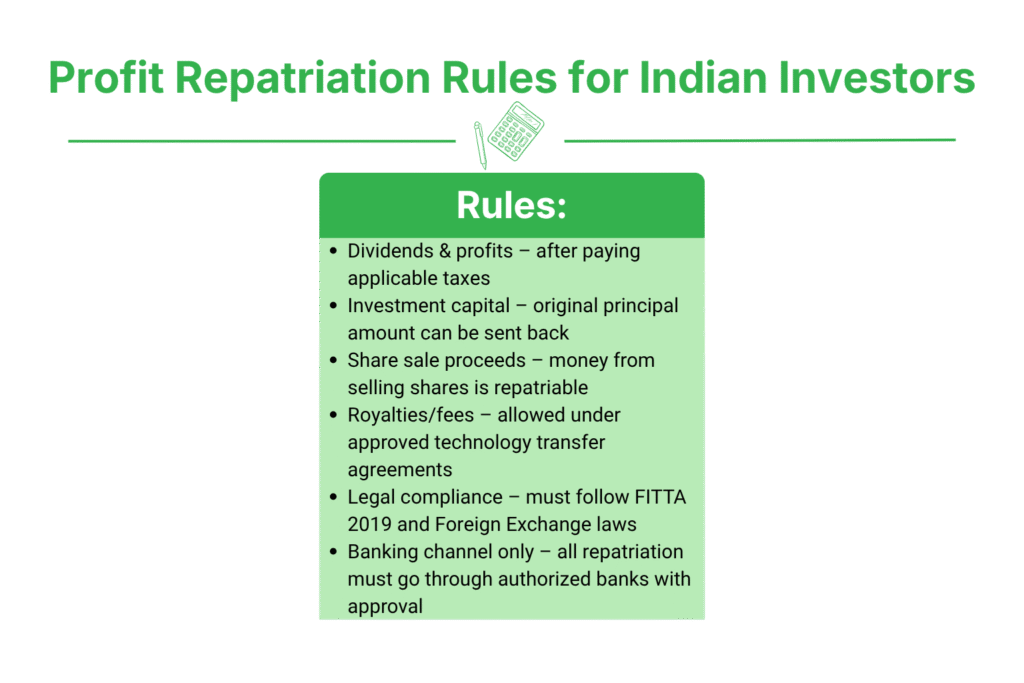
Under FITTA 2019 and the Foreign Exchange Regulation Act, 2019, foreign investors including Indian nationals who have registered under the formal FDI framework are permitted to repatriate:
- Dividends and profits after paying applicable taxes
- Principal amount of investment
- Proceeds from the sale of shares
- Royalties and fees from technology transfer agreements
All repatriation must go through Nepal Rastra Bank (NRB) approved channels. The investor must submit an audited financial statement, tax clearance certificate, and NRB approval before remitting funds.
FAQs
1. Can Indian nationals start a business in Nepal without foreign investment approval?
Yes. Under the 1950 India-Nepal Treaty, Indian nationals can set up sole proprietorships and partnerships in Nepal on the same basis as Nepali citizens, without requiring formal FDI approval, unless they intend to repatriate profits to India.
2. What is the minimum investment required for an Indian national to register a foreign investment in Nepal?
Under FITTA 2019, the minimum threshold for formal foreign investment is NPR 20 million. This applies when the Indian national seeks FDI status, profit repatriation rights, or invests in sectors requiring foreign investment approval.
3. Which government authority approves foreign investment applications in Nepal?
The Department of Industry (DOI) approves investments below NPR 6 billion. The Investment Board Nepal (IBN) approves investments above NPR 6 billion. Both operate under the FITTA 2019 framework.
4. Are Indian nationals allowed to own land in Nepal for business purposes?
Indian nationals can lease land for business operations but cannot purchase land for commercial real estate trading. Under Nepali law, land ownership for business premises is allowed in leasehold format for foreign investors under approved sectors.
5. Is there a Double Taxation Avoidance Agreement between India and Nepal?
Yes. India and Nepal have a DTAA that prevents the same income from being taxed in both countries. Indian business owners in Nepal should structure their tax filings in both jurisdictions accordingly to benefit from this treaty.
6. How long does the business registration process take for Indian nationals in Nepal?
The process typically takes 30 to 60 working days from the date of submitting a complete application to DOI, followed by OCR registration, PAN/VAT registration, and sector-specific licenses. Timelines may vary based on investment size and sector.
Conclusion
Setting up a business in Nepal as an Indian national is a structured process governed by FITTA 2019, the Companies Act 2006, the Industrial Enterprises Act 2020, and the landmark India-Nepal Treaty of Peace and Friendship, 1950. Indian nationals enjoy unique legal advantages in Nepal compared to other foreign investors. However, compliance with Nepali laws including sector restrictions, investment thresholds, tax obligations, and registration requirements remains mandatory. Consulting a qualified Nepali legal professional and engaging with the Department of Industry or Investment Board Nepal at the initial stage ensures a smooth and lawful business setup process.