

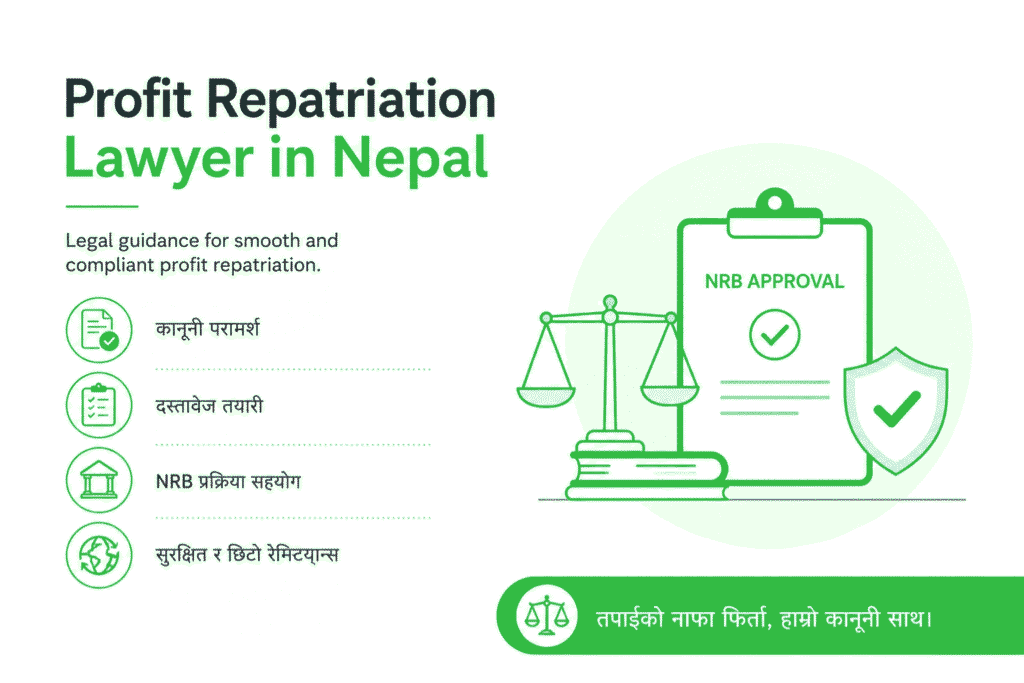
Foreign investors operating in Nepal often face complex legal and regulatory requirements when they wish to send their earnings back to their home countries. The process of transferring dividends, profits, and returns from Nepal to a foreign jurisdiction is governed by specific laws and regulations. A profit repatriation lawyer in Nepal assists foreign nationals, multinational companies, and investors in completing this process lawfully, efficiently, and without regulatory complications.
This article explains what profit repatriation is, the applicable legal framework, the role of a specialized lawyer, and the complete process involved.
What Is Profit Repatriation in Nepal?
Profit repatriation refers to the legal process by which a foreign investor or foreign company transfers earnings, dividends, profits, or capital gains earned in Nepal back to their home country or to a foreign bank account. This process is also known as foreign profit remittance or dividend repatriation.
In Nepal, profit repatriation is not automatic. It requires approval from the Nepal Rastra Bank (NRB) and must comply with the provisions of the Foreign Investment and Technology Transfer Act, 2019 (FITTA 2019) and the Foreign Exchange (Regulation) Act, 1962.
Foreign investors can repatriate:
- Net dividends or profits after paying applicable taxes
- Proceeds from the sale of shares or ownership stakes
- Royalties and fees for technical services
- Principal and interest on foreign loans approved by NRB
- Compensation received from expropriation or nationalization
- Amounts received upon winding up or liquidation of a company
Legal Framework Governing Profit Repatriation in Nepal
Several laws and regulations govern the profit repatriation process in Nepal. A profit repatriation lawyer in Nepal must have a thorough understanding of all these statutes.
1. Foreign Investment and Technology Transfer Act, 2019 (FITTA 2019)
FITTA 2019 is the primary legislation regulating foreign investment and profit repatriation in Nepal. Section 9 of FITTA 2019 provides foreign investors the right to repatriate the following amounts through a bank in convertible foreign currency:
- Profits and dividends earned from the investment
- Proceeds from the sale of shares or transferred ownership
- Amounts received from liquidation of a company
- Royalties and technology service fees
FITTA 2019 replaced the earlier Foreign Investment and Technology Transfer Act, 1992, and introduced a more liberalized approach to foreign investment.
You can access the official text at the Office of the Investment Board Nepal.
2. Foreign Exchange (Regulation) Act, 1962
This Act regulates all transactions involving foreign currency in Nepal. Any transfer of money outside Nepal, including profit repatriation, must comply with this Act. The Nepal Rastra Bank enforces this law and must approve all foreign exchange transactions.
3. Income Tax Act, 2002
Before repatriating profits, the investor must pay all applicable taxes. Section 88 and 88Ka of the Income Tax Act, 2002 govern withholding tax on dividends. The standard withholding tax on dividends distributed to foreign investors is 5% for listed companies and 5% to 15% depending on tax treaty provisions.
4. Nepal Rastra Bank Directives
The Nepal Rastra Bank (NRB) issues circulars and directives from time to time that set procedural requirements for repatriation. These include documentation requirements, limits on remittable amounts, and guidelines for authorized dealer banks.
Visit the official site of Nepal Rastra Bank for the latest foreign exchange directives.
Who Needs a Profit Repatriation Lawyer in Nepal?
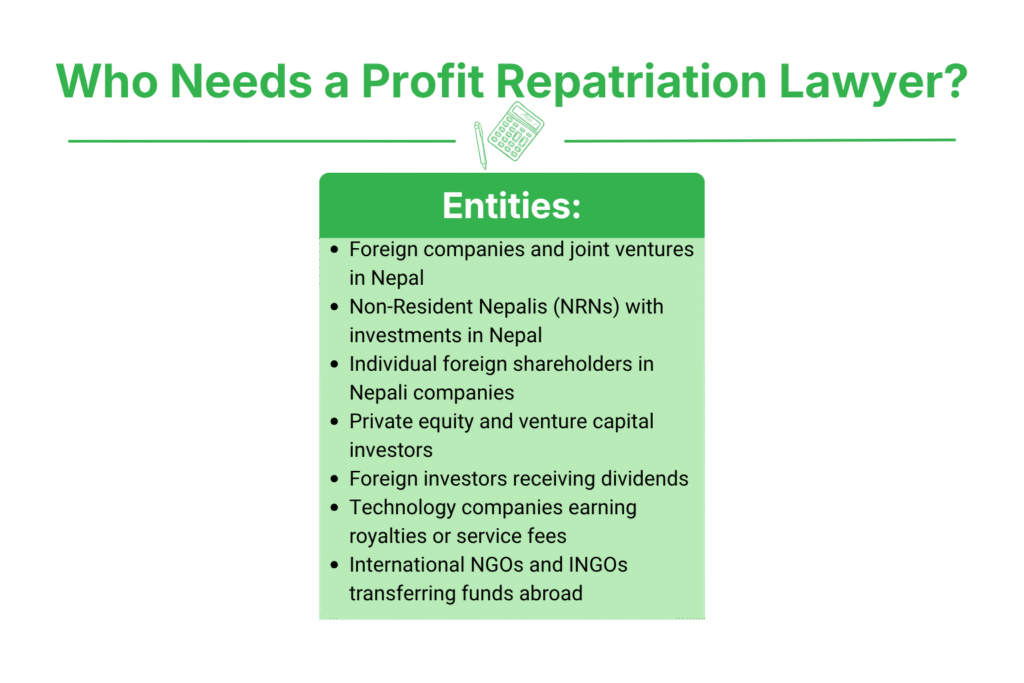
A profit repatriation lawyer in Nepal serves a wide range of clients. The following persons or entities typically need legal assistance for profit repatriation:
- Foreign companies with subsidiaries or joint ventures in Nepal
- Non-Resident Nepalis (NRNs) who have invested in Nepal under the NRN Investment Policy
- Individual foreign investors holding shares in Nepali companies
- Private equity and venture capital firms with stakes in Nepali businesses
- Foreign nationals who have received dividends from investments in Nepal
- Technology companies that receive royalties or service fees from Nepal
- International NGOs or INGOs seeking to transfer funds abroad
Each of these clients faces different legal challenges, and a skilled foreign investment lawyer in Nepal helps them structure the repatriation properly.
Role of a Profit Repatriation Lawyer in Nepal
A profit repatriation attorney in Nepal performs multiple functions throughout the repatriation process.
Legal Due Diligence
The lawyer first reviews whether the foreign investment was made in compliance with FITTA 2019 and NRB regulations. Illegal or unregistered investments are not eligible for repatriation.
Tax Compliance Review
The lawyer verifies that all income taxes, corporate taxes, and withholding taxes have been paid before initiating repatriation. Any outstanding tax liability blocks the repatriation process.
Documentation Preparation
One of the most important roles of a profit repatriation lawyer is preparing and verifying all required documents. Incomplete documentation is the most common cause of delays.
Liaison with Nepal Rastra Bank
The lawyer communicates with the NRB and authorized dealer banks on behalf of the client. They submit the repatriation application and respond to any queries from the NRB.
Tax Treaty Analysis
Nepal has Double Taxation Avoidance Agreements (DTAAs) with several countries including India, China, Norway, Mauritius, Austria, and others. A profit repatriation lawyer in Nepal analyzes the applicable DTAA to ensure the client benefits from reduced withholding tax rates.
Dispute Resolution
If the NRB or tax authority raises a dispute regarding the repatriation, the lawyer represents the client in legal proceedings before the Revenue Tribunal or other competent authorities.
Process of Profit Repatriation in Nepal

The profit repatriation process in Nepal involves several steps. A foreign exchange lawyer in Nepal guides the client through each stage.
Step 1: Verify Foreign Investment Registration
The foreign investment must be registered with the Department of Industry (DOI) or the Investment Board Nepal (IBN) depending on the size of the investment. The lawyer confirms that the registration is valid and current.
Step 2: Obtain Audited Financial Statements
The company must have audited financial statements prepared by a Chartered Accountant registered in Nepal. These statements confirm the profits earned and dividends declared.
Step 3: Tax Clearance Certificate
The company must obtain a Tax Clearance Certificate from the Inland Revenue Department (IRD). This certificate confirms that all taxes have been paid. Visit Inland Revenue Department Nepal for details.
Step 4: Board Resolution for Dividend Declaration
If the repatriation relates to dividends, the Board of Directors of the company must pass a formal resolution declaring the dividend. The resolution must comply with the Companies Act, 2006.
Step 5: Deduct Withholding Tax
The company deducts the applicable withholding tax on dividends before the dividend is paid to the foreign investor.
Step 6: Application to Authorized Dealer Bank
The foreign investor submits a formal application to an NRB-authorized dealer bank in Nepal. The authorized bank then submits the application to the Foreign Exchange Management Department of NRB.
Step 7: NRB Approval
The NRB reviews the application, verifies all documents, and grants approval for the repatriation of profits.
Step 8: Transfer of Funds
Once NRB approval is obtained, the authorized dealer bank processes the international wire transfer and sends the funds to the foreign investor’s designated bank account abroad.
Documents Required for Profit Repatriation in Nepal
The following documents are generally required for profit repatriation. A profit repatriation lawyer in Nepal helps compile and verify these:
- Copy of the company’s registration certificate
- Foreign investment approval certificate from DOI or IBN
- Audited financial statements for the relevant fiscal year
- Board resolution declaring dividends
- Tax clearance certificate from the Inland Revenue Department
- Withholding tax deposit slip (payment receipt)
- Share register showing foreign investor’s shareholding
- Copy of the foreign investor’s passport or identification
- Application form as prescribed by NRB
- Agreement or contract (for royalty or service fee repatriation)
- Technology transfer agreement (if applicable)
- Any applicable DTAA benefit claim form
Table 1: Key Laws Governing Profit Repatriation in Nepal
| Law / Regulation | Authority | Key Provision |
|---|---|---|
| Foreign Investment and Technology Transfer Act, 2075 (FITTA 2019) | Investment Board Nepal / Department of Industry | Right to repatriate profits, dividends, and sale proceeds |
| Foreign Exchange (Regulation) Act, 1962 | Nepal Rastra Bank | Regulation of all foreign exchange transactions |
| Income Tax Act, 2058 | Inland Revenue Department | Withholding tax on dividends |
| Companies Act, 2063 | Office of Company Registrar | Dividend declaration and distribution process |
| NRB Directives | Nepal Rastra Bank | Procedural requirements for remittance |
| Double Taxation Avoidance Agreements | Ministry of Finance | Reduced withholding tax rates for treaty countries |
Table 2: Withholding Tax Rates on Dividends for Foreign Investors in Nepal
| Type of Investor / Country | Withholding Tax Rate |
|---|---|
| General Foreign Investor (Listed Company) | 5% |
| General Foreign Investor (Non-Listed Company) | 5% |
| India (DTAA) | 5% to 10% depending on shareholding |
| China (DTAA) | 10% |
| Norway (DTAA) | 10% |
| Austria (DTAA) | 5% to 15% |
| Mauritius (DTAA) | 5% to 10% |
Taxes Applicable on Profit Repatriation in Nepal
A foreign investment tax lawyer in Nepal must understand all tax obligations associated with profit repatriation.
Corporate Tax
The investee company in Nepal must pay corporate income tax before distributing any dividends. The standard corporate tax rate in Nepal is 25% for most companies and 20% for manufacturing industries.
Withholding Tax on Dividends
When a company distributes dividends to a foreign investor, it must deduct withholding tax as per the Income Tax Act, 2002. The standard rate is 5% under domestic law, but DTAA provisions may alter this rate.
Capital Gains Tax
If the foreign investor sells shares in a Nepali company, capital gains tax is applicable. The rate is 25% for non-resident sellers under the Income Tax Act, 2002, though DTAA provisions may reduce this.
No Additional Tax on Repatriation Itself
Nepal does not impose a separate tax specifically on the act of repatriation. The taxes are paid at the source level (corporate tax and withholding tax), and the repatriated amount is the net post-tax profit.
Challenges in Profit Repatriation in Nepal
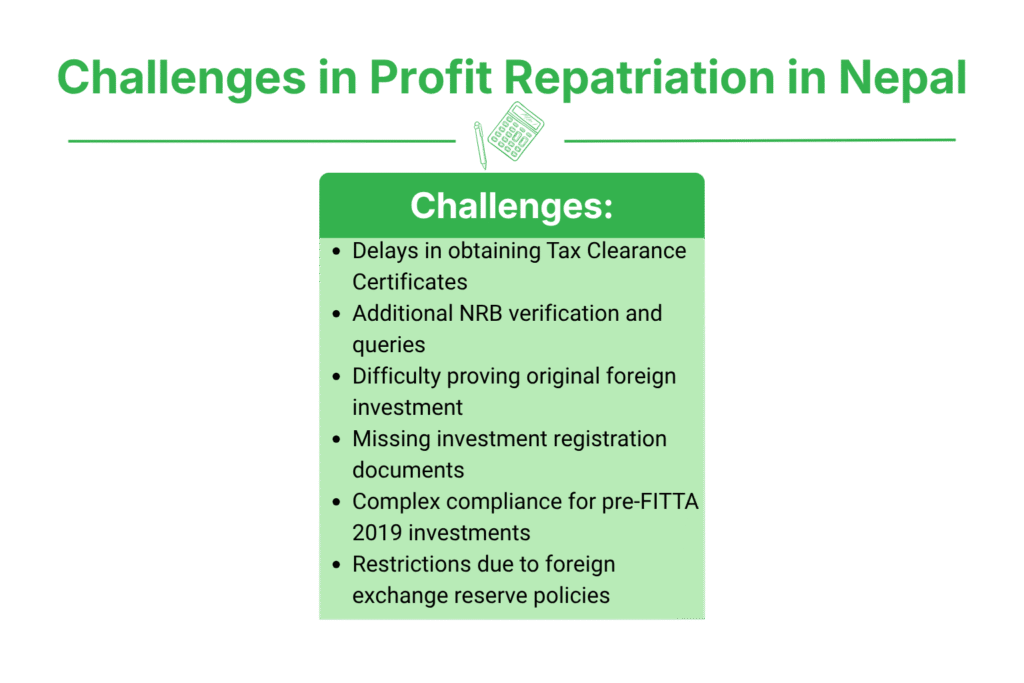
Even with a competent profit repatriation lawyer in Nepal, certain practical challenges arise:
- Delays in obtaining the tax clearance certificate from IRD
- NRB’s additional queries regarding the source of investment
- Difficulty in proving the original foreign currency investment
- Lack of original foreign investment registration documents
- Complex compliance requirements for older investments made before FITTA 2019
- Restrictive NRB policies during foreign exchange reserve shortages
FAQs
1. Can a foreign investor freely repatriate profits from Nepal?
Yes, under Section 9 of FITTA 2019, foreign investors have the right to repatriate profits, dividends, and proceeds from share sales in convertible foreign currency through an NRB-authorized bank after paying applicable taxes.
2. What taxes must be paid before repatriating profits from Nepal?
The company must pay corporate income tax, and the investor must pay withholding tax on dividends at 5% under the Income Tax Act, 2002, before repatriation is processed by the NRB.
3. How long does the profit repatriation process take in Nepal?
The process typically takes 4 to 8 weeks depending on document readiness, NRB workload, and bank processing times. A lawyer can expedite the process through proper documentation.
4. Does Nepal have Double Taxation Avoidance Agreements for profit repatriation?
Yes, Nepal has DTAAs with India, China, Norway, Austria, Mauritius, and other countries. These treaties may reduce withholding tax rates applicable on dividends and other income repatriated abroad.
5. Is a lawyer mandatory for profit repatriation in Nepal?
A lawyer is not legally mandatory but is highly recommended given the complex documentation requirements, tax compliance checks, NRB procedures, and the risk of application rejection.
6. Can Non-Resident Nepalis (NRNs) repatriate profits from Nepal?
Yes, NRNs who invest under the NRN Investment Policy and FITTA 2019 are entitled to repatriate profits and dividends earned in Nepal in convertible foreign currency through authorized banks.
Conclusion
Profit repatriation in Nepal is a legally regulated process that requires compliance with FITTA 2019, the Foreign Exchange (Regulation) Act 1962, the Income Tax Act 2002, and NRB directives. A qualified profit repatriation lawyer in Nepal provides comprehensive assistance from verifying investment registration to obtaining NRB approval and facilitating the final fund transfer. Foreign investors, joint venture partners, NRNs, and technology licensors all benefit from proper legal guidance to ensure that their earnings are transferred abroad lawfully, efficiently, and with full tax compliance.