

Cross border tax legal advisory in Nepal is a specialized area of international tax law that deals with tax obligations arising from transactions, investments, and business operations that span across Nepal’s borders. As Nepal continues to integrate into the global economy, understanding cross border tax matters has become essential for foreign investors, multinational companies, non-resident Nepalis (NRNs), and domestic businesses with international operations.
What Is Cross Border Tax Legal Advisory in Nepal?
Cross border tax legal advisory refers to professional legal and tax guidance provided to individuals and entities involved in international financial transactions, foreign investments, cross-border business activities, and repatriation of profits to or from Nepal.
This advisory covers:
- Tax obligations of foreign companies operating in Nepal
- Tax treatment of income earned abroad by Nepali residents
- Withholding tax on payments made to non-residents
- Double Taxation Avoidance Agreements (DTAA) Nepal has signed with other countries
- Transfer pricing regulations for related-party transactions
- Permanent establishment rules under Nepali tax law
- Foreign tax credits available under Nepal’s Income Tax Act
The primary legislation governing cross border taxation in Nepal is the Income Tax Act, 2058 (2002) and its amendments, along with the Value Added Tax Act, 2052 (1996), the Foreign Investment and Technology Transfer Act, 2075 (2019), and various Double Taxation Avoidance Treaties.
Legal Framework Governing Cross Border Taxation in Nepal
Nepal’s cross border tax regime is governed by a combination of domestic statutes and international treaties. The Inland Revenue Department (IRD) under the Ministry of Finance is the principal authority administering tax laws.
Key Legislation
| Legislation | Relevance to Cross Border Tax |
|---|---|
| Income Tax Act, 2058 | Primary tax law covering residents, non-residents, and foreign income |
| Value Added Tax Act, 2052 | VAT on cross-border supply of goods and services |
| Foreign Investment and Technology Transfer Act, 2075 | Tax incentives for foreign investors |
| Industrial Enterprises Act, 2076 | Tax holidays and concessions for industries |
| Double Taxation Avoidance Treaties | Relief from double taxation for residents of treaty countries |
Section 67-71 of Income Tax Act, 2058
Sections 67 to 71 of the Income Tax Act, 2058 deal specifically with international tax arrangements, including the treatment of foreign income, foreign tax credits, and relief under double taxation treaties.
Under Section 68, a resident person may claim a foreign tax credit against their Nepali tax liability for foreign income taxes paid, provided the credit does not exceed the Nepali tax payable on that income.
Double Taxation Avoidance Agreements (DTAA) in Nepal
Nepal has entered into Double Taxation Avoidance Agreements (DTAA) with several countries to prevent the same income from being taxed twice. These treaties are bilateral agreements that allocate taxing rights between Nepal and the treaty partner country.
Countries with DTAA with Nepal
Nepal has signed DTAA with the following countries (as updated by the Inland Revenue Department):
- India
- China
- Sri Lanka
- South Korea
- Norway
- Austria
- Pakistan
- Thailand
- Mauritius
- Qatar
- Bangladesh
These treaties generally follow the OECD Model Tax Convention or the UN Model Double Tax Convention, which is more favorable to developing countries like Nepal.
How DTAA Works in Nepal
When a person or company is a resident of a DTAA country and earns income in Nepal:
- The treaty determines which country has the primary right to tax that income.
- The country of residence provides either an exemption or a tax credit for tax paid in Nepal.
- Reduced withholding tax rates apply on dividends, royalties, interest, and technical service fees.
For example, under the Nepal-India DTAA, dividends paid by a Nepali company to an Indian resident are taxed at a maximum rate of 10% instead of the standard domestic withholding tax rate.
Withholding Tax on Cross Border Transactions in Nepal
Withholding tax is one of the most frequently encountered cross border tax obligations in Nepal. Under the Income Tax Act, 2058, payments made to non-residents are subject to withholding tax, which serves as a final tax.
Standard Withholding Tax Rates for Non-Residents
| Type of Payment | Withholding Tax Rate (Domestic) |
|---|---|
| Dividends | 5% |
| Interest | 15% |
| Royalties | 15% |
| Technical Service Fees | 15% |
| Capital Gains on Sale of Shares | 10% (listed), 15% (unlisted) |
| Management Fees | 15% |
| Reinsurance Premiums | 1.5% |
These rates may be reduced under applicable DTAA provisions. A cross border tax legal advisor helps determine the applicable treaty rate and ensures compliance with withholding tax obligations.
The Inland Revenue Department requires the payer to deduct withholding tax at the time of payment, file monthly TDS returns, and remit the tax to the government treasury within 25 days of the end of each month.
Transfer Pricing Regulations in Nepal
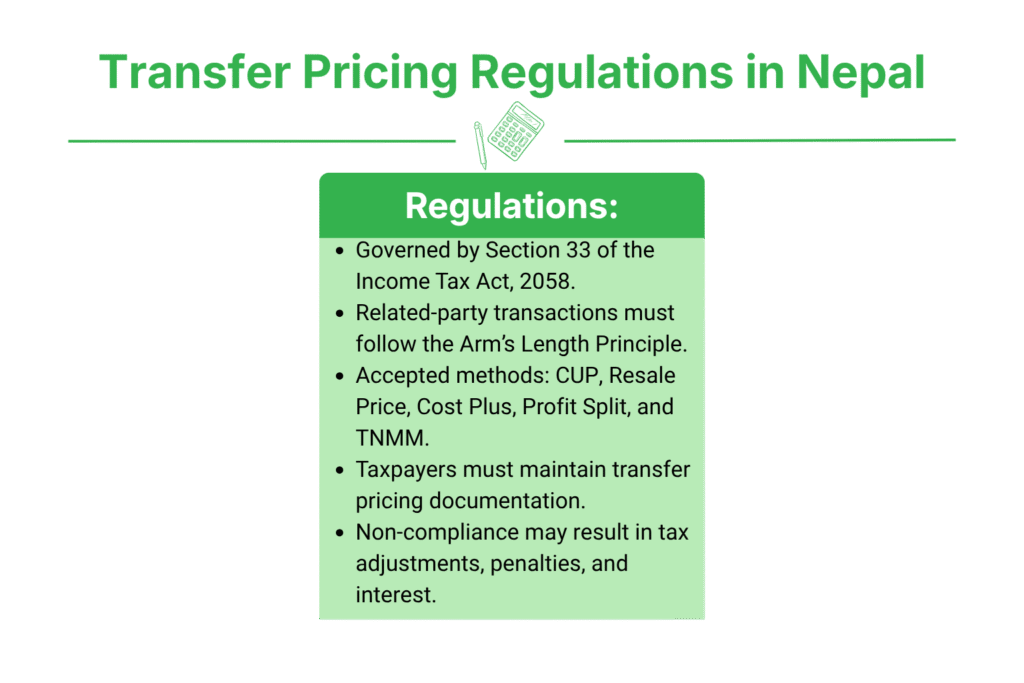
Transfer pricing is the pricing of transactions between related parties, such as a parent company and its Nepali subsidiary. Nepal introduced transfer pricing provisions under Section 33 of the Income Tax Act, 2058, which requires that transactions between related parties be conducted at arm’s length prices.
What Is Arm’s Length Pricing?
Arm’s length pricing means that the price charged between related parties must be equivalent to the price that would be charged between independent parties in a comparable transaction under comparable circumstances.
Transfer Pricing Methods Accepted in Nepal
The Inland Revenue Department accepts the following transfer pricing methods:
- Comparable Uncontrolled Price (CUP) Method
- Resale Price Method
- Cost Plus Method
- Profit Split Method
- Transactional Net Margin Method (TNMM)
Taxpayers engaged in cross border related-party transactions must maintain adequate documentation to support their transfer pricing policies. Failure to comply may result in tax adjustments, penalties, and interest charges by the IRD.
Permanent Establishment and Taxation of Foreign Companies
A Permanent Establishment (PE) is a fixed place of business through which a foreign enterprise carries out its business activities in Nepal. The concept of PE is defined under Section 2(da) of the Income Tax Act, 2058 and corresponding DTAA provisions.
When Does a Foreign Company Create a PE in Nepal?
A PE is established when:
- A foreign company has a fixed place of business in Nepal (office, branch, factory)
- An agent in Nepal habitually concludes contracts on behalf of the foreign company
- A construction or installation project lasts more than 90 days (or the period specified in the applicable DTAA)
- Services are provided in Nepal for a continuous period exceeding the threshold specified in the DTAA
Once a PE is established, the income attributable to the PE is subject to Nepali income tax at the corporate rate of 25%. An additional branch profit tax of 5% applies upon repatriation of profits.
Foreign Investment and Tax Incentives in Nepal
Nepal actively encourages foreign direct investment (FDI) and provides various tax incentives under the Foreign Investment and Technology Transfer Act, 2075 (2019) and the Industrial Enterprises Act, 2076 (2020).
Tax Incentives Available
- Tax holidays ranging from 5 to 10 years for priority industries
- Income tax concessions (up to 50% reduction) for manufacturing industries in remote areas
- Exemption from customs duty on machinery and equipment for approved industries
- Repatriation of profits permitted in convertible foreign currency after payment of applicable taxes
Foreign investors must obtain approval from the Department of Industry (DOI) or Investment Board Nepal (IBN) for FDI above certain thresholds. Tax repatriation requires compliance with Nepal Rastra Bank (NRB) foreign exchange regulations.
You can check the updated foreign investment procedures on the Department of Industry Nepal official website and the Inland Revenue Department Nepal.
Cross Border Tax Compliance: Required Documents
Businesses and individuals engaged in cross border transactions in Nepal must maintain the following documents for tax compliance:
- PAN registration certificate (if registered in Nepal)
- Tax residency certificate from the home country for DTAA benefit claims
- Audited financial statements of the Nepali entity
- Transfer pricing documentation for related-party transactions
- Withholding tax payment receipts and TDS returns
- Foreign tax payment evidence for claiming foreign tax credits
- Transaction contracts or agreements for cross-border service payments
- Board resolutions authorizing cross-border payments
Process for Claiming DTAA Benefits in Nepal
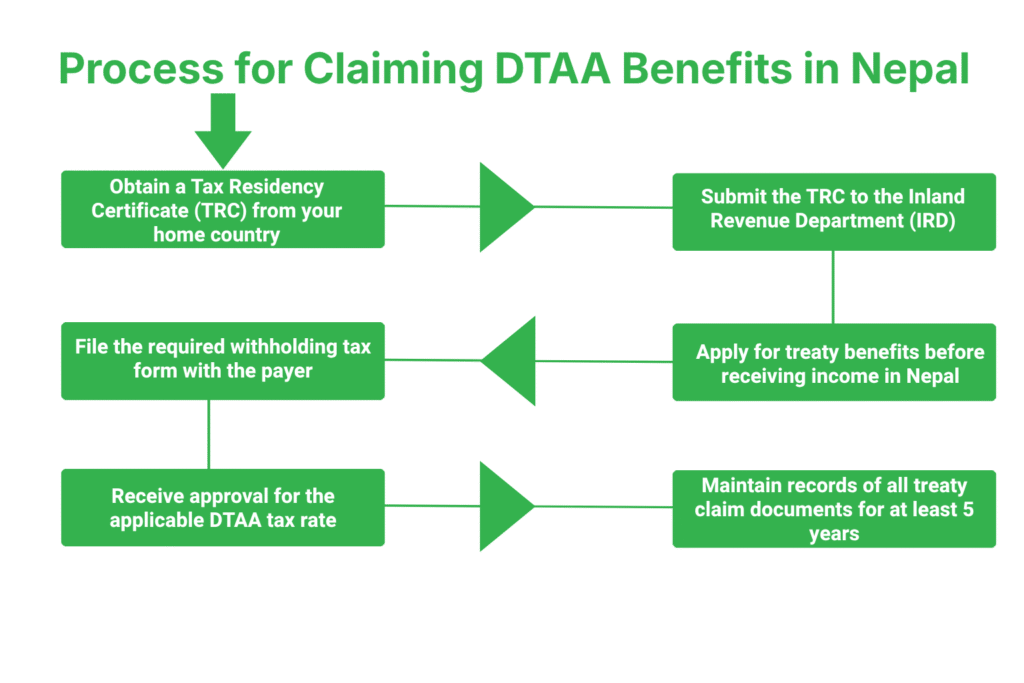
To claim reduced withholding tax rates or exemptions under DTAA, a non-resident must follow these steps:
- Obtain a Tax Residency Certificate (TRC) from the tax authority of the country of residence.
- Submit TRC and application to the Inland Revenue Department before or at the time of receiving income in Nepal.
- File Form 102 (applicable withholding tax form) with the payer entity.
- The payer applies the treaty rate at the time of payment after receiving IRD approval.
- Maintain documentation of all treaty claim submissions for at least 5 years.
Role of a Cross Border Tax Legal Advisor in Nepal
A qualified cross border tax legal advisor in Nepal performs the following functions:
- Analyzes the tax impact of international transactions before execution
- Advises on the applicability of DTAA provisions
- Structures foreign investments to minimize tax liability legally
- Assists in transfer pricing documentation and benchmarking
- Handles tax dispute resolution with the Inland Revenue Department
- Advises on withholding tax compliance for payments to non-residents
- Prepares advance pricing agreements with the IRD
- Guides on profit repatriation strategies compliant with NRB and IRD regulations
- Represents clients during tax audits and assessments
Penalties for Non-Compliance in Cross Border Tax Matters
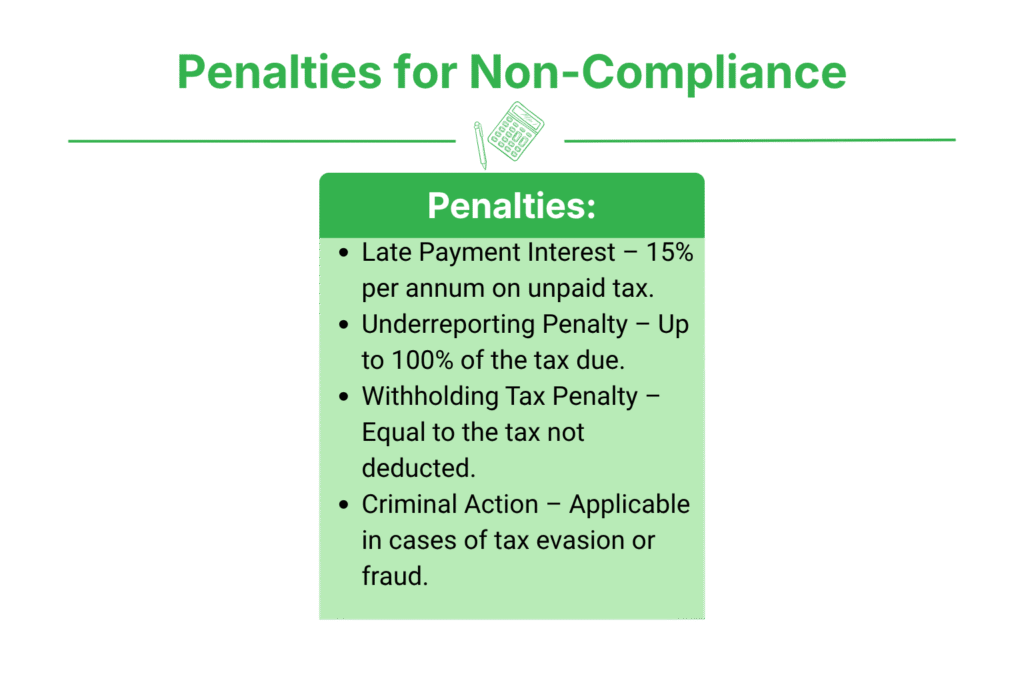
The Income Tax Act, 2058 imposes strict penalties for non-compliance:
- Late payment interest: 15% per annum on unpaid tax
- Penalty for underreporting: Up to 100% of the tax liability
- Penalty for failure to deduct withholding tax: Equal to the undeducted tax amount
- Criminal prosecution: In cases of tax evasion and fraud
FAQs
1. What is the corporate income tax rate for foreign companies in Nepal?
Foreign companies operating through a permanent establishment in Nepal pay corporate income tax at 25%. An additional branch profit tax of 5% applies on repatriation. DTAA countries may receive different treatment under applicable treaties.
2. Can Nepal residents claim a tax credit for taxes paid abroad?
Yes. Under Section 68 of the Income Tax Act, 2058, Nepal residents can claim a foreign tax credit for income taxes paid abroad. The credit is limited to the Nepali tax payable on the foreign-sourced income.
3. What documents are required to claim DTAA benefits in Nepal?
A valid Tax Residency Certificate from the home country tax authority, along with the applicable withholding tax forms, must be submitted to the Inland Revenue Department before receiving Nepal-sourced income.
4. Does Nepal have transfer pricing regulations?
Yes. Section 33 of the Income Tax Act, 2058 mandates arm’s length pricing for transactions between related parties. The IRD can make adjustments if transactions are not priced at market rates.
5. Is VAT applicable on cross-border services in Nepal?
Yes. The Value Added Tax Act, 2052 applies VAT on the import of services into Nepal. Foreign service providers supplying digital or professional services in Nepal may have VAT registration obligations under current IRD guidance.
6. Where can I find official information on Nepal’s tax treaties?
The official list of Double Taxation Avoidance Agreements signed by Nepal is available on the Inland Revenue Department Nepal website under the international tax section.
Conclusion
Cross border tax legal advisory in Nepal covers a wide range of tax obligations under the Income Tax Act, 2058, DTAA provisions, transfer pricing rules, withholding tax regulations, and foreign investment tax incentives. Businesses and individuals engaged in international transactions must seek professional legal advice to ensure full compliance with Nepal’s tax laws while optimizing their tax positions lawfully. The Inland Revenue Department remains the key regulatory authority, and all cross border tax matters must be addressed in accordance with its guidelines and applicable bilateral treaties.