


Foreign company compliance in Nepal, operating in Nepal must follow a defined set of legal obligations under Nepali law. Whether a company has established a branch office, liaison office, or a joint venture, it must comply with the applicable statutes and regulatory frameworks. This article covers the complete compliance landscape for foreign companies in Nepal.
What Is a Foreign Company Under Nepali Law?
Under Section 2(n) of the Companies Act, 2063 (2006), a foreign company refers to a company incorporated outside Nepal that establishes a place of business within the territory of Nepal. This definition includes branch offices, representative offices, and liaison offices of overseas entities.
The Foreign Investment and Technology Transfer Act, 2075 (2019) (FITTA) further defines foreign investment as investment made by a foreign investor through equity, reinvestment of earnings, or lending arrangements in a Nepali enterprise.
Foreign companies must register with the Office of the Company Registrar (OCR) and comply with applicable provisions across company law, tax law, labor law, and foreign exchange law.
What Laws Govern Foreign Company Compliance in Nepal?
Nepal has a multi-layered legal framework governing foreign companies. The compliance obligations arise from several statutes:
| Law | Governing Body | Key Area |
|---|---|---|
| Companies Act, 2063 | Office of Company Registrar | Registration, Annual Filing |
| Foreign Investment and Technology Transfer Act, 2075 (FITTA, 2075) | Department of Industry / Investment Board Nepal | Foreign Investment Approval |
| Industrial Enterprises Act, 2076 | Department of Industry | Industrial Registration |
| Income Tax Act, 2058 | Inland Revenue Department | Tax Compliance |
| Labor Act, 2074 | Department of Labour | Employment & Labor |
| Foreign Exchange (Regulation) Act, 1962 | Nepal Rastra Bank | Foreign Currency Transactions |
| Value Added Tax Act, 2052 | Inland Revenue Department | VAT Registration & Filing |
How Does a Foreign Company Register in Nepal?

Step 1: Obtain Investment Approval
Before registration, a foreign company must obtain approval under FITTA, 2075. For investments up to NPR 6 billion, the approval authority is the Department of Industry (DoI). For investments exceeding NPR 6 billion, the Investment Board Nepal (IBN) handles the approval.
The application must be submitted through the online portal at Department of Industry Nepal.
Step 2: Register with the Office of the Company Registrar
After receiving investment approval, the foreign company must register with the OCR under Section 153 of the Companies Act, 2063. Foreign companies wishing to establish a place of business in Nepal must submit the following documents:
- Certified copy of the Certificate of Incorporation from the home country
- Memorandum and Articles of Association (or equivalent constitutive documents)
- Board resolution authorizing establishment in Nepal
- Details of the authorized representative in Nepal
- Certified copy of the latest audited financial statements
- Power of Attorney for the local representative
- Passport copy of the authorized representative
- Address proof of the principal place of business in Nepal
- Investment approval letter from DoI or IBN
Step 3: Register with Inland Revenue Department
Following OCR registration, the company must obtain a Permanent Account Number (PAN) from the Inland Revenue Department (IRD). If the annual turnover exceeds NPR 50 lakh, VAT registration is mandatory under the Value Added Tax Act, 2052.
Step 4: Open a Corporate Bank Account
Foreign companies must open a bank account with a commercial bank licensed by Nepal Rastra Bank (NRB). All foreign investment amounts must be channeled through this bank account in accordance with the Foreign Exchange (Regulation) Act, 2019.
What Are the Annual Compliance Requirements for Foreign Companies in Nepal?
Annual compliance is a mandatory obligation for all registered foreign companies in Nepal. Failure to comply results in penalties and potential deregistration.
Annual Filing with OCR
Under Section 154 of the Companies Act, 2063, foreign companies must submit an annual return to the OCR within three months from the end of the fiscal year (which ends Ashadh end, i.e., mid-July). The annual return must include:
- Updated list of directors and officers
- Any changes in the Memorandum and Articles of Association
- Audited financial statements for the Nepal operations
- Declaration of any changes in the registered address
The OCR portal for filing is accessible at ocr.gov.np.
Tax Filing with IRD
Foreign companies are subject to income tax in Nepal under the Income Tax Act, 2058 (2002). The applicable provisions include:
- Section 67 – A permanent establishment (PE) of a foreign company in Nepal is taxed on its Nepal-source income
- Section 2(dha) – Defines permanent establishment broadly to include offices, branches, and places of management
- Corporate income tax rate – 25% for general companies; 20% for certain special industries; 30% for banking and financial institutions
Tax return filing must be completed within three months from the end of the fiscal year under Section 96 of the Income Tax Act, 2058.
Advance tax payments are required on a quarterly basis under Section 94 of the Income Tax Act, 2058.
VAT Return Filing
Registered VAT payers must file monthly VAT returns with the IRD. VAT is levied at 13% on taxable supplies under the Value Added Tax Act, 2052.
What Are the Labor Compliance Requirements?
Foreign companies employing staff in Nepal must comply with the Labor Act, 2074 (2017) and the Social Security Act, 2074 (2017).
Employment Obligations
- All employment contracts must be in writing as per Section 6 of the Labor Act, 2074
- Employees are entitled to provident fund contributions at 10% of basic salary by the employer and 10% by the employee
- Gratuity, festival allowances, leave encashment, and overtime payments are mandatory under the Labor Act
- Foreign nationals employed in Nepal must hold a valid work permit issued by the Department of Labor and Occupational Safety
Social Security Contributions
Under the Social Security Act, 2074, employers must contribute 20% of basic salary to the Social Security Fund (SSF), while employees contribute 11%. The SSF portal is accessible at ssf.gov.np.
What Are the Foreign Exchange Compliance Requirements?
Foreign companies must adhere to foreign exchange regulations administered by Nepal Rastra Bank (NRB) under the Foreign Exchange (Regulation) Act, 2019 (1962).
| Transaction | Regulatory Requirement |
|---|---|
| Remittance of Profits | Approval from Nepal Rastra Bank; withholding tax applies |
| Repatriation of Capital | Prior approval from Nepal Rastra Bank required |
| Foreign Loan Borrowing | Approval under Foreign Investment and Technology Transfer Act, 2075 and Nepal Rastra Bank guidelines |
| Technology Transfer Fees | Registered under FITTA; remittance with Nepal Rastra Bank approval |
| Dividend Repatriation | 5% withholding tax under Income Tax Act, 2058 |
Under Regulation 3 of FITTA, 2075, foreign investors are guaranteed the right to repatriate profits, dividends, and principal after fulfilling tax obligations.
What Are the Penalties for Non-Compliance?
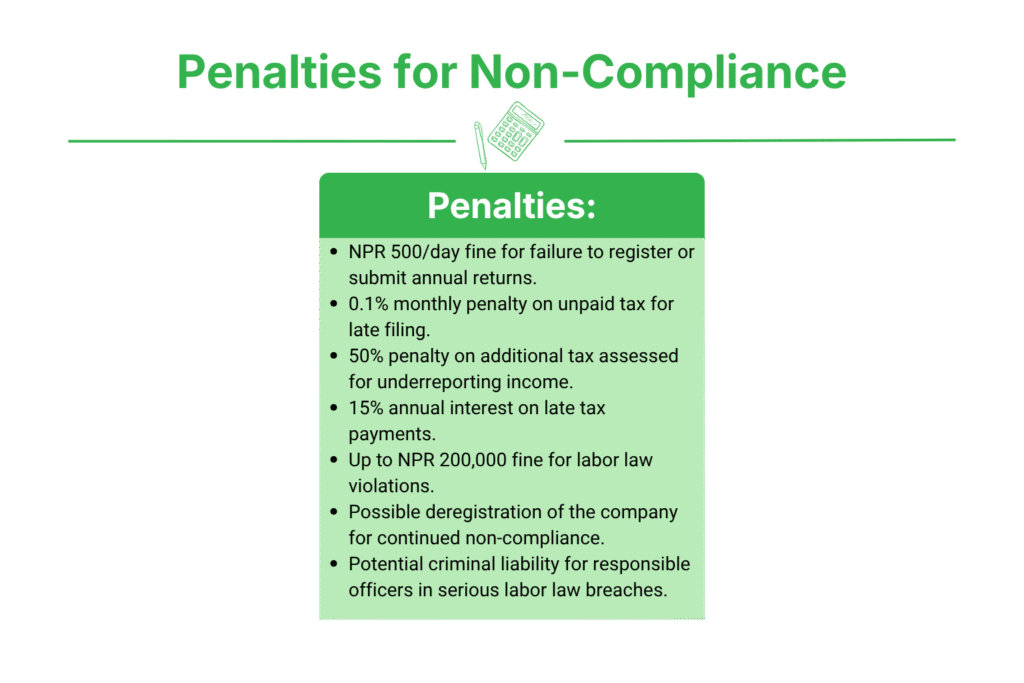
Nepal’s legal framework prescribes penalties for failure to comply with company, tax, and labor laws.
Penalties Under the Companies Act, 2063
Under Section 157 of the Companies Act, 2063, a foreign company that fails to register or submit annual returns is subject to a fine of NPR 500 per day for continuing default. The OCR may also initiate proceedings for deregistration.
Penalties Under the Income Tax Act, 2058
- Late filing penalty: 0.1% per month of the unpaid tax amount under Section 117
- Penalty for underreporting: 50% of the additional tax assessed under Section 118
- Interest on late payment: 15% per annum under Section 119
Penalties Under the Labor Act, 2074
Failure to maintain employment records, non-payment of social security contributions, or non-payment of wages may result in fines up to NPR 200,000 and potential criminal liability for responsible officers under Chapter 12 of the Labor Act, 2074.
What Is the Difference Between a Branch Office and Liaison Office?
Foreign companies in Nepal can establish their presence in two primary forms:
Branch Office:
- Can conduct commercial activities and generate revenue in Nepal
- Subject to full tax liability on Nepal-source income
- Must register under Section 153 of the Companies Act, 2063
- Requires investment approval under FITTA, 2075
Liaison Office (Representative Office):
- Cannot conduct commercial activities or generate revenue
- Limited to coordination, promotion, and communication functions
- Annual operating expenses must be funded through remittances from the parent company
- Must obtain approval from the Department of Industry and register with OCR
FAQs
1. Does a foreign company need to appoint a local representative in Nepal?
Yes. Under Section 153 of the Companies Act, 2063, every foreign company operating in Nepal must appoint an authorized representative who resides in Nepal and is responsible for compliance matters before the OCR and other regulatory authorities.
2. What is the minimum foreign investment required to register under FITTA?
Under FITTA, 2075 (2019), the minimum foreign investment threshold is NPR 50 million (approximately USD 400,000). Investments below this threshold are not eligible for foreign investment approval unless categorized under specific priority sectors.
3. Can a foreign company own 100% equity in a Nepali entity?
Yes, 100% foreign ownership is permitted in most sectors under FITTA, 2075. However, certain sectors such as media, retail trade, and some services are restricted or reserved for Nepali nationals under the Negative List of FITTA regulations.
4. What taxes does a foreign company’s branch office pay in Nepal?
A branch office pays 25% corporate income tax on Nepal-source income, along with applicable VAT, withholding taxes on payments, and advance tax under the Income Tax Act, 2058. Remittance of branch profits also attracts 5% withholding tax.
5. How long does OCR registration of a foreign company take?
OCR registration of a foreign company typically takes 7 to 15 working days after submission of all required documents. The timeline depends on document completeness and OCR processing capacity. You can track the status at ocr.gov.np.
6. What happens if a foreign company does not file its annual return?
Under Section 157 of the Companies Act, 2063, the OCR imposes a daily fine of NPR 500 for non-filing. Prolonged default may lead to deregistration, blacklisting, and legal proceedings against the authorized representative.
Conclusion
Foreign company compliance in Nepal involves multiple layers of legal obligations under the Companies Act, 2063, FITTA, 2075, Income Tax Act, 2058, Labor Act, 2074, and the Foreign Exchange (Regulation) Act, 2019. Every foreign entity operating in Nepal must maintain annual filings with the OCR, pay taxes on time with the IRD, comply with social security obligations, and follow NRB guidelines on foreign exchange transactions. Non-compliance carries financial penalties, operational disruption, and potential deregistration. Companies should maintain proper legal counsel and stay updated with regulatory changes issued by the Office of the Company Registrar, the Department of Industry, and the Inland Revenue Department to maintain full compliance in Nepal.