
Cross border compliance in Nepal refers to the set of legal, regulatory, and procedural obligations that individuals, businesses, and organizations must fulfill when moving goods, services, capital, or people across Nepal’s international borders. Nepal shares open borders with India and regulated borders with China (Tibet Autonomous Region). Understanding cross border compliance in Nepal is essential for importers, exporters, foreign investors, travelers, and migrant workers who operate within Nepal’s jurisdiction.
What Is Cross Border Compliance in Nepal?
Cross border compliance in Nepal is the process of adhering to all applicable laws, rules, and regulations when conducting any activity that crosses Nepal’s national boundaries. This includes customs procedures, immigration controls, foreign exchange regulations, trade compliance, and taxation requirements.
Nepal’s cross border compliance framework is governed by multiple laws and regulatory bodies. The key governing laws include:
- Customs Act, 2007 (2064 BS)
- Foreign Exchange (Regulation) Act, 1962 (2019 BS)
- Immigration Act, 1992 (2049 BS)
- Industrial Enterprises Act, 2020 (2076 BS)
- Foreign Investment and Technology Transfer Act, 2019 (2075 BS)
- Income Tax Act, 2002 (2058 BS)
- Value Added Tax Act, 1995 (2052 BS)
The Department of Customs and the Department of Immigration are the two primary regulatory bodies managing cross border compliance in Nepal.
What Are the Key Areas of Cross Border Compliance in Nepal?
Cross border compliance in Nepal covers several distinct regulatory areas. Each area has its own set of rules, documentation requirements, and penalties for non-compliance.
1. Customs Compliance
Customs compliance is one of the most critical areas of cross border compliance in Nepal. The Customs Act, 2007 governs all import and export activities. Nepal uses the Harmonized System (HS) Code for classifying goods, which aligns with international customs standards.
All goods entering or exiting Nepal must pass through designated customs checkpoints. The major customs checkpoints include:
- Birgunj Customs Office (Nepal-India border)
- Biratnagar Customs Office (Nepal-India border)
- Bhairahawa Customs Office (Nepal-India border)
- Tatopani Customs Office (Nepal-China border)
- Rasuwagadhi Customs Office (Nepal-China border)
- Tribhuvan International Airport Customs Office (Kathmandu)
2. Immigration Compliance
Nepal’s immigration compliance is governed by the Immigration Act, 1992 and the Immigration Regulations, 1994. Foreign nationals entering Nepal must hold a valid visa, except for Indian citizens who can enter Nepal without a visa under the Treaty of Peace and Friendship, 1950.
Citizens of most countries can obtain a visa on arrival at Tribhuvan International Airport and at designated land border checkpoints. The Department of Immigration issues various types of visas including tourist visas, business visas, residential visas, and non-tourist visas.
3. Foreign Exchange Compliance
The Foreign Exchange (Regulation) Act, 1962 governs the movement of foreign currency in and out of Nepal. Nepal Rastra Bank (NRB) is the regulatory authority for foreign exchange compliance. Key requirements include:
- Travelers entering Nepal with more than USD 5,000 (or equivalent) must declare the amount at customs.
- Travelers leaving Nepal can carry a maximum of NPR 5,000 in Nepalese currency.
- Foreign investors must repatriate profits through official banking channels only.
- Foreign currency brought into Nepal for investment must be registered with the NRB.
4. Trade Compliance
Nepal’s trade compliance framework involves adherence to bilateral and multilateral trade agreements. Nepal is a member of:
- World Trade Organization (WTO) – member since 2004
- South Asian Free Trade Area (SAFTA)
- Bay of Bengal Initiative for Multi-Sectoral Technical and Economic Cooperation (BIMSTEC)
- Asia-Pacific Trade Agreement (APTA)
Trade compliance also involves obtaining the required licenses, permits, and certificates for specific categories of goods.
What Documents Are Required for Cross Border Compliance in Nepal?
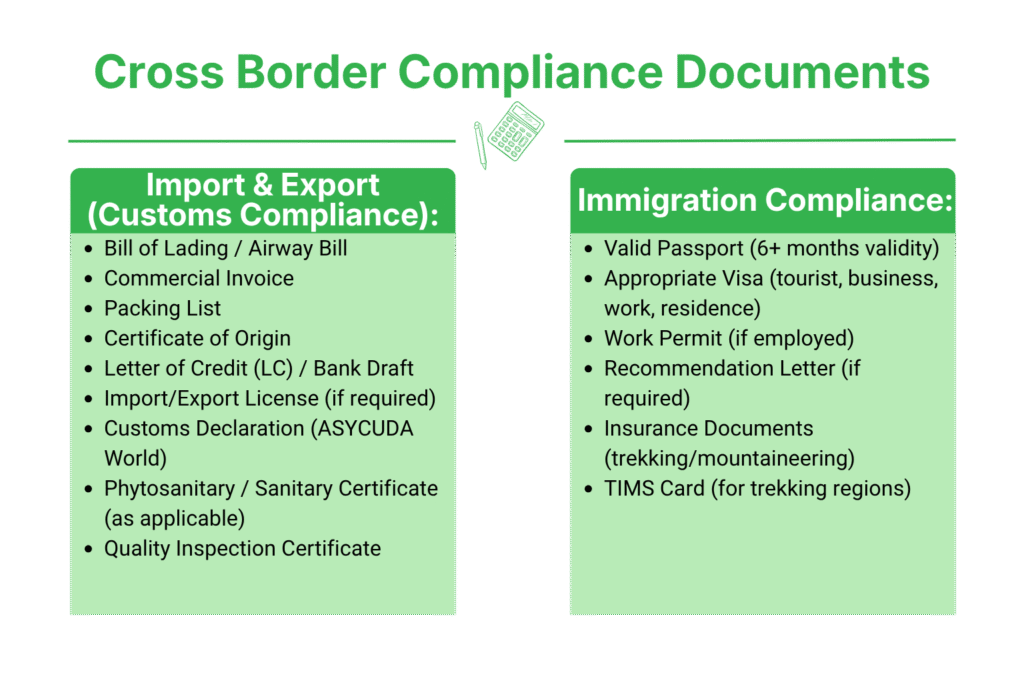
For Import and Export (Customs Compliance)
- Bill of Lading or Airway Bill
- Commercial Invoice
- Packing List
- Certificate of Origin
- Letter of Credit (LC) or Bank Draft
- Import/Export License (for restricted goods)
- Customs Declaration Form (ASYCUDA System)
- Phytosanitary Certificate (for agricultural products)
- Sanitary Certificate (for animal products)
- Quality Inspection Certificate
Nepal uses the ASYCUDA World System (Automated System for Customs Data) for electronic customs declaration, which the Department of Customs administers.
For Immigration Compliance
- Valid Passport (minimum 6 months validity)
- Visa (tourist, business, work, or residential)
- Work Permit (issued by the Department of Labour)
- Recommendation Letter from relevant ministry (for certain visa categories)
- Insurance Documents (for trekking and mountaineering)
- TIMS Card (Trekkers’ Information Management System) for trekking areas
What Are the Cross Border Compliance Requirements for Foreign Investors?
Foreign investors operating in Nepal must comply with the Foreign Investment and Technology Transfer Act, 2019 (FITTA 2019). This law defines foreign investment as investment made by a foreign national or company in Nepal through equity participation, reinvestment of earnings, or lending to affiliated companies.
Key Compliance Steps for Foreign Investors:
- Register the company with the Office of Company Registrar under the Companies Act, 2006.
- Obtain approval from the Department of Industry or Investment Board Nepal (IBN) depending on the investment size.
- Register foreign investment with Nepal Rastra Bank for foreign exchange compliance.
- Obtain industry-specific licenses from concerned ministries or departments.
- Register for tax with the Inland Revenue Department (IRD) under the Income Tax Act, 2002.
- Register for VAT with the Inland Revenue Department if annual turnover exceeds NPR 5 million.
- Obtain necessary environmental clearances if the investment involves industries covered under the Environment Protection Act, 2019.
| Investment Amount | Approval Authority |
|---|---|
| Up to NPR 6 billion | Department of Industry |
| NPR 6 billion to NPR 20 billion | Investment Board Nepal (IBN) |
| Above NPR 20 billion | Investment Board Nepal (IBN) with Cabinet approval |
The minimum foreign investment threshold under FITTA 2019 is NPR 20 million (approximately USD 150,000).
What Are the Penalties for Non-Compliance with Cross Border Regulations in Nepal?
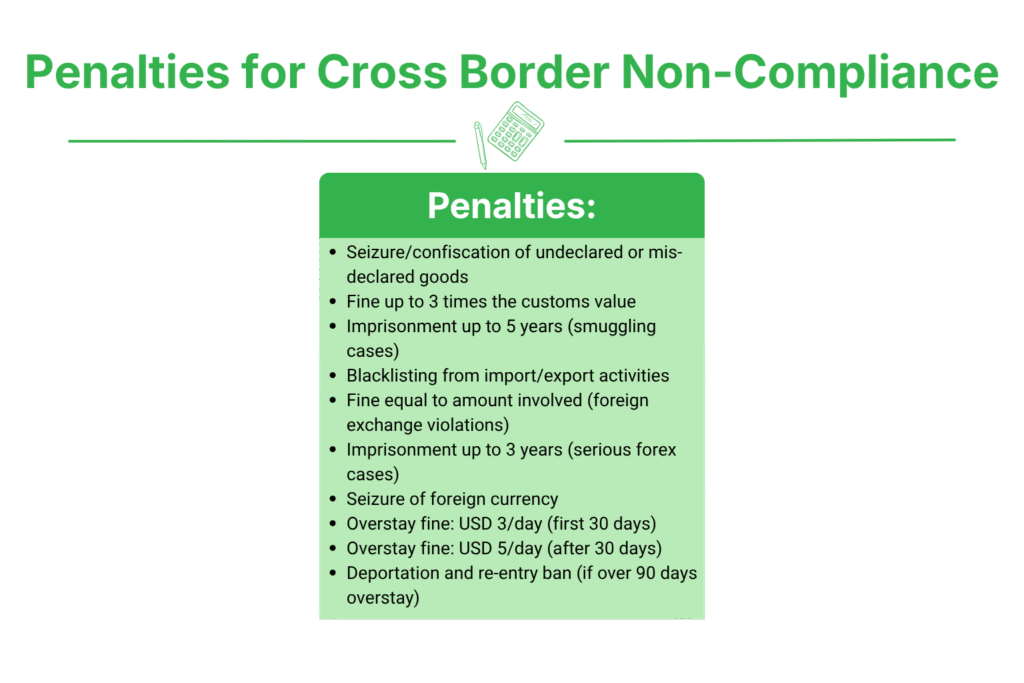
Non-compliance with cross border regulations in Nepal carries significant legal and financial consequences. The Customs Act, 2007 prescribes the following penalties:
- Seizure and confiscation of undeclared or mis-declared goods
- Fine up to three times the customs value of the goods
- Imprisonment up to five years for smuggling offenses
- Blacklisting of importers or exporters from future customs clearance
Under the Foreign Exchange (Regulation) Act, 1962, violations related to unauthorized foreign exchange transactions can result in:
- Fines equivalent to the amount involved in the violation
- Imprisonment up to three years for serious offenses
- Seizure of foreign currency
Under the Immigration Act, 1992, overstaying a visa in Nepal results in a fine of USD 3 per day for the first 30 days and USD 5 per day beyond 30 days. Foreigners who overstay for more than 90 days may face deportation and a ban on re-entry.
What Is the Role of the Department of Customs in Cross Border Compliance?
The Department of Customs Nepal operates under the Ministry of Finance and is the primary authority for cross border compliance related to goods. The Department administers:
- Customs tariff rates under the Nepal Customs Tariff schedule
- Customs valuation based on WTO Customs Valuation Agreement principles
- Risk management and post-clearance audits
- Anti-dumping and countervailing measures
- Trade facilitation through the ASYCUDA World System
Nepal’s customs tariff is structured into multiple bands. The general customs duty rates range from 0% to 80% depending on the category of goods. Additional levies such as Value Added Tax (13%), Excise Duty, and Agricultural Reform Fee may also apply on imports.
Key Regulatory Bodies and Their Functions
| Regulatory Body | Function | Governing Law |
|---|---|---|
| Department of Customs | Import/export clearance, tariff administration | Customs Act, 2007 |
| Department of Immigration | Visa issuance, entry/exit control | Immigration Act, 1992 |
| Nepal Rastra Bank | Foreign exchange regulation | Foreign Exchange (Regulation) Act, 1962 |
| Department of Industry | Foreign investment approval | Foreign Investment and Technology Transfer Act, 2075 (FITTA, 2019) |
| Inland Revenue Department | Tax registration, VAT compliance | Income Tax Act, 2058; Value Added Tax Act, 2052 |
| Department of Labour | Work permit issuance | Labor Act, 2074 |
| Investment Board Nepal | Large investment approvals | Investment Board Nepal Act, 2011 |
How Does Nepal’s Open Border with India Affect Cross Border Compliance?
Nepal and India share an open border under the Treaty of Peace and Friendship, 1950. This treaty allows citizens of both countries to move freely without passports or visas. However, cross border compliance requirements still apply in several areas:
- Customs compliance remains mandatory for goods crossing the Nepal-India border. Commercial goods require full customs documentation regardless of the open border arrangement.
- Foreign exchange controls apply for both Nepali and Indian citizens. The Nepal-India currency exchange operates under a fixed exchange rate managed by Nepal Rastra Bank.
- Anti-smuggling measures are actively enforced along the Nepal-India border through joint operations between Nepal’s customs authorities and India’s Sashastra Seema Bal (SSB).
The Nepal-India Trade Treaty and the Nepal-India Transit Treaty provide the legal framework for bilateral trade compliance between the two countries.
What Are the Steps for Customs Clearance in Nepal?
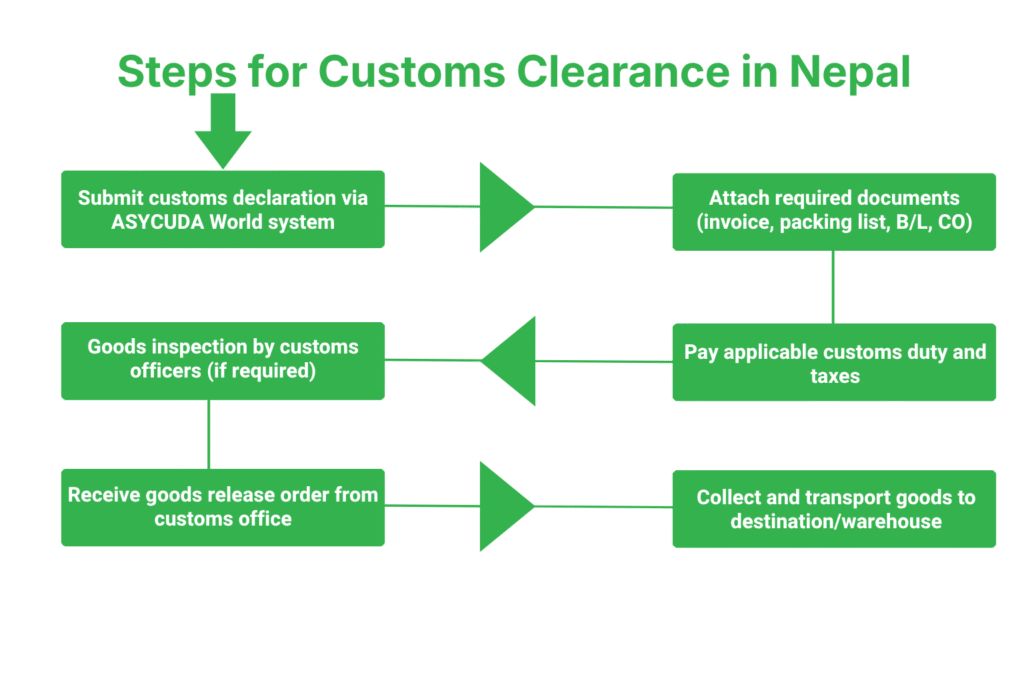
- Submit the customs declaration through the ASYCUDA World System electronically.
- Attach all required documents including the commercial invoice, packing list, bill of lading, and certificate of origin.
- Pay customs duty and taxes at the designated bank counter or through online payment.
- Physical examination of goods by customs officers (applies to red channel or amber channel shipments).
- Obtain the goods release order from the customs office.
- Transport goods to the designated warehouse or delivery point.
Nepal’s customs clearance system uses a risk-based selectivity system categorized into:
- Green Channel – automatic clearance without physical examination
- Yellow Channel – document verification only
- Red Channel – physical examination and document verification
FAQs
1. What is the minimum foreign investment amount required in Nepal?
Under the Foreign Investment and Technology Transfer Act, 2019 (FITTA 2019), the minimum foreign investment threshold in Nepal is NPR 20 million. This applies to equity participation in Nepalese companies by foreign nationals or entities.
2. Do Indian citizens need a visa to enter Nepal?
No. Indian citizens do not require a visa to enter Nepal under the Treaty of Peace and Friendship, 1950. They can enter Nepal with a valid Indian passport or voter ID card and stay without any time restriction.
3. What happens if a foreign national overstays their visa in Nepal?
Foreign nationals who overstay their visa in Nepal must pay USD 3 per day for the first 30 days and USD 5 per day beyond 30 days. Overstays exceeding 90 days may result in deportation and a re-entry ban.
4. Which authority approves foreign investment in Nepal?
The Department of Industry approves foreign investments up to NPR 6 billion. Investments above NPR 6 billion require approval from the Investment Board Nepal (IBN). Both operate under separate legal frameworks.
5. What is the customs duty rate range in Nepal?
Nepal’s customs duty rates range from 0% to 80% depending on the category of goods under the Nepal Customs Tariff schedule. Additional levies including 13% VAT, excise duty, and agricultural reform fees may also apply on imported goods.
6. What is the ASYCUDA system used in Nepal’s customs?
ASYCUDA World (Automated System for Customs Data) is the electronic customs declaration system used by Nepal’s Department of Customs. It processes import and export declarations, manages duty calculations, and facilitates trade documentation online.
Conclusion
Cross border compliance in Nepal involves adherence to a comprehensive legal framework covering customs, immigration, foreign exchange, taxation, and trade regulations. The Customs Act 2007, Immigration Act 1992, Foreign Exchange (Regulation) Act 1962, and FITTA 2019 form the backbone of Nepal’s cross border regulatory structure. Businesses and individuals who plan to engage in cross border activities in Nepal must understand and comply with these laws to avoid penalties, delays, and legal complications. Regular updates from the Department of Customs, Department of Immigration, and Nepal Rastra Bank are advisable to stay aligned with current compliance requirements.Add to Conversation