

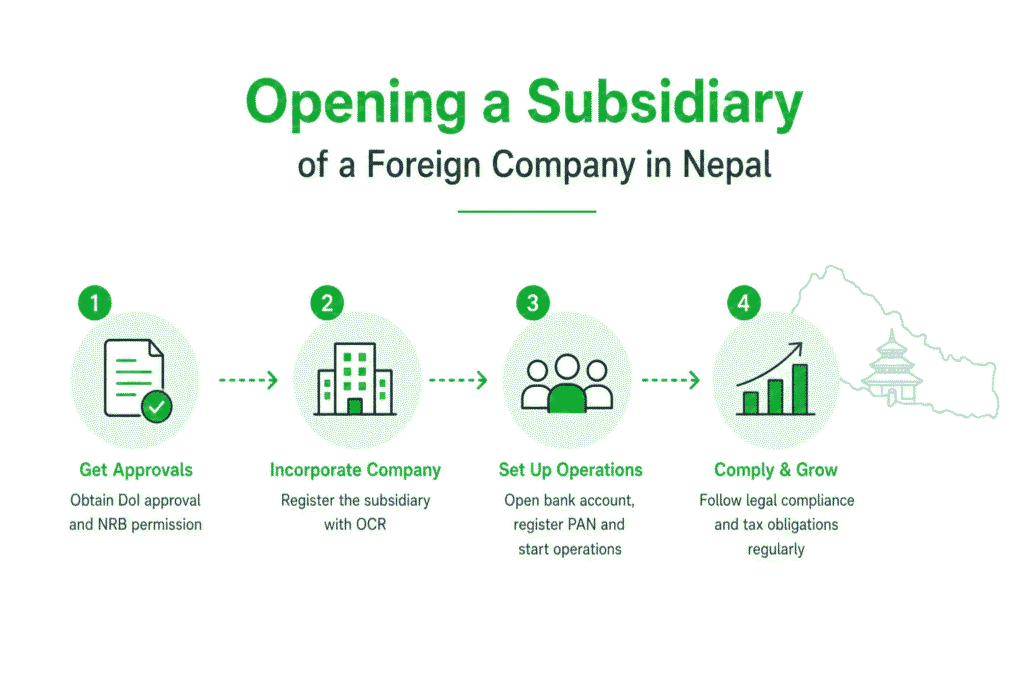
Foreign companies looking to establish a presence in Nepal often consider opening a subsidiary as a preferred mode of entry. A subsidiary of a foreign company in Nepal is a separate legal entity incorporated under Nepali law, where the parent foreign company holds ownership either fully or partially. This article covers the legal framework, registration process, required documents, capital requirements, and all related aspects of opening a subsidiary of a foreign company in Nepal.
What Is a Subsidiary of a Foreign Company in Nepal?
A subsidiary company is an independent legal entity registered under the laws of Nepal, in which a foreign parent company holds shares or ownership. Unlike a branch office or liaison office, a subsidiary has its own legal identity, can own assets, enter contracts, sue and be sued in its own name, and operate independently within the scope of Nepali law.
The subsidiary is distinct from:
- Branch Office: An extension of the foreign parent company without a separate legal identity.
- Liaison Office: A representative office that cannot conduct commercial activities.
- Joint Venture: A partnership between a foreign entity and a Nepali entity.
A subsidiary is the most comprehensive and legally robust form of foreign business presence in Nepal.
Legal Framework Governing Foreign Company Subsidiaries in Nepal
The following laws and regulations govern the establishment and operation of a subsidiary of a foreign company in Nepal:
| Law / Regulation | Purpose |
|---|---|
| Companies Act, 2006 (2063 B.S.) | Governs company registration and corporate governance |
| Foreign Investment and Technology Transfer Act, 2075 (FITTA, 2019) | Governs foreign direct investment in Nepal |
| Industrial Enterprises Act, 2076 (2020) | Governs industrial operations and permits |
| Income Tax Act, 2058 (2002) | Governs taxation of companies |
| Foreign Exchange (Regulation) Act, 1962 | Governs foreign currency transactions |
| Labor Act, 2074 (2017) | Governs employment of workers |
The Foreign Investment and Technology Transfer Act (FITTA), 2019 is the primary legislation for foreign investors. It replaced the earlier FITTA of 1992 and provides a more streamlined and investor-friendly legal environment for foreign direct investment (FDI) in Nepal.
Under Section 3 of FITTA 2019, foreign investment in Nepal is permitted in the form of:
- Equity shares
- Reinvestment of earnings
- Loan or debenture investment
- Technology transfer agreements
Can a Foreign Company Own 100% of a Subsidiary in Nepal?
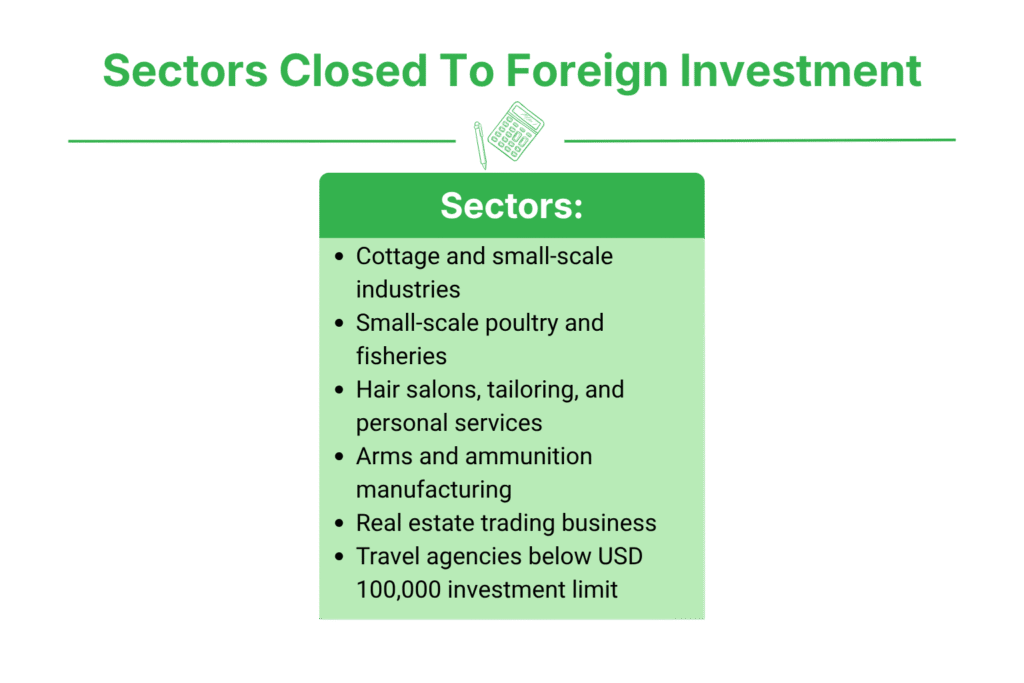
Yes, a foreign company can own 100% of a subsidiary in Nepal in most sectors. However, certain sectors are restricted or reserved under Schedule 1 and Schedule 2 of FITTA 2019, which list sectors that are either closed to foreign investment or require mandatory joint venture arrangements with Nepali partners.
Sectors closed to foreign investment include:
- Cottage and small-scale industries
- Poultry farming and fisheries (below specified thresholds)
- Personal service businesses such as hair salons, tailoring
- Arms and ammunition manufacturing
- Real estate business (buying and selling of land)
- Travel agency (below USD 100,000 investment)
For sectors not listed in the restricted schedule, a foreign company may own 100% equity in a subsidiary incorporated in Nepal.
Minimum Foreign Investment Requirement in Nepal
Under FITTA 2019, foreign investors must meet a minimum investment threshold to qualify for foreign investment approval. The minimum foreign investment required is:
- NPR 50 million (approximately USD 375,000) for most sectors.
However, for specific sectors such as information technology, consulting, and certain service industries, the minimum investment may differ as prescribed by the government through separate notifications.
Types of Subsidiary Structures Available
A foreign company may incorporate a subsidiary in Nepal under the following structures as defined in the Companies Act, 2006:
- Private Limited Company (Pvt. Ltd.): Most common structure for subsidiaries; requires a minimum of one shareholder and maximum of 101 shareholders.
- Public Limited Company (Ltd.): Required for companies intending to raise funds from the public; requires a minimum of seven shareholders.
Most foreign companies choose the Private Limited Company structure due to its simpler governance, lower compliance requirements, and flexibility.
Step-by-Step Process to Register a Subsidiary of a Foreign Company in Nepal
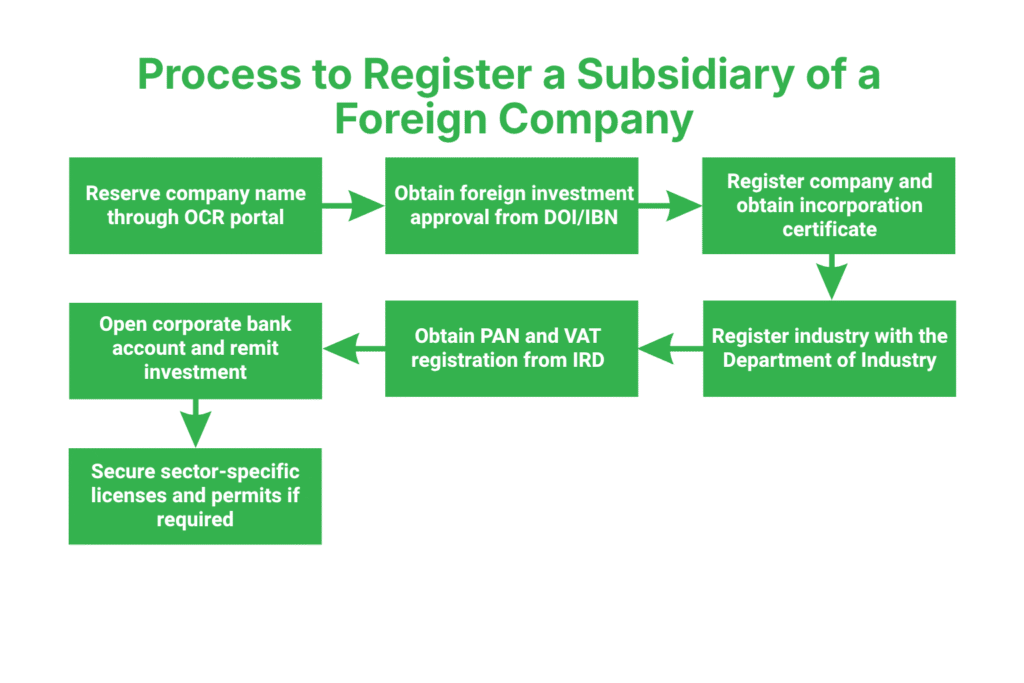
Step 1: Name Reservation
- Apply for company name reservation at the Office of the Company Registrar (OCR) in Nepal.
- Visit the official OCR portal: https://ocr.gov.np
- Submit the desired company name for approval.
- Name approval is usually granted within 1-3 working days.
Step 2: Obtain Foreign Investment Approval
- Apply to the Department of Industry (DOI) or the Investment Board Nepal (IBN) depending on the investment size.
- DOI handles investments below NPR 6 billion.
- IBN handles investments above NPR 6 billion.
- Submit the foreign investment application along with required documents.
- DOI website: https://doind.gov.np
- IBN website: https://ibn.gov.np
Step 3: Company Registration at OCR
- After obtaining foreign investment approval, register the company at the OCR.
- Submit the Memorandum of Association (MOA) and Articles of Association (AOA).
- Pay the prescribed registration fees.
- OCR issues the Certificate of Incorporation.
Step 4: Register at Department of Industry
- Register the company as an industry at the DOI to obtain an Industry Registration Certificate.
Step 5: Tax Registration (PAN/VAT)
- Register the company at the Inland Revenue Department (IRD) to obtain a Permanent Account Number (PAN).
- If annual turnover exceeds the prescribed threshold, VAT registration is mandatory.
- IRD website: https://ird.gov.np
Step 6: Open a Corporate Bank Account
- Open a company bank account at a licensed commercial bank in Nepal.
- Remit the foreign investment amount through proper banking channels as per Nepal Rastra Bank (NRB) regulations.
Step 7: Obtain Additional Licenses (if applicable)
- Depending on the sector, the subsidiary may require additional licenses or permits from relevant regulatory authorities.
Documents Required to Register a Subsidiary of a Foreign Company in Nepal
From the Foreign Parent Company:
- Certificate of Incorporation of the parent company (notarized and apostilled)
- Memorandum and Articles of Association of the parent company
- Board resolution authorizing the establishment of the subsidiary in Nepal
- Latest audited financial statements of the parent company
- Passport copies of directors/authorized signatories
- Power of Attorney (if applicable)
For Nepal Company Registration:
- Proposed Memorandum of Association (MOA)
- Proposed Articles of Association (AOA)
- Name reservation approval letter from OCR
- Passport-sized photographs of directors
- Residential address proof of directors
- Foreign investment approval letter from DOI/IBN
- Tax clearance certificate or equivalent from the parent company’s home country
Foreign Investment Approval: DOI vs. Investment Board Nepal
| Criteria | Department of Industry (DOI) | Investment Board Nepal (IBN) |
|---|---|---|
| Investment Threshold | Up to NPR 6 billion | Above NPR 6 billion |
| Processing Time | 15–30 working days | Variable |
| Applicable Law | Foreign Investment and Technology Transfer Act, 2075 (FITTA 2019) | Investment Board Nepal Act, 2011 |
| Industries Covered | Manufacturing, service, IT | Large infrastructure, hydropower, etc. |
Taxation of a Foreign Company Subsidiary in Nepal
A subsidiary registered in Nepal is treated as a resident company under the Income Tax Act, 2002 and is therefore subject to full Nepali taxation. The key tax obligations include:
- Corporate Income Tax: The standard corporate tax rate is 25% for most industries. Special tax rates apply for certain industries, such as 20% for special industries and 15% for export-oriented industries.
- Dividend Tax: When the subsidiary distributes profits to the foreign parent company, a 5% dividend withholding tax applies.
- Value Added Tax (VAT): Standard VAT rate is 13% on taxable goods and services.
- Tax Treaty Benefits: Nepal has Double Taxation Avoidance Agreements (DTAA) with several countries including India, China, Sri Lanka, Norway, Austria, Pakistan, and South Korea. Subsidiary companies can benefit from reduced withholding tax rates under applicable treaties.
Repatriation of profits from the subsidiary to the parent company is governed by Nepal Rastra Bank (NRB) regulations and FITTA 2019. Foreign investors are permitted to repatriate dividends, profits, and capital after meeting all tax obligations.
Employment of Foreign Nationals in a Subsidiary
A subsidiary of a foreign company in Nepal may employ foreign nationals subject to the following conditions under the Labor Act, 2017 and the Department of Labor:
- Foreign nationals require a work permit from the Department of Labor and Occupational Safety.
- The number of foreign employees must comply with the ratio prescribed by law, generally not exceeding 5% of the total workforce in most industries.
- Senior management and technical expert positions may be filled by foreign nationals where qualified Nepali professionals are not available.
- Work permits must be renewed annually.
Timeline for Establishing a Subsidiary of a Foreign Company in Nepal
The overall timeline for incorporating a subsidiary and obtaining all necessary approvals in Nepal typically ranges from 45 to 90 working days, depending on the sector, investment size, and completeness of documents submitted.
Advantages of Establishing a Subsidiary in Nepal
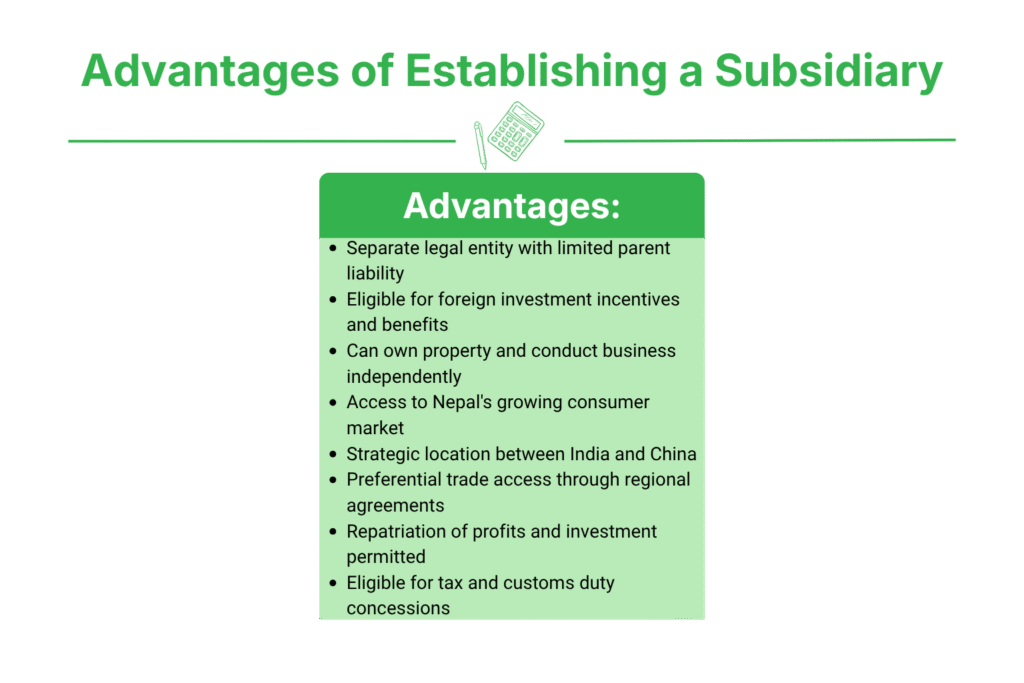
- The subsidiary operates as a separate legal entity, limiting the liability of the foreign parent company.
- Eligible for all incentives and facilities under FITTA 2019 and Industrial Enterprises Act 2020, including tax holidays, customs duty concessions, and repatriation rights.
- Can enter into contracts, own property, and conduct full-scale commercial operations independently.
- Access to Nepal’s growing consumer market and strategic geographic location between India and China.
- Nepal’s membership in SAFTA, BIMSTEC, and WTO provides preferential trade access to regional markets.
FAQs
1. Can a foreign company open a 100% owned subsidiary in Nepal?
Yes, a foreign company can own 100% of a subsidiary in Nepal in sectors not restricted under FITTA 2019. Sectors listed in the restricted schedules require joint ventures or are closed to foreign investment entirely.
2. What is the minimum investment required for a foreign company subsidiary in Nepal?
Under FITTA 2019, the minimum foreign investment threshold is NPR 50 million (approximately USD 375,000) for most sectors. Specific sectors may have different thresholds as notified by the government.
3. Where does a foreign company apply for investment approval in Nepal?
Foreign companies apply to the Department of Industry (DOI) for investments below NPR 6 billion, and to the Investment Board Nepal (IBN) for investments exceeding NPR 6 billion.
4. How long does it take to register a subsidiary of a foreign company in Nepal?
The entire process, including foreign investment approval and company registration, typically takes 45 to 90 working days, subject to document completeness and sector-specific requirements.
5. Can a subsidiary of a foreign company in Nepal repatriate profits?
Yes, after meeting all Nepali tax obligations and complying with NRB regulations, a foreign company subsidiary can legally repatriate dividends and profits to the parent company abroad under FITTA 2019.
6. What taxes does a foreign company subsidiary pay in Nepal?
A subsidiary pays corporate income tax at 25% (standard rate), 5% dividend withholding tax on profit distribution, and 13% VAT on applicable transactions. Double taxation treaty benefits may apply depending on the parent company’s home country.
Conclusion
Opening a subsidiary of a foreign company in Nepal involves a structured legal process under FITTA 2019, the Companies Act 2006, and other applicable laws. From name reservation at the OCR to obtaining foreign investment approval from DOI or IBN, each step requires careful preparation of documents and compliance with Nepali regulations. A subsidiary is the most commercially viable and legally secure form of foreign business presence in Nepal, offering full operational freedom, profit repatriation rights, and access to available investment incentives. Foreign investors are advised to consult qualified legal and financial professionals in Nepal to ensure full regulatory compliance throughout the establishment and operation of the subsidiary.Add to Conversation