
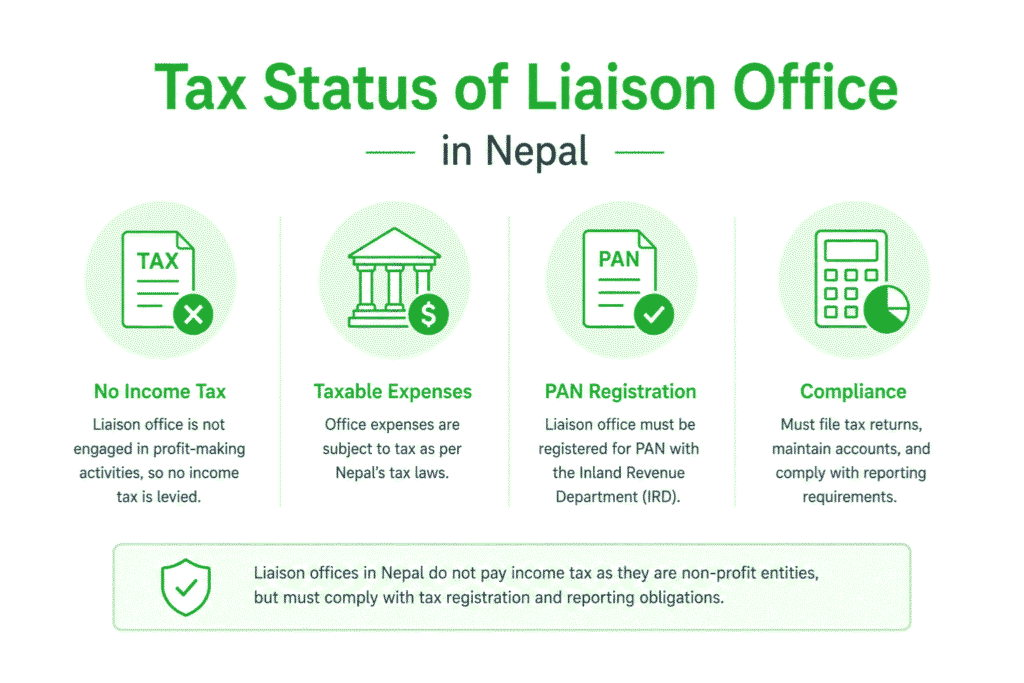
Tax Status of Liaison Office in Nepal, A liaison office in Nepal operates under a distinct legal and tax framework that differs significantly from a branch office or a subsidiary company. Foreign companies that establish liaison offices in Nepal often face questions about their tax obligations, registration requirements, and compliance duties under Nepali law. This article provides a detailed explanation of the tax status of a liaison office in Nepal, covering the applicable laws, tax treatment, registration requirements, and compliance obligations.
What Is a Liaison Office in Nepal?
A liaison office is a representative office established by a foreign company in Nepal to conduct limited, non-commercial activities on behalf of the parent company. It does not engage in direct commercial transactions, does not generate revenue in Nepal, and acts purely as a communication channel between the foreign parent company and its Nepali counterparts.
The Department of Industry (DoI) under the Ministry of Industry, Commerce and Supplies governs the registration of liaison offices in Nepal. Foreign companies must obtain approval from the DoI under the Foreign Investment and Technology Transfer Act (FITTA), 2075 (2019) and the Industrial Enterprises Act, 2076 (2020) to operate a liaison office in Nepal.
The permitted activities of a liaison office in Nepal include:
- Conducting market research and feasibility studies
- Promoting the parent company’s products and services
- Coordinating communication between the parent company and Nepali partners
- Collecting information on behalf of the parent company
- Providing technical assistance in limited capacity
Legal Framework Governing Liaison Offices in Nepal

Several laws and regulations govern the establishment and operation of liaison offices in Nepal:
- Foreign Investment and Technology Transfer Act (FITTA), 2075 (2019) – Provides the framework for foreign investment and establishment of representative offices.
- Industrial Enterprises Act, 2076 (2020) – Governs industrial registration, including liaison offices.
- Income Tax Act, 2058 (2002) – The primary legislation for determining tax obligations of entities in Nepal.
- Value Added Tax Act, 2052 (1995) – Governs VAT registration and compliance.
- Company Act, 2063 (2006) – Regulates company-related matters, including foreign company registrations.
- Nepal Rastra Bank Act, 2058 (2002) – Governs foreign exchange transactions related to liaison office operations.
Tax Status of a Liaison Office in Nepal
Is a Liaison Office Subject to Income Tax in Nepal?
The tax status of a liaison office in Nepal depends on whether the office constitutes a Permanent Establishment (PE) under the Income Tax Act, 2058. This is the most fundamental question in determining the tax liability of a liaison office.
Under Section 2(da) of the Income Tax Act, 2058, a permanent establishment is defined as a fixed place of business through which the business of a person is wholly or partly carried on in Nepal. A liaison office that restricts its activities to preparatory and auxiliary functions such as market research, information gathering, and communication generally does not qualify as a permanent establishment.
Key Principle: If the liaison office does not constitute a PE in Nepal, the income attributable to it is not taxable in Nepal under the Income Tax Act, 2058.
When Does a Liaison Office Become a Permanent Establishment?
A liaison office in Nepal may be treated as a permanent establishment and thus become subject to income tax in the following situations:
- The office concludes contracts on behalf of the foreign parent company in Nepal
- The office carries out activities beyond auxiliary or preparatory functions
- The office generates or facilitates revenue directly within Nepal
- Employees of the liaison office have authority to bind the parent company in transactions
If the Inland Revenue Department (IRD) determines that a liaison office functions as a PE, it becomes subject to corporate income tax at the rate of 25% as applicable to foreign entities under the Income Tax Act, 2058.
Tax Registration Requirements for Liaison Offices in Nepal
Even if a liaison office does not have taxable income in Nepal, it still has mandatory tax registration obligations.
Permanent Account Number (PAN) Registration
Every liaison office operating in Nepal must obtain a Permanent Account Number (PAN) from the Inland Revenue Department (IRD). This requirement applies regardless of whether the office has taxable income. The PAN registration is mandatory under Section 77 of the Income Tax Act, 2058.
Documents required for PAN registration:
- Certificate of registration from the Department of Industry
- Approval letter from the Department of Industry for the liaison office
- Citizenship or passport copy of the authorized representative
- Office address proof (lease agreement or ownership document)
- Duly filled PAN registration form
VAT Registration
A liaison office in Nepal that does not engage in taxable transactions is generally exempt from mandatory VAT registration under the Value Added Tax Act, 2052. Since a liaison office does not sell goods or supply taxable services, it does not meet the threshold for VAT registration.
However, if the liaison office’s activities cross into commercial territory, the VAT Act, 2052 may apply and the IRD may require VAT registration.
Withholding Tax Obligations of Liaison Offices in Nepal
Even though a liaison office may not be subject to income tax on its own activities, it has withholding tax obligations when making certain payments.
Under the Income Tax Act, 2058, a liaison office must deduct withholding tax when making the following payments:
| Criteria | Department of Industry (DOI) | Investment Board Nepal (IBN) |
|---|---|---|
| Investment Threshold | Up to NPR 6 billion | Above NPR 6 billion |
| Processing Time | 15–30 working days | Variable |
| Applicable Law | Foreign Investment and Technology Transfer Act, 2075 (FITTA 2019) | Investment Board Nepal Act, 2011 |
| Industries Covered | Manufacturing, service, IT | Large infrastructure, hydropower, etc. |
The liaison office must deposit the withheld tax with the IRD within the prescribed deadline and file monthly withholding tax returns accordingly.
Annual Tax Compliance Obligations
Tax Return Filing
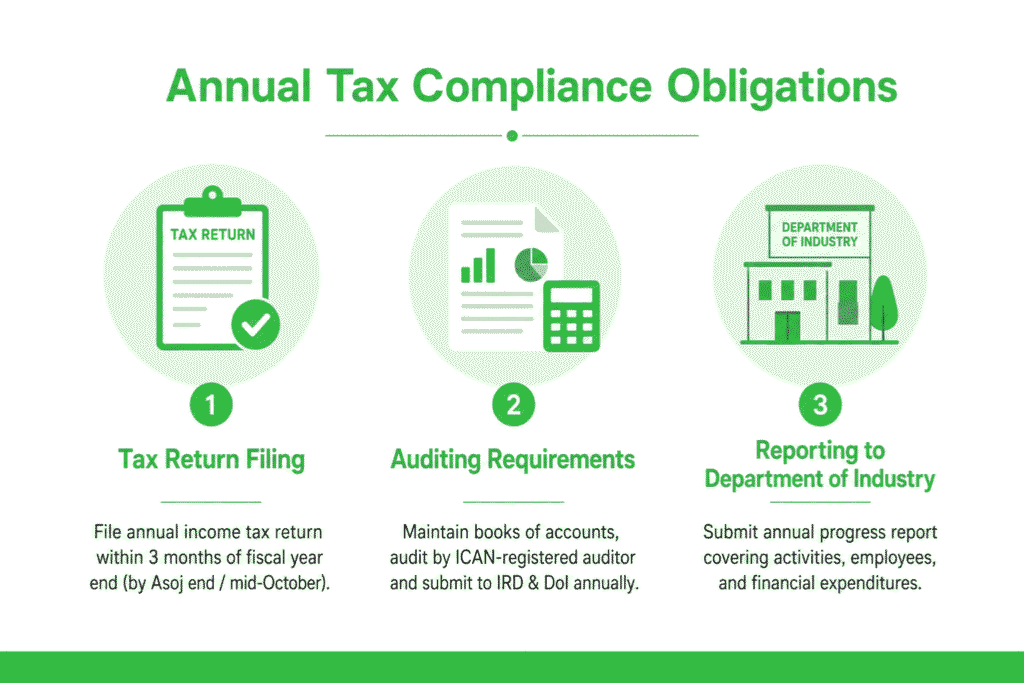
A liaison office registered in Nepal must file an annual income tax return with the IRD even if it has no taxable income for the year. The return must declare all sources of funds received from the parent company and all expenditures made in Nepal.
The annual tax return must be filed within three months from the end of the fiscal year (i.e., by Asoj end / mid-October) under the Income Tax Act, 2058.
Auditing Requirements
A liaison office in Nepal must maintain proper books of accounts and have them audited by a licensed auditor registered with ICAN (Institute of Chartered Accountants of Nepal). The audited financial statements must be submitted to the IRD and the Department of Industry annually.
Reporting to Department of Industry
Under the FITTA, 2075 and the Industrial Enterprises Act, 2076, a liaison office must submit an annual progress report to the Department of Industry. This report covers the activities conducted during the year, employee details, and financial expenditures.
Transfer Pricing Considerations for Liaison Offices
Transfer pricing is an area of concern when a liaison office receives funds from the parent company for operational expenses. The Income Tax Act, 2058, Section 33 addresses transfer pricing and requires that transactions between related parties including a liaison office and its parent company be conducted at arm’s length prices.
The IRD may scrutinize the fund transfers from the parent company to the liaison office to ensure that the amounts represent genuine reimbursements for actual expenses and are not used to shift profits or avoid taxes in either jurisdiction.
Fund Repatriation and Foreign Exchange Compliance
A liaison office in Nepal funds its operations through remittances from the parent company abroad. These fund transfers must comply with the Foreign Exchange (Regulation) Act, 2019 (2076 BS) and the directives issued by Nepal Rastra Bank (NRB).
The liaison office must:
- Open a bank account in Nepal in Nepali Rupees
- Receive funds only through banking channels
- Maintain records of all foreign exchange transactions
- Report foreign exchange transactions to the NRB as required
The liaison office cannot repatriate profits since it does not generate profits in Nepal. All fund transfers represent reimbursements of operational costs only.
Summary Table: Tax Status of Liaison Office vs. Branch Office vs. Subsidiary in Nepal
| Criteria | Liaison Office | Branch Office | Subsidiary Company |
|---|---|---|---|
| Income Tax on Business Income | Not applicable (if no Permanent Establishment) | Applicable at 25% | Applicable at 25% |
| PAN Registration | Mandatory | Mandatory | Mandatory |
| VAT Registration | Generally not required | Required if taxable turnover exceeds threshold | Required if taxable turnover exceeds threshold |
| Withholding Tax | Mandatory | Mandatory | Mandatory |
| Annual Tax Return | Mandatory (nil return if no income) | Mandatory | Mandatory |
| Profit Repatriation | Not permitted | Permitted after tax | Permitted after tax |
| Audited Accounts | Mandatory | Mandatory | Mandatory |
| Permanent Establishment Risk | Low (if activities are auxiliary) | Yes (constitutes PE) | Separate legal entity |
Penalties for Non-Compliance
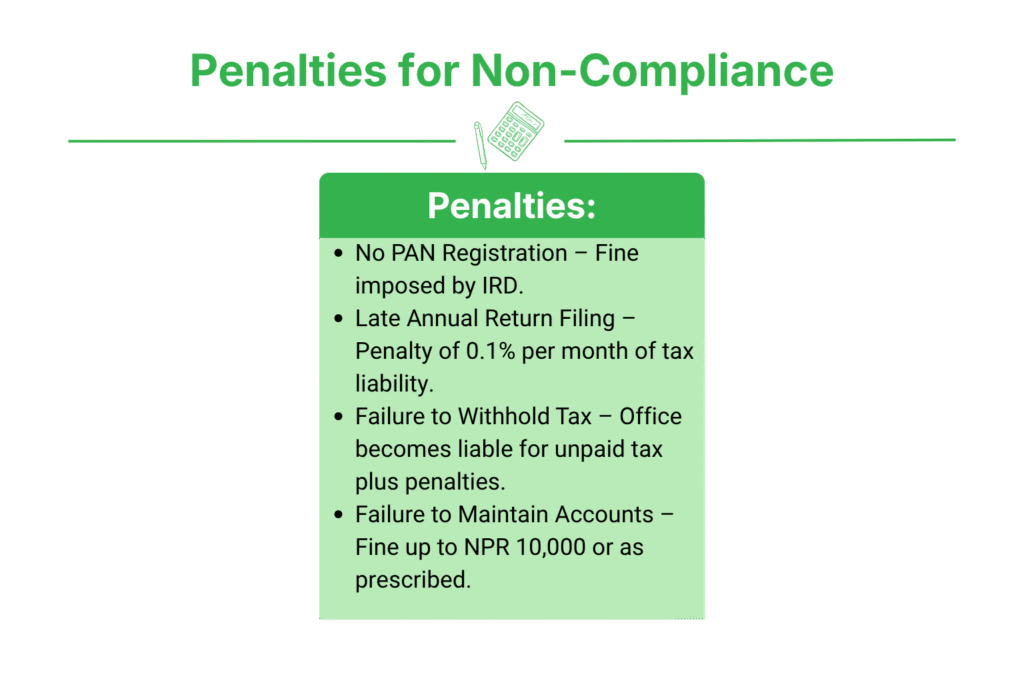
A liaison office that fails to meet its tax obligations under Nepal’s tax laws faces penalties under the Income Tax Act, 2058 and the Tax Administration Guidelines. Key penalties include:
- Failure to register for PAN: Fine as determined by the IRD
- Failure to file annual returns on time: 0.1% per month of the total tax liability
- Failure to withhold tax: The liaison office itself becomes liable for the tax amount plus penalties
- Failure to maintain accounts: Fine up to NPR 10,000 or as prescribed
Relevant Government Resources
For official information, liaison offices can visit the following government portals:
- Inland Revenue Department Nepal – www.ird.gov.np
- Department of Industry Nepal – www.doind.gov.np
- Nepal Rastra Bank – www.nrb.org.np
- Office of the Company Registrar – www.ocr.gov.np
FAQs
1. Is a liaison office in Nepal required to pay income tax?
A liaison office in Nepal is generally not subject to income tax if it does not constitute a permanent establishment under the Income Tax Act, 2058. If it crosses into commercial activities, income tax at 25% applies.
2. Does a liaison office in Nepal need to register for PAN?
Yes. Every liaison office in Nepal must register for a Permanent Account Number (PAN) with the Inland Revenue Department under Section 77 of the Income Tax Act, 2058, regardless of taxable income.
3. Is a liaison office required to file annual tax returns in Nepal?
Yes. Even if a liaison office has no taxable income, it must file an annual nil income tax return with the Inland Revenue Department within three months of the fiscal year’s end.
4. What is the withholding tax obligation of a liaison office in Nepal?
A liaison office must deduct withholding tax on payments for salaries, rent, services, and contracts and deposit the withheld amount with the IRD monthly, as required under the Income Tax Act, 2058.
5. Can a liaison office in Nepal conduct commercial activities?
No. A liaison office is restricted to auxiliary and preparatory activities under FITTA, 2075. Conducting commercial activities violates its registration terms and may expose it to permanent establishment tax liability.
6. What happens if a liaison office in Nepal violates its tax obligations?
The IRD can impose penalties, fines, and interest on unpaid taxes. In serious cases, the Department of Industry may revoke the liaison office registration under the Industrial Enterprises Act, 2076.
Conclusion
The tax status of a liaison office in Nepal is primarily governed by whether it constitutes a permanent establishment under the Income Tax Act, 2058. A properly structured liaison office that restricts its activities to auxiliary and preparatory functions does not bear income tax liability in Nepal. However, it must comply with PAN registration, withholding tax obligations, annual return filing, and audit requirements. Non-compliance with these obligations carries financial penalties and the risk of registration cancellation. Foreign companies operating liaison offices in Nepal must ensure full compliance with the Income Tax Act, 2058, FITTA, 2075, and related regulations to avoid legal complications.