


A representative office for foreign company in Nepal is a formal business presence that a foreign entity establishes in Nepal without engaging in direct commercial or profit-generating activities. It serves as a liaison, coordination, or promotional arm of the parent company. Nepal’s legal framework permits foreign companies to open representative offices under specific conditions, subject to approval from relevant government authorities.
This article covers everything about establishing a representative office in Nepal, including the legal basis, registration process, required documents, permitted activities, taxation, and compliance obligations.
What Is a Representative Office of a Foreign Company in Nepal?
A representative office is a non-commercial extension of a foreign company registered and operating in another country. It does not independently conduct business, generate revenue, or enter into commercial contracts in Nepal on its own behalf. Instead, it represents the parent company for purposes such as market research, promotion, liaison work, and coordination.
The concept of a representative office in Nepal is governed under:
- The Companies Act, 2006 (2063 B.S.)
- The Foreign Investment and Technology Transfer Act (FITTA), 2019 (2075 B.S.)
- The Industrial Enterprises Act, 2020 (2076 B.S.)
- Nepal Rastra Bank (NRB) Foreign Exchange Regulations
Under FITTA 2019, foreign investment is broadly defined, and representative offices fall within a regulated category. The Office of the Company Registrar (OCR) and the Department of Industry (DOI) are the primary authorities overseeing the registration and operation of such offices.
Why Do Foreign Companies Open Representative Offices in Nepal?
Foreign companies choose to open a representative office in Nepal for several strategic reasons:
- To explore market entry opportunities in Nepal without committing to full business registration
- To manage bilateral communication between the parent company and Nepali clients or partners
- To conduct research, feasibility studies, and market analysis
- To promote the parent company’s products, services, or brand
- To supervise ongoing projects or contracts awarded to the parent company by Nepali entities
- To fulfill requirements under donor-funded projects or development assistance programs
A representative office does not have legal capacity to independently sign commercial contracts or invoice clients in Nepal. All such transactions must go through the parent company abroad.
Legal Framework Governing Representative Offices in Nepal
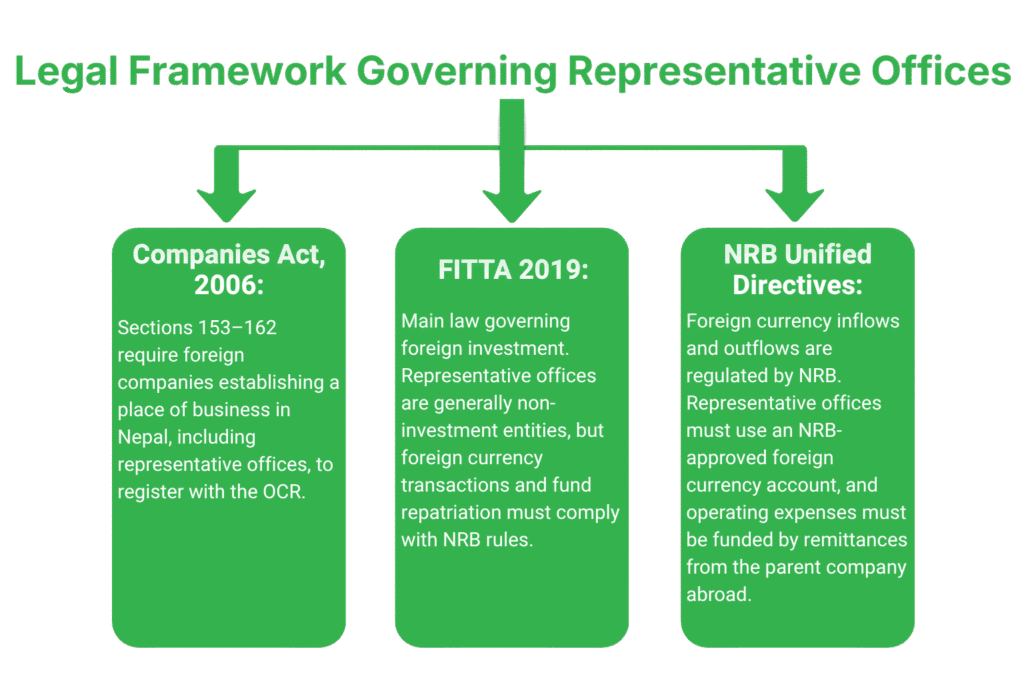
Companies Act, 2006
Section 153 to 162 of the Companies Act, 2006 deals with foreign companies operating in Nepal. A foreign company that establishes a place of business in Nepal must register with the OCR. This includes representative offices.
Foreign Investment and Technology Transfer Act (FITTA), 2019
FITTA 2019 is the principal law regulating foreign investment in Nepal. It defines the sectors open and restricted for foreign investment. While representative offices are generally non-investment entities, any repatriation of funds or foreign currency transactions must comply with NRB regulations under this law.
Nepal Rastra Bank Unified Directives
NRB regulates all foreign currency inflows and outflows. A representative office must open a foreign currency account with a commercial bank in Nepal approved by NRB. Operating expenses of the representative office must be funded through remittances from the parent company abroad.
Who Can Establish a Representative Office in Nepal?
Any foreign company legally incorporated in its home country can apply to establish a representative office in Nepal, provided:
- The company is validly registered under its home country’s laws
- The company has a legitimate business purpose for the representative office
- The proposed activities fall within permitted, non-commercial functions
- The company appoints a resident representative in Nepal
There is no minimum capital requirement for a representative office. However, the parent company must demonstrate its financial capacity to fund the office’s operations through remittances.
Permitted and Prohibited Activities of a Representative Office
| Permitted Activities | Prohibited Activities |
|---|---|
| Market research and feasibility studies | Direct sale of goods or services in Nepal |
| Promotion and marketing of parent company | Signing of commercial contracts independently |
| Liaison between parent company and Nepali clients | Generating revenue or invoicing in Nepal |
| Monitoring and coordination of ongoing projects | Opening letters of credit independently |
| Representing the parent company in meetings | Engaging in retail or wholesale trade |
| Hiring local staff for office operations | Borrowing from Nepali financial institutions |
The representative office cannot earn profit in Nepal. All operating expenses must be met through funds remitted from the parent company’s foreign account.
Registration Process for a Representative Office in Nepal
The registration of a representative office involves multiple steps across different government bodies. The process is sequential and must be completed in the order described below.
Step 1: Obtain Approval from the Department of Industry (DOI)
The first step is to apply to the Department of Industry (DOI) under the Ministry of Industry, Commerce and Supplies. The applicant must submit:
- Application form for representative office registration
- Board resolution of the parent company authorizing establishment in Nepal
- Certificate of incorporation of the parent company (notarized and apostilled)
- Memorandum and Articles of Association of the parent company
- Latest audited financial statements of the parent company
- Passport copy of the authorized representative
- Letter of authorization appointing the Nepal representative
- Proposed activities of the representative office in Nepal
DOI reviews the application and issues an approval letter if all conditions are met. This typically takes 15–30 working days.
For more information, visit the official DOI website: https://www.doind.gov.np
Step 2: Register with the Office of the Company Registrar (OCR)
After receiving DOI approval, the foreign company must register with the OCR under Section 153 of the Companies Act, 2006. Required documents include:
- DOI approval letter
- Certified copy of the parent company’s incorporation certificate
- Memorandum and Articles of Association
- Board resolution in favor of Nepal office establishment
- Name and address of the resident representative
- Registered address of the Nepal office
- Power of attorney in favor of the representative
OCR issues a registration certificate upon completion. This officially recognizes the representative office as a legal presence in Nepal.
Visit OCR’s official portal: https://www.ocr.gov.np
Step 3: Register for PAN at the Inland Revenue Department (IRD)
All businesses operating in Nepal, including representative offices, must obtain a Permanent Account Number (PAN) from the Inland Revenue Department (IRD). PAN is mandatory for:
- Tax compliance
- Opening a bank account
- Hiring local staff and managing payroll
VAT registration is generally not required unless the office exceeds the taxable threshold through any commercial activity. Visit: https://www.ird.gov.np
Step 4: Open a Bank Account and Register with Nepal Rastra Bank
The representative office must open a Non-Resident Foreign Currency (NRFC) account or an approved local bank account with a licensed commercial bank in Nepal. The NRB must be notified of this account, and all funds must be remitted from the parent company abroad.
Documents Required for Representative Office Registration in Nepal
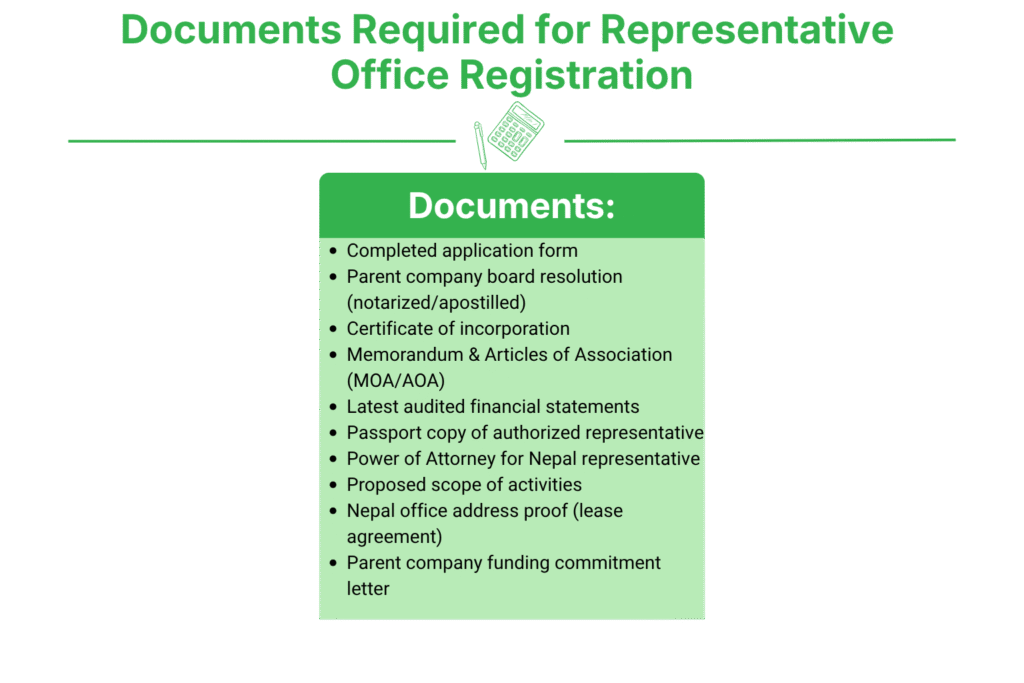
- Completed application form
- Board resolution of the parent company (notarized and apostilled)
- Certificate of incorporation of parent company
- Memorandum and Articles of Association
- Latest audited balance sheet and financial statements
- Passport copy of the authorized representative
- Power of attorney in favor of the Nepal representative
- Proposed scope of work and activities
- Registered office address proof in Nepal (lease agreement)
- Letter from the parent company committing to fund operations
Tax and Compliance Obligations of a Representative Office
Income Tax
Under the Income Tax Act, 2002 (2058 B.S.), representative offices are subject to Nepali tax law. Even though the office does not generate revenue locally, salaries paid to local staff and certain expenses may have tax implications.
The office must:
- File annual tax returns with IRD
- Deduct TDS (Tax Deducted at Source) on salaries of local employees
- Submit annual financial statements
Audit Requirement
The representative office must maintain proper books of accounts and get them audited by a registered auditor in Nepal. These accounts must be submitted to both OCR and IRD annually.
Renewal of Registration
Representative office registration in Nepal is not a one-time process. The registration must be renewed annually with DOI and OCR. Failure to renew can lead to cancellation of the registration.
Work Permit and Visa for Foreign Nationals Working in Nepal
If the parent company assigns a foreign national to Nepal as the representative, that person must obtain:
- Business Visa from the Department of Immigration
- Work Permit from the Department of Labour and Occupational Safety
Work permits are granted on a yearly basis and must be renewed annually. The Department of Labour website provides detailed procedures: https://www.dolidar.gov.np
Table: Key Authorities and Their Roles
| Authority | Role | Website |
|---|---|---|
| Department of Industry (DOI) | Initial approval for representative office | Department of Industry |
| Office of Company Registrar (OCR) | Legal registration of foreign company branch | Office of Company Registrar |
| Inland Revenue Department (IRD) | PAN, tax registration, and compliance | Inland Revenue Department |
| Nepal Rastra Bank (NRB) | Foreign currency account regulation | Nepal Rastra Bank |
| Department of Immigration | Visa for foreign representative | Department of Immigration |
| Department of Labour | Work permit for foreign employees | Department of Labour |
Difference Between a Representative Office and a Branch Office in Nepal
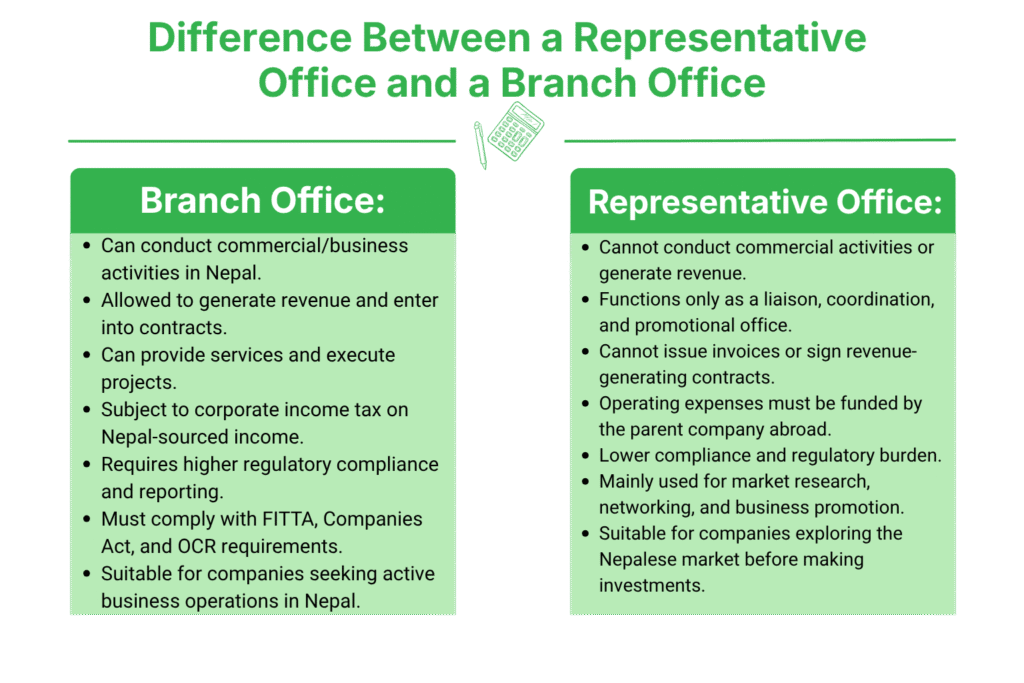
Many foreign companies confuse representative offices with branch offices. The two are legally distinct:
- A branch office can carry out commercial activities and generate revenue in Nepal
- A representative office cannot earn revenue and only performs liaison and promotional functions
- A branch office requires higher compliance under FITTA and OCR regulations
- A representative office has lower regulatory burden but limited operational scope
FAQs
1. Can a representative office in Nepal earn revenue?
No. A representative office cannot earn revenue, invoice clients, or engage in commercial transactions in Nepal. All operating expenses must be funded through remittances from the parent company abroad.
2. How long does it take to register a representative office in Nepal?
The complete registration process, including DOI approval and OCR registration, typically takes 30 to 60 working days, depending on document completeness and government processing times.
3. Is a representative office required to pay taxes in Nepal?
Yes. The office must register for PAN, file annual tax returns, and deduct TDS on employee salaries. While it does not pay corporate income tax on profits, other tax obligations under the Income Tax Act, 2002 apply.
4. How many employees can a representative office hire in Nepal?
There is no fixed limit on local staff. However, foreign employees require a work permit from the Department of Labour. The number of foreign employees may be subject to the ratio regulations under Nepali labor law.
5. Does a representative office in Nepal need to be audited?
Yes. The representative office must maintain accounts and have them audited by a licensed auditor in Nepal. Audited statements must be filed with OCR and IRD annually.
6. Can a representative office be converted into a company in Nepal?
Yes. A representative office can be converted into a private limited company or a joint venture company in Nepal by completing the full foreign investment registration process under FITTA 2019 and OCR regulations.
Conclusion
Establishing a representative office for a foreign company in Nepal is a structured legal process that requires approval from the Department of Industry, registration with the Office of the Company Registrar, and tax compliance with the Inland Revenue Department. The office must operate within the permitted scope of activities and cannot engage in commercial transactions independently. Foreign companies planning long-term presence in Nepal often begin with a representative office before transitioning to a full branch or subsidiary structure. Compliance with the Companies Act 2006, FITTA 2019, and Nepal Rastra Bank regulations is mandatory throughout the life of the office.