
Nepal has become an increasingly active destination for foreign companies seeking a presence in South Asia. One of the most common entry-level structures that foreign companies use is the Foreign Liaison Office setup in Nepal. This type of office allows a foreign company to maintain a representative presence in Nepal without engaging in direct commercial activities.
This article covers everything you need to know about setting up a Foreign Liaison Office in Nepal, including the legal framework, registration process, required documents, permitted activities, and compliance obligations.
What Is a Foreign Liaison Office in Nepal?
A Foreign Liaison Office (also called a Representative Office or Liaison Office) is a branch-level presence established by a foreign company in Nepal. It operates as a non-commercial extension of the parent foreign company.
The liaison office does not generate revenue from Nepal. It acts as a communication and coordination point between the foreign parent company and its clients, partners, or projects in Nepal. This structure is widely used by foreign NGOs, INGOs, foreign companies, and development organizations.
The legal basis for establishing a Foreign Liaison Office in Nepal comes primarily from:
- Companies Act, 2006 (2063 B.S.): Section 153 to 162 governs foreign company registration.
- Foreign Investment and Technology Transfer Act (FITTA), 2019 (2075 B.S.): governs foreign investment entry modes.
- Income Tax Act, 2002 (2058 B.S.): governs tax obligations even for non-profit liaison offices.
- Industrial Enterprises Act, 2020 (2076 B.S.): governs industrial and service-oriented investments.
Who Can Establish a Foreign Liaison Office in Nepal?
Any foreign company incorporated outside Nepal can establish a liaison office in Nepal, provided it complies with Nepal’s registration and regulatory requirements. This includes:
- Multinational corporations
- Foreign development organizations
- International consulting firms
- Foreign-based NGOs and INGOs
- Foreign companies engaged in projects under the Government of Nepal
The parent company must be a legally registered entity in its home country with valid registration documents and a clear purpose for establishing a presence in Nepal.
What Are the Permitted Activities of a Foreign Liaison Office in Nepal?
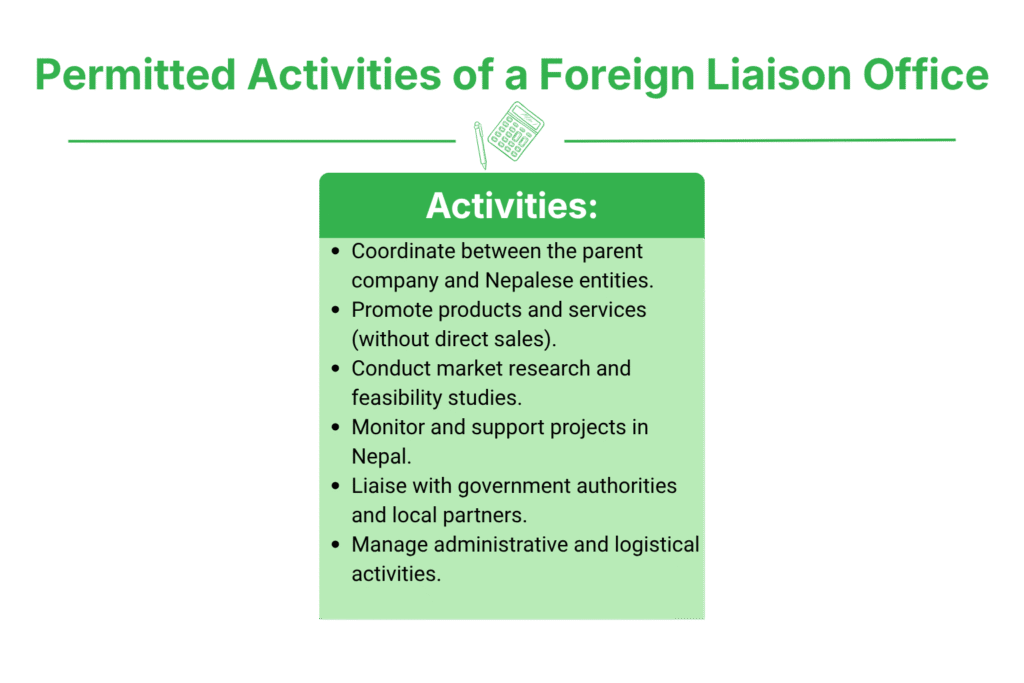
A Foreign Liaison Office in Nepal is allowed to perform only non-commercial activities. These include:
- Coordinating between the foreign parent company and local Nepalese entities
- Promoting the parent company’s products or services (but not selling them directly)
- Conducting market research and feasibility studies
- Monitoring ongoing projects in Nepal
- Liaising with government bodies and local partners
- Managing administrative and logistical matters for the parent company
What Activities Are Prohibited for a Foreign Liaison Office in Nepal?
The liaison office cannot engage in any revenue-generating activity in Nepal. Prohibited activities include:
- Direct sale of goods or services in Nepal
- Signing commercial contracts on behalf of the parent company without specific approval
- Earning local income in Nepalese currency
- Importing and selling goods for profit
- Functioning as a trading company
If a foreign company wants to conduct commercial business, it must register a Private Limited Company or a Branch Office under the Office of the Company Registrar (OCR).
Which Government Bodies Regulate Foreign Liaison Offices in Nepal?
| Regulatory Body | Role |
|---|---|
| Office of Company Registrar (OCR) | Primary registration authority for foreign companies |
| Department of Industry (DOI) | Issues approval for foreign investment-linked liaison offices |
| Inland Revenue Department (IRD) | PAN registration and tax compliance |
| Department of Immigration | Work permit coordination for foreign staff |
| Ministry of Finance | Overall foreign investment policy oversight |
Foreign companies can visit the Department of Industry (DOI) or the OCR Nepal for registration-related inquiries.
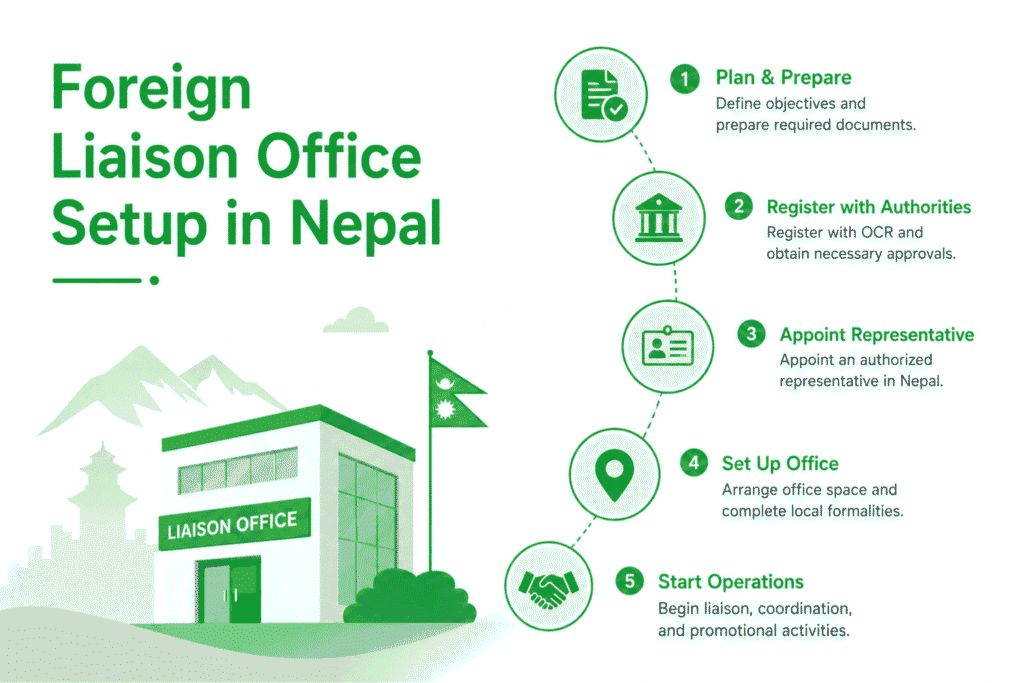
What Is the Step-by-Step Process to Register a Foreign Liaison Office in Nepal?
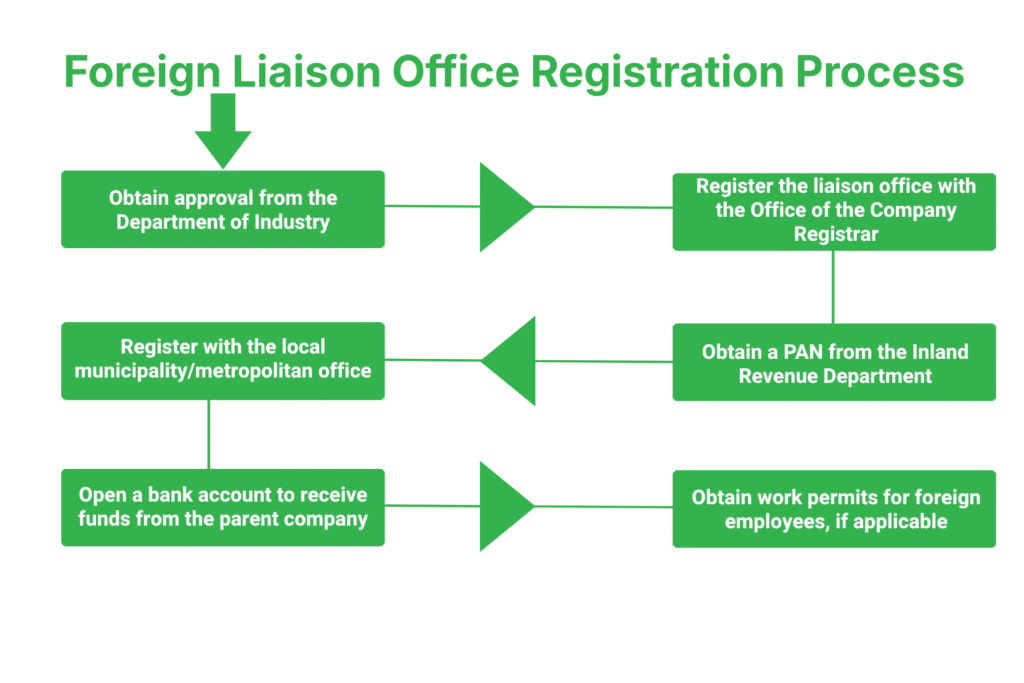
Step 1: Obtain Approval from the Department of Industry (DOI)
The foreign company must first apply to the Department of Industry for approval to establish a liaison office in Nepal. The DOI evaluates the nature of the company and the proposed activities.
Step 2: Register at the Office of the Company Registrar (OCR)
After obtaining DOI approval, the foreign company must register the liaison office at the Office of the Company Registrar (OCR) under Section 153 of the Companies Act, 2006. The OCR issues a Certificate of Registration to the foreign company as a registered foreign entity in Nepal.
Step 3: Obtain PAN Registration from the Inland Revenue Department (IRD)
Every registered entity in Nepal, including liaison offices, must obtain a Permanent Account Number (PAN) from the Inland Revenue Department (IRD). This is mandatory even if the liaison office does not earn income in Nepal.
Step 4: Register with Local Municipality
The liaison office must register at the local municipality or metropolitan city office where it is located for a Business Registration Certificate (Sahayog Karyalaya Darta).
Step 5: Open a Bank Account
The liaison office must open a bank account in a licensed commercial bank in Nepal to receive remittances from the parent company to fund its operational expenses.
Step 6: Obtain Work Permits for Foreign Staff (If Applicable)
If the liaison office employs foreign nationals, it must obtain work permits from the Department of Labour and Department of Immigration.
What Documents Are Required to Register a Foreign Liaison Office in Nepal?
The following documents are required for the registration of a Foreign Liaison Office in Nepal:
Documents from the Parent Foreign Company:
- Certificate of Incorporation of the parent company (notarized and apostilled)
- Memorandum and Articles of Association of the parent company
- Latest audited financial statements of the parent company
- Board Resolution authorizing the establishment of a liaison office in Nepal
- Power of Attorney in favor of the local representative in Nepal
- Passport copy and identity documents of the authorized representative
- Company profile and details of business activities
Documents to be Submitted to OCR Nepal:
- Duly filled application form for foreign company registration
- Certified copy of the parent company’s incorporation documents
- Notarized Power of Attorney for the local agent
- Details of the principal place of business in Nepal
- Address proof of the proposed office in Nepal (lease agreement)
- Proposed activities of the liaison office in Nepal
- DOI approval letter
Note: All foreign-language documents must be translated into Nepali or English and notarized by a notary public and apostilled or legalized by the relevant authorities in the country of origin.
What Are the Fees for Registering a Foreign Liaison Office in Nepal?
| Registration Activity | Approximate Fee |
|---|---|
| DOI Application Fee | NPR 1,000 to NPR 5,000 (varies) |
| OCR Registration Fee | NPR 5,000 to NPR 30,000 (based on capital) |
| PAN Registration (IRD) | Free |
| Municipality Registration | NPR 500 to NPR 5,000 (varies by municipality) |
| Notarization and Translation | Varies by document |
Fees are subject to change based on government notifications. Always verify current fees at OCR Nepal or DOI Nepal.
What Are the Annual Compliance Requirements for a Foreign Liaison Office in Nepal?
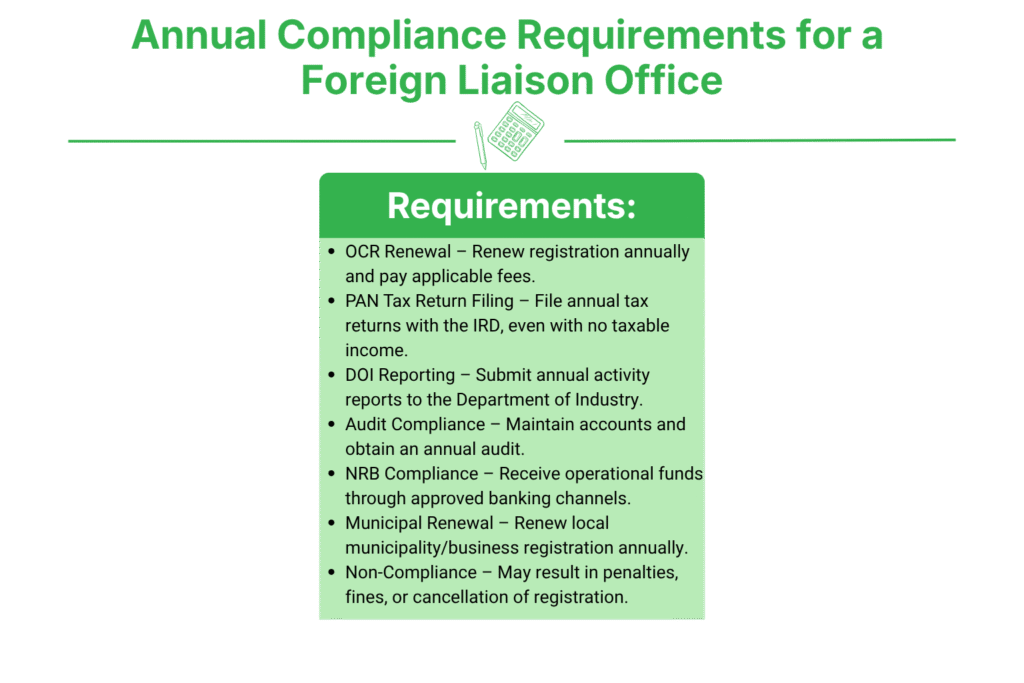
Once registered, a Foreign Liaison Office must meet the following annual compliance obligations:
- Annual Renewal at the OCR by submitting updated documents and paying renewal fees
- Annual PAN Tax Return filing with the Inland Revenue Department, even if no taxable income exists
- Submission of annual reports to the DOI on activities carried out in Nepal
- Audit requirement the liaison office must maintain accounts and get them audited by a registered auditor in Nepal
- Remittance compliance all operational funds must enter Nepal through proper banking channels as per Nepal Rastra Bank (NRB) directives
- Renewal of municipal registration annually
Failure to meet these compliance requirements can result in the suspension or cancellation of the liaison office’s registration.
How Long Does It Take to Register a Foreign Liaison Office in Nepal?
The total timeline for registering a Foreign Liaison Office in Nepal is typically 4 to 8 weeks, depending on the completeness of documents and the processing speed of the relevant authorities. Document preparation and legalization from the home country may take additional time.
The process breakdown is approximately:
- DOI approval: 2 to 3 weeks
- OCR registration: 1 to 2 weeks
- PAN registration: 1 to 3 working days
- Municipality registration: 1 to 5 working days
Can a Foreign Liaison Office Be Converted Into a Company in Nepal?
Yes. A foreign liaison office can be converted into a Private Limited Company or a Joint Venture Company by following the procedures under FITTA 2019 and the Companies Act 2006. This requires a fresh registration at the OCR and DOI and compliance with Foreign Direct Investment (FDI) regulations in Nepal.
Foreign investors can also visit Investment Board Nepal (IBN) for large-scale investment inquiries.
FAQs
1. What is the difference between a Foreign Liaison Office and a Branch Office in Nepal?
A Liaison Office only conducts non-commercial coordination activities, while a Branch Office can carry out limited commercial operations. A Branch Office requires additional regulatory approvals and carries higher compliance obligations under the Companies Act, 2006.
2. Does a Foreign Liaison Office in Nepal pay taxes?
A liaison office with no local income has minimal tax liability. However, PAN registration is mandatory and annual tax returns must be filed with the Inland Revenue Department under the Income Tax Act, 2002, even with zero taxable income.
3. Can a Foreign Liaison Office hire Nepalese employees?
Yes, a Foreign Liaison Office can hire Nepalese nationals. All employees must be registered under the applicable labor laws, and the office must comply with the Labour Act, 2017 (2074 B.S.) and make contributions to the Social Security Fund (SSF).
4. Is a Foreign Liaison Office allowed to sign contracts in Nepal?
A Foreign Liaison Office cannot sign commercial contracts on its own behalf. It may only facilitate communication and coordination. The parent company signs contracts directly or through a properly authorized legal representative in Nepal.
5. How long is the Foreign Liaison Office registration valid in Nepal?
The registration is generally valid for one year and must be renewed annually at the OCR and the local municipality. The DOI may also require periodic reporting to maintain active status of the liaison office.
6. What happens if a Foreign Liaison Office violates Nepalese law?
If a Foreign Liaison Office conducts prohibited commercial activities or fails to comply with registration and tax obligations, authorities can cancel its registration under the Companies Act, 2006, and impose penalties under applicable Nepalese law.
Conclusion
Setting up a Foreign Liaison Office in Nepal requires careful compliance with the Companies Act 2006, FITTA 2019, and other applicable regulations. The registration process involves multiple government bodies including the DOI, OCR, and IRD. Foreign companies must ensure that all documents are properly notarized, apostilled, and submitted accurately to avoid delays. Annual compliance, including tax filing and registration renewal, remains a mandatory obligation throughout the operational life of the liaison office in Nepal.