


This article covers everything you need to know about the local representative for foreign branch in Nepal, including legal obligations, registration procedures, required documents, and responsibilities.
Foreign companies that want to operate in Nepal through a branch office must appoint a local representative. This requirement is mandatory under Nepali law and ensures that the branch office has a legally accountable person within Nepal.
What Is a Local Representative for a Foreign Branch in Nepal?
A local representative is a natural person or a Nepali citizen appointed by a foreign company to act on its behalf in Nepal. When a foreign company registers a branch office in Nepal, it cannot operate without designating a local representative who is physically present and legally authorized to act for the company within the country.
Under the Companies Act, 2063 (2006), specifically Section 153, any foreign company that establishes a place of business in Nepal must register with the Office of the Company Registrar (OCR) and appoint a local representative. The local representative holds authority to receive legal notices, respond to regulatory bodies, and represent the foreign company in official matters.
This position is different from a managing director or a general employee. The local representative carries legal responsibilities and is the primary point of contact between the foreign branch and Nepali authorities.
Legal Framework Governing Foreign Branch and Local Representative in Nepal
Several laws regulate the establishment of a foreign branch office and the role of a local representative in Nepal.
| Law | Relevance |
|---|---|
| Companies Act, 2063 (2006) | Mandatory registration of foreign company and appointment of local representative |
| Foreign Investment and Technology Transfer Act, 2075 (FITTA 2019) | Governs foreign investment entry, approval, and operations |
| Industrial Enterprises Act, 2076 (2019) | Regulates industrial operations of foreign companies |
| Income Tax Act, 2058 (2002) | Tax obligations of branch offices and local representatives |
| Foreign Exchange (Regulation) Act, 1962 | Controls remittance and foreign currency transactions |
| Immigration Act, 1992 | Visa requirements for foreign nationals managing branch offices |
The Office of the Company Registrar (OCR) under the Ministry of Industry, Commerce and Supplies is the primary regulatory authority. You can access official registration requirements at www.ocr.gov.np.
Who Can Be a Local Representative for a Foreign Branch in Nepal?
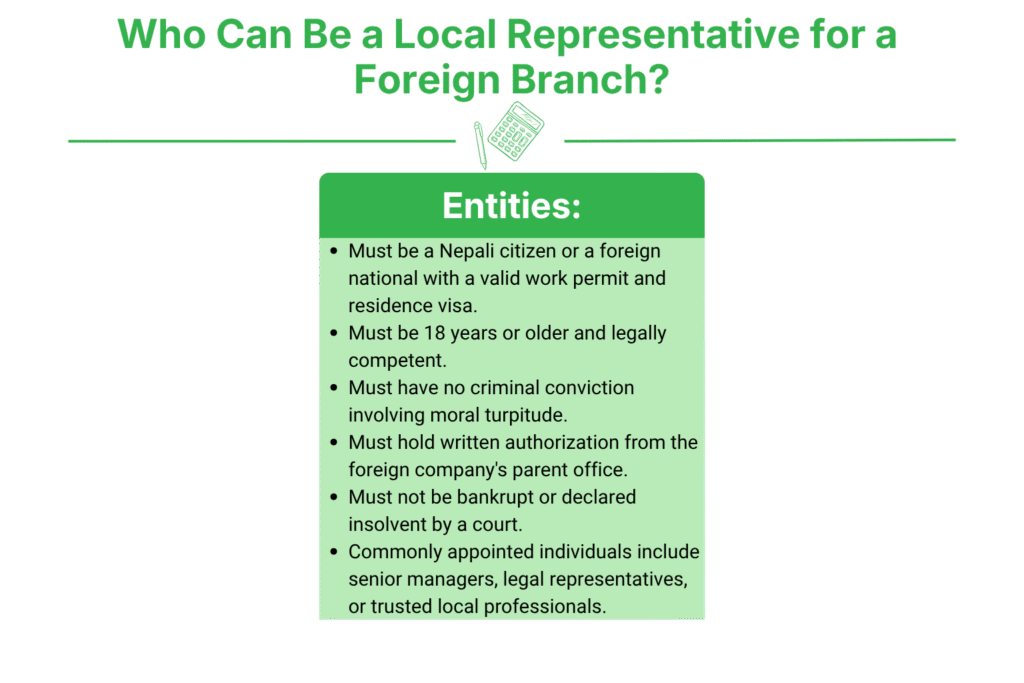
The local representative must meet certain eligibility criteria under Nepali law.
- The local representative must be a Nepali citizen or a foreign national holding a valid work permit and residence visa in Nepal.
- The person must be 18 years or older and of sound mind.
- The person must not have been convicted of any criminal offense involving moral turpitude under Nepali law.
- The person must hold written authorization from the foreign company’s parent office clearly stating the scope of authority.
- The local representative cannot be a person declared bankrupt or insolvent by a competent court.
In practice, most foreign companies appoint a senior Nepali employee or a legal professional as the local representative. Some companies appoint a chartered accountant or a lawyer based in Kathmandu for this purpose.
Why Does a Foreign Branch in Nepal Need a Local Representative?
The appointment of a local representative is not optional. It is a statutory requirement under the Companies Act, 2063. The reasons for this requirement are both legal and operational.
Legal Accountability: The foreign branch must have a person who can be held legally responsible within Nepal. Regulatory bodies, courts, and government agencies need a domestic contact for correspondence, notices, and enforcement.
Tax Compliance: The Inland Revenue Department (IRD) requires a local representative for tax registration, filing of Permanent Account Number (PAN), and submission of annual tax returns for the branch office.
Business Operations: Banks in Nepal require a local representative to open corporate bank accounts, execute financial transactions, and comply with Nepal Rastra Bank (NRB) regulations.
Legal Proceedings: Nepalese courts must serve summons and notices to the local representative in any legal proceeding involving the foreign branch.
How to Register a Local Representative for a Foreign Branch in Nepal
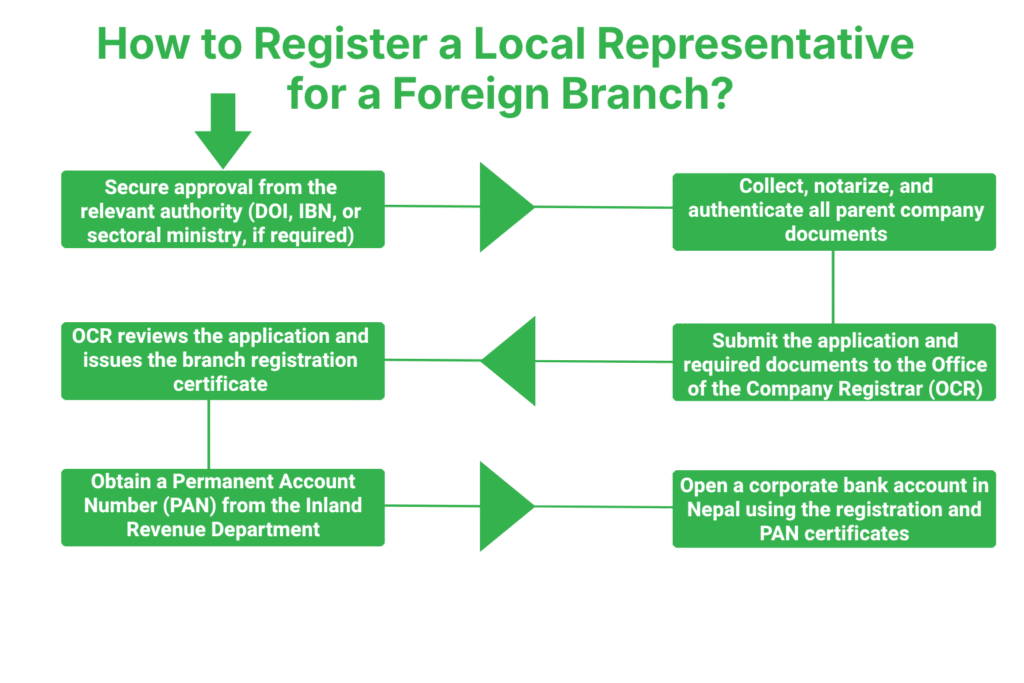
The registration process for a foreign branch office and appointment of a local representative involves multiple steps. The process is overseen by the Office of the Company Registrar (OCR).
Step-by-Step Registration Process
Step 1: Obtain Approval from Concerned Authority
- Foreign companies in regulated sectors must first obtain approval from the Department of Industry (DOI) or the relevant sectoral ministry before registering with OCR.
- For foreign investment-related activities, approval under FITTA 2019 from the Investment Board Nepal (IBN) or DOI is required. Visit www.ibn.gov.np for investment approvals.
Step 2: Prepare and Notarize Documents
- Prepare all required documents (listed below) from the parent company’s home country.
- All foreign documents must be apostilled or notarized and authenticated by the Nepali Embassy or Consulate in the respective country.
Step 3: Submit Application to OCR
- Submit the completed application form along with all required documents to the Office of the Company Registrar, Tripureshwor, Kathmandu.
- Pay the applicable registration fee as prescribed by OCR.
Step 4: Verification and Approval
- OCR verifies the documents and may request additional information if needed.
- Upon successful verification, OCR issues the Certificate of Registration for the foreign branch in Nepal.
Step 5: Tax and PAN Registration
- After receiving the OCR certificate, the local representative must register the branch office with the Inland Revenue Department for a Permanent Account Number (PAN).
- Visit www.ird.gov.np for tax registration procedures.
Step 6: Bank Account Opening
- The local representative opens a corporate bank account in Nepal in the name of the foreign branch using the OCR certificate, PAN certificate, and authorization letter.
Documents Required for Registering a Local Representative for a Foreign Branch
The following documents are required for registration of a foreign branch office and appointment of a local representative in Nepal.
Documents from the Parent Foreign Company:
- Certificate of Incorporation of the foreign company from the home country (apostilled/notarized)
- Memorandum of Association and Articles of Association of the foreign company
- Board Resolution authorizing the establishment of a branch in Nepal
- Power of Attorney or Authorization Letter appointing the local representative in Nepal
- Audited financial statements of the parent company for the last two years
- Details of the foreign company’s directors and shareholders
Documents from the Local Representative:
- Nepali citizenship certificate of the local representative (photocopy and original for verification)
- Recent passport-size photographs of the local representative
- Personal details form of the local representative
- Declaration that the local representative is not disqualified under the Companies Act, 2063
General Documents:
- Completed application form as prescribed by OCR
- Proposed registered office address proof in Nepal (rental agreement or property ownership document)
- Description of the nature of business activities to be carried out in Nepal
Roles and Responsibilities of the Local Representative
The local representative of a foreign branch in Nepal carries significant legal and operational responsibilities.
| Responsibility | Details |
|---|---|
| Legal Representation | Represents the foreign branch in all legal proceedings within Nepal |
| Regulatory Compliance | Ensures timely compliance with Office of Company Registrar, Inland Revenue Department, Nepal Rastra Bank, and other regulatory bodies |
| Tax Filing | Files annual tax returns and maintains proper accounts under the Income Tax Act, 2058 |
| Annual General Reporting | Submits annual returns to Office of Company Registrar as required under the Companies Act, 2063 |
| Contract Execution | Signs contracts, agreements, and official documents on behalf of the foreign branch |
| Receiving Legal Notices | Accepts all legal notices, summons, and official correspondence from government bodies |
| Work Permit Coordination | Assists in obtaining work permits and visas for foreign employees of the branch |
The local representative cannot exceed the authority granted by the parent company’s authorization letter or Power of Attorney. Any action outside the defined scope makes the local representative personally liable under Nepali law.
Annual Compliance for Foreign Branch with Local Representative in Nepal
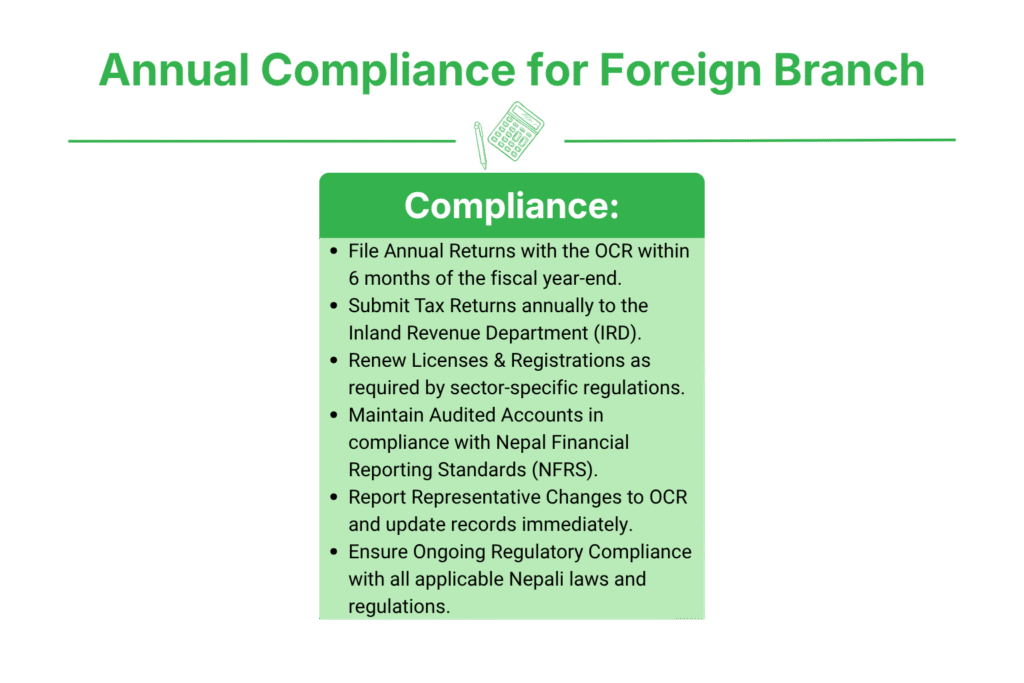
After registration, the foreign branch and its local representative must fulfill annual compliance requirements.
- Annual Return Filing: The foreign branch must file an annual return with OCR within six months of the end of each fiscal year, as per the Companies Act, 2063.
- Tax Return Filing: Annual income tax returns must be filed with the Inland Revenue Department. Nepal’s fiscal year runs from Shrawan to Ashadh (mid-July to mid-July).
- Renewal of Registration: Some sector-specific licenses and registrations require annual renewal.
- Audited Accounts: The branch must maintain audited financial accounts in Nepal. The accounts must comply with Nepal Financial Reporting Standards (NFRS).
- Changes in Local Representative: If the local representative changes, the foreign branch must immediately notify OCR and file updated documents.
Liabilities and Penalties for Non-Compliance
Non-compliance with the requirements related to local representative appointment or branch registration attracts penalties under Nepali law.
Under the Companies Act, 2063, Section 160, a foreign company that fails to register or maintain a local representative in Nepal is liable to fines. The OCR can impose penalties and in serious cases, deregister the branch. The local representative can also be personally held liable for regulatory violations committed in their official capacity if they were done knowingly.
FAQs
1. Is it mandatory to appoint a local representative for a foreign branch in Nepal?
Yes. Under Section 153 of the Companies Act, 2063, it is legally mandatory for every foreign company establishing a branch in Nepal to appoint a local representative. The OCR will not complete the registration without this appointment.
2. Can a foreign national be a local representative for a foreign branch in Nepal?
A foreign national can serve as a local representative only if they hold a valid work permit and residence visa in Nepal. In most cases, Nepali citizens are preferred and appointed for this role.
3. What happens if the local representative resigns or is removed?
The foreign branch must immediately notify the OCR and file updated documents appointing a new local representative. Operating without a registered local representative is a violation of the Companies Act, 2063 and attracts penalties.
4. What authority does the local representative hold over the branch office?
The local representative’s authority is defined by the Power of Attorney issued by the parent company. They act within that scope and cannot enter into obligations beyond what is authorized. Personal liability applies for unauthorized acts.
5. How long does it take to register a foreign branch and local representative in Nepal?
The registration process at OCR typically takes 15 to 30 working days after submission of complete documents. Delays may occur if documents require additional verification or apostille authentication from the home country.
6. Does the local representative need to be present in Nepal full-time?
The law does not specify full-time presence, but the local representative must be available and reachable in Nepal for official correspondence, legal notices, and regulatory compliance. Practical necessity demands regular availability.
Conclusion
Appointing a local representative for a foreign branch in Nepal is a legal requirement under the Companies Act, 2063 and is central to all regulatory, tax, and operational activities of the branch. The local representative acts as the legal face of the foreign company within Nepal and carries significant responsibilities toward Nepali authorities. Foreign companies must ensure proper documentation, timely registration with OCR, and ongoing compliance to maintain their legal standing in Nepal. Consulting a qualified Nepali legal professional or registered company secretary is advisable to handle the appointment and registration process accurately.