

Foreign nationals who want to establish a business presence in Nepal must complete three distinct but interconnected processes: company registration, tax registration, and industry registration, collectively referred to as Company Tax Industry Registration for Foreigners in Nepal. Nepal has gradually opened its doors to foreign direct investment (FDI), and the legal framework governing these processes has become more structured over the years.
This article explains each step, the applicable laws, the required documents, and the responsible government bodies involved in the entire registration process for foreigners in Nepal.
Legal Framework Governing Foreign Business Registration in Nepal
Nepal’s business registration framework for foreigners rests on several key pieces of legislation. Understanding these laws is the foundation of any foreign investment venture in Nepal.
- Companies Act, 2006 (2063 BS) Governs the registration and operation of all companies in Nepal, including those with foreign shareholding.
- Foreign Investment and Technology Transfer Act (FITTA), 2019 (2075 BS) The primary law regulating foreign investment, repatriation of profits, and technology transfer agreements.
- Industrial Enterprises Act, 2020 (2076 BS) Defines the categories of industries and regulates the registration and operation of industrial enterprises.
- Income Tax Act, 2002 (2058 BS) Governs the taxation of companies and individuals operating in Nepal.
- Value Added Tax Act, 1995 (2052 BS) Regulates VAT registration and compliance for businesses.
The Department of Industry (DoI), the Office of the Company Registrar (OCR), and the Inland Revenue Department (IRD) are the three principal government bodies managing these registrations.
Who Can Register a Company in Nepal as a Foreigner?
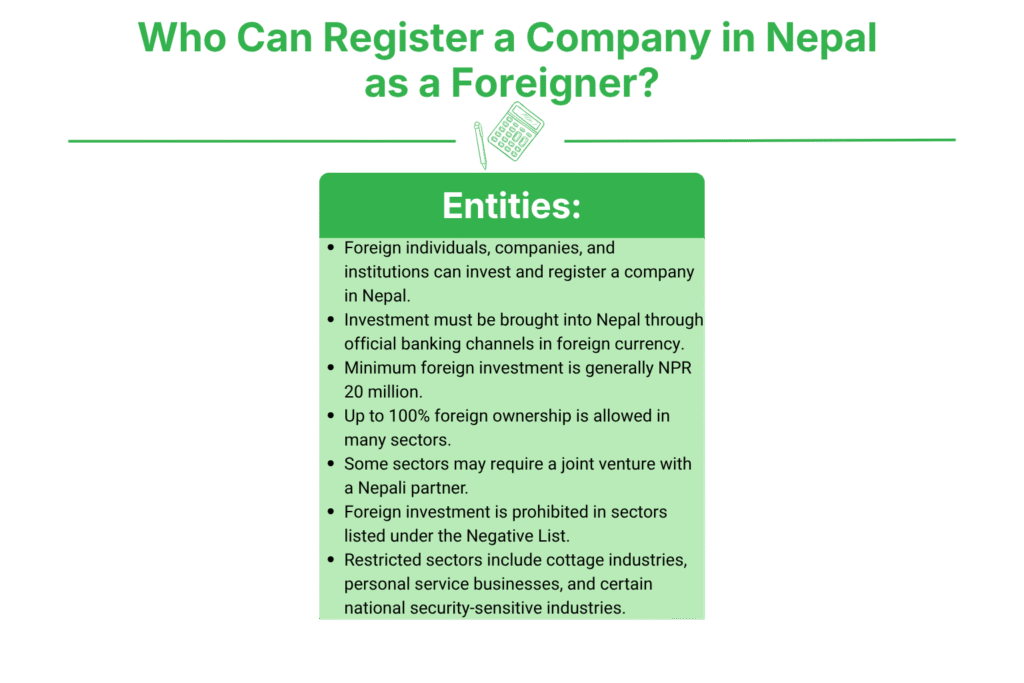
Under FITTA 2019, any foreign individual, institution, or company can invest in Nepal and register a company, subject to the following conditions:
- The foreign investor must bring foreign currency into Nepal through a banking channel.
- The minimum foreign investment threshold is NPR 20 million (approximately USD 150,000) for most sectors.
- Foreign ownership can go up to 100% in certain sectors, while some sectors require joint ventures with Nepali partners.
- Some sectors are listed in the Negative List where foreign investment is prohibited entirely.
Sectors in the negative list include cottage industries, personal service businesses, and sectors deemed sensitive to national security.
Types of Companies a Foreigner Can Register in Nepal
Foreign investors can register the following types of business entities under the Companies Act, 2006:
| Company Type | Minimum Shareholders | Foreign Ownership Allowed |
|---|---|---|
| Private Limited Company | 1–10 | Up to 100% (sector-dependent) |
| Public Limited Company | 7 or more | Up to 100% (sector-dependent) |
| Branch Office | Parent company required | 100% foreign |
| Liaison / Representative Office | Parent company required | 100% foreign |
| Joint Venture Company | 2 or more | Negotiated % |
A Private Limited Company is the most common form chosen by foreign investors in Nepal due to its simpler governance structure and lower compliance burden.
Step-by-Step Company Registration Process for Foreigners in Nepal
The company registration process for foreigners involves the Office of the Company Registrar (OCR) and follows the process outlined in the Companies Act, 2006.
Step 1: Name Reservation
- Visit the OCR portal at https://ocr.gov.np
- Submit a name reservation request online.
- The proposed name must not conflict with existing registered companies.
Step 2: Obtain Foreign Investment Approval from Department of Industry
Before registering the company at OCR, foreign investors must obtain prior approval from the Department of Industry (DoI) under FITTA 2019.
Documents required for DoI approval:
- Application form in the prescribed format
- Passport copy of the foreign investor
- Certificate of Incorporation of the parent company (if corporate investor)
- Board Resolution authorizing the investment
- Project proposal or business plan
- Bank guarantee or proof of financial capacity
- Proposed shareholding structure
The DoI reviews the application and issues an Investment Approval Letter if the investment falls in an approved sector.
Step 3: Company Registration at OCR
Once DoI approval is in hand, the company registration proceeds at OCR.
Documents required for OCR registration:
- Memorandum of Association (MoA)
- Articles of Association (AoA)
- DoI Investment Approval Letter
- Passport copies of all shareholders and directors
- Passport-size photographs of directors
- Proof of registered office address in Nepal (rent agreement or ownership document)
- Application fee payment receipt
OCR typically processes the application within 7–15 working days and issues a Company Registration Certificate.
Tax Registration for Foreign-Owned Companies in Nepal
After receiving the Company Registration Certificate, the company must register with the Inland Revenue Department (IRD) to obtain a Permanent Account Number (PAN) and, if applicable, a VAT registration.
PAN Registration (Permanent Account Number)
PAN registration is mandatory for all businesses operating in Nepal under the Income Tax Act, 2002.
Process for PAN Registration:
- Visit the IRD portal at https://ird.gov.np or the nearest Tax Office.
- Submit the PAN registration form (Form 01).
- Attach required documents.
- Receive PAN certificate upon verification.
Documents required for PAN registration:
- Company Registration Certificate from OCR
- MoA and AoA
- Passport copy of the authorized representative/director
- Proof of office address (rent agreement with landlord’s citizenship or passport copy)
- Passport-size photograph
PAN is issued within 1–3 working days in most cases.
VAT Registration
Under the Value Added Tax Act, 1995, a company must register for VAT if its annual turnover exceeds NPR 5 million for goods or NPR 2 million for services.
Documents required for VAT registration:
- PAN Certificate
- Company Registration Certificate
- Proof of business address
- Bank account details
- Application form
Companies in certain sectors are mandatorily required to register for VAT regardless of turnover.
Industry Registration for Foreigners in Nepal
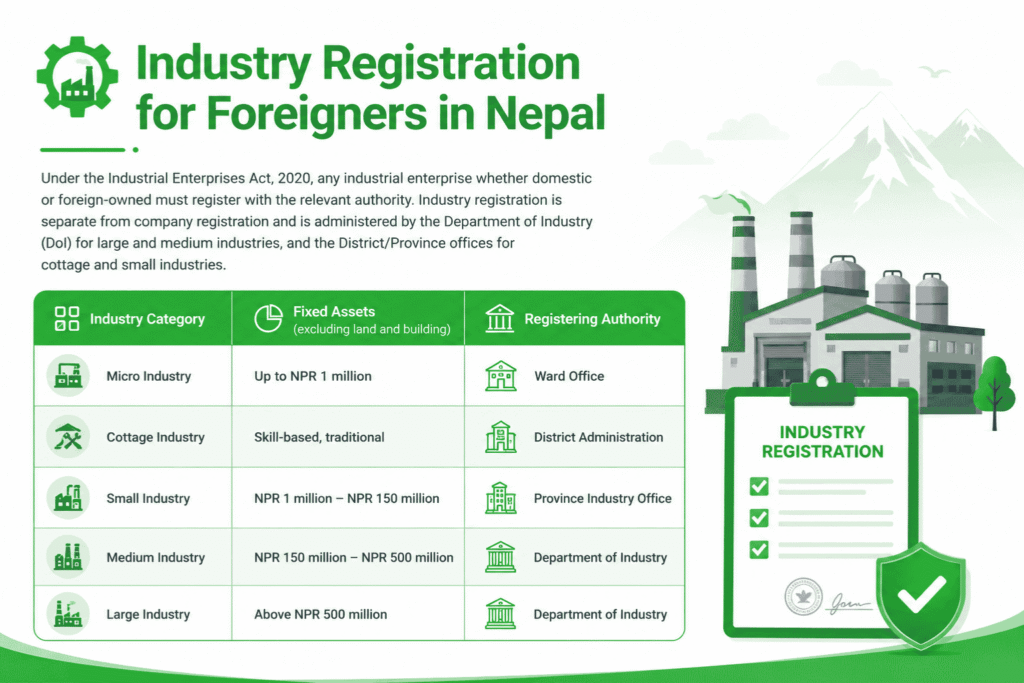
Under the Industrial Enterprises Act, 2020, any industrial enterprise whether domestic or foreign-owned must register with the relevant authority. Industry registration is separate from company registration and is administered by the Department of Industry (DoI) for large and medium industries, and the District/Province offices for cottage and small industries.
Industry Categories Under Industrial Enterprises Act, 2020
| Industry Category | Fixed Assets (excluding land and building) | Registering Authority |
|---|---|---|
| Micro Industry | Up to NPR 1 million | Ward Office |
| Cottage Industry | Skill-based, traditional | District Administration |
| Small Industry | NPR 1 million – NPR 150 million | Province Industry Office |
| Medium Industry | NPR 150 million – NPR 500 million | Department of Industry |
| Large Industry | Above NPR 500 million | Department of Industry |
Foreign investors generally establish large or medium industries, making DoI the primary registration authority.
Process for Industry Registration at DoI
- Submit the industry registration application at DoI.
- Attach all required documents.
- DoI verifies the documents and conducts due diligence.
- DoI issues the Industry Registration Certificate upon approval.
Documents required for Industry Registration:
- Company Registration Certificate
- Investment Approval Letter (for foreign companies)
- Project report
- Proof of land/building for factory or office
- Environmental Impact Assessment (EIA) or Initial Environmental Examination (IEE), if applicable
- Passport copies of directors
- PAN Certificate
- Bank account proof
Industry registration under DoI for large industries may take 15–45 working days depending on the nature of the industry and environmental clearances required.
Foreign Investment Repatriation and Banking Requirements
Foreign investors in Nepal can repatriate profits, dividends, and capital under FITTA 2019, subject to the following conditions:
- All foreign currency investment must be brought in through a Class A licensed commercial bank in Nepal.
- The investor must open a Foreign Currency Account and then convert funds to Nepali Rupees (NPR).
- Repatriation is allowed after paying all applicable taxes in Nepal.
- The Nepal Rastra Bank (NRB) regulates all foreign exchange transactions.
Failure to route foreign investment through proper banking channels can result in the investment not being recognized under FITTA, which eliminates repatriation rights.
Key Government Portals for Foreign Company Registration in Nepal
- Office of the Company Registrar: https://ocr.gov.np
- Department of Industry: https://doind.gov.np
- Inland Revenue Department: https://ird.gov.np
- Nepal Rastra Bank (NRB): https://nrb.org.np
- Investment Board Nepal: https://ibn.gov.np (for investments above NPR 6 billion)
Common Challenges Faced by Foreign Investors During Registration
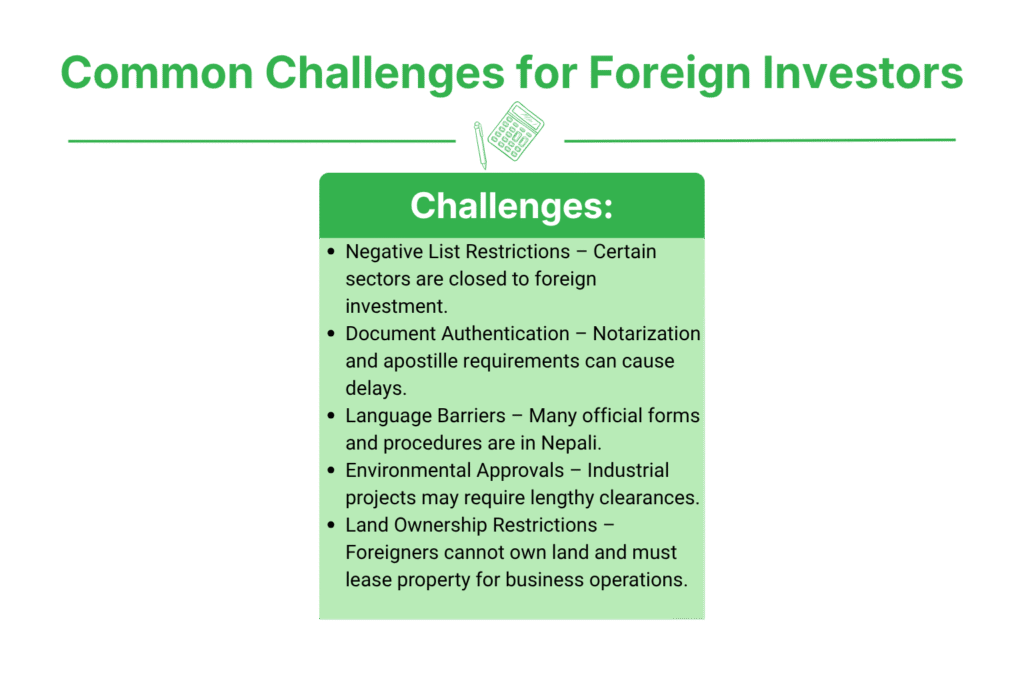
Foreign investors frequently encounter the following challenges during the registration process in Nepal:
- Sector restrictions under the Negative List of FITTA 2019 block investment in certain industries.
- Document notarization and apostille requirements for foreign documents can delay the process.
- Language barriers since most official forms and procedures are in Nepali.
- Environmental clearances for industrial projects can extend timelines significantly.
- Land ownership restrictions foreigners cannot own land in Nepal and must lease it for factory or office use.
Engaging a registered legal practitioner or company secretary in Nepal helps address these procedural challenges efficiently.
FAQs
1. What is the minimum investment required for a foreigner to register a company in Nepal?
Under FITTA 2019, the minimum foreign investment required is NPR 20 million (approximately USD 150,000). This amount must be transferred via a banking channel to be recognized as a valid foreign investment in Nepal.
2. Can a foreigner own 100% of a company in Nepal?
Yes, a foreigner can own 100% of a company in Nepal in sectors permitted under FITTA 2019. However, some sectors require a joint venture with a Nepali partner, and certain sectors completely prohibit foreign investment under the Negative List.
3. Is it mandatory to register for both PAN and VAT in Nepal?
PAN registration is mandatory for all companies in Nepal. VAT registration is mandatory only if the annual turnover exceeds NPR 5 million (goods) or NPR 2 million (services), or if the company operates in a mandatorily VAT-registered sector.
4. What is the difference between company registration and industry registration in Nepal?
Company registration at OCR establishes the legal entity. Industry registration at DoI or Province offices under the Industrial Enterprises Act, 2020 authorizes the company to operate as an industry and entitles it to industrial benefits such as tax holidays and concessions.
5. Can a foreign company open a branch office in Nepal instead of registering a new company?
Yes, a foreign company can open a branch or liaison office in Nepal. The parent company must apply to OCR and DoI with its incorporation documents, board resolution, and a representative’s appointment letter, subject to sectoral approval.
6. How long does the entire registration process take for a foreign company in Nepal?
The complete process from DoI investment approval to company registration, PAN/VAT registration, and industry registration generally takes 30–90 days, depending on the industry type, document readiness, and applicable environmental clearance requirements.
Conclusion
Company, tax, and industry registration for foreigners in Nepal involves multiple government bodies, legal frameworks, and procedural steps. The process is governed by the Companies Act 2006, FITTA 2019, Industrial Enterprises Act 2020, Income Tax Act 2002, and the VAT Act 1995. Foreign investors must secure DoI approval before registering at OCR, followed by PAN/VAT registration at IRD and industry registration at the relevant authority. Proper understanding of sector-specific restrictions, minimum investment requirements, and document requirements significantly reduces delays and ensures full legal compliance from the outset.